Cinegear 2019 News and Rumors

  • Thread starter Thread starter Guest
  • Start date Start date
For the sake of clarity, the ProRes 4444 and 4444XQ files that typically recorded on the Arri Alexa are 12-bit files. While it's possible to record lower quality files I don't know why anyone would for anything important, especially if you are using Log C encoding.

https://forum.arri.com/viewtopic.php?f=105&t=127

I recall from various sources that ProRes 422 (+HQ)(10-bit log encoded) being used for Alexa as the sweet spot for quality and file size for the most common use e.g. television production. Where high end film uses ARRIRAW (but not always- 4444 XQ used too).

One example: https://blog.frame.io/2018/04/02/arri-workflow-premiere/

For those with cameras that shoot more that 10-bits- try shooting something challenging e.g. a high dynamic range scene with lots of blue sky and important shadows and compare to 10-bit (both using log) then compare the results and post them if you find differences. Green/blue-screen with fine blonde hair is another area where more than 10 bits can help with keying. For ‘normal’ shots e.g. as used for TV, commercials, docs, news, not likely to see an advantage using greater than 10-bit log (even 8-bit goes a long way when shot for ‘look in camera’: I replaced my 12-bit C300 II with the 8-bit 1DX II with a custom picture style as ‘A camera’ (max DR non log)) and it works great (shot for mostly in camera looks with very minor post work needed).
 
For those with cameras that shoot more that 10-bits- try shooting something challenging e.g. a high dynamic range scene with lots of blue sky and important shadows and compare to 10-bit (both using log) then compare the results and post them if you find differences.
There is definitely a perceptual difference between 10 and 12 bit log, only a minimum of 12-bit log or 15-bit linear guarantees that all human perceptual gradations can be detected under ideal circumstances.

Obviously you won't see (hardly) any differences when you view a video on a SDR monitor.
 
Last edited:
ProRes 422 HQ (10-bit) vs. RAW vs. Alexa 4444 (12-bit): https://chazcreative.wordpress.com/2014/07/27/is-the-black-magic-cinema-camera-an-alexa-killer/
For the first Test, I was very surprised – shocked in fact at how well the Black magic cinema camera preformed against the Arri Alexa – aside from depth of field, they were nearly identical. I was not expecting this! I was also even more surprised at how the new Prores HQ held up against RAW. Only a very, very subtle difference.

Alexa 422 10-bit vs. 4444 12-bit: https://forums.creativecow.net/docs/forums/post.php?forumid=294&postid=832&univpostid=832&pview=t

Oscar winner Moonlight shot on ProRes (apparently 422 not even HQ and not log: Rec709): https://filmmakermagazine.com/100603-a-one-camera-show-dp-james-laxton-on-moonlight/

Guy tested 8-bit vs. 10- and 12-bit. After test, shoots everything 8-bit:

While there is a good jump in gradations from 8 to 10 bits, and 10 bits is needed for HDR, beyond 10 bits if not doing heavy post/VFX is typically not worth the space-time load.

For the >10-bit debate team: post real world examples to support your position.
 
Last edited:
I recall from various sources that ProRes 422 (+HQ)(10-bit log encoded) being used for Alexa as the sweet spot for quality and file size for the most common use e.g. television production. Where high end film uses ARRIRAW (but not always- 4444 XQ used too).

One example: https://blog.frame.io/2018/04/02/arri-workflow-premiere/

I'm a bit confused about what you are trying to say. The article you linked confirmed that the ARRI ProRes are 12-bit.

The Arri’s ProRes and ArriRaw have the exact same bit depth of 12 bits.
 
I'm a bit confused about what you are trying to say. The article you linked confirmed that the ARRI ProRes are 12-bit.

ProRes 422, HQ is 10-bit.
ProRes 4444, XQ is 12-bit (the last 4 is for alpha, not used unless for VFX).

Arri cameras have the fantastic ability to shoot directly to ProRes. Specifically, ProRes 422 HQ and ProRes 4444 are the most common codecs I will get back from an Alexa shoot.

Note he puts 422 first.
 
This is kind of the level of science that concludes that Cineform is twice as efficient as ProRes.

I would suggest Peter Barten's book:
https://www.amazon.com/s?k=9780819434968&i=stripbooks&linkCode=qs

There is an online link hosted from his alma mater (but I can't confirm if this is intentional or was placed there by mistake)
https://pure.tue.nl/ws/files/1613279/9901043.pdf

Here is a depiction of the Barten Ramp:
Dolby_PQ_EOTF_resize.jpg

PQ is a future proof EOTF designed to reproduce up to 21 stops of dynamic range. Cameras use OETF for encoding the scene, the curves (Log-C, S-log, F-Log etc.) are optimised for what the sensors are capable off, usually never more than 14 stops.

But even then:

- 10 or 11 bits were always enough to eliminate visible quantization artifacts with PQ.
- Most PQ images looked good with 10 bits or even slightly less.

From:
https://www.smpte.org/sites/default/files/23-1615-TS7-2-IProc02-Miller.pdf
 
  • Like
Reactions: jcs
This is kind of the level of science that concludes that Cineform is twice as efficient as ProRes.

I would suggest Peter Barten's book:
https://www.amazon.com/s?k=9780819434968&i=stripbooks&linkCode=qs

There is an online link hosted from his alma mater (but I can't confirm if this is intentional or was placed there by mistake)
https://pure.tue.nl/ws/files/1613279/9901043.pdf

Here is a depiction of the Barten Ramp:
Dolby_PQ_EOTF_resize.jpg

Lol- I personally tested Cineform and got results that matched what Frame.io posted. The results vary from 1.25x to 2.3x smaller files vs. ProRes. In all cases the results were visually lossless, even though I was open to seeing evidence posted by others from PSNR/SSIM showing statistical evidence. You can do these tests yourself- why didn't you do them?

I studied cognitive science and artificial intelligence in college (while writing video games (computer graphics and computational physics) and math + neuroscience related software). In addition to studying human perception, we also studied statistics including doing clinical trials with human beings (double blind studies etc.).

In this debate (thanks everyone for being civil so far), I've posted links to real world evidence, which when viewed statistically one could argue is anecdotal (small sample size, not a 'rigorous scientific process'). This debate is starting to remind me of a debate on global warming where after doing a bit of research I realized the so-called scientists were making everything up, and how it was almost impossible to dig into their data and methods to see how they reached their conclusions. When I pointed this out, the argument then became I'm not a scientist, when I pointed out that I was, the argument became you're not the right kind of scientist. When I pointed out that we could walk through the math and processes together to see how it was faked, the argument became 'we're not qualified to understand' so we can't trust you our ourselves: we can only trust the media and their scientists. In other words, they couldn't/didn't want to think for themselves. Let's stay out of politics of climate change- the point is that this is a similar discussion that involves math, science, and human perception. While I would agree that doing deep analysis into changes in the behavior of bits from a statistical point of view can show differences, ultimately images are meant to be viewed by human beings. So if human beings can't see any difference between 10-bit log and 12-bit log (or even 14 or 16 bit log linear or anything else), there's no point arguing about it, is there?

As seen from the camera sensor resolution debate, I'm open to changing my view on any topic, however you'll need to provide real world evidence to support your position. This means posting stills or video showing that > 10-bit log provides a significant quality improvement for normal shooting cases. It's been acknowledged that for high DR sky/shadow scenes we can see improvements in 10-bit over 8-bit, however I haven't seen any examples showing 12- or more bits doing better over 10-bit log. To make a case for > 10-bit at this point means showing real-world evidence.

The Oscar winner Moonlight was shot in Rec709! 8-bit would have worked. Cary- do you own or have you owned a >10-bit camera? I've done lots of test with 8, 10, 12, and 14-bit footage (and regularly shoot 14-bit raw stills on the 1DX II and process them in ACR). I'll stand by the 10-bit log being good enough for most video applications until there's real world evidence which shows otherwise. I think for myself, have done the tests myself, and encourage everyone else to do the same. Think for yourself, do the tests yourself, and share the results for all to see if you can show > 10-bit log is worth the extra disk space- lots of people would be interested (from my tests and internet research- so far that's not the case; open to seeing more evidence).
 
PQ is a future proof EOTF designed to reproduce up to 21 stops of dynamic range. Cameras use OETF for encoding the scene, the curves (Log-C, S-log, F-Log etc.) are optimised for what the sensors are capable off, usually never more than 14 stops.

But even then:


From:
https://www.smpte.org/sites/default/files/23-1615-TS7-2-IProc02-Miller.pdf

Right on Marvin- that PDF matches my experience and real-world research: 10-bit log is good enough for most cases, acknowledging that there are some rare cases when more bits are helpful e.g. the black ramp and CGI/VFX work. The reason the black ramp is challenging is related to Mach Banding and human perception: https://en.wikipedia.org/wiki/Mach_bands. Adding (or leaving) a bit of analog-like noise helps with reducing banding and has a more film-like / realistic looking result (acts like dithering).
 
So if human beings can't see any difference between 10-bit log and 12-bit log (or even 14 or 16 bit log linear or anything else), there's no point arguing about it, is there?
So is your claim that Barten's model is in contradiction with human perception and thus the Barten ramp is bogus?
 
So is your claim that Barten's model is in contradiction with human perception and thus the Barten ramp is bogus?

Human perception is inherently subjective therefore bound to variations, that's why Schreiber threshold and Barten threshold are used together.
 
So is your claim that Barten's model is in contradiction with human perception and thus the Barten ramp is bogus?

If human beings can't see a difference, why argue about it?

In game development, there's a common idea to 'cheat' with e.g. graphics or physics to hit performance requirements, because people won't see or know the difference. That said, I've done 'crazy things' (from other game developer's point of view), e.g. doing ray cubic surface physics interaction for more realistic car simulation, and creating symplectic integrators which preserve energy to make motion look 100% accurate and real. As far as I know, there's no commercial game or simulator on the market using cubic surfaces for car sims nor using symplectic / energy-accurate integrators*. Why? Customers don't really care- they care about fun experiences and flashy graphics! Same pattern for video & > 10-bit: people can't see a difference and don't care about statistics or papers showing what they can't see.


* my sim isn't currently on the market though I am working on a fun/simple 2D game and may use a symplectic integrator.
 
If human beings can't see a difference, why argue about it?
So is your claim that Barten's model is in contradiction with human perception and thus the Barten ramp is bogus?

I will answer it for you: Barten compared his model with measurements performed by various researches and the model fits well with the findings of those researchers.

But eh, perhaps Barten and those researchers don't know what they are doing and they should really consult YouTube 'studies' like the ones that you quoted?
 
Last edited:
Marvin’s PDF started 10 bits or less is enough in most cases. So let’s think for ourselves- post visual examples we can all evaluate ourselves and see where the truth lives.
 
Marvin’s PDF started 10 bits or less is enough in most cases. So let’s think for ourselves- post visual examples we can all evaluate ourselves and see where the truth lives.
Ok, so it seems you do not want to answer the question. And eh, on what monitor are you going to make your evaluation?
 
Last edited:
Ok, so it seems you do not want to answer the question. And eh, on what monitor are you going to make your evaluation?

Let's review science- is there a replication/verification by third parties step? How would you go about proving to yourself that > 10-bit log was worth shooting? I've done the tests myself, log: 8, 10, 12, linear: 14 bit. Except for green screen / VFX I found it wasn't worth it. In most cases 8-bit is enough! The typical use case for most people needing more than 8-bits is blue sky outdoors, high DR and needed shadows, or a solid color wall/building that breaks gradients (quantizes/solarizes). 10-bit log can solve those shots (though one may need to add noise/dither before delivery in 8-bit). VFX and keying are helped with 12 or more bits. Nothing contradicting your position here, is there?

There's no argument that > 10-bit log can help in some cases, statistical analysis and even double blind studies with a large sample size is irrelevant for 99% of normal shooting cases. Are there any corporations selling products funding these studies (e.g. Dolby)?

Real world example: you need to shoot a lot of footage and you have a limited budget- your storage budget is limited (drives) as well as memory cards. What tests do you perform to convince yourself one way or the other to shoot 10 or 12 (or more) bits?
The YouTube video you mocked clearly showed the value of 10-bits over 8-bits (and not funded by a corporation selling products). Can you think of a test you could perform (or others) on video which could show the value of 12-bit (or more) over 10-bit?

Have you noticed how some people simply believe so-called expert opinions and never test things for themselves, or don't think logically, or don't do research to verify what a so-called expert has said? That statement wasn't meant to put anyone down, only to raise awareness that simply trusting what people write/say because of their perceived status (e.g. a scientist or the media, vs. a YouTuber) doesn't always lead to the truth. In my experience, doing one's own research and thinking for oneself is always a useful exercise- even when the expert/source is correct, you'll have a better understanding why.

EDIT: 10-bits is plenty except certain idealized cases. This matches my experience and Marvin's PDF, from: https://www.mysterybox.us/blog/2016/10/19/hdr-video-part-3-hdr-video-terms-explained
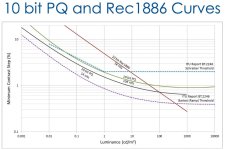
Q is designed that when operating at 12 bits per channel, the stepping between single digital values is always below the Barten threshold, for the whole range from 0.0001 to 10,000 nits, without being so far below that threshold that the resolution between bits is wasted. At 10 bits per channel, the PQ function is just slightly above the Barten threshold, where in some (idealized) circumstances stepping may be visible, but in most cases should be unnoticeable.

Page 22 (paper from Dolby): https://www.smpte.org/sites/default/files/23-1615-TS7-2-IProc02-Miller.pdf
Barten10bit.jpg

Last page (emphasis mine):
Conclusion
It is clear that current, high performance displays having higher brightness, higher dynamic
range, wider color gamut, and lower noise levels are beginning to show the weaknesses of
traditional display response functions, and that a new type of EOTF is required to allow these
displays to reach their full potential. It is also clear that this new EOTF must satisfy the criterion
of minimum visibility of steps using 10 or 12 bits, over a wide brightness range (wider than
available in current display devices in order to allow for future developments in display
technology). The conventional gamma based curve, which came from the no longer employed
Cathode Ray Tube (CRT), does not meet the requirements; experiments show that stepping is
visible at even 12-bits.
An EOTF based on perception can easily meet the requirements. Even
over an extreme brightness range (up to 10,000 cd/m2), visible stepping is not apparent on test
patterns at 11 bits, or on images tested down to 9 or 10 bits.

Even 9-bits can work (unless you only watch test patterns lol)! Makes sense based on experience with 8-bits. 10-bit log looks like a good sweet spot.

Another example: you're in the market to buy a new HDR TV, most sets are 10-bit, a new much more expensive model is 12-bit (hypothetical; not aware of any consumer 12-bit HDTV's yet), and the manufacturer is touting how much better 12 bits is. How do you go about testing this TV to validate spending more money for it? Are those few idealized use cases worth the extra cost for the more expensive 12-bit TV? A quick google search found a 12-bit monitor: https://www.dolby.com/us/en/professional/cinema/products/prm-4220.html . Wow, it's made by Dolby! lol
 
Last edited:
Are there any corporations selling products funding these studies (e.g. Dolby)?
Barten's book is his Ph.D. dissertation on contrast sensitivity on the eye, he quotes scientific studies on contrast sensitivity measurements on the eye.

It seems you simply want to be right whether it is true or not.
Even after being confronted by scientific studies your reply is questioning the integrity of the researchers.

I think I will end the discussion on my part before we get into a world conspiracy that is undermining you for being right all the time! :)

The 10-bit PQ curve is above the Barten (Ramp) Threshold (see prior post), multiple sources repeat 10 bit is enough, where 9-bit is enough if not using test patterns (I noted this paper was also from Dolby- giving credit where credit is due). No one in this thread is dismissing Barten's research or equations. The point was to do one's own research to verify truth, regardless of what experts say, vs. blindly believing things without doing due diligence to verify truth. What are you disagreeing with?
 
The 10-bit PQ curve is above the Barten (Ramp) Threshold (see prior post), ....
You are reading it wrong, any curve above the ramp is not accurate enough to resolve the human perceptible contrast.

Here is a comparison, 10 versus 12 bit:

Barten+Thesholds+for+10+bit+and+12+bit+Rec.+1886+and+PQ+curves


A Log curve, which is not represented here, would look like a horizontal line on this diagram.
 
Last edited:
Back
Top