
Navigation
Install the app
How to install the app on iOS
Follow along with the video below to see how to install our site as a web app on your home screen.
Note: This feature may not be available in some browsers.
More options
You are using an out of date browser. It may not display this or other websites correctly.
You should upgrade or use an alternative browser.
You should upgrade or use an alternative browser.
Mitch Gross
Veteran
Here's a pretty big announcement just in time for CineGear.
https://www.newsshooter.com/2019/05/29/panasonic-drops-the-price-of-the-varicam-lt-to-9995/
https://www.newsshooter.com/2019/05/29/panasonic-drops-the-price-of-the-varicam-lt-to-9995/
I kind of look at these new models as, "this will have XYZ that you have always wanted ... and 6K" rather than, "Here's 6K and the same old, the same old".
But the manufacturers are definitely trying to up the resolution game. The new CPU's and GPU's - 7 nM is here - will help the transition along but it'd be funny if someone released a brand new 1080p camera just to say, "this is for the everyday use". It shouldn't be expensive either .. or buy C100's while they're still in stock.
But the manufacturers are definitely trying to up the resolution game. The new CPU's and GPU's - 7 nM is here - will help the transition along but it'd be funny if someone released a brand new 1080p camera just to say, "this is for the everyday use". It shouldn't be expensive either .. or buy C100's while they're still in stock.

marvinhello
Well-known member
I don't have a use for 6k or 8k, and the added bitrate would not be welcome, but 14-bit ADCs in video mode would be SWEET. I have a p4k and still lust over the DR of the FS7 or the UMP. Those 14-bit ACDs could deliver just that.
Only Alexa and Sony CineAlta have 14 bit ADC.
FS7 has 12bit ADC, and UMP has dual 11bit.

puredrifting
Major Contributor
Only Alexa and Sony CineAlta have 14 bit ADC.
FS7 has 12bit ADC, and UMP has dual 11bit.
And the C200 must be 12-bit too since I can shoot Cinema RAW Light in 12-bit?
Remember, more bits != more DR when talking about cameras and sensors (only more gradations).
I seem to recall a camera from 2012 that had 14-bit ADC's and also shot raw: the Canon 5D Mark III with ML. While using ACR for highlight recovery was pretty excellent (14-bit raw frames), the 14-bits didn't provide any more real DR over 8-bit H.264 beyond a bit of highlight recovery. Raw processing provided the extra DR-ness vs. 14-bits over 8-bits. 10-bits is probably plenty for gradations. I never saw any more/less banding when shooting 12-bit RGB 444 vs. 10-bit YUV 422 on the C300 II, though my goal was accurate/high quality skin tones vs. radical color shifting for post work. 8-bit is certainly a lot more fragile, though I had pretty good luck with the 8-bit A7S II and SLog2 and the 1DX II using Filmic Skin (lowest contrast profile). Most folks shooting CLog on 8-bit Canon cameras have been impressed how well it holds up too. 10-bit log is probably good enough for 99% of typical applications. For VFX/keying etc. 12 or more bits is certainly helpful. + 10 or more bits is needed for HDR applications.
I seem to recall a camera from 2012 that had 14-bit ADC's and also shot raw: the Canon 5D Mark III with ML. While using ACR for highlight recovery was pretty excellent (14-bit raw frames), the 14-bits didn't provide any more real DR over 8-bit H.264 beyond a bit of highlight recovery. Raw processing provided the extra DR-ness vs. 14-bits over 8-bits. 10-bits is probably plenty for gradations. I never saw any more/less banding when shooting 12-bit RGB 444 vs. 10-bit YUV 422 on the C300 II, though my goal was accurate/high quality skin tones vs. radical color shifting for post work. 8-bit is certainly a lot more fragile, though I had pretty good luck with the 8-bit A7S II and SLog2 and the 1DX II using Filmic Skin (lowest contrast profile). Most folks shooting CLog on 8-bit Canon cameras have been impressed how well it holds up too. 10-bit log is probably good enough for 99% of typical applications. For VFX/keying etc. 12 or more bits is certainly helpful. + 10 or more bits is needed for HDR applications.

Samuel H
Major Contributor
Remember, more bits != more DR when talking about cameras and sensors (only more gradations).
Yes, I know. But the sensors in current mirroless cameras seem to be limited by the lowly ADC mode they switch to when they shoot video. It's pretty common to have 2+ extra stops of DR when shooting RAW stills vs when shooting video, and I don't think it's because of badly designed gamma curves anymore, it must be an ADC thing. Then again, on the GH5s, the DR improvement when moving from 12-bit to 14-bit is only half a stop (link), so, I'm optimistic, but who knows...
marvinhello
Well-known member
Yes, I know. But the sensors in current mirroless cameras seem to be limited by the lowly ADC mode they switch to when they shoot video. It's pretty common to have 2+ extra stops of DR when shooting RAW stills vs when shooting video, and I don't think it's because of badly designed gamma curves anymore, it must be an ADC thing. Then again, on the GH5s, the DR improvement when moving from 12-bit to 14-bit is only half a stop (link), so, I'm optimistic, but who knows...
Higher single ADC bitdepth only dives into deep shadows, you get lower and finer noise that results in pretty numbers in DR charts. But in reality these deep shadows get crushed after grading.

Run&Gun
Veteran
Only Alexa and Sony CineAlta have 14 bit ADC.
FS7 has 12bit ADC, and UMP has dual 11bit.
The now ancient HDX-900 tape camera has 14-bit processing. So does the 2700 P2 VariCam. And 3700.... And lots of others. And these are "last gen"(or last, last gen) cameras. Can't find it in any of their literature, but I'd be surprised if the current V35/LT/Pure don't have 14 bit processing.
Samuel H
Major Contributor
Higher single ADC bitdepth only dives into deep shadows, you get lower and finer noise that results in pretty numbers in DR charts. But in reality these deep shadows get crushed after grading.
If it doesn't come crushed out of the camera, it's DR and therefore useful. In either log or raw, it's straightforward to underexpose in order to move that extra headroom into the highlights. Yes, that will make shadows noisier, but having better ADCs makes that less of a problem, and that's precisely the new extra headroom.
Photographers have been using their 14 stops of DR in $2k cameras for years now. It's the same sensors we use, the difference is that for video they usually switch to faster ADCs with lower bit depth. It can go either way, but I'm hoping this provides a noticeable advantage.
puredrifting
Major Contributor
CineGear Check In Report - A few random observations from the exhibit floor
1. Really crowded this year compared to last year. If you're thinking about going, Paramount shut down the Van Ness entrance/parking structure and wouldn't let me in to park in the structure. According to security, they were saving the last few spots for Paramount employees. Had to pay $20.00 to park over at Hollywood Forever on Santa Monica and take a shuttle back over to Paramount. This was with me arriving at 9:30, 2.5 hours before the exhibits opened
2. There are more exhibitors this year than last. A ton on New York Street like last year, but also four full stages of exhibits.
3. I'm trying to not sound jaded but other than the Panasonic S1H presser and the Atomos Neon roll out, I don't see really anything here that wasn't here last year or just slight variations of what was shown last year. FF mania still in effect, all of the lens manufacturers showing their FF glass.
4. Other than the Sumire lenses, NOTHING new at Canon. Yawn.
5. Sony booth was VERY crowded, lots of Venices on display, in different configurations and setups. No sign of the A7 SIII, of course and no reps there would say anything about it, not surprisingly. They had some FS7MKII different configuration kits, had the RX01 in an interesting display setup as a "micro cinema camera". The Sony booth feels like the Emporers new clothes to me, lots of nice cameras and hardware, yet almost everything on display short of the Venice has those sickly Sony skin tones. Am I too picky about skin tones, seems like the rest of the world doesn't care?
6. Arri exhibit was hopping, no new product displays that I could see but TONs of Alexas all over the place with different glass in different configurations. They had an interesting three camera "live" shot set up of two models and man, I have to say, on nice monitors, correctly setup, the Arris still make the most appealing images out there. Better than the Venice, better than RED, the models skin tones and the overall look was just beautiful.
7. The Panavision Millenium DXL2 looks very nice, it's an interesting camera in that it uses the RED Monstro 8K imager but somehow the images don't look like a RED to me, probably because the DSP and ADC tuning is done by LightIron Digital? If I were in the rarefied league of shooting with a very high end camera for a high end project and
money wasn't an issue, I would choose this camera over the RED, it's kind of amazing. The Monstro RED is a good looking camera but this camera seems to look better. But I still like the look of the Arris best.
8. While I saw lots of cool lighting, I didn't see much that wasn't here last year. I'm still trying to figure out how and why NBC is marketing "Lightblade" lighting? Since when does a TV network market LED video lighting? They look like cool lights, it's just weird to see NBC marketing them?
9. The FF brainwashing continues unabated, I heard conversations and saw displays that intimate that S35 lenses, cameras and gear are going the way of the Dodo. I will always contiinue to buy and support S35 gear for as long as possible as I think it's DOF and FOV characteristics are superior to FF, although FF doesn have better low light capability. As far as FF video/digital cinema, never has a new technology been hyped so much, by so many for so little gain to the average user. You'd think that intellgent people in our community would see what is happening and would rebel against it by not buying this gear, but that isn't happening, the marketing brainwash has been a massive success and today, most people in our business truly believe that FF is MUCH better than S35 for digital cinema production. Sheeple.
Overall, I see that the industry is continuing into it's period of Stasis. There was almost nothing shown at CineGear that made me want to write a check or whip out my credit card. Lots of cool gear for sure, but it's all mostly newer versions of what we already have with just tiny, incremental increases in features. The Panasonic S1H announcement was snore worthy, I'm sorry. It was about as exciting as the GH5S was after the GH5. Not bad, I'm sure it's a nice camera. But nobody needs to be shooting 6K, I can almost guarantee that heat generation will be a problem with this camera as it has no fans or heat sinks, it's just a bit larger body than it's S1 and S1R brothers. Still no built-in NDs (that would be innovation in a mirrorless camera, wouldn't it?), no XLRs, no SDI i/o and it's a digital cinema camera that will only have fly by wire lenses, not exactly the hot tip for cinematic shooting, perhaps?
No new cameras from Canon, Sony, Arri, Panasonic other than the Lumix S1H, no EVA 2 or Varicam LT II. In a way, I think it's okay and healthy that innovation is in a period of dormancy. Filmed entertainment as a business isn't growing, it's shrinking so it makes sense that the industry of gear that is used to generate content is taking a break after a period of insane change and growth. It may be a long time or never before we see a C100 MKIII, C300 MKII, FS-7MKIII, I think the paradigm is shifting toward smaller (BMPCC 4K), cheaper cameras in this space. After owning both the C200 and the XT-3, I can see a lot of the type of work that used be shot with the C200 is able to be shot with the XT-3 (not all of it obviously), you can extrapolate that out to a lot of FS7 work can now be shot with thge A7 RIII, etc. The high end will still need and want bigger, heavier cameras for crewed production but for the low to medium level work, mirrorless is the growth space.
The full frame and the 8K pushes are concurrent. The low light performance seems to be big deal, however.
And the consumer/prosumer market likes to make splashes toward the holiday shopping season, so there's room for more summer/IBC announcements down the road.
As to dormancy, the visual acquisition industry has pretty much tapped out its technical "retina" potential. 3D, 360, VR have all ran into a dead end. And, after that, it's going to come down to pricing and the inevitable race toward bottom.

Cary Knoop
Veteran
For Rec709 yes but not for HDR!Higher single ADC bitdepth only dives into deep shadows, you get lower and finer noise that results in pretty numbers in DR charts. But in reality these deep shadows get crushed after grading.
Dan- the S1H would have been interesting if they'd used a sensor with some form of phase detection! DFD (Doesn't Focus Dammit!) was interesting on paper lol.
On the plus side re: your sig- there's no motivation to buy anything when you've got a C200 and X-T3. For my stills+video work, the 1DX II was the best Canon purchase to date, by far. Better than the 5D3 for stills and better than the C300 II for 4K video (Overall image quality and usability. C300 II has a bit more DR, less RS, XLR, though the NDs had color shift which I don't see with e.g. Tiffen VND on the 1DX II (plus I like the VND solution to fine tune exposure).
Re: dynamic range with 14-bits & shadows- take a look at the long term king of DR and image quality, the ALEV III sensor vs. the C300 II and FS7: https://www.cinema5d.com/canon-c300-mark-ii-review-dynamic-range/
Note C300 II has sensor smear and Canon's 15 stop DR claim was not true. Along with all manufacturers pulling a fast one on true camera resolution (except for perhaps ARRI), it's cool that most informed camera users are now aware of what it takes to get real resolution and to wait for multiple independent tests to verify things like real DR.
10-bit vs. 12-bit and DR (this matches my experience as well):
Again, 10-bit log is sufficient for most cases (e.g. 99%). 14-bits and up is fine for linear recording, but again, won't increase DR. Case in point: Alexa 10-bit log ProRes: shot most of the time- because it's good enough without crazy file sizes.
Underexposing to protect highlights- good idea in general, how many cameras (other than the Alexas, perhaps some Sonys) can you push a bunch of stops and in post recover shadows without having to denoise (which will remove any perceived DR increase)? Most people, myself included, are into the mid-tones (where the people live!), next is highlights, and lastly shadows: because who really looks at shadows beyond a select few? You know who you are lol. Complain about shadows to the average person and you'll be met with a funny look... except for perhaps that GoT episode! (which was low DR except during fire/dragon-flame).
More bits for more gradations and less banding- sure that's very helpful! https://petapixel.com/2018/09/19/8-12-14-vs-16-bit-depth-what-do-you-really-need/
If there's evidence of higher than 10-bit log showing more real DR (from shadow recovery vs. a sensor change)- let's see the evidence from real world tests.
On the plus side re: your sig- there's no motivation to buy anything when you've got a C200 and X-T3. For my stills+video work, the 1DX II was the best Canon purchase to date, by far. Better than the 5D3 for stills and better than the C300 II for 4K video (Overall image quality and usability. C300 II has a bit more DR, less RS, XLR, though the NDs had color shift which I don't see with e.g. Tiffen VND on the 1DX II (plus I like the VND solution to fine tune exposure).
Re: dynamic range with 14-bits & shadows- take a look at the long term king of DR and image quality, the ALEV III sensor vs. the C300 II and FS7: https://www.cinema5d.com/canon-c300-mark-ii-review-dynamic-range/
Note C300 II has sensor smear and Canon's 15 stop DR claim was not true. Along with all manufacturers pulling a fast one on true camera resolution (except for perhaps ARRI), it's cool that most informed camera users are now aware of what it takes to get real resolution and to wait for multiple independent tests to verify things like real DR.
10-bit vs. 12-bit and DR (this matches my experience as well):
Why did I compare 4K to 2K? I decided to shoot the Canon C300 Mark II in 4k (not 2K) for this test as I felt the image looked better when downscaled to 2K. I am aware Canon says they achieve best image quality at 2K in 12 bit. I did not see any improvement for the tests conducted. 12 bit will not give you a higher dynamic range, only better gradations.
Again, 10-bit log is sufficient for most cases (e.g. 99%). 14-bits and up is fine for linear recording, but again, won't increase DR. Case in point: Alexa 10-bit log ProRes: shot most of the time- because it's good enough without crazy file sizes.
Underexposing to protect highlights- good idea in general, how many cameras (other than the Alexas, perhaps some Sonys) can you push a bunch of stops and in post recover shadows without having to denoise (which will remove any perceived DR increase)? Most people, myself included, are into the mid-tones (where the people live!), next is highlights, and lastly shadows: because who really looks at shadows beyond a select few? You know who you are lol. Complain about shadows to the average person and you'll be met with a funny look... except for perhaps that GoT episode!
(which was low DR except during fire/dragon-flame).More bits for more gradations and less banding- sure that's very helpful! https://petapixel.com/2018/09/19/8-12-14-vs-16-bit-depth-what-do-you-really-need/
If there's evidence of higher than 10-bit log showing more real DR (from shadow recovery vs. a sensor change)- let's see the evidence from real world tests.
puredrifting
Major Contributor
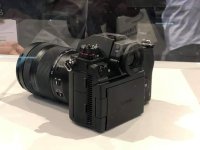
View attachment 135730
Looks like a fan vent on the SH1, and a flippable screen
Interesting, all that was mentioned was "they are still working on options for cooling, media choice and a bunch of other potential options for the S1H"
I didn't go to the booth to see the mock up but you're right, those do look like cooling/fan vents. I can't see how they can record 6K without that.
Vents or not, I still predict thermal issues. I've ran into them on my C200 is 60F temps with a breeze and I've ran into them on my XT-3 shooting 4K 60p.
That would be another innovation in camera technology, better, more efficient thermal management. Most mirrorless cameras shooting 4K can be made to overheat
pretty easily. The stampede toward 6K and 8K mirrorless will exacerbate this. Maybe Panasonic will figure it all out?
Historically, the heat issue depended on heat production by the microprocessors and the ability to dissipate the said heat. Those frequenting the Canon portion of the DVXUser may recall various means of the external cooling on C500. These latest models have a "disadvantage" of HEVC, which is far more labor intensive than H.264 based codecs. On the other hand, the processors themselves are far more efficient than those of recent vintage. The current period is using 7nM lithography (whether these new models are 7 or 10, I do not know, but mobile phones are on 7 and moving toward 5). The other issue is weather sealing and the body size. The recent trend was for the smaller mirrorless bodies, which left the electronics very densely packed. That trend appears to have been, at least, partially reversed with the bigger full frame models.
As far as S1H goes, today's announcement looks a bit premature since so many pertinent details have not been finalized. Even the price of "around $4,000" has not been truly determined.
As far as S1H goes, today's announcement looks a bit premature since so many pertinent details have not been finalized. Even the price of "around $4,000" has not been truly determined.
Panasonic are the masters of dealing with heat - their cameras haven't suffered with that issue like all it's competitors have. I'm pretty sure that's a big reason we've not seen a Sony a7s3 - there's no way they can squeeze 4k60p 10 bit in those bodies without it exploding, and now Panasonic have pushed the specs even higher with 6k, Sony will have to bring out a much bigger body to compete
Last edited:
Again, 10-bit log is sufficient for most cases (e.g. 99%). 14-bits and up is fine for linear recording, but again, won't increase DR. Case in point: Alexa 10-bit log ProRes: shot most of the time- because it's good enough without crazy file sizes.
For the sake of clarity, the ProRes 4444 and 4444XQ files that typically recorded on the Arri Alexa are 12-bit files. While it's possible to record lower quality files I don't know why anyone would for anything important, especially if you are using Log C encoding.
https://forum.arri.com/viewtopic.php?f=105&t=127