C300: Canon C300 Mark II Announced & Pre-Order List at Texas Media Systems

Canon USA C300 Mark II Free Jacket & Vest Promo

Canon USA C300 Mark II Free Jacket & Vest Promo

Canon USA C300 Mark II camera buyers (1st 600) can claim a free special edition Cinema EOS Jacket and Cinema EOS vest.

C300 Mark II purchased from Canon USA dealers will have the sticker below on the retail box and a black card inside the box with the manuals.

usa.canon.com/C300MkIIoffer


Canon C300 Mark II Free Jacket & Vest Offer Texas Media Systems.jpg IMG_3484.jpg

 
Hate to hijack your thread Terry but maybe you can pass this bit of information on the powers at be (Canon). Since April I've been excited about this camera, even with a hefty price tag I saw a worthwhile investment. Until recently, after reviewing demo 120fps footage from the mk ii, I decided to run a few of my own tests and do some digging.

Was surprised to find out that the 120fps/crop mode of the mk ii is up-sampling from a 1024x540 area and calling that HD. The result is a shockingly soft / detail barren image(much like the fs7, fs700 and any highspeed option found in CONSUMER cameras). Even the mighty c500, ask any owner about it's 120fps mode and they will likely tell you to not even consider using it. Now my question is without 4k 60p AND 2k 120p, where is Canon going with this camera? These are standard features in all but Canon products.

I realize that I am only one person with an opinion, but I do happen to be heavily invested in Canon(1dx, 5dmk ii/iii, c100, 16-35, 24-105, 35, 28, 50, 100, 85, 70-200, 28-300) but this kind of product crippling has become a bit too much to stomach.

ps: Don't let my rant deter anyone, I have purchased from Terry and TMS before and their customer service is without a doubt 5 stars!
Bummer
 
Was surprised to find out that the 120fps/crop mode of the mk ii is up-sampling from a 1024x540 area and calling that HD. The result is a shockingly soft / detail barren image(much like the fs7, fs700 and any highspeed option found in CONSUMER cameras).

Except it isn't. Where did you get this information. Where are your test files?

Right click image and open in new tab for full size (from Bloom's shared files) EDIT: if you are on a Retina Mac you need to drag it to your desktop. Your browser might show it twice its actual size:

C300mkII100fps.jpg
 
Last edited:
I'm really confused by this whole outcry over lack of 4K 60p. Are that many clients really asking for that? Like, lack of 4K 120 fps is fine because clients don't care much about that, apparently, but oh, that lack of 4K 60p is some huge deal. What benefits is that really giving anyone? The ability to crop in on slow motion shots (while still being limited to 60p)? Even the Arri Alexa doesn't do 4K 60p and is good enough to be the most used camera on big budget productions. It just seems like a feature with very limited uses and benefits to me, at least in regards to the outcry over the camera lacking that feature.

I'm just not seeing what market segment is actually distributing in 4K, needs 60p, doesn't need 4K 120+ fps (hence a Phantom Flex 4k or similar), and thus bemoans this lacking feature on the C300 Mark II.

My best guess is that people just like to complain about missing specs on a camera regardless of how important their actual uses for that spec is, but perhaps I'm wrong and someone could enlighten me on how important 4k 60p is.


When I bought the C100 Mark II I was thinking that'd I'd make good use of being able to have 1080p 60p, and while it does look good, I find I hardly ever use it. I think slow motion is a highly overused gimmick which has brought down the quality level of a lot of people's work. Nice to have it when you actually need it, but you only really need it on rare occasions (though, it does depend on the type of work you do). I know for one when I see movies in theaters, which certainly have the budgets for high speed cameras, only a small percentage of movies actually use slow-motion, and a much smaller percentage are showing slow motion in 4K.
 
Was surprised to find out that the 120fps/crop mode of the mk ii is up-sampling from a 1024x540 area and calling that HD. The result is a shockingly soft / detail barren image(much like the fs7, fs700 and any highspeed option found in CONSUMER cameras). Even the mighty c500, ask any owner about it's 120fps mode and they will likely tell you to not even consider using it. Now my question is without 4k 60p AND 2k 120p, where is Canon going with this camera? These are standard features in all but Canon products.
To quote Andrew who just posted...

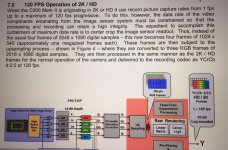
When reading the white paper on the first pass, it might come across as if the 120fps mode is severely cropped when Larry talks about 1024x540 frames. Don't forget that at this level we are talking about discreet color components/diodes of the Bayer pattern. In 'pixels' these 'frames' would be 2048x1080. Just like in 4k, the Red, Green (x2) and Blue components are 2048x1080 each in a 4096x2160 pixel frame.

In all modes Canon is then up sampling the color components (i.e. filling the holes in the Bayer grids) so that 1024x540 diodes become 2048x1080 pixels. A great cure against aliasing.
 
I think slow motion is a highly overused gimmick which has brought down the quality level of a lot of people's work. Nice to have it when you actually need it, but you only really need it on rare occasions (though, it does depend on the type of work you do).

When the FS700 was new I rented it for a project over a weekend. Since I didn't know the camera I spent some time playing with it (and my kids) to get accustomed. After that weekend slow motion was kind of "out of my system". Everything tends to look the same. With the really high fps, even the briefest moment takes forever in the timeline at the project fps.

For commercial work it's a need to have. You'd use it almost every shoot I guess. But for a lot else it gets old REALLY fast.

But hey, it's better if your camera shoots it, than if it doesn't. What some people have trouble with is attributing it its correct level of importance. In a spec list it does look impressive.

I think the C300 mkII hits the sweet spot with 120 proper quality frames per second. That's enough for many situations.
 
Except it isn't.

Except it is.. See page 5 of Canon's white paper on the mk II.. There is PLENTY of footage out in the wild(and will be in the coming days) that substantiates it I assure you. Heck, even the screen grab you linked too from Blooms footage looked soft and muddy. Here is another example :)

Full_Size_Render_3.jpg


Sampled plenty of 2k footage up to 4k and it is nowhere near that soft.
 
Last edited:
Except it is.. See page 5 of Canon's white paper on the mk II.. There is PLENTY of footage out in the wild(and will be in the coming days) that substantiates it I assure you. Heck, even the screen grab you linked too from Blooms footage looked soft and muddy. Here is another example :)

Like Eric kindly quoted above—you are not understanding what the white paper says. Regardless of that: if you open the file I linked and look at it at actual resolution, and you still find it soft, that's fair. A highly subjective opinion that you are entitled to!
 
Like Eric kindly quoted above—you are not understanding what the white paper says. Regardless of that: if you open the file I linked and look at it at actual resolution, and you still find it soft, that's fair. A highly subjective opinion that you are entitled to!

I am definitely open for debate, but I think with a background in engineering I understand the white paper just fine. If you sincerely believe that the screen capture you posted is of "proper" resolution, you may be delusional. I'm sure there will be plenty of reviews(some smart enough to shoot charts) that will confirm this and make it a little more obvious for the aging eyes.


buy a camera that is designed for 120FPS capture.

That is in fact my point. Being under the impression that the mk II was designed for 120fps with a clean 2x crop per their press release. I also don't think anyone can deny that the #1 most requested feature missing from the mk I was 60p, so much for listening to your customers.

I'm just not seeing what market segment is actually distributing in 4K, needs 60p, doesn't need 4K 120+ fps (hence a Phantom Flex 4k or similar), and thus bemoans this lacking feature on the C300 Mark II.

Distribution is irrelevant and has very little impact on my decision making process. What is relevant is the wants/needs of my clients and the creative treatments I submit to them. As a director/dp that services a few different markets(sports, fashion, commercial and pharmaceutical) and travels heavily, I need to be flexible and so does my tool set. I understand there is an abundance of videographers "bemoaning" for features they will only use shooting raindrops in their backyard, but I am not one of them.
 
Last edited:
That is in fact my point. I was under the impression that the mk II was designed for 120fps with a clean 2x crop per their press release.

It looks like it is a clean 2x crop of their 4K image. I'm sure it will not be as detailed as the regular 1080p image, but it reads like Canon are using a 2X crop of the center image and putting it through their standard 4K image debayering and processing scheme. The resulting resolution will probably be closer to the 1080p that you get from a 5D, but it is definitely not going to be a 540p resolution. Whether this is good enough for most 120 fps slo mo that the C300 will be used for is up to the user.
 
I am definitely open for debate, but I think with a background in engineering I understand the white paper just fine.

Looking at a Bayer filter for reference:

Bayer_pattern_on_sensor_profile.svg


In the paragraphs previous to what you quoted, the white paper talks about how it extracts the individual components (Red, Green, Blue) from the 4k sensor in that it reads each lattice as a separate "frame". You get one Red, two Green and one Blue—each consisting of 2048x1080 samples (every other pixel in a 4k sensor). Each "frame" get's up sampled to fill in the empty spots in the color grids and you end up with 8MP (4k) discreet color frames. From these, the regular full frame 2k image is constructed.

In the 120 fps mode, the sensor is center cropped into a mini 2k sensor. Within that mini sensor, logically, each discreet lattice will now only be 1024x540 samples—you have 4 frames of 1024x540 that get up sampled like the previous example. The up sampling of each frame is something that Canon does extra. It should be good against aliasing. That you only get 1024x540 Red and Blue samples in a 2k sensor is normal for the Bayer pattern.

Just like the full 4k (4096x2160) image consists of 2048x1080 Red, Green[SUP]1[/SUP], Green[SUP]2[/SUP] and Blue samples.
 
C300 mark II: 2 and half times less frames per second for 2 and half times more (than FS7, at least in my country). That's basically sums it up.

No matter what science is behind this that example of 120fps looks VERY soft. Definitely softer then even 180fps from FS7.

Far from being a hater, as before IBC I was decided that my next camera will be C300II. But seeing it's limitations and price tag it was no go for me- went Sony route again. And as LeoGrey said above it's not a matter of stylistic choice or simply hating on a product. If you do commercials or music videos slow mo is a MUST nowadays. And when using slowmo I tend to go 4K60fps more then I though so. You can always conform it to 24/25/30fps and have "normal" 4K, so there are not questions like: slowmo or resolution?
 
[I have sampled PLENTY of 2k footage up to 4k and it is nowhere near that soft.[/QUOTE]
Slightly soft yes, but interesting organic look.
 
Slightly soft yes, but interesting organic look.

For consumer/prosumer products this look is understandable, one has to pay to play. Throughout the couple of dozen fs700 projects I have shot/seen, the soft 240fps worked mostly because it was often on the same timeline as other debayered/line skipped footage(5d, 7d, fs100, bmcc, etc). Unless it was a closeup of some kind, the second you put it it next to 4k or downsampled HD(cinema EOS, a7s, f5) it loses that "organic" aesthetic and appears muddy, overly scaled and void of detail.
 
Off one of the C300 MKII threads on the News forum (forgot which particular thread though), 60 fps in 4K is a requirement for many a TV/cable network. IIRC, the Discovery Channel was mentioned there. I assume there are others. As mentioned above, slow-mo is not just for play.
 
Back
Top