Camera rumors for 2016?


That is simply untrue. They are still not profitable. That is well known. There are scores of articles with Musk promising investors that Tesla will finally be profitable in 2016. (the stock price jumped with his announcement)

Again, the point is; it's harder for the little guys to compete against the bigger companies, unless they find a niche.

Black Magic had found that niche by offering, among other things, affordable 4k to low budget filmmakers.

But that niche is starting to be encroached upon by newer offerings from Sony, Panasonic, JVC, etc...
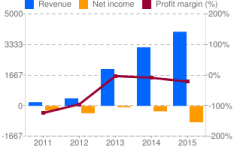
 
Your previous statement was "Tesla, however good, has yet to show a profit." They have made a profit. You're right, they are not profitable, yet. That's expected to be in 2020.
 
They hit profit roughly 3 years ago....

That is simply untrue.

It was true that quarter, Q1 2013. But ever since then they were unprofitable again, but just barely.

chart.png​


That's net profit. Its gross profit is 20-30%, which "is higher than GM, Ford and Toyota. The company 'loses' money via depreciation of capital purchases. Factories and equipment. A rapidly growing company is likely to show a loss for some years as they spend money to grow their business" (https://forums.teslamotors.com/foru...historical-gross-profit-margin-quarterly-data).
 
That is simply untrue. They are still not profitable. That is well known. There are scores of articles with Musk promising investors that Tesla will finally be profitable in 2016. (the stock price jumped with his announcement)

Again, the point is; it's harder for the little guys to compete against the bigger companies, unless they find a niche.

Black Magic had found that niche by offering, among other things, affordable 4k to low budget filmmakers.

But that niche is starting to be encroached upon by newer offerings from Sony, Panasonic, JVC, etc...

And yet none of those offerings have RAW internal recording. Its the RAW workflow that makes BMD shine and not the resolution or anything else. 4k is such a non issue here and plenty of film makers have made great use of BMD's 2k cameras even though there were a crap load of other 2k cameras out there at the time. Its giving the most unprocessed image possible to the artist to do what they want in post. Thats the true power of what BMD offers. If one doesn't need RAW the alternative is to use ProRes which is still 10bit with very low compression compared to many other cameras. The Canon C100 is a nice camera but the thing records to 24mbps H264 for heavens sake. As long as the big dogs continue to try to push their P2 or SxS technology they will limit the format their cameras can record. Sure to the average Joe not a big deal but to a film maker the quality of the recording is in fact very important.

BMD offers cameras all the way down to the Pocket camera that record internal with no funny business or extra external hardware RAW and ProRes422 10bit. Show me another $995 camera that can do that. On the 4k side there may be more 4k cameras coming but do they shoot RAW? Do they even shoot 10bit? The A7S and almost all DSLR class cameras accept for the GH4 only output 8bit via HDMI. When it comes to serious color work almost all of those cameras are severely limited compared to BMD. LOG helps but really right now the GH4 is the only DSLR that has the ability to record externally 10bit LOG material.
 
A Blackmagic Pocket in a handicam body would sell very well.

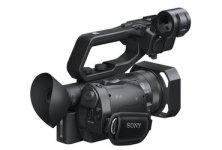
pxw-x70.jpg

(with an interchangeable lens mount, still, though)

And if it had global shutter up to 60p, it may be all I need forever.
 
Hi Steve,

Yes for me 60p for slow-mo. As for Sony vs. Ursa, I love the color science and cinematic quality of BMD cameras. Wish it had built in ND's for run n gun, especially for the PL/B4 mount versions.

Couple of thoughts for the more experienced filmmakers here. First, I'm not understanding the desire for 60p. Is it because you are interested in a moderate slow motion or because you like the look of 60p? I figured most would be shooting at 24p. Second, I am having trouble understanding why people want the Ursa for the look and dismissing Sony. Can't you achieve the look you want through LUTS, post production, etc..? Help me understand.
 
A Blackmagic Pocket in a handicam body would sell very well...
There are several gaps in the low end pro/high end consumer market (or those that I can think of). Bottoms up --

1) "A6300 in an ILC camcorder body" with the 10-bit HDMI out, image stabilization and a high internal bit rate.

2) A Raw 1080p/1440p ILC camcorder that is not an ML hack (internal SSD).

3) "A7SII inside an ILC camcorder body" - a full frame, low light specialist with a more robust codec and different ergonomics and workflow to A7SII

4) "A7RII inside an ILC camcorder body" - ditto to above (in theory, this is more or less where the 4.6 URSA Mini was headed)

5) "GH4/GH5 inside an ILC camcorder body" - this was the bandied about AF200 that never came out. In its stead, we saw GH4+YAGH combo, with plenty of YAGH's still sitting on store shelves. GH4 by itself was a monster hit.

1" and MFT run-n-run gaps were filled with with the new 1" Z-150 and MFT DVX200. It seems pretty clear that the photo-video cartel hit the most obvious features and price points as its opening salvo in the 4K tsunami. From now on, it might move to fill the less obvious and more eclectic choices. Or it could just as easily double up on what worked.
 
I suppose one can also add a list of "missing" accessories. One that I can think of is a small and affordable external 4K recorder similar to Atomos Ninja Star. Just 4K, ma'am.
 
I would buy a small 4K ninja star and inexpensive parfocal lens (with some range) at the same time.
 
Can't someone just make a Full Frame 12-120mm T1.3 anamophic parfocal servo-powered zoom lens for $1000? ;)

Make it 12-240mm and I’d happily pay $50 more, provided of course that it has 0 distortion over its entire zooming range. And it should weigh no more than 1.5 pounds.
 
Y'all are so funny. But your mockery is a little incongruous, since the posts just before yours were of conservative ideas like putting Pocket or DSLR guts in little bit larger bodies.
 
That is simply untrue. They are still not profitable. That is well known. There are scores of articles with Musk promising investors that Tesla will finally be profitable in 2016. (the stock price jumped with his announcement)

Again, the point is; it's harder for the little guys to compete against the bigger companies, unless they find a niche.

Black Magic had found that niche by offering, among other things, affordable 4k to low budget filmmakers.

But that niche is starting to be encroached upon by newer offerings from Sony, Panasonic, JVC, etc...
Spec wise, yes. But arguably, not quality wise.
 
Spec wise, yes. But arguably, not quality wise.

For sure.

A lot of low-volume manufacturers tend to go 'upscale' because component prices are usually higher for them. (Arri would be a good example)

Smaller manufacturers do have other advantages, tho'; Low over-head costs, more flexibility and the ability to put more quality into their product.
 
A lot of low-volume manufacturers tend to go 'upscale' because component prices are usually higher for them. (Arri would be a good example)

This is a subject that I consistently fail to fully wrap my head around. While I of course understand that it must cost more to make something better, I'm often shocked by the difference.

Take this helpful article above, This is how ARRI makes cameras (thank you, roxics), which concludes that the cameras "couldn’t be made any cheaper." At around $50,000 each, I find that astonishing.

I can't help but wonder if such pricing is a vicious cycle. You price your camera at $50,000. So, only a few people can afford them. So, you'll only ever sell a few. So you have to charge $50,000 each.

Surely I'm missing something. And I know I've already simplified things for the sake of brevity. Like, making thousands and thousands a year isn't something their little German factory could handle. They would have to outsource them to a bigger factory, like in China, which they may be unwilling to do, because it would be harder to maintain quality over long distance.

The same goes for other things in life, be they cars, watches, and clothing. There's the stuff at prices the average Joe can afford (the $15,000 car, the $100 watch, the $50 shirt) and then the highest-end stuff at absurdly high prices (the $150,000 car, the $10,000 watch, and the $500 shirt). Were I born yesterday, I would guess that the nice stuff would be 10% to 100% more, not 1,000% more. It's not like the average car is made out of paper and the Porsche is made out of diamond. I always thought the high-end companies were just being snobby, that they could sell their stuff for a tenth the price but for whatever reason they got cool, and so can charge indecent amounts. But that doesn't add up, because you read about how Porsche almost went out of business. I guess I should have taken that Economics class in high school.
 
This is a subject that I consistently fail to fully wrap my head around. While I of course understand that it must cost more to make something better, I'm often shocked by the difference...
ARRI manufacturing harks back to the pre- and WWII era German economy, which essentially disdained the "American style" mass production techniques and used the so-called "Taktzeit" (loosely translated as "timing") methodology. Which was the primary reason - in my opinion - of why the Germans lost the war. For example, having built the largest automobile factory in the world for car manufacturing (VW, then "Kraft durch Freude/"Strength through joy"), the state run plant produced about 58,000 Kubelwagen/Swinnwagen (military versions of the Maykäfer/May Beetle) in about four and a years of production or roughly a thousand per month. By comparison, Wyllys-Overland produced ~ 360,000 or ~ 8,000/mo from the factory half the size. The German system was based on highly skilled labor that took years to educate and bring up to the required standards. The American system was based on "Rosie the Riveter". Obviously, since then, the German manufacturers in general developed automated technologies on par with anyone in the world but, IMO, they still have the "kraftsman" mentality, which is why there's essentially no low end product that comes out of Germany. Many nations - the US, Mexico and anyone in South East Asia - is perfectly willing to slap together an inexpensive mass-assembled product to be sold at the gigantic retail outlets but that rarely happens in Germany and rarely comes from it.

As to ARRI, it's not that FPGA's are that much more expensive than ASIC's but that a high end product manufacturer is far more likely to deploy far more expensive materials and then use a far more labor intensive process, including quality control, during the every point of the process. Porsche, likewise, deploys some aerospace quality material on its turbos, engines and so on.

PS. Vladimir Putin has a $600,000 watch and more than one of those too.
 
Back
Top