C100: C100 mk2 & C100 film look

The colour issue isn't really an issue. Skin tones remain great pretty much no matter what. Mark 2 is just more neutral than the Mark 1.You can use a custom MKii profile from AbelCine (here)or Shane Hurlbut for warmer looks. The sensor can produce classic Canon colour no problem with some minor matrix adjustments.

After more tests with sharpness, I suppose some people may have issues even with it turned down. The MKII really is a 4K cam trying to burst out of a HD cam's body (Canon really should have allowed it to record 4K externally). Diffusion filters are, of course, an easy fix.

This picture is from here
https://vimeo.com/118014790

I hope "blue tint" is very easily to fix in camera . I know , in post I can do it later , but from my experience when you have 8 bit camera it is much better to get right colour look in camera . Next week I am going buy mk2 but I have to be sure that I will easily match mk2 to mk1 , no in other way . mk1 looks much better for me . I shoot a lots of video with people , skin tone is priority . Unfortunately I am getting mk2 from second hand , I will be not able to test it and send it back if I do not like it .
I do not know how to get profile from Shane Hurlbut website .
http://www.thehurlblog.com/canon-c100-mk-ii-custom-picture-profiles-2/
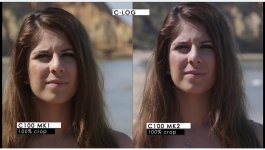
 
You tell me which one is C100 Mark I and which is C100 Mark II.

Full-size: http://s21.postimg.org/zd3ktq2qt/Priest_medium_2.png
Priest_medium_2.png


Full-size: http://s8.postimg.org/4858zfffn/Priest_tight_1.png
Priest_tight_1.png
 
Last edited:
In Singin' in the Rain they didn't think talkies would become popular. Things change over time. It remains to be seen if the "film look" will still be popular in 50 years from now, or if it will be more of "vintage" look that is used on rare occasions. I'd guess the latter.
Modern cinema isn't that different from the cinema of 50 years ago. The Good the Bad and the Ugly, The Sound of Music, Doctor Zhivago, are all 50 years old. The look back then might not have been as shallow DOF as today, but selective focus and 24p was the standard then just as it is now. The only recent movies that I can think of that've really broken with that would be Avatar and The Hobbit. Avatar did well in theaters because of the immersive environment in 3D, but the Hobbit was panned for looking too much like video. The film look to me is more about enhancing the suspension of disbelief in order to tell a story. Avatar was able to do that by creating a convincing environment. The Hobbit lost the magic of Middle Earth by being too realistic in 48fps 3D. It was hard to immerse yourself in that story when it looked like a live action video game.
Higher resolution alone doesn't make much difference here. It's the use of it that will. I don't think that shooting a film with bright realistic colors and a deep depth of field will allow someone to get lost in the story as easily as a more graded and selectively focused look would. That's where the concern about the C100 II comes from. If it's a little sharper and the color isn't as warm, people start to think it looks a little more like video. It's funny how such a subtle difference can become noticeable. That suspension of disbelief can be hard to achieve and easy to break. Luckily it looks like a small tweak can get the C100 II back in line.

BTW, Singin' in the Rain was a talkie. ...and I don't think it was a documentary either so maybe we should take opinions from a fictional film with a little salt, eh?
 
It was hard to immerse yourself in that story when it looked like a live action video game.
But it's comparative lines like this that make me think the "film look" is only a matter of a transitory look (fad) not based on anything objective. It's non-immersive because it looks like a video game, and people are used to the video game look because...of videos games...of our time period...etc. It's the same as saying a look is bad because it looks like (reminds us of) soap operas, and we psychologically associate soap operas with lower production values. But 75 years ago did we associate 30p with TV soap operas and 60p with sports and video games? No. It's just a matter of what genres used what formats that we eventually began to draw associations with them, associations, which I would say are temporary at best.

For myself, I don't watch much sports, I don't watch TV soap operas, and I rarely play video games, so I personally don't make those associations.

Now, if instead of saying, "because it looks like video games," or "because it looks like soap operas," one was to simply say, "it objectively looks bad for the story it is trying to tell," I'd take that statement to have more long term merit than making a statement purely on temporary associations with other formats (video games, soap operas). Which you did pretty much also said, but I'm just saying.


BTW, Singin' in the Rain was a talkie. ...and I don't think it was a documentary either so maybe we should take opinions from a fictional film with a little salt, eh?
Seeing how it was shot on film I was so immersed in the story that I took the fictional characters words at face value. :P

More seriously, several characters in the movie originally didn't think talkies would become popular because they were so used to everything being silent. I'm guessing that at least for some people in the industry at the time, that that was an accurate representation. Yet, silent movies quickly faded out of popularity and the industry changed, despite some likely thinking it wouldn't. The idea of talkies not becoming popular in mainstream movies could be similar to thinking the digital super sharp look won't become popular in mainstream films.

I wouldn't be surprised if in 50 years from now some younger people avoid old movies because of the soft dated look (instead of the pristine look of their times) just like some younger people now avoid black and white films.
 
Last edited:
Yes, and you were wise to use the C100 MKI for the close up for precisely the reasons mentioned..... warmer film look.
 
Erick
Could you show it before colour correction in post ? Could you show here, how sample look straight out both camera ? Did you shoot in c-log or wide DR ? Thanks
Your grading is rich in colour , I mostly shoot in wide DR or c-log . I love creamy look . Mostly I have no problem to even match c100 with fs100 if I go down with level and add some colour saturation in post , but this is not what I am looking for .
 
Last edited:
Erick
Could you show it before colour correction in post ? Could you show here, how sample look straight out both camera ? Did you shoot in c-log or wide DR ? Thanks
Your grading is rich in colour , I mostly shoot in wide DR or c-log . I love creamy look . Mostly I have no problem to even match c100 with fs100 if I go down with level and add some colour saturation in post , but this is not what I am looking for .
I'd rather not take the time to dig up that project file and post the original ungraded frame grabs. It was shot Wide DR, graded with Colorista II. Pretty simple and straightforward.

I guess if you're doing a lot of shoots without grading then matching them up could be a concern, but otherwise I wouldn't worry about it. They look pretty close as is with a slight difference in look, and with simple grading match very well in my opinion.
 
that low res dvx paired with a 35mm adapter looks more filmic than anything these dslrs can produce. The sharper it is this like film it looks. So we have to choose our poison. I've found myself abandoning the nx1 to go back to the super soft canon 5d mark ii to get that organic look I've been missing. just wished it had the same auto focus capabilities and other features the nx1 has. At this point the consumer is not that hung up on sharpness as much as us more techy peeps are.
 
welllllllllll the thing is film is not "soft"...its super high res but does not have the artificially sharpened look of video. Its crisp without looking sharpened.
 
I find the res on the "House of Cards" just fine but the overall look is too warm for my taste, given the feeling that the cinematography needs to convey for this specific program. In this case, the mood ought to be cold ans sterile rather than warm.

Getting back to "film looks", framing obviously changed greatly when 1.33 became 2.4 in the 1950's. Film Noir has different lighting principles than, say, something like the "Midnight Cowboy" or the "Conversation". The TV framing changed with the switch to HD and 1.78. Et cetera.

A side note - Jean Hagen's Lina "the squeaky voice" Lamont (Oscar nom for the best supporting actress) probably shouldn't have been too afraid for her career, as the voice was fairly easy to dub. The musical numbers have pretty much always been a lip-sync job. Likewise, lower budget productions usually did their final audio track in post and many do it to this day. I find it distracting but it saves a lot of time on the set.
 
But it's comparative lines like this that make me think the "film look" is only a matter of a transitory look (fad) not based on anything objective. ...It's just a matter of what genres used what formats that we eventually began to draw associations with them, associations, which I would say are temporary at best....
Now that is a good discussion to have. FWIW, there have been some studies that link aspects of cinema to human physiology. The cadence of 24p, the selective focus, aspect ratio, and Walter Murch wrote a whole book based on the idea that edits should happen when people are naturally inclined to blink. These physiological connections are different than psychological ones, or sociological as in it being a "fad".
I think this is a big part of why the "film look" works. It's based enough on how our eyes and brain perceive things, but not so much that it approaches the point of being questioned a la the "uncanny valley" effect.
I wouldn't be surprised if in 50 years from now some younger people avoid old movies because of the soft dated look (instead of the pristine look of their times) just like some younger people now avoid black and white films.
That is a legitimate concern. I don't care for a lot of the much older movies because of how they seem too staged, like they were performing a play with a camera in front of them. I understand how this is due to the technological limitations, so there definitely is some validity to what you're saying. I guess the real question then is a matter of degree. Will the next generation prefer movies with what we call a "video look" that is sharp, colorful, and has a deep depth of field? Or will they still prefer the "film look" of 24p with more selective focused, shallower DOF with graded colors?
There is of course the possibility that VR really does take off and become the norm. Having sat through several 3D fads I'm not exactly convinced!
 
Some interesting points here. Film aesthetics are certainly a trained thing, and people definitely have far less patience now than they did even a couple decades ago. Gratification has to be instant and attention spans are limited. How many movies do you see these days with full opening credits? Very few, if any. I think the last one I can remember seeing in the theater was in "Oz The Great and Powerful." I remember a kid sitting next to me, watching the credits (which were animated in a cool, clever way), but still asking his mom "When is this going to be over?" Same attitude is reflected in modern-day direction and editing. Shaky cam, quick edits, and moving cameras are the norm. I remember trying to watch a Duplass brothers movie a while back. "Jeff, Who Lives at Home," I believe. First scene was a standard shot/reverse shot conversation in a room. Shaky cam all over the place. Why? To what end? Bandwagon garbage. Direction, editing, and virtually every other element of the craft should serve one purpose -- to support the script and the mood of the scene. There should be a reason or a psychological impetus for everything behind the camera, and if it works, you really shouldn't even notice, at least not on a first viewing. Anyway, in regards to "film look," well, I don't think there is one these days. Especially when you're talking about TV shows. "Looks" for a television series are established early, and they tend to remain consistent throughout the remainder of the series. If it's done well, the audience is trained to accept it and they move along with the story. "House of Cards" was mentioned earlier, and I think those guys do a great job. Very Fincher-esque by design. Anybody watch "The Man in the High Castle?" Very bright, diffused video look, but after a couple episodes, you forget about it. What about "Master of None?" Curious that they decided to letterbox it, even though it'll never see a big screen. I still notice that on every episode. Seems like a half-cocked decision. But you roll with it.
 
Back
Top