
Navigation
Install the app
How to install the app on iOS
Follow along with the video below to see how to install our site as a web app on your home screen.
Note: This feature may not be available in some browsers.
More options
You are using an out of date browser. It may not display this or other websites correctly.
You should upgrade or use an alternative browser.
You should upgrade or use an alternative browser.
Best Documentary Camera
- Thread starter Eric Coughlin
- Start date

Run&Gun
Veteran
Not saying I'm an expert on terms, but I'd think a "short doc" is still a doc. "Packages" and "features" are TV terms and I don't do much TV work.
I actually don't know why I put "packages" in there. That's more of a TV news thing. But without arguing semantics, I'd consider a lot of what you're calling docs or short docs, features, in my world. And that actually helps me understand your needs better, because when you were saying docs, I was picturing more along the lines of what Ned is talking about and that is definitely(usually) better served by an ENG style camera, whether that be a "true" ENG camera and lens set-up like a 2/3" VariCam(my ENG rig) or an Amira, Alexa, new VariCam(s35), etc. with a "cine-servo" zoom lens or even cine zoom.
On some of my feature piece work, I have shot strictly s35, strictly 2/3" and combinations of both, using the best tool for the job/situation at hand.

Liam Hall
Veteran
I just wrote a bunch of stuff, and deleted it.
All I can say at this point is Uggg! Good luck with your choice.
Post of the week

morgan_moore
Major Contributor
I think this there is a limit any poster here can add.. so yes we should all delete our stuff.
The right camera can only be come across.. maybe rent some or borrow or whatever. Get experience.
For example I was a 'paper' fan of the Varicam until I found out that (AFAIK) frame rate changes take upward of 16 seconds and audio tracks three and four are not added to the proxy files. For me these two things might make it a worse shot loser (and post nightmare) than the FS7.
When I was 'set on Red' (2012?) I rented one. Within half an hour I knew it was too heavy. When I wanted an F5 (2014?) I rented and realised that it lacked audio pots (to name one of the multiple 'problems') and would not work for my work.
Try them out!

jamedia.uk
Well-known member
Sure. What is the best documentary camera to own if the goal is to make the best documentary work.
Obviously the iPhone because you can use that without anyone realising you are a documentary film maker (heisenberg uncertainty principle ) and turning up with anything else on the estate near me will get you beaten up and the camera stolen.
Facetiousness aside there is no "best" it depends on the sort of documentary both the style wanted and the subject matter. It is more likely to require a range of cameras or a compromise. Either on the camera or the material shot.
Now for the important question: what is the best flavour of ice cream?

bill totolo
Veteran
. If a producer wants to film with the best camera, finds a DP they like who has the second best camera, they may want to hire the DP and rent the best camera separately. Then the DP doesn't make any money off of the camera they already own. So one option is to then buy the best camera.
This happens all the time. I like to work, and I like to work on interesting projects when the opportunity comes up. I'm not going to let the fact that I don't own "x" camera prevent me from working if production is willing to rent a camera, or let me sub-rent it for them. You can never own all the cameras out there. The good thing is I can usually throw a sub-rental to a colleague, and hopefully they'll hook me up at some point, either with work or some kind of sub-rental in return.
BTW, the "best" camera is usually the one that works best for their post production pipeline, not the one with the most DR or resolution.
deltoidjohn
Veteran
Well you can feel free to go to my Vimeo page to see what kind of doc style work I do. Aside from projects I'm doing and projects I've done, as I said, I don't buy cameras for particular booked projects, but for general projects in the future, of which my crystal ball still isn't working, so I don't see why you expect me to describe my unknown future work to you. I'd say I do short doc style projects now, and am interested in doing a feature length doc or docs at some point.
I've checked out your some of your examples on Vimeo, and this is exactly what I was referring to by the "Vignette" style short-film docs, even bordering on promotional work. They're a totally different ball game to feature length documentaries, and like I said earlier these projects give you far more time and flexibility than a feature doc ever will. It's a lot easier to pull out the all the toys, rigs, and lenses that you want and work at your own pace with whatever camera you choose. When you're talking about feature doc work, there is going to be far less control on your end and you'll be required to be ready at a moments notice for months or years on end. Sure, there are plenty of time-consuming beauty shots involved in high end documentary work, but as I said before high end documentaries also have the budget to bring on specialists for these roles, or they simply purchase high-quality stock footage. The ground-zero run-n-gun camera work, and the IV's, is what you'll be doing if you're not one of those specialists.
Perhaps you need to do some serious market research on the type of docs you want to shoot, what crew they've hired, what gear they used, etc. Can you provide us with an example of the type of documentaries you'd like to be working on, so that we can at least get some context?

nedcam
Well-known member
Good morning RunnGun,
Yes I have done a zillion packages including BTSs, VNRs, PSAs. Hell, I'll shoot anything if they pay! I'm freelance so anything that comes in, if I'm not booked that day I must consider. If you watched the film I suggested in the last post of mine, Who Needs Sleep, there are scenes from Road To Perdition with Paul Newman, Tom Hanks and Jude Law, coincidentally I did the BTS of that movie for an entertainment TV show (got in big trouble from eating from the stars craft service table). That's what I would call "documentary style", a package, using the same techniques as a traditional doc but it has a commercial goal and is short. BTS is tricky doc style because you're not allowed to get close and sometimes they demand no sticks on set. I do not know how a DP could make their living on just doing true, full length docs unless it was produced by a large company. Most everything I do now is "doc style". Tomorrow and Thurs I'm shooting car dealer spots in doc style but they will intersperse driving shots provided by the manufacturers. It is a people driven piece so they want me to do doc rather than pristine. Fortunately for me that is a very popular look right now.
I have done several feature length docs and documentary series so I do know the difference between a true doc and packages, I also know the hours involved so the weight/ergonomic factor outweighs almost all others for me and the need for the longest focal range servo zoom.
SNEAKING AROUND: Another issue not mentioned is the "sneaking around factor" which I excel at, and when the C100 came out it was a Godsend. Stripped down I could be on the subway without a permit shooting next to a cop and he would have no idea I was a pro without a permit. Documentaries and permits don't mix since we can't go to City Hall and fill out forms stating where we will be exactly and when, how many parking spaces we need and where, etc., so the C100 to me became the ultimate low profile camera. I have been arrested twice, both times by National Park Service Police, at the Alamo and St. Louis Arch, caught sneaking in without a permit, being kicked out and sneaking in again. So when one asks what is the perfect doc camera, there are many factors individually unique to ourselves.
I shot a feature length doc over 1.5 years on the pedophile priest abuse scandal in the Catholic church right before it hit the public's radar, won a Cine Golden Eagle. I had to film three semiannual bishops' conferences all held at various Hyatts. At the last one they had a security guard outside my door and he said they had a polaroid of me on their bulletin board. I had used a small DV camera on the others but once I got spotted sneaking in with the full rig betacam with fake credentials I was toast. So if it's a true doc you often have to be stealthy and a stripped down C100 would beat a BMC in a Zacuto/Wooden Handle rig, correct?
I stumbled across this Documentary forum after being on DVXuser for many years, didn't drill into it, topics looked like newbies. Do any of you fellows know how this forum got its name? The Panasonic DVX100 was an earth shattering breakthrough small model with great specs, replaced the Sony PD150 you saw Haskell shooting with if you watched Who Needs Sleep.
Due to my high SEO I have over the years received many proposals to get involved in feature length docs, not just shoot the US/Midwest/Chicago segments, and I cringe when we get down to details. These projects, often by dreamers or activists but sometimes from a bona fide producer or prod co, will need shooting over many months, an erratic last minute schedule, long hours requiring a flat rate (since they need to plug in budget figures they want a "ballpark" from me). So they can't tell me what days to hold unless there's special events and milestones. It becomes a can of worms and the last few years I have been suggesting they contact others, especially since the rates in our biz have plummeted. It's an area of DPing where they ask for a "weekly rate". Ugh. Oh yes, they are often techy enough that much of their shooting will be DIY, as in Making of a Murderer. That is common. But basically, in a true indie doc coming from a self financed individual who is not a trust fund kid, I now steer clear. But I digress again...
In sum, since Eric owns the C300s, there's nothing better out there presently for doc unless he wants to go to a more ergonomically designed unit for lengthy handheld in the ENG family, which the manufacturers are coming out with more and more. Besides, a gritty image can work in doc as "authenticity" so besides interviews, the glass is less important.
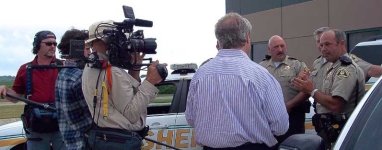
Oh! To my point. Here is a prod still of me using a C300 on two pilots about bank robbery shoot outs for Discovery. As you can see from my ungainly custom designed Frankenrig I would have been MUCH BETTER OFF with an ENG camera on my shoulder. And Eric, if I have a semi circle of four cops giving an impromptu stand up interview and may leave at the next alert, I have to be handheld. I may be 100 yards from my sticks, I don't know who will speak next, etc. Conclusion: Unless one specializes in spots or narrative handheld skills are very, very important and I'd much rather be holding the camera than Zacuto handles!
Attachments
Last edited:
Liam Hall
Veteran
Ned, there's a difference between capturing and crafting. And, in this day and age, there are many documentaries, feature length ones too, that utilise techniques normally found in features or commercials, rather than the news style of capture that you seem to favour. Each has its place. They are choices to be embraced. Don't be so dogmatic.
Liam Hall
Veteran
I don't see it has anything to do with money. It's an approach to photography, and having a flexible mentality, with a willingness to go the extra distance to get a crafted, composed and considered image. Some guys I know like to turn up, put the camera on their shoulder, whack the aperture on f/11 and get it in the can. They scoff at doing 'photography'. That's fine, but it's not how I roll.
I think this is one of the most valuable threads on DVXUser right now, and I credit Ned for having some of the most clear and useful insights to this whole game. You rock, Ned. I hope you don't retire next year, but if you do, you deserve it.
Like many others on here, I didn't come from the ENG era. Rather, I jumped into the industry during the birth of DSLR video. A few years and hundreds of short doc-style videos later, I'm super proud of the work I and my Video Dads partner-in-crime do (and last week we won a couple Emmys for it . . . sorry, had to humble brag, it still feels good). But this kind of work is far from the kind of shooting Ned and others are talking about, namely reality or long-form documentary. The experience and wisdom it takes to shoot those kinds of productions is something you (or at least I) can't acquire, without actually doing it time and time again.
My partner and I produce, shoot, and edit all our videos, and for a 2-6 minute video, we can hustle and shoot everything in 4-5 hours. That's a couple C100s or a C300II on a monopod for bread and butter shots, several long 30-40 minute well-lit interviews, plus the beauty shots with gimbals, sliders, drones, slow-mo, or other sweet gear of the moment. And with multiple locations or "scenes," we can guarantee a beautiful and touching video every time, no matter the subject or theme. It's because we're shooting for the edit we already have in mind, even with the unknowns of "doc-style" shooting.
But when you're following around a subject for reality, a TV program, or a documentary that's "showing" versus "telling" - or, relying on capturing the story in action rather than creating it with highly edited interviews - it's an entirely different beast. The couple times I worked on a reality show in Alaska, we had to roll continuously in case there was good conversation in the audio. So I had to frame a face and record for what felt like eternity (compared to 5-10 second shots and then moving on). And then when suddenly the subject started to move, I had to pick up my monopod and run ahead, get the subject walking towards me, then away, and then the cat and mouse game over and over again. Tons of sloppy shots there. And then if I happened to have a 70-200mm on when the subject began to move, I would hustle to change lens and invariably lose the shot.
During those shoots I wished I was comfortable with a ENG-style camera on a shoulder, because that setup and previous experience would have helped me capture all the pertinent action - which would have been highly preferable to a ton of beautiful large-sensor shots of non-action B-roll, along with mostly unusable shots during the times that mattered the most. I wish I had the doc skills and experience that Ned is talking about, but that's a different skillset and I bow down to the guys who can do that, day in, day out.
I also agree with Ned in that the shooters-for-hire who want to make a living shooting on others' productions, the only camera that matters is the one the producer wants you to have, whether they know anything about that camera or not. Personally I'm way into the Canon C-series cameras and really don't like the Sony FS7 or other shoulder-rig setups, but if I was hoping to get hired on as an owner/operator on a weekly basis, I get that I would have to use what the industry demands. But since my clients like the look of my videos and they have no idea what I shoot with, I'll keep doing my thing, shooting with the cameras that I enjoy using and allow me to focus on shooting people's stories in 4-5 hours, on a monopod and gimbal and tiny sliders and tripods, and hope that some day I get a chance to unlearn it all and shoot a documentary like Hoop Dreams. On a shoulder rig with a solid lens, with whatever camera the director or producer asks me to use.
Cheers,
Slavik
videodads.com
morgan_moore
Major Contributor
I don't see it has anything to do with money. It's an approach to photography, and having a flexible mentality, with a willingness to go the extra distance to get a crafted, composed and considered image. Some guys I know like to turn up, put the camera on their shoulder, whack the aperture on f/11 and get it in the can. They scoff at doing 'photography'. That's fine, but it's not how I roll.
I think it is horses for courses. I like crafted cinematography.. at the weekend I was out with the Army.. the pace was so fast that I hardly had time to change lenses (already having stripped back to 28-85 and 50-300).
Oddly my huge focus was the capture of audio from screaming sergeant major to an emotional about sticking kids back together in Afghan. The dual sound levels from the FS7 were killer for this as the screamers tended to clip channel one.
Yes I did a few artso shots.. but most of the time I just need a camera that could grab stuff.
Here the time to change to S+Q, the lightness of the rig, the reach of the lens all become critical (not to mention the loss of Cache Record after disengagement of S+Q)
Story leads.. and so much story is audio.
I had a b-cam op on the Ronin and a shoulder gh4 too.. and still we struggled with the pace!
S
Liam Hall
Veteran
I think it is horses for courses. I like crafted cinematography.. at the weekend I was out with the Army.. the pace was so fast that I hardly had time to change lenses (already having stripped back to 28-85 and 50-300).
Yes, I agree, it's horses for courses, but shooting fast doesn't always mean abandoning craft skills. It can actually mean developing them so you can make better decisions quicker, so allowing you to capture more interesting shots than you would if you simply took a news style approach and stood there with a camera on your shoulder and a big zoom lens. The FS7 is a great camera for this as it's so light. And it's great for dynamic hand held - you don't need to just put it on your shoulder, you can cradle it in your arms, put it on the floor or on your knee. It's light, so you can run, change angles, zoom with your legs etc. I simply don't buy into this argument that people don't have enough time to get a shot. There's always a better shot. Always
BTW Sam, I've shot and directed loads of jobs for the military so I know what you've been through. It is tough, having a sound recordist makes a huge difference, allows you to focus on what you need to.
Last edited:

jamedia.uk
Well-known member
SONY RX10II with cage and Tascam ?
And that works underwater?

Jim Feeley
Veteran
And that works underwater?
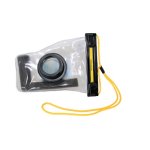
SONY RX10II with cage and Tascam in a plastic bag.
A bag from EWA-Marine, that is.
http://www.ewa-marine.com/
deltoidjohn
Veteran
I don't see it has anything to do with money. It's an approach to photography, and having a flexible mentality, with a willingness to go the extra distance to get a crafted, composed and considered image. Some guys I know like to turn up, put the camera on their shoulder, whack the aperture on f/11 and get it in the can. They scoff at doing 'photography'. That's fine, but it's not how I roll.
It goes both ways.
I know guys who like to turn up like they OWN the event, spend an hour putting their RED kit together, whack the aperture on f/1.8 and get a few beauty shots. They scoff at doing any sort of "live coverage", even for jobs which they've agreed to shoot which require that style. And by the end of the day they've abandoned their rig, matte box, and prime lenses other than wides because they're sick of carrying everything around. Usually they don't get hired again.
Yes, there is time for beauty shots on documentaries, even feature length ones. But that is not what you will spend the majority of your time doing - and that is if the producer even wants you to cover those shots, rather than assigning them to a 2nd unit (who specialises in having the "willingness to go the extra distance to get a crafted, composed and considered image", as you put it.)

Eric Coughlin
Veteran
I think someone in this topic said they could get the shots they need for a five minute doc (or feature; whatever you want to call it) over the course of one day. So, say five minutes of interviews and "crafted" b-roll shots that look nice and aren't all handheld. Which means what in relation to time to get the same on a feature length doc? Well, a 90 minute doc would at the rate of five minutes per day take 18 days to film. That doesn't sound like an unreasonable schedule to film a feature length doc. So, I'm with Liam on this one; I don't see why you can't film with more sophisticated stabilization gear on a reasonable budget and schedule.
Docs are mostly interviews and b-roll. You have plenty of cutaways to work with, which helps with not always needing a long clean shot. Sure, there are instances where you're filming conversations, for example, where you need a clean shot for minutes at a time and handheld is often best for that, but there's still got to be tons of opportunities for b-roll that just needs a 3-5 second shot. That's the stuff where handheld isn't necessary, and you can try to up the game in terms of stabilization.
Docs are mostly interviews and b-roll. You have plenty of cutaways to work with, which helps with not always needing a long clean shot. Sure, there are instances where you're filming conversations, for example, where you need a clean shot for minutes at a time and handheld is often best for that, but there's still got to be tons of opportunities for b-roll that just needs a 3-5 second shot. That's the stuff where handheld isn't necessary, and you can try to up the game in terms of stabilization.
morgan_moore
Major Contributor
Eric
I think you probably (without watching your work) need to do a lot of editing of the longer doco form. With longer form you will find need for longer bRoll clips.. partly to get audio handles and also because you need to cover interview cuts. Also fast cutting is cool with some sections but over an interview the pace can need to slow down to allow the viewer to both take in the words and images. Also you might need shots to roll text and statistics over. Long form eats shots!
Also sometimes you need to roll long to 'catch the bunny'.. an extreme example of this is waiting for an animal to pop out of its hole.. you may roll for hours looking at a hole but only the shot is going to 'make' is when the face pops out. With filming humans it is sort of the same.
We only want 5 seconds.. but which 5 seconds?
S