Camera Expert
Well-known member
I was going to write H.265 as well but decided not to thinking it would probably take too much processing power but it's true that you already have Samsung using it. Plus, you'd be able to halve the bit rate.

Follow along with the video below to see how to install our site as a web app on your home screen.
Note: This feature may not be available in some browsers.

Hey if Panasonic can cram all those cores into the tiny GH4 surely they can get enough processing power for h.265 in the DVX200!I was going to write H.265 as well but decided not to thinking it would probably take too much processing power but it's true that you already have Samsung using it. Plus, you'd be able to halve the bit rate.
What if Panasonic released a P2/microP2/expressP2 recorder with all (or most) of the AVC-Ultra codecs that attached to the GH4 (and eventual GH5) the same way the YAAAAAAAAAAAGH!!!!! does? Bonus points if it has XLR ports as well?
Okay, been thinking about this a bit... folks saying that Panasonic isn't listening to them, and "what were they thinking", followed by some of us actually coming around to say "hey, actually, maybe this isn't such a bad idea..."
So -- if you'll indulge me, can I please explore a lesson in history, and compare it to today?
And what does Panasonic do? They give us a fixed lens. And even though it may be a fine lens, it doesn't sell the DREAM of filmmaking. I'm not being cynical here, I'm being serious. A slow fixed lens, which limits your creative palette and which doesn't emulate the approach of higher-end cinematography feels like a step backwards. In all practicaiity, I'm sure it will be a great camera. But would it be the camera I shoot my weekend masterpiece with? No. Is it a camera I'd want to shoot a feature with? No.
I was going to write H.265 as well but decided not to thinking it would probably take too much processing power but it's true that you already have Samsung using it.
This is why I should be more careful over what I post at night since your brain might not be entirely awakeYour computer might encode H.265 more slowly than H.264, but is that not because it uses a general-purpose processor, like a Core i7, which also opens spreadsheets, surfs the internet, and several other things?
Cameras typically don't use a general-purpose processor to encode video though. They use an ASIC (Application-Specific Integrated Circuit), a chip whose sole purpose in life is to encode and decode H.265 video, for example. Since it need not also open and close spreadsheets, surf the internet, or play Crysis, it is simpler, faster, and cooler.
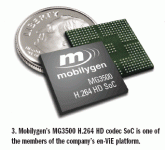
For example, here is a seven-year-old chip for H.264:
View attachment 100078
"Mobilygen’s H.264 HD codec system-on-a-chip (SoC), the MG3500 . . . can encode HD content, including 720p60, 1080p24, 1080p30, or 1080i60 material. It additionally may be used to encode two 720p30 sources or encode and decode 720p30 content simultaneously.
"The MG3500 supports H.264’s Baseline, Main, and High Profiles up to Level 4.1. . . . the MG3500 HD codec costs $30 in high volume."
--- Electronic Design, 2/28/2008
Technically you weren't wrong... it does take more processing power... in the form of a dedicated h.265 chip which isn't included in the GH4 but could be added to the DVX.This is why I should be more careful over what I post at night since your brain might not be entirely awake
I too got a DVX100 a few months after it's initial release, but I came from a different faction of video production. I didn't come from the world of Beta SP, I came from the world of Hi-8 and miniDV. You know, the Canon XL-1 and the Canon GH1. The Sony VX1000 and PD150. Many of us got our start that way.
And as an aspiring filmmaker, the goal was ALWAYS to figure out a way to make SD video look more like film. 24 frames per second was the Holy Grail at that time, and previous to the DVX100 there were all different post-production alchemies we tried to get the 24p look. Deinterlacing, frame-blending, Magic Bullet plug-ins, etc. Everyone had their own recipe.
Another goal to achieve a film look was a contrast curve that more resembled film. We didn't really talk about dynamic range much back then, but we knew that by crushing the blacks or adding contrast, the results looked more filmic.
Then the DVX100 hit, offering 24p and Cinelike Gamma to us mere mortals for the first time. We were one step closer to making our Hollywood masterpiece with a $3500 camera.
THAT'S what made the camera a hit to indie filmmakers. Not it's ergonomics or anything practical. It was the DREAM. The notion that the entry barrier to making a film was no longer the price of 35mm film stock and all that entailed. All I can say is that I made a lot of short films on the DVX100 as it really fueled the creative fires with its look.
The game changed again, of course, when DSLRs introduced shallow depth-of-field into the mix. And with that, an introduction into the culture of interchangeable lenses. Both of these aspects bringing us closer to the dream of making "real" movies.
The GH4 then brought us 4k, and here we are. Most of us invested in the MFT format, owning some Lumix glass and various other primes and zooms (I even have some Switar c-mount lenses). We're so, so close to attaining the dream of eclipsing film at a reasonable price.
And what does Panasonic do? They give us a fixed lens. And even though it may be a fine lens, it doesn't sell the DREAM of filmmaking. I'm not being cynical here, I'm being serious. A slow fixed lens, which limits your creative palette and which doesn't emulate the approach of higher-end cinematography feels like a step backwards. In all practicaiity, I'm sure it will be a great camera. But would it be the camera I shoot my weekend masterpiece with? No. Is it a camera I'd want to shoot a feature with? No.
And that's why people are disappointed with the DVX200. It isn't cool. It isn't sexy. It doesn't promise to take you to a higher place like the DVX100 did in 2004. In fact, it feels like it's taking you to a lower place. It's taking you back to the quaint old days when you thought fixed lenses were OK because you didn't have experience with anything else. We've all been using interchangeable lenses now for over 5 years and we've learned to love their individuality, and the creative variety we can get with them. The DVX200 just cuts this off.
And if we adopt the DVX200, what are we supposed to do with our lens collection? Somebody else above asked why Panasonic didn't just release 2 versions of the camera. A fixed and an interchangeable. I have to wonder the same thing. After all, Panasonic co-developed the MFT mount. Wouldn't they benefit from selling more Lumix lenses? From a marketing standpoint, the camera seems wrongheaded to me.
I also have a dozen lenses I could use with micro four thirds mount cameras but I also want to get the best possible image for each dollar our nonprofit invests. Please be open to the possibility that this camera might give that.

I too got a DVX100 a few months after it's initial release, but I came from a different faction of video production. I didn't come from the world of Beta SP, I came from the world of Hi-8 and miniDV. You know, the Canon XL-1 and the Canon GH1. The Sony VX1000 and PD150. Many of us got our start that way.
And as an aspiring filmmaker, the goal was ALWAYS to figure out a way to make SD video look more like film. 24 frames per second was the Holy Grail at that time, and previous to the DVX100 there were all different post-production alchemies we tried to get the 24p look. Deinterlacing, frame-blending, Magic Bullet plug-ins, etc. Everyone had their own recipe.
Another goal to achieve a film look was a contrast curve that more resembled film. We didn't really talk about dynamic range much back then, but we knew that by crushing the blacks or adding contrast, the results looked more filmic.
Then the DVX100 hit, offering 24p and Cinelike Gamma to us mere mortals for the first time. We were one step closer to making our Hollywood masterpiece with a $3500 camera.
THAT'S what made the camera a hit to indie filmmakers. Not it's ergonomics or anything practical. It was the DREAM. The notion that the entry barrier to making a film was no longer the price of 35mm film stock and all that entailed. All I can say is that I made a lot of short films on the DVX100 as it really fueled the creative fires with its look.
The game changed again, of course, when DSLRs introduced shallow depth-of-field into the mix. And with that, an introduction into the culture of interchangeable lenses. Both of these aspects bringing us closer to the dream of making "real" movies.
The GH4 then brought us 4k, and here we are. Most of us invested in the MFT format, owning some Lumix glass and various other primes and zooms (I even have some Switar c-mount lenses). We're so, so close to attaining the dream of eclipsing film at a reasonable price.
And what does Panasonic do? They give us a fixed lens. And even though it may be a fine lens, it doesn't sell the DREAM of filmmaking. I'm not being cynical here, I'm being serious. A slow fixed lens, which limits your creative palette and which doesn't emulate the approach of higher-end cinematography feels like a step backwards. In all practicaiity, I'm sure it will be a great camera. But would it be the camera I shoot my weekend masterpiece with? No. Is it a camera I'd want to shoot a feature with? No.
And that's why people are disappointed with the DVX200. It isn't cool. It isn't sexy. It doesn't promise to take you to a higher place like the DVX100 did in 2004. In fact, it feels like it's taking you to a lower place. It's taking you back to the quaint old days when you thought fixed lenses were OK because you didn't have experience with anything else. We've all been using interchangeable lenses now for over 5 years and we've learned to love their individuality, and the creative variety we can get with them. The DVX200 just cuts this off.
And if we adopt the DVX200, what are we supposed to do with our lens collection? Somebody else above asked why Panasonic didn't just release 2 versions of the camera. A fixed and an interchangeable. I have to wonder the same thing. After all, Panasonic co-developed the MFT mount. Wouldn't they benefit from selling more Lumix lenses? From a marketing standpoint, the camera seems wrongheaded to me.
But what about all the people who are NOW where you were when you bought the DVX100 -- i.e., in the world of consumer cameras, ready to make their first leaps into semi-professional gear? All the interchangeable lenses, etc., aren't going to do them much good.
You've grown and advanced and moved beyond the entry-level, which is great. But lots and lots of people are on the bottom rung, and frankly, that's a bigger market -- the more advanced you get, the fewer of you there are.
There needs to be a camera to serve that entry-level market.

...But would it be the camera I shoot my weekend masterpiece with? No. Is it a camera I'd want to shoot a feature with? No.
And that's why people are disappointed with the DVX200. It isn't cool. It isn't sexy. It doesn't promise to take you to a higher place like the DVX100 did in 2004. In fact, it feels like it's taking you to a lower place. It's taking you back to the quaint old days when you thought fixed lenses were OK because you didn't have experience with anything else. We've all been using interchangeable lenses now for over 5 years and we've learned to love their individuality, and the creative variety we can get with them. The DVX200 just cuts this off.
I agree. I was only trying to explain why people are expressing their disappointment. Also, I would say there's a flaw in your argument: the people who are NOW where I was when I bought the DVX100 are now using DSLRs, and are not very intereted in a fixed lens solution.
In addition to being a freelance cinematographer, I also teach film and video to college students. For student projects, the HPX170s and AC160s do NOT get checked out by the students at all. They hate how it looks. Instead, they check out the Canon 60D from the equipment room. Now, certainly that may have more to do with the small sensor and not the fixed lens, but the culture has changed. Kids just starting out in the video world don't have a fixed lens camera, nor do they particularly want one. At least none of the students I have taught for the last 5 years do. The all have a T4i or something.
When I showed my students the DVX200 specs, they all said "Meh."
Also, I don't consider $5000 entry-level. Not when you can buy a DSLR for $600. Again, a lot of this is about advertising. It's about selling a dream beyond what the actual product offers. My students are all salivating over the Blackmagic Ursa Mini, not the DVX200. If you look at the Ursa Mini website, it's all about using it for films. Commercials, features. The images show a crew and lights on a location. They're selling the dream of filmmaking. They're not selling it as an entry-level camera to do bread-and-butter work. We all have to do that work to pay the bills, but that's not how you get people excited about a camera.
Chances are someone with the DVX200 and an interest in "filmic" will try to find some of the old/new lens adapters. It seems like the least expensive/most reasonable solution.How about this question...
What if Panasonic took the DVX200 and removed the ENG lens and then added a robust Micro 4/3 lens mount ?
.
But, as the debate goes on, some people aren't in this 100%/0 (i.e., all event and corporate and nothing for themselves). Some may be 60/40 and some may be 40/60. So, while this may "check all the boxes" for some, it checks far fewer for others.I don't want a camera to take me to a higher place. I don't want it to be cool. I don't want it to be sexy. If I'm buying a $4,500-$5,000 camera, I don't want it to shoot my weekend masterpiece. I want it to make me money on Thursday morning...