AG-AC90 Review - in the Dominican Republic

Hi Mar-10

The balance there should be pretty good..Can you share the details of the matte box and rig ...(where you bought it?) With it sitting on your shoulder, how far away from your eye is the LCD ...Are you putting a loupe eyepiece on it. What I do like here is that with a shoulder mount you DO need somewhere for your left hand to go and with the lower handles the left handle with be used with one's left hand so you tend not to use the LCD as a contact point so it doesn't get damaged!!

Chris
 
Hi Chris,
this is a rig I use for different cameras.
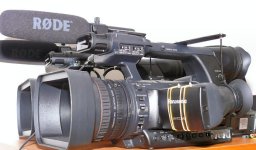
It's a RedRock Micro Matte box, grip, shoulder pad and V-battery plate.
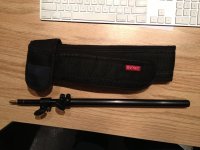
There's also a few parts from an old DV RIG Pro I got a few years ago: The quick release clamp and a spring loaded support arm that attaches on a belt.
It really helps to keep the camera steady when using one hand to hold the cam.
I love that thing so much that I keep fitting it to every rig I get.
DVTEC.jpg
The LCD stands about 12" from my eyes. I have a Small HD DP6 I usually use to shoot but I will try without it for a bit since the onboard LCD is quite good and the cam's depth of field is not too shallow :)
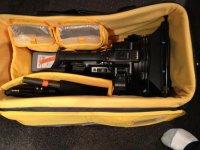
I was also able to fit the whole rig in a Kata bag so setup is really quick for corporate gigs.
Bag.jpg
Cheers

Martin
 
Hi Martin

Thanks for the pics!!

Yeah on my current HMC82's I have a DIY aluminium rail under the cameras and the exact same sprung rod that goes into a mini-ball head under the lens hood..makes life a lot easier at weddings and takes all the weight off the front end of the camera. I just added a brass sleeve to the tripod mount side of the ball head so the shaft of the rod snaps in and it gives the rig a lot more flexibility in all directions (I simply leave the ball loose) ..The bag is very neat too and the matte box certainly smartens up the AC-90 and makes it look even more professional plus if you need to add a ND filter on the beach you can now?

I think I would still like to have a loupe eyepiece on the LCD when working outdoors ..On my previous AC-130's I found the the loupe tended to twist the LCD and put a strain on the hinges so I made a bracket with a rod that took the weight off the LCD. I have already heard that the 90 LCD is a bit flimsy so maybe a similar sort of thing might be necessary on the handle and mounted higher than the LCD so the loupe can hang from it.

Chris
 

Attachments

  • evf1.jpg
    evf1.jpg
    63.8 KB · Views: 0
Great review Barry!

Great review Barry!

Hello everyone and especially Barry Green,

I just joined the forum, being a Panasonic aficionado but especially very interested in the Ag-AC90.

I would like to add my thoughts to the already excellent report on the AG-AC90 by Barry. I have been on the lookout for an HD camera to move from my Panasonic DVC30 (yes I know, I am very late, but there are valid reasons for my delay and it would take too long to explain them here), and budgetary and practical constraints mean that I have to look at small-ish cameras in the sub $5,000 range (and possibly much less than that). I can always hire a high-end camera when required, so what I need is something that I can use at short notice and covers many or most of the other things I intend to do, and the AC90 seems to fit my requirements. Its main competitor in my case is the Canon XF100, but I am also looking at other alternatives, like the Sony NX70 for instance, or even a used Pana 200a/151/171, but the problem with these is the huge storage (and media cost) of the P2/DVCPROHD format.

I appreciate and agree with pretty much everything that Barry has said about the AC90. Although I do not own the camera, I have studied quite a bit about it and also had a chance to play with it at a trade show recently, so here are my thoughts.

I think the advantages of this camcorder are many and mostly to do with how much you pay for it. I think at this price point this camera is simply unbeatable. The full-auto/full-manual, and everything in between, character of the AC-90, coupled with image controls and what seems an amazing stabiliser, make it a very versatile camera. The three rings are a joy to use for someone like me who started filming using reflex SLR cameras at a young age, I can establish a shot much quicker and more effectively with them. From what I can see the picture quality is very very good, although colours tend to be a little flat and de-saturated, but maybe that can be tweaked.

There are lots of very good things and I don't want to repeat what Barry has said, but there are other things that have not been mentioned and are worth considering, for instance:
- the camera has a Pre-Rec mode, allowing you to record the last three seconds before you actually hit the rec button. It's not huge but it does help when you're on stand-by waiting for something unrepeatable to happen.
- Time lapse is something I always wanted, and although it is already present on the HMC40 and other recent Panasonics, it's still better (in my view) than the XF100 for instance, which records a minimum of two frames (although with more interval options), resulting in choppy motion in some cases.
- being able to mix internal and external microphone inputs is a big plus, although it is a shame the same can't be done when recording in 5.1.
- face detection, combined with intelligent auto, helps to concentrate on content and mood with people rather than technical issues.
- the pixel-shifting performed in 4K/4:2:2 space is incredible at this price, with a clean 4:2:2 output on the HDMI, this means you can record to a broadcast codec on an external recorder without giving away your 'humble origins'.
- the guidelines and safey zone display on the LCD are an extremely useful tool, especially when you need to line up the camera to existing structures on the picture.
- the extra zoom rocker on the handle is useful.
- the camera is a very good combination of size and weight, it is incredibly light for its size. That helps a lot in many situations.
- I am very glad to hear that the hood can be removed!
- I am also glad to hear that the eyecup can be reversed for those like Barry and me who are left-eye dominant!

Now for the negative points that I have noticed.
The first and foremost is the viewfinder. It is really poor resolution, but especially it must be of the LCoS type, which in people like me produces a very disturbing, almost sickening effect of green and red streaks whenever I move or blink (something us humans tend to do very often), otherwise known as 'rainbow effect'. What do you think Barry? I don't think there is a solution to that other than using the LCD, but I actually prefer using a viewfinder becuse it helps to concentrate on the picture and it is invaluable in strong sunlight.

When panning the camera on a tripod, even slowly, the picture appears quite blurred and blocky. I tried increasing the shutter speed, using progressive and opening the iris further, but it just seems to lose a lot of detail when panning unless you move at snail-speed. Can someone comment on this please?

The LCD does not turn sideways. Not a major problem but sometimes (like on a tripod or on sunny days) it is useful to be able to turn the LCD slightly sideways. This is however a hurdle when I self-shoot interviews, since I seat in front of the interviewee and beside the camera, and I need to be able to check the display from time to time: with the LCD facing towards the back of the camera, it's going to be difficult.

There is no option to set the speed range of the main zoom rocker, nor to vary the speed at beginning and end; this is strange and I am going to miss it a lot, since it is a feature I have on the AVC30.

Another thing I am going to miss is infrared capability. For some of the things I would use this camera for, it would have been a very handy feature, at least to save me when I can't use video lights.

You can't have everything at this price, and this camera still packs an amazing lot of excellent features and quality for the price, much more than others. However some of the snags are kind of holding me back, although I know I'll buy it in the end...

Barry do you think this camera can be suitable for more things than just 'run-and-gun', events and basic corporate videos? I am thinking of self-shoot documentaries. Incidentally, is your book on the AC90 going to be included inside the camera box internationally or just the USA?

Cheers
 
Hello everyone and especially Barry Green,
......
I am thinking of self-shoot documentaries. Incidentally, is your book on the AC90 going to be included inside the camera box internationally or just the USA?
Cheers

Will those of use who have already bought the AC90 be able to get a copy of the book? (Electronically would do) Or will we have to go and buy it separately?
BTW I did not see any mention of the book being included in the box other than above (must be getting senile. :) .
 
What type of crop marks can appear on the LCD, I do a lot of 2:35:1 and it's nice to see a proper overlay as opposed to using tape. Furthermore, when using the HDMI-out with external recorders... is it also possible to record audio uncompressed?
 
ALSO...keep DRS OFF. 24 fps=Shutter 1/48 30fps=Shutter 1/60 60i=Shutter 1/120

There are detail settings for this:

1.) Turn off hybrid stabilization (optical stab ok)
2.) Choose 1080/50p
3.) Make sure skin detail is off.
4.) Tap the LCD screen, press shutter and then auto to allow the camera to choose optimal settings. Verify that gain is not added.
5.) Use the following settings, Auto focus on, detail +1, vertical detail -1, coring -3, gamma cine-d, matrix norm1, drs 1. If hybrid stabilization is off, and there is no gain added, and shutter is 1/50th or faster, and iris is f/6.4 or larger opening, the image should be very sharp with lots of detail while panning and no blurring or blockiness.

The variables that especially cause loss of detail while panning are hybrid stabilization, skin detail on, coring -2 or above, iris opening smaller than f/6.4, shutter slower than 1/50 sec, gain > 0 db. If the picture remains sharp following steps 1,2,3,4,5 above, then one by one you can change the variables to find which one is causing the blurring.


Will those of use who have already bought the AC90 be able to get a copy of the book? (Electronically would do) Or will we have to go and buy it separately?
BTW I did not see any mention of the book being included in the box other than above (must be getting senile. :) .


I do believe that Barry's contract is only with Panasonic Professional USA. I don't believe that Panasonic Professional EU has ever had a similar arrangement with him.

There is probably a good chance that the book will become available for sale on amazon.co.uk
 
There are detail settings for this:

1.) Turn off hybrid stabilization (optical stab ok)
2.) Choose 1080/50p
3.) Make sure skin detail is off.
4.) Tap the LCD screen, press shutter and then auto to allow the camera to choose optimal settings. Verify that gain is not added.
5.) Use the following settings, Auto focus on, detail +1, vertical detail -1, coring -3, gamma cine-d, matrix norm1, drs 1. If hybrid stabilization is off, and there is no gain added, and shutter is 1/50th or faster, and iris is f/6.4 or larger opening, the image should be very sharp with lots of detail while panning and no blurring or blockiness.

The variables that especially cause loss of detail while panning are hybrid stabilization, skin detail on, coring -2 or above, iris opening smaller than f/6.4, shutter slower than 1/50 sec, gain > 0 db. If the picture remains sharp following steps 1,2,3,4,5 above, then one by one you can change the variables to find which one is causing the blurring.
OK wonderful. Too many different setting and now I am seeing folk are not consistent in them. I think it was Lance Bruno who had 4 of the setting different from what you just posted (and there is zero explanation in the manual about them). He had vert detail at +2, Detail coring @ -3, Gamma on Low, and Matrix on Cine-Like. The adjustments on these setting is so fine that its hard for me unless I had a color chart to determine why they are set one way or another.
 
Yeah on my current HMC82's I have a DIY aluminium rail under the cameras and the exact same sprung rod that goes into a mini-ball head under the lens hood..makes life a lot easier at weddings and takes all the weight off the front end of the camera. I just added a brass sleeve to the tripod mount side of the ball head so the shaft of the rod snaps in and it gives the rig a lot more flexibility in all directions (I simply leave the ball loose) Chris
I am having a bit of trouble visualizing what you are describing.

I have a Vello 3.5" lens hood and so far its working well. The Vello is not a loupe though and probably weighs quite a bit less. I plan to use the LCD or possibly a small monitor in the field. I wear glasses so the viewfinder is not a good option. So far the LCD has been bright enough with just the Vello. I feel the LCD is as solid as others I've worked with, but I am not going to test it. I snapped a LCD off on a Sony EX1 once, so I am careful and yeah your support really adds to that safety.

I was giving a lot of thought into a rig. Right now my best rig option is a monopod. I don't want to be raising my right hand and I want to keep the camera close to my body. I want my hand as vertical as possible. That puts the camera quick release connection about 4" below my shoulder and its not above it like most of (if not nearly all) of the rigs I see. The OIS of this camera is fascinating, because it can almost be hand held for a static shot and the shake is so little. However, with the addition of a shotgun and a big LED light its front heavy. The monopod makes the imbalance a piece of cake, but then the only way to compare would be a side by side. I want to keep the camera very close to my body and my right hand vertical. The spider rig I have is pushing everything further away from my body and therefore greater stress. I need to do a test clip handheld, with the spider rig, and without the monopod to compare. The only thing so far I've seen but is way overpriced and I would have to camera much lower is the http://www.bhphotovideo.com/c/product/836927-REG/CameraRibbon_RIG_R_Rig_R_Shoulder_Rig.html
 
My setting was taken directly from Panasonic for my 130. It is called STYLIN.


OK wonderful. Too many different setting and now I am seeing folk are not consistent in them. I think it was Lance Bruno who had 4 of the setting different from what you just posted (and there is zero explanation in the manual about them). He had vert detail at +2, Detail coring @ -3, Gamma on Low, and Matrix on Cine-Like. The adjustments on these setting is so fine that its hard for me unless I had a color chart to determine why they are set one way or another.
 
ALSO...keep DRS OFF. 24 fps=Shutter 1/48 30fps=Shutter 1/60 60i=Shutter 1/120

Sorry Lou, I don't understand this post, is something missing? I also cannot track down Tom Roper's original message to further investigate what he's talking about.

By the way, I have read that you had a Canon Xf100 and swapped it for an AC90. That's precisely my dilemma about which camera to choose (chance it with the AC90 or play safe with the XF100 but spend much more overall), can I ask you what in your opinion are the main differences between the two cameras (and the codecs)? In your experience of having used both, can you say which is the better one for certain shoots and which is the worse?
Every camera has its pros & cons, that fit some people and some shoots better than others, can you give us your opinion?

Cheers
 
Custom Scene files vary, depending on the shooting situation. It can be frustrating to find the favorite setting. For instance, the lowlight settings offered on the Panasonic Pro site would not be proper for outdoors use.

In other words, different scene files may work at times, while others do not depending on lighting. Also, scene files are a matter of 'taste' as I prefer to adjust the gamma and black levels to crush the blacks. Panasonic had a PDF file that explains all the internal menu scene file functions.

My favorite is STYLIN. SPARKLE. LOWLIGHT.

Agree should not have bothered.
 
Sorry Lou, I don't understand this post, is something missing? I also cannot track down Tom Roper's original message to further investigate what he's talking about.

By the way, I have read that you had a Canon Xf100 and swapped it for an AC90. That's precisely my dilemma about which camera to choose (chance it with the AC90 or play safe with the XF100 but spend much more overall), can I ask you what in your opinion are the main differences between the two cameras (and the codecs)? In your experience of having used both, can you say which is the better one for certain shoots and which is the worse?
Every camera has its pros & cons, that fit some people and some shoots better than others, can you give us your opinion?

Cheers


I know the question is not directed at me, however I have been considering a XF105 for several months and now the AG-AC90 has also caught my eye.

There are many factors I like about both but I would like to point out some of the differences I have noticed while investigating the two.

Lets start with why I wanted the XF100, price is a factor, I used to do work for tv and I became very comfortable with camcorders big and small. Because a steady job at a station was hard for me to find I switched to freelance, and switched to HDSLR, I missed using cameras like the Sony EX3 BUT myself and clients were excited about the look.... However over time I have noticed there are times when I want a camcorder, built in XLR, waveforms, servo-zooms etc etc... its nice for certain projects.

XF100 pros (as seen by me & limited time trying the cam)

The XF codec at 4:2:2 50mbs seemed like a great feature because there is always the chance I might do some broadcast stuff again, however the last place I was, was fine with XD cam 4:2:0 @ 35mbs.... however they insisted on 3 chip cameras..... so really "broadcast acceptable" is a place by place factor. If broadcast acceptability is one of the reasons you are looking into the XF100 it might now be as safe a route as you thought. However having that 4:2:2 is a nice feature regardless!!!

The XF100 has a TON more recording formats than the AC90, this is great because sometimes people work in entirely 720p workflows, if you work for them its nice to match that (the AC90 does only 1080 & SD) It even has settings for 1440x1080 so if you work for other companies this could be a huge up for you! It also has timestamps if you do legal work.

The XF105 Offers HD-SDI/Genlock etc etc.... again this, much like the mentioned above, may not be all that important if you only shoot web videos (or weddings/events) where you can just constantly use your same personal workflow.

XF100 Cons (as observed by me)

There is no 1920x1080 60p for high-speed..... you are still having to shoot 720p and upscale :( Brutal in this day and age.

The noise is pretty noticeable, look at xf100-105 forums and that grain haunts every thread, the single sensor is tiny and just pours tone of noise at even 0db, sometimes compression hides it a bit but there are tons of places to download the native files and see for yourself. Now there are all kinds of picture settings available to help with this but overall, when I think of cameras in this price range I think of event people with lots of low light situations and this little sensor just needs light to look good, if you can light it I'm sure you will be happy... if you can't, watch out

It looks pretty soft, the lens is not an L and it kinda shows compared to something like an XF300 or EX3, the native sized sensor is nice so there is not real aliasing/moire problems but its just not a sharp looking camera. I hate using SLR's on Deep wides, so that's one of the reasons I want a camcorder kicking around... I want those nice wide and deep focus shots and when I tested this alongside the DSLR footage I was bummed to see only a marginal difference, now I heard that one of the problems is diffraction, and that the built in ND'S just can't keep you from stopping down into softness..... this is a really bummer because I feel like the camera is weak when its too bright and weak when its too dark, it seems like it has a really finite zone it likes to behave well in.

Flare, flare, flare, that's nasty and spotty, I see so many awful looking flares on XF100 content on the web and lots

Single ring, this gets seen a lot it in in-expensive cameras, its nice to have 3 rings but... its $3000


AG AC90 Pros (I have NOT tried the camera, just things I have noticed while trying to decided between the two like yourself)

The camera is CHEAP CHEAP CHEAP! A single project will pay for this camera so its hard to beat that $2000 price tag... the XF100 was known for its being inexpensive and great but the for the same price as the XF you could get the panasonic and an external recorder, or decent tripod, etc etc its a great value!

Some kind of zero noise magic, although the image does soften I am amazed high clean this camera looks with high gain!!!!

Some kind of stabilization magic, this thing really does have some great stabilization!

It has 3 rings and a sharp image!

AGAC90 Cons

AVCHD, the editing problem has become less of an ordeal over the years as people have updated their machines, but the codec itself is still not great for acquisition. I mainly do web stuff now (with slr) and considering its almost always going to web and only ever getting a light grade in post the AVC has served me well.... however it has been pretty rough when trying to grade more dramatically shot material (though not much better then the XDcam35) and the compression is noticeable the odd time but clients seldom notice.... the 4:2:0 isn't as nice to key as the Canon BUT adobe premiere has some amazing ability for chroma key! If you do a lot of green screen you may love the Canon but honestly you could buy a ninja for the price of the Canon to go alongside the panasonic and recorded out the AC90's HDMI out a 4:2:2.... still 8 bit though I believe

The 3 ringed lens barrel is as good as it sounds, according to Barry the gears are still digital (at least the zoom one) meaning that snap zooms are still a no-no

NO waveform, no waveform........ no waveform........... bummer (again a AC90 & zacuto monitor/ small DP is about the same price as the canon soooo you could have those waveforms)


Anyway that has been my long post, again I have only spent very little time with the Canon and none with the Panasonic... truthfully if I wasn't so interested in a new large chip camera (thinking fs700) I wouldn't buy either, I'd go a little more expensive (I have a thing for EX3) but truthfully I rarely need a camcorder as I don't do weddings/events/eng stuff at all really..... but for certain things (conferences, documentary) I would like to have a cheap one about... so I still cant decided but hopefully my research and findings help you in this hard process.

They are both "cheap" but $2000-$3000 is still a lot of food/ rent/ mortgage so take your time.

Also, this may not match the views and opinions of others but I'd like to avoid a slew of comments and counter arguments. Both cams are great, I want one as well, the more knowledge and discussion the more educated we are as buyers.

Cheers
 
Without going into all the technical "stuff" I lecture about at seminars as it relates to cameras. The XF-100 is grainy. Period. The AG AC-90 is NOT THAT GRAINY-albeit a pleasant softer in the higher Db range. DO NOT CONFUSE this DB range on the AC-90 or equate it to be equal to what we are accustomed to using GAIN settings-it is MUCH different with the PANNY vs. other cameras. In lower light, the GAIN setting increases but it appears to be a continuation of the IRIS setting after one is past the OPEN iris.

The AC-90 is SHARPER under proper lighting. The glass in the Canon is probably better but the AC-90 makes electronic corrections thus minimal noise. The form factor of both is easy to handle.

Both have scene files. The Panny is intuitive in that regard; unlike my XF-100 was. Stabilizer....much, much better than the XF-100. Picture quality: AC-90 resolves better for some magical reason in proper lighting-outdoors. The AC-90.... 17-21Mbs compared to 50Mps for the XF-100. My eyeballs can not tell a difference though it has much to do with broadcast specs. vs. personal viewing.

Pricewise? The XF-100 does not produce a $1500 dollar BETTER picture.

These are my personal thoughts and feel free to respectfully disagree. The more I use the AC-90, the better I like the picture quality. But, the user must be familiar with scene file settings and not rely on the default settings.


I know the question is not directed at me, however I have been considering a XF105 for several months and now the AG-AC90 has also caught my eye.

There are many factors I like about both but I would like to point out some of the differences I have noticed while investigating the two.

Lets start with why I wanted the XF100, price is a factor, I used to do work for tv and I became very comfortable with camcorders big and small. Because a steady job at a station was hard for me to find I switched to freelance, and switched to HDSLR, I missed using cameras like the Sony EX3 BUT myself and clients were excited about the look.... However over time I have noticed there are times when I want a camcorder, built in XLR, waveforms, servo-zooms etc etc... its nice for certain projects.

XF100 pros (as seen by me & limited time trying the cam)

The XF codec at 4:2:2 50mbs seemed like a great feature because there is always the chance I might do some broadcast stuff again, however the last place I was, was fine with XD cam 4:2:0 @ 35mbs.... however they insisted on 3 chip cameras..... so really "broadcast acceptable" is a place by place factor. If broadcast acceptability is one of the reasons you are looking into the XF100 it might now be as safe a route as you thought. However having that 4:2:2 is a nice feature regardless!!!

The XF100 has a TON more recording formats than the AC90, this is great because sometimes people work in entirely 720p workflows, if you work for them its nice to match that (the AC90 does only 1080 & SD) It even has settings for 1440x1080 so if you work for other companies this could be a huge up for you! It also has timestamps if you do legal work.

The XF105 Offers HD-SDI/Genlock etc etc.... again this, much like the mentioned above, may not be all that important if you only shoot web videos (or weddings/events) where you can just constantly use your same personal workflow.

XF100 Cons (as observed by me)

There is no 1920x1080 60p for high-speed..... you are still having to shoot 720p and upscale :( Brutal in this day and age.

The noise is pretty noticeable, look at xf100-105 forums and that grain haunts every thread, the single sensor is tiny and just pours tone of noise at even 0db, sometimes compression hides it a bit but there are tons of places to download the native files and see for yourself. Now there are all kinds of picture settings available to help with this but overall, when I think of cameras in this price range I think of event people with lots of low light situations and this little sensor just needs light to look good, if you can light it I'm sure you will be happy... if you can't, watch out

It looks pretty soft, the lens is not an L and it kinda shows compared to something like an XF300 or EX3, the native sized sensor is nice so there is not real aliasing/moire problems but its just not a sharp looking camera. I hate using SLR's on Deep wides, so that's one of the reasons I want a camcorder kicking around... I want those nice wide and deep focus shots and when I tested this alongside the DSLR footage I was bummed to see only a marginal difference, now I heard that one of the problems is diffraction, and that the built in ND'S just can't keep you from stopping down into softness..... this is a really bummer because I feel like the camera is weak when its too bright and weak when its too dark, it seems like it has a really finite zone it likes to behave well in.

Flare, flare, flare, that's nasty and spotty, I see so many awful looking flares on XF100 content on the web and lots

Single ring, this gets seen a lot it in in-expensive cameras, its nice to have 3 rings but... its $3000


AG AC90 Pros (I have NOT tried the camera, just things I have noticed while trying to decided between the two like yourself)

The camera is CHEAP CHEAP CHEAP! A single project will pay for this camera so its hard to beat that $2000 price tag... the XF100 was known for its being inexpensive and great but the for the same price as the XF you could get the panasonic and an external recorder, or decent tripod, etc etc its a great value!

Some kind of zero noise magic, although the image does soften I am amazed high clean this camera looks with high gain!!!!

Some kind of stabilization magic, this thing really does have some great stabilization!

It has 3 rings and a sharp image!

AGAC90 Cons

AVCHD, the editing problem has become less of an ordeal over the years as people have updated their machines, but the codec itself is still not great for acquisition. I mainly do web stuff now (with slr) and considering its almost always going to web and only ever getting a light grade in post the AVC has served me well.... however it has been pretty rough when trying to grade more dramatically shot material (though not much better then the XDcam35) and the compression is noticeable the odd time but clients seldom notice.... the 4:2:0 isn't as nice to key as the Canon BUT adobe premiere has some amazing ability for chroma key! If you do a lot of green screen you may love the Canon but honestly you could buy a ninja for the price of the Canon to go alongside the panasonic and recorded out the AC90's HDMI out a 4:2:2.... still 8 bit though I believe

The 3 ringed lens barrel is as good as it sounds, according to Barry the gears are still digital (at least the zoom one) meaning that snap zooms are still a no-no

NO waveform, no waveform........ no waveform........... bummer (again a AC90 & zacuto monitor/ small DP is about the same price as the canon soooo you could have those waveforms)


Anyway that has been my long post, again I have only spent very little time with the Canon and none with the Panasonic... truthfully if I wasn't so interested in a new large chip camera (thinking fs700) I wouldn't buy either, I'd go a little more expensive (I have a thing for EX3) but truthfully I rarely need a camcorder as I don't do weddings/events/eng stuff at all really..... but for certain things (conferences, documentary) I would like to have a cheap one about... so I still cant decided but hopefully my research and findings help you in this hard process.

They are both "cheap" but $2000-$3000 is still a lot of food/ rent/ mortgage so take your time.

Also, this may not match the views and opinions of others but I'd like to avoid a slew of comments and counter arguments. Both cams are great, I want one as well, the more knowledge and discussion the more educated we are as buyers.

Cheers
 
I know the question is not directed at me, however I have been considering a XF105 for several months and now the AG-AC90 has also caught my eye.

That's great Plazer, this is a forum and open participation is welcome, besides I'm happy to engage with anyone with the same dilemma as me.

I have not really used either of the cameras but I have studied them and their footage a lot, plus I had a chance to play with them at trade fairs so I could get a good feel about them.
Originally I was all set on the XF100 (not the 105, don't really care about SDI), but then doubts came to my mind about the codec (which, by a convoluted array of reasons, means that I have to completely overhaul my computer system with new software/hardware to deal with and edit the footage), the cost of media (CF cards are roughly twice the cost of SD cards), and the fact that I would have to refurbish my kit with Canon-compatible gear (extra batteries, remote controls, filters etc.), whereas I would not have any of those problems with the Panasonic AC90. So it wasn't just the cost of the camera but everything else going along with it. The size also plays a factor but in reality the XF100 is quite a small camera and there is a risk of not being taken seriously with it. And in the end, technically (by EBU standards) the XF100 is still not fully broadcast because of the single CMOS, so I thought 'why bother'? It is however a great little camera and does have features (like infrared) that I actually would need.

So I also thought about other alternatives like the Sony NX70 but again cost considerations would emerge similar to those of the XF100 (or more), and for unclear advantages.

Then up came the AC90 and everything changed.

Aside for cost concerns (in which the AC90 is a total winner with me and not just because of its mere price), I liked the size and the philosophy behind it: good professional features, not too fussy yet not cheesy, at a low price. People find it a prosumer camera but for me it's just a great value, low-end professional camera.

By the way I have also trained on the X1R and find it a fantastic camera, but too expensive and bulky for what I need it for.

The XF codec at 4:2:2 50mbs seemed like a great feature because there is always the chance I might do some broadcast stuff again... If broadcast acceptability is one of the reasons you are looking into the XF100 it might now be as safe a route as you thought.
As I said above, the XF100 isn't really up to scratch with European HD TV standards, although many think most people would not notice if you told them you shot on an XF300.

However having that 4:2:2 is a nice feature regardless!!!
As you know the AC90 outputs a clean 8-bit 4:2:2 via HDMI and that is great news for me, as you said I can always buy and attach an external recorder, several are on offer and I think we'll see an increase in their number and a decrease of their cost over time. Obviously I'd rather a 4:2:2 native codec and not have to stick extra bits onto the camera, but hey it's only a $2,000 camcorder! Anyway I wouldn't do much green-screen or grading so it's a bit of a non-issue for me.

The XF100 has a TON more recording formats than the AC90, this is great because sometimes people work in entirely 720p workflows...
Hardly anyone uses 720p in Europe, except for sports perhaps. Everything has gone from SD to absolute full HD (at least in the northern countries) and what a pain it is sometimes. Even some corporates demand top notch 1080p when it's just for the web, which is ridiculous really.

The noise is pretty noticeable...It looks pretty soft...its just not a sharp looking camera... I feel like the camera is weak when its too bright and weak when its too dark, it seems like it has a really finite zone it likes to behave well in...Flare, flare, flare.... Single ring...
Thanks for that, that's all useful to know, and I agree about the single ring - mostly about the benefit of having three. What does not convince me is some of the footage from the XF100, it looks 'plasticy', there again you can never be sure because it depends on how it was shot, when and often the web compression makes everything soft and flat. However the AC90's footage does seem to have more of a 'bite' and slightly more warmth and depth, but image controls will play their part no doubt.


AG AC90 Pros ... A single project will pay for this camera ...for the same price as the XF you could get the panasonic and an external recorder, or decent tripod, etc etc
Absolutely totally agree and it is also what made me think about the AC90. Obviously if I could spend $10,000 I would look at something else, but I think below $5,000 the AC90 must be seriously considered.

Some kind of zero noise magic... Some kind of stabilization magic
I have seen a walking shot on a street and was totally amazed, this is a feature I actually really need for what I do.

AVCHD, the editing problem has become less of an ordeal ... has served me well.... however it has been pretty rough ... BUT adobe premiere has some amazing ability for chroma key!
How is it going for you with AVCHD in Premiere and what version are you using, may I ask?

If you do a lot of green screen you may love the Canon but honestly you could buy a ninja for the price of the Canon to go alongside the panasonic and recorded out the AC90's HDMI out a 4:2:2.
I don't do and probably won't do any green screen, but should I need to... you've already given yourself the answer!

The 3 ringed lens barrel is as good as it sounds... snap zooms are still a no-no ....NO waveform, no waveform........ no waveform..
I actually like the feel of the three rings, it's a bit stiff and that suits me just fine, and they're easy to identify when not looking. I don't do snap zooms, and I don't really use waveforms... I didn't even use vectorscopes in the days of Betacam, I use my eyes, and zebras if in doubt!


They are both "cheap" but $2000-$3000 is still a lot of food/ rent/ mortgage so take your time.
Been taking my time since last year! To be honest the only way would be to hire them both for a few days and try out a full workflow, including editing & mastering, but who's got the time/money to do that?

Thanks for your comments, but have you also any other camera in mind in this price range?


Cheers!
 
Last edited:
The XF-100 is grainy. Period. The AG AC-90 is NOT THAT GRAINY

The AC-90 is SHARPER under proper lighting.

Both have scene files. The Panny is intuitive in that regard; unlike my XF-100 was. Stabilizer....much, much better than the XF-100. Picture quality: AC-90 resolves better for some magical reason in proper lighting-outdoors. The AC-90.... 17-21Mbs compared to 50Mps for the XF-100. My eyeballs can not tell a difference though it has much to do with broadcast specs. vs. personal viewing.

Pricewise? The XF-100 does not produce a $1500 dollar BETTER picture.

These are my personal thoughts and feel free to respectfully disagree. The more I use the AC-90, the better I like the picture quality. But, the user must be familiar with scene file settings and not rely on the default settings.

Cheers for that Lou, and I am surprised you have found the XF100 to be grainy, and its scene files not intuitive. Can you elaborate on that?

Good to know the AC90 is sharper in your experience. It is difficult to tell without actually having tried both. The magic in resolving detail could be the pixel-shifting done in 4K/4:2:2 space....

I totally agree with judging picture quality with eyes rather than on paper. This is a sore issue for me with broadcasters, their rigidity annoys me. I have started my career with film, nobody would judge picture quality on the stock you used in those days (except perhaps that they would not accept Super8), and this 'tick the box' approach is even more debatable when it comes to software encoding. I still don't understand why Mpeg-2 (a codec from the 90's) at 50mbps should be better than H264 at 24mbps, when the latter is 10 years younger, more advanced and more than twice as efficient, and chosen as a standard for HD Blu-ray. At the end of the day is how a picture will look, you can have c**p looking stuff shot at 100mbps, and beautiful imagery on a slim 24mbps AVCHD, why should one be 'broadcast' and not the other because of mere technical specs instead of final image quality? I have seen beautifully shot documentaries on HDV being turned down for TV because they were...HDV, yet on screen they almost looked like film. Dumb TV bureaucrats....

Interesting comment on the (lack of) picture quality difference for the extra $1,500. For me actually that is probably the most important. What about sound, how would you compare the two?

The input from someone like you is invaluable, and point taken about the scene file, I thought so. What about actual use, what differences did you experience on the field with both cameras?

Well, it seems we are establishing that the AC90 could be an alternative to the XF100, who would have thought that three months ago?

Cheers!
 
Last edited:
How is it going for you with AVCHD in Premiere and what version are you using, may I ask?


I use Production Premium CS5.5 ( no money to upgrade to 6) and I started with just CS5 when I first started doing AVCHD edits.

On my desktop machine it is ZERO problem, just today I had a 27min edit will all kinds of graphics and layers playing back no problem with Encore, Photoshop, word and firefox open as well. It can sometimes buckle down when stuff gets REALLY big but for the average "under 15 mins" web video, I have no problems what so ever....

On my laptop (MBP from late 2011.....2ghz i7 with 4 gigs of ram and the AMD Radeon HD 6490M, (and built in 3000)... it handles it fairly well, playback isn't as smooth but I have put together some pretty elaborate stuff (music videos) with just this machine and it works..... I wouldn't like putting together say a feature on it though... trans coding to something else makes it WAY better.... but you don't have to.
 
Last edited:
I use Production Premium CS5.5 ...On my desktop machine it is ZERO problem

What CPU/RAM/OS/Video card do you use and how would your system work with a 1-hour timeline? Can you output back to AVCHD without re-compressing? Have you ever transcoded to something else like Apple ProRes or others prior to ingest?
 
Back
Top