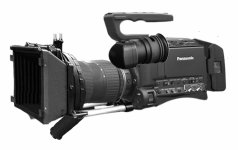
AF100-Successor in 2015!!!!

I side with OldCorpse on this one. I doubt 2015 will be the year of the $1,700 AF200, but a year will be.

I also doubt that the breakthrough will be from Panasonic, Sony, or Canon. Instead it will be another surprise from an outlier like BlackMagic or AJA. I believe it's time for Sound Devices to step into the camcorder fray. After a company with no upper tier to protect introduces a $1,700 AF200, the larger companies will have to follow suit.

I believe OldCorpse is just trying to spare Panasonic the embarrassment, encouraging them to be first to market instead of being forced to play catch-up. No one is asking Panasonic to sell cameras at a loss. We all expect them to sell the camera at normal profit margins --- like, cost plus 15-25%. We just disagree what the cost is. So naturally we disagree about what cost plus 15-25% is.

Bear in mind that Blackmagic was selling the Pocket for $500, and I highly doubt they were selling them at a loss. Also bear in mind that technology advances.
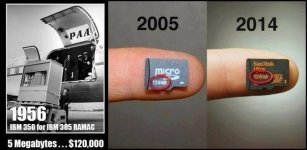
enhanced-buzz-23633-1418149073-23.jpg

I'm not sure why you would argue with OldCorpse, even if you doubt you'll see a camera at that price next year.

1. If he's right, and you argue with him, you'll just be embarrassed.

2. If he's wrong but his pining away, along with the support of many others, reaches the ears of Panasonic and influences them to sell the camera for $4,000 instead of $5,000, you win. It is not delusions of grandeur to think that companies are listening in here. Didn't a member tell us a few pages back that he was going to talk directly to Panasonic engineers? Haven't people from RED responded to posts on this forum? Aren't there resellers actively participating in these threads, and don't they also have a direct line to Panasonic and the other companies?

3. If he's wrong and all his pining away has no influence on the price of the AF200, it sells for $5,000 or whatever, what do you lose?
 
I'm not sure why you would argue with OldCorpse, even if you doubt you'll see a camera at that price next year.

You are correct Combat but the title of the thread is "AF-200 in 2015" Every comment I have made is regarding an AF-200 showing up at this year's NAB. It is just a little too convenient to switch the narrative to 'sometime in the future' as we all know how fast this stuff changes. Look at the KineRAW. It is close to the value level you mention and it exists. The AF-200 will probably not show up at NAB anyway but I am sticking with XLRs... :)
 
We are a small market. We are a niche market. You can't keep bringing up "economies of scale" when there is no scale for us.

... true, the consumer doesn't want XLR, but who can blame them... XLR is a clunky stupid solution to a legitimate problem - the answer is to come up with a good non-clunky solution... seriously, have you looked at an XLR connector - it's like something you'd design with the technology rooted in the last century... someone mentioned how XLR is a standard in many industries (like audio) - but doesn't mean it can't change..
.

Of course consumers don't want XLR, they don't understand it and they don't need it's advantages (long cable runs, ruggedness, flexibility, etc). XLR is inexpensive to build and maintain, it's easy to test, it's robust, and it's probably the most compatible, professional interconnect available. What exactly do you find clunky about it... is it just size? Would you embrace a new audio port if it were smaller, but more expensive and less compatible?

Shawn
 
I never said next year - as a matter of fact I said I think that's not enough time (certainly not NAB 2015). But I do think if they had started earlier - or at least right now - $1700 is possible sometime in the latter part of 2016. The relevance to AF200 in 2015 is that unless they start thinking about that process of going toward $1700 it will not be the success it needs to be to climb back on top and take it away from Sony. Panasonic needs a game changer to overcome Sony and the other competitors. Coming up with a "me too" camera is not going to be a game changer. I believe the original idea behind the AF100 was to have it a sort of crowd-sourced spec game changing camera. I still think it was a good idea, although imperfectly implemented. I wish they quickly followed up with an AF200 in a punch-punch fashion to hold off Sony (FS100). They should have had at the very least the speed of new cameras like the GH series - and preferably faster. Cheap cameras that are breakthroughs - a bit like what BM did, except their execution wasn't the best on account of being a small company. Basically I want to see sub $2000 AF cams coming out every 9-12 months, more or less like computers were doing. That way buyers can be frequent upgraders without fear of "waiting on what comes next" - because if you know upgrades are coming regularly like clockwork every 12 months, you just go ahead and buy since there is no sense in waiting (unless it's like a month before the next upgrade). That's a strategy that keeps people buying (look at how Apple got people on the treadmill of upgrades every year if not more often with iPhones).

Don't demand $5000 for a camera that then will sit unupgraded for 5 years. That's a loser strategy of the AF100. The tech will get old, people lose interest and investment in the brand. Look at folks who stuck to the GH series often upgrading - some even every single one GH1, to GH2, to GH3 to GH4 - and if not every single one, then maybe every other one. It's possible to do that for $1700, not for $5000 for large numbers of people. You accomplish two things - the tech is kept fresh and up to date, and the market grows and the volume explodes with yearly upgrade buying. Win-Win-Win.

That's what I'd like to see for the AF series - sub $2K cameras every single year like clockwork, newest tech, best available, always evolving.
 
Last edited:
Now that you're producing 100 widgets, you're going to need more people to make them, box them, and ship them.


Nope. It's called robots, and automation, and rationalization and process optimization. See what Amazon is doing in their warehouses - it's beyond belief, and they're poised to do more. In fact it can be the opposite - with more volume, you can now justify an investment in robotics and the kind of scale that brings costs down even below to what you were paying out for smaller volume in absolute terms!

You're also going to need increased machinery and facilities for production, as well as warehouse space.

The entire history of technological development is arguing against you. And that includes innovation in process - for example, the Japanese were able to handle *more* product with *less* warehouse space, by the innovation of JIT - Just In Time. And so on. The mistake you are making is a common one - of extrapolation. Extrapolation that does not account for dynamic systems is bound to lead to absurdities. One famous example - at the end of the 1890's an urban planner calculated that given the density and size of New York and how fast it is developing, in 20 years the sheer amount of horsesh|t from all those horse carriages would fill all the streets up to waist level and all movement would stop. Only he didn't count on the automobile - capable of moving more people with 0 horse waste (but other kinds of waste... and now electric cars... and tomorro?). Lesson - you can't do straight line extrapolations of dynamic systems. Innovation is inherently dynamic and changes all parameters unpredictably.

AF200 for $1700 FOR THE WIN!

OldCorpse, I live in the Seattle area. I used to drive by Amazon's headquarters every day. They now own pretty much the entire South Lake Union area of Seattle... and they are still expanding their property footprint by leaps and bounds. That is just their corporate staff, not warehouse staff. It has cost them a fortune, but they need breathing human beings to do a lot of their work. Amazon is setting up warehouses in more an more locations to handle inventory and speed up the process of getting customers what they want. And people need to still work in those warehouses... trust me, I've met quite a few of them. Those forklifts don't drive themselves yet.

This is also the land of Boeing, and they went to the JIT method for the new 787 Dreamliner. They promised it would streamline everything and save money. JIT has been an absolute nightmare for them in the production of the new 787. The second there is a single hiccup in parts delivery line, it creates a snowball effect and holds up everything. JIT makes sense if you can guarantee everything works perfectly 100% of the time. Plus, I was referring to finished products to deliver... you need some place to put them before you can deliver them. Once they roll off the production line, you need to stick them somewhere in order to get them on the truck or train, especially if that truck or train is late. The higher the volume, the more space to load more freight... not to mention room for office supplies, shrink wrap, boxes, etc.

And I also do a bunch of work on the Microsoft campus... it is, honest to goodness, bigger than my home town, complete with it's own bus service, taxi service, and parks and rec department. And it's getting bigger. No amount of efficiency will replace that the need for humans to manage all that.

[EDIT] Remember, we're not talking about the camera of 25 years from now, 15 years from now, or 5 years from now. We're talking about a camera that we're hoping will be announced at NAB in 5 months, and released in less than a year from now.
 
Last edited:
OldCorpse, I live in the Seattle area. I used to drive by Amazon's headquarters every day. They now own pretty much the entire South Lake Union area of Seattle... and they are still expanding their property footprint by leaps and bounds. That is just their corporate staff, not warehouse staff. It has cost them a fortune, but they need breathing human beings to do a lot of their work. Amazon is setting up warehouses in more an more locations to handle inventory and speed up the process of getting customers what they want. And people need to still work in those warehouses... trust me, I've met quite a few of them. Those forklifts don't drive themselves yet.

This is also the land of Boeing, and they went to the JIT method for the new 787 Dreamliner. They promised it would streamline everything and save money. JIT has been an absolute nightmare for them in the production of the new 787. The second there is a single hiccup in parts delivery line, it creates a snowball effect and holds up everything. JIT makes sense if you can guarantee everything works perfectly 100% of the time. Plus, I was referring to finished products to deliver... you need some place to put them before you can deliver them. Once they roll off the production line, you need to stick them somewhere in order to get them on the truck or train, especially if that truck or train is late. The higher the volume, the more space to load more freight... not to mention room for office supplies, shrink wrap, boxes, etc.

And I also do a bunch of work on the Microsoft campus... it is, honest to goodness, bigger than my home town, complete with it's own bus service, taxi service, and parks and rec department. And it's getting bigger. No amount of efficiency will replace that the need for humans to manage all that.

Agreed, 100%.

Mike I didn't know you were at The Empire, are you working at Microsoft Studios, the EBC or one of the micro-studios around campus?

Shawn
 
Mike - all that doesn't matter, because that investment is not a cost in an absolute sense, since it lowers the marginal cost of every product pushed - that's what productivity is all about. If you invest $1000, but that allows you to lower costs by $5000, you haven't lost money, you've made money. You cannot justify that $1000 investment if it doesn't increase your sales - but that's the whole point, that if sales increase to the point where it's worth putting that $1K in, it's a win for the bottom line. Your question shouldn't be - does Amazon have more warehouses, but does the cost of warehousing per dollar earned on products in the warehouse go down. If yes, then build more warehouses by all means! Think like this: one warehouse - profit $1 million; 2 warehouses - profit $5 million, 10 warehouses profit $200 million. Nobody is then going to be worried about the cost of building another warehouse, because the marginal cost will be nothing next to the payoff for every dollar you've put in - the more you put in, the more it comes back to you in triplicate.
 
Agreed, 100%.

Mike I didn't know you were at The Empire, are you working at Microsoft Studios, the EBC or one of the micro-studios around campus?

Shawn

One of the venders doing event recording around campus, plus a few projects on my own. Only work there a few times a month, though (so I should probably say 'some' work instead of 'a bunch' of work).
 
Exactly. I have no doubt capability will increase and price will decrease as it always does... but whatever Panasonic may or may not be introducing next year has already been researched and developed and has to fit within Panasonic's current lineup. It's not that we'd hate a FS7-featured camera at under $2K, it's just that it's simply not going to happen next year.

The GH4 was indeed somewhat of a coup with its capabilities and price in the DSLR video sector... but not all that far outside of previous GH cameras.

A possible "AF200's" competitors in entry-level large sensor self-contained flexible cinema cameras, the current 'state of the art' within that middle price range, are the FS700, FS7, C100 mk2, AJA CION, BMD URSA, and the JVC LS300. None of them are less than $4000, two of them don't even manage internal 4K (one having no 4K at all). Even the crappy Sony VG30 still rings up at $2500. I really don't want Panasonic to make the compromises currently necessary to undercut all of those. And before the chorus of 4K pooh-poohing commences, it's really surprised me how much practical use I've made of 4K with the GH4... to the point where it's less of an 'oh, that's nice' and instead an 'I must always have this.'

I'd love to be proven otherwise and a $1700 camera debut that meets all my freelance broadcast video shooter needs for the next three years... but wish in one hand and spit in the other and see which gets filled first....
 
One of the venders doing event recording around campus, plus a few projects on my own. Only work there a few times a month, though (so I should probably say 'some' work instead of 'a bunch' of work).

Ah, gotcha'. I may have run into you once or twice at the EBC or something. It's good to see another video person (on these forums) who has experienced the Disney-like wonderland that is Microsoft campus. Sometimes people just don't believe you when you tell them what it's like. :-)

Shawn
 
Think like this: one warehouse - profit $1 million; 2 warehouses - profit $5 million, 10 warehouses profit $200 million. Nobody is then going to be worried about the cost of building another warehouse, because the marginal cost will be nothing next to the payoff for every dollar you've put in - the more you put in, the more it comes back to you in triplicate.

Except it's more like 1 warehouse - $1 million, 2 warehouses - $2 million. At some point, you simply run out of space, and I'm pretty sure Amazon has perfected the efficiency concept a while ago. At this point, they're dealing with volume, not efficiency. Building more warehouses doesn't increase demand, it's the opposite. They have such skyrocketing demand that if they don't build more warehouses, they'll go out of business from not being able to keep up with the demand.

By the way, at one point I was toying with manufacturing a modular accessory mount and selling it through Amazon. There is an option, which I'm sure is quite popular, where you send all your widgets to Amazon, and they handle all the warehousing and shipping. It's great for small, mom & pop manufacturers... however that can never be done in a JIT method, as it defeats the purpose... and there are a LOT of little manufacturers and retailers doing it like that on Amazon. It's highly inefficient from that standpoint, but in order to manufacture enough widgets to be profitable, you have to do it this way (I have friends who manufacture knives this way). For a lot of low volume manufacturers, they have to manufacture in big batches sporadically, then let them sit in a warehouse until they all sell... doing it JIT would be too low a volume to justify costs. Which means they have a lot of widgets sitting in an Amazon warehouse for a few months. Multiply that by a lot of small manufacturers, and you suddenly need a whole lot of warehouse space.

Granted, this is all starting to get WAY off topic
 
Ah, gotcha'. I may have run into you once or twice at the EBC or something. It's good to see another video person (on these forums) who has experienced the Disney-like wonderland that is Microsoft campus. Sometimes people just don't believe you when you tell them what it's like. :-)

Shawn

A friend from my home town just got a job at Bungie, and was house hunting a few months ago before he moved down here. His jaw dropped when I drove him through the campus on the way from Bellevue to Kirkland :)
 
There are a few things that you're missing out on :)

Now that you're producing 100 widgets, you're going to need more people to make them, box them, and ship them.
Well, I did make the assumption that "We'll assume the cost per unit includes not just cost of manufacture, but advertising, distribution etc." - and that was intended to take into account moving premises and employing staff when the production got scaled up to 100...! :) And I was trying to keep the hypothetical case as simple as possible, but in practice, yes, you're right.
OldCorpse said:
There is concrete tech available. There are economic realities. Unfortunately, unless we have access to a huge amount of very specific information, a lot of this is going to be speculation. I try to be as informed as I can be, but even I have to make guesses and estimates. All of us do. Some speculate $5K and some $1.7. It's all - I repeat - all speculation. The only differentiation is in trying to see the broader picture, which is why my figure of $1700 is grounded on the best evidence available (and even so, it's still speculation!)
But there is speculation and speculation, and I query what "best evidence" you are basing this $1700 figure on? Because whilst all this may indeed be "all speculation" as far as Panasonic may be concerned, I think a lot of conclusions can be drawn from the FS7. It's a very recent launch, and it's reasonable to say spec wise it's pretty close to what may be hoped for of this "AF200", yes?

And Sony have chosen around $8,000 as the launch price. If you accept that (at least in theory) it's possible to chart for maximum profit, then why do you think they chose that figure? Random? Drawn out of a hat? A bit less than other models? Or just maybe their calculations have shown that's what they estimate to be the sweet spot for profit? Maybe their calculations showed that $1,700 was just too far away from the sweet spot, or even that it could never make a profit at all - maybe the minimum cost per unit of manufacturing (and including packaging, transportation, marketing etc) itself is more than that?

This is not to say that such a thing could NEVER sell for such, I'm not saying we'll NEVER see a $1,700 "AF 200". But (as others have mentioned) this thread is talking about the near future, or 2015 at least. Technology certainly has been moving quickly - but there are limits. And as regards the comparisons with memory, then I'd say two things. Firstly, then after allowing for inflation, what really has changed dramatically has been the price per GB - or price per KB if you go back far enough! :) But what has stayed far more constant has been the sort of price you pay for the best performing card - what's changed has been the performance of such: faster and larger. Secondly, that it's in semiconductors that it's been relatively easy to make these advances. In other areas it's been much less dramatic. Lenses, maybe? Batteries? Even switches and connectors? And there's a lot more to any camera than just the electronics.

And is this not maybe happening here with cameras in this class? Advancing tech is not so much giving us vastly cheaper cameras, but is advancing tech by leaps and bounds? So this class of camera remaining somewhere around $5-10K, but getting vastly better and more sophisticated every couple of years? I can remember when the Z1 first came out - wow! (At least at the time.....!) And frankly I don't expect this sort of price slashing marketing coming from the Panasonic pro division anyway, not going by how they're doing with the new Varicam. Nothing wrong with the camera as such, but with that they seem to have gone exactly the opposite way to OldCorpse is advocating - priced way ABOVE what most people expect. That is not to exclude the Panasonic consumer division doing something - and I really hope they do - but as said before, I would strongly expect that to be more along modular lines such as the GH4 and YAGH.

At the end of the day, does it really matter whether or not an AF200 ever sees the light of day or not, if a user is able to buy a tool that does the job from someone else? This may be an interesting academic discussion, but in the real world I just get the impression that people who want this sort of camera are simply buying C300s and now FS7s and getting on with filming.
 
Well, no, efficiency has been increasing at Amazon warehouses - famously so. Just recently they expanded the use of robots. Note, again, and again, productivity and efficiency at those warehouses is growing. But I agree we are getting far into the weeds here, so I'll drop that tangent. My point is simply that the camera producers are dinosaurs and especially the pro division at Panasonic. Really, the market for pro cameras is changing super rapidly and one thing is crystal clear - the trend is to dropping prices. Now, either Panasonic can try to get in front of that trend, or trail behind, and trailing behind means they'll be left behind and left for dead. Panasonic must actually start making money to survive. They won't do it by being a "me too" company. This is a call for action - get in front of the trend, lead, don't trail behind. It's do or die. Therefore:

AF200 for $1700 FOR THE WIN!
 
For a lot of low volume manufacturers, they have to manufacture in big batches sporadically, then let them sit in a warehouse until they all sell... doing it JIT would be too low a volume to justify costs. Which means they have a lot of widgets sitting in an Amazon warehouse for a few months.
At the risk of off-topicness continuing, then whilst JIT does have possibilities for cost reductions, it also has possibilities for causing huge problems. You're actually trading redundancy for efficiency, simple as that. Fantastic when things go well - but means a small problem can cause a disaster when they don't! (I remember a friend who worked at a firm who had just embraced it whole-heartedly referring to it as "Just too late". Draw your own conclusions.)

I have heard that cameras tend to get manufactured that way as well (big batch at a time) and I'm sure I heard a story that in at least one case, all the units of a particular model would be manufactured in a single batch, then the line ripped up and turned over to something else. So when the last one got sold, that was it - no more would be made. So a lot of responsibility to get the forecast right. Make too few, and you're stuck for something to sell if the next models not ready. Make too many and get stuck with a lot of unsold stock which simply gets more and more obsolescent.

Thank goodness my widget manufacturing plant doesn't have that problem..... :)
 
Harddrive nails it, I think. Especially with the example of the FS7. If Sony could have made more money at $1,700, or $5,000, or $11,673.93, they would have. They didn't feel they could.

I remember when the AF100 was announced, and folks were wondering why it wasn't P2, or there wasn't a P2 version. Jan said that it would have added $1,000 to the cost of the camera, and they didn't feel that they could sell enough of them at that price to justify including that feature.

Also, OldCorpose, I have to take issue with something you may or may not be saying. I get the impression from several of your posts about people "tolerating" a $5,000 camera with this feature set instead of demanding something cheaper is somehow inherently bad. I guess my question is, why is it a bad thing to be okay with a camera that costs $5k? Yes, I would love a $1,700 camera, but in no way do I feel like I'm getting screwed over or anything. $5,000 for something that is going to be the tool I use as my primary source of income for several years does not seem unreasonable to me. Even if it were possible for them to manufacture a profitable $1,700 AF200 that they still chose to sell for $5,000, that still seams like a pretty good investment considering the amount of money I'm going to make with it in the next 3-5 years. Maybe I'm reading your comments wrong (and apologies if I am), but the price difference spread out over several years, considering how stupid cheap $5k is for the image we would be getting compared to a decade ago, is not unreasonable at all.
 
By profession I am a software engineer. Most of my 35 year career I've worked for manufacturing companies making a wide variety of different products. Some high tech....some low tech and a lot in between. But the equations that concern themselves with the economies of scale fundamentally never seems to change(for good reason). It will always be a good idea to spread your fixed costs over the greatest number of units that's possible for your situation. It's a simple concept....so where does all the difficulty lie?

In just two primary areas:

Understanding the market your selling into: if there is a complicated part .... This is it. But still it's not rocket science.
If you understand elasticity of demand, market drivers for product ... so you know to increase your products demand Etc. you'rehalf way their...
Keeping up with the rate of change in the market place is becoming or is the hardest part to the puzzle. So you may know what will increase your products demand.....but you may not be able to do anything to help yourself.

Tricks of the trade: this is more of a grab bag of things used to keep fixed costs down so widgets can be produced more cheaply. They include things like just in time inventory and I'm guessing one of OldCorpse's favorites .....bringing those ugly and very difficult 'variable costs' under control by converting them to fixed costs! Neat trick....how are they doing this? OldCorpse mentioned one of the most common was it's being done today.....automation!

It's all about control.....and the more ones knowledge about what there making and how to make it and to keep making it more useful....the more control they have over their future success and the happiness of ther end users....

Ps. I almost forgot a little tangential element to all of this .... It's a little...big thing called customer service!!!!

Cheers..

Tye
 
At the risk of off-topicness continuing, then whilst JIT does have possibilities for cost reductions, it also has possibilities for causing huge problems. You're actually trading redundancy for efficiency, simple as that. Fantastic when things go well - but means a small problem can cause a disaster when they don't! (I remember a friend who worked at a firm who had just embraced it whole-heartedly referring to it as "Just too late"...
FWIW, the Germans used this system prior to and during WWII. It was called Taktzeit (a term stolen from jazz, roughly equal to a drummer keeping time) and it pretty much cost them the war. (I am big WWII history buff)

... And Sony have chosen around $8,000 as the launch price. If you accept that (at least in theory) it's possible to chart for maximum profit, then why do you think they chose that figure? Random? Drawn out of a hat? A bit less than other models? Or just maybe their calculations have shown that's what they estimate to be the sweet spot for profit? Maybe their calculations showed that $1,700 was just too far away from the sweet spot, or even that it could never make a profit at all - maybe the minimum cost per unit of manufacturing (and including packaging, transportation, marketing etc) itself is more than that?
.
All their marketing expertise aside, Panasonic actually whiffed on the GH-4 sales estimates. They had to stop a different production line in order to ramp up the GH-4 manufacturing, as the demand was exceeding the expectations - and thus the production - by a ~ 2-1 margin.

Now, time for a quick homage to devil's advocacy - when GH-3 premiered in the fall of 2012, it retailed for $1.700. It's selling now for $700. A similar price decline of GH-4 should bring it down to ~ $1,200 by next fall. (it's currently on/for sale at $1,500).

If so, what should Panasonic do in the $1,700 range for the fall of 2015? I would bet on GH-5/GH4 MK II, with more processing power, higher bit rate internal AVC-Ultra, 4K HDMI out to Shogun and CD Q7+.

And, if this is what that new camera will be, then who will need a $1,700 AF-200? There's not much sense to compete against itself. A $5,000 model, on the other hand, might move a lot of shooters toward the brand. And there, harddrive may have a point. By the fall of 2015, Panasonic will need an s35 sensor to sell a $5,000 camera.
 
Last edited:
ag-af200.jpg

This is a quickly Photoshoped pic I posted here in November, 2010 - four years ago - in a thread similar to this one. At the time I thought proprietary P2, because I had a bunch then, but now with cards like the SanDisk Extreme Pro, that seems more plausible (Panasonic Broadcast would not agree I'm sure). I said I'd be willing to pay 8 grand for a camera like this with an improved sensor. Never happened, and frankly I'm pretty sure it never will.
 
Back
Top