A7s sample footage

I've shot a TON of S-Log 2 on the FS700, both internal 420 8-bit and on the 7Q in 10-bit 422 and RAW as well.

i can say with 100% certainty that S-Log 2 requires a 10-bit codec to really work. 8-bit just does not cut it with S-Log 2 as the grading is very limited and artifacting appears quickly.

You check out my Vimeo page as it has a fair bit of S-Log shot in internal AVCHD and to the much better 10-bit and RAW codecs. 8-Bit S-Log is very, very frustrating as it looks amazing sometimes, but quickly self destructs in other situations. 10-bit is much more versatile and is the minimum bit depth required for such a flat profile.

www.vimeo.com/builtbyugene

or more S-Log stuff on my URL: www.builtbyUgene.com

There's a horrible Disney Junior spot I DP'd that was all RAW S-Log in the "Movies" section. Not my fault as Disney wanted it to look very homemade, as if someone's Mom shot it. But you can see how it deals with skin tones of all ethnicities, which I really like from S-Log 2.

Also, at the very end of my live action reel are some shots from a soon to be released shoe spot that really shows how awesome 10-bit S-Log is. It starts with the shots of the snail on he shoe.

If there's a way that Magic Lantern can hack the A7s and give it a higher bit depth than 8-bit, the A7s S-Log will be golden. Otherwise, it's a constant struggle.
 
Last edited:
Slog2--->Impulz Kodak 5213 FC
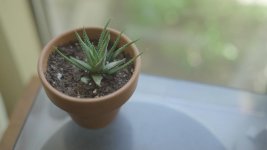
original plant original_1.43.4.jpg
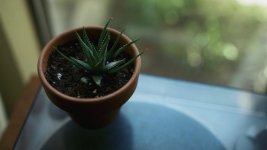
gradedplant_1.43.2.jpg

Lots of wiggle room....
 
Last edited:
Looking great cyork!!
The Impulz Luts seem to work really nicely with that Slog2, that's reassuring ;) Did you encounter any major trouble while grading?
 
Last edited:
Samuel, the downsampling could well be false noise, i think you are probably right. It's usuall to actually soften 4K before downsampling otherwise, depending on the scaling algorithm, you can introduce high frequency aliasing. Also depending on approach you can also introduce the overshoot and actually create the black edges in post!

Kholi, i have more time over the next few days to look in more detail at everything. I have to say that image you posted of the girl on the bed has some of the nicest tonality i've seen from this camera - or was that from a BMC?

The purple blobs are a strange artefact. They're present on the HDMI output but just as purple noise in a 422 pattern, the odd looking blobs being created i think are an XAVC side effect of dealing with this noise.
I've not seen horrible banding yet but i've not got anything to look at here.

Using Slog2 and a different colour profile? Well there might be dragons there, any LUT which is not doing just a tone mapping will not work with a different source gamut. One of the biggest workflow headaches with Slog and the 700 in general is that the reds are well out of sRGB gamut, so if you post process in sRGB (even Rec709) the reds get clipped and scaled in awful ways. If you have the choice to debayer/work in a larger colourspace then all is well. BestRGB is an excellent colourspace to work in (or BruceRGB). I need to look at the Slog2 out of this camera by comparison.

I shot with the A7s as a B cam though. Managed to get some shots that would have been impossible with anything larger. Figure a 12mm lens, helicoid M mount adapter so focus is 3cm in front and a full frame. So 12mm shallow DOF. An odd and awesome look.

I'm warming to the stills side as well, which is my primary use. Just takes some time to become one with the camera.

Exposing is a challenge. 70% zebra i think equates to around 90% reflectance in Slog2. So you could use paper white to expose rather than mid grey. But if you use the spot meter you can use mid grey and then watch the exposure compensation measurement chance as you approach 'correct' exposure.


cheers
Paul
 
^ 90% white is 2.2 stops brighter than 18% grey and should land on IRE 59% according to Sony (here). If you use zebras to keep a white card just below 70%, you are overexposing by less than one stop. Not a bad idea if you don't have a light meter at hand...
 
Last edited:
^ 90% white is 2.2 stops brighter than 18% grey and should land on IRE 59% according to Sony (here). If you use 70% zebras to keep a white card just below clipping, you are overexposing by less than one stop. Not a bad idea if you don't have a light meter at hand...

Allowing for some over exposure to get the shadows looking nice, it's quick and dirty but might work in most cases.

I looked at James Millers 4K downsample, nothing jumps out at me in terms of false detail, which sections are you seeing something?

cheers
Paul
 
I see some aliasing in roofs, and a lot of it in the 100% crops that eoshd posted here (the first one with the chair is particularly telling).

Even if the downsides are minor, I just don't need the extra sharpness: the stock a7s 1080p is plenty sharp for me, 95% of the time. YMMV.
 
I see some aliasing in roofs, and a lot of it in the 100% crops that eoshd posted here (the first one with the chair is particularly telling).

Even if the downsides are minor, I just don't need the extra sharpness: the stock a7s 1080p is plenty sharp for me, 95% of the time. YMMV.

Okay, i didn't see the eoshd write up.

Interesting though, i think whatever scaling algorithm in that box is rubbish. I don't think it's false detail though, just a crappy scale. Nice lateral thinking and i like the soldering iron in the kitchen, i wonder what other 4K scalers are out there?

cheers
Paul
 
The charts show the A7s in 1080p 24p mode resolves more detail than the MK3 raw, and the MK3 raw is right up there with the C series Canons so I'm not really fussed about 4k, I'd have to start using diffusion with actors with anything more resolute. 4k would be a good option on big wide landscape shots though. I'd like to see if the 4k to 10bit downscale is any good.
 
Samuel, the downsampling could well be false noise, i think you are probably right. It's usuall to actually soften 4K before downsampling otherwise, depending on the scaling algorithm, you can introduce high frequency aliasing. Also depending on approach you can also introduce the overshoot and actually create the black edges in post!

Kholi, i have more time over the next few days to look in more detail at everything. I have to say that image you posted of the girl on the bed has some of the nicest tonality i've seen from this camera - or was that from a BMC?

The purple blobs are a strange artefact. They're present on the HDMI output but just as purple noise in a 422 pattern, the odd looking blobs being created i think are an XAVC side effect of dealing with this noise.
I've not seen horrible banding yet but i've not got anything to look at here.

Using Slog2 and a different colour profile? Well there might be dragons there, any LUT which is not doing just a tone mapping will not work with a different source gamut. One of the biggest workflow headaches with Slog and the 700 in general is that the reds are well out of sRGB gamut, so if you post process in sRGB (even Rec709) the reds get clipped and scaled in awful ways. If you have the choice to debayer/work in a larger colourspace then all is well. BestRGB is an excellent colourspace to work in (or BruceRGB). I need to look at the Slog2 out of this camera by comparison.

I shot with the A7s as a B cam though. Managed to get some shots that would have been impossible with anything larger. Figure a 12mm lens, helicoid M mount adapter so focus is 3cm in front and a full frame. So 12mm shallow DOF. An odd and awesome look.

I'm warming to the stills side as well, which is my primary use. Just takes some time to become one with the camera.

Exposing is a challenge. 70% zebra i think equates to around 90% reflectance in Slog2. So you could use paper white to expose rather than mid grey. But if you use the spot meter you can use mid grey and then watch the exposure compensation measurement chance as you approach 'correct' exposure.


cheers
Paul

Dead on. I think for the most part I'm resigned to discarding a predetermined SLog2 workflow in favor of figuring out what the camera wants to do. Really glad so many people are on it, though. Looking forward to seeing what settings you find as you dig in.


^ 90% white is 2.2 stops brighter than 18% grey and should land on IRE 59% according to Sony (here). If you use zebras to keep a white card just below 70%, you are overexposing by less than one stop. Not a bad idea if you don't have a light meter at hand...

This is a good idea... I do kinda wish the zebras would saturate above the specified amount instead of just showing you exactly what's at 70, 80, etc.


The charts show the A7s in 1080p 24p mode resolves more detail than the MK3 raw, and the MK3 raw is right up there with the C series Canons so I'm not really fussed about 4k, I'd have to start using diffusion with actors with anything more resolute. 4k would be a good option on big wide landscape shots though. I'd like to see if the 4k to 10bit downscale is any good.

Considering that a7s s-log2 footage is quite noisy, the benefits of a 10-bit downscale will likely be quite noticeable.

I managed to figure out what was wrong with my Decklink 4K extreme last night, and I'm re-installing it today. So I can actually take the tower and record some 4K from the HDMI port before I get the camera back to Strancali.
 
Last edited:
Looking great cyork!!
The Impulz Luts seem to work really nicely with that Slog2, that's reassuring ;) Did you encounter any major trouble while grading?

There are certain things you can do that will break it but you can tell when you're heading on that direction. Exposure is more forgiving that it seems so avoid underexposing and Filmcomvert will let you shape the image just fine. Impulz is great too though it doesn't have an overall exposure slider and that is part of Filmcomvert's wizardy. Their exposure tool performs multiple functions at once and works great getting lifted exposures back into the range you want.
 
Considering that a7s s-log2 footage is quite noisy, the benefits of a 10-bit downscale will likely be quite noticeable.

It's very noisy at all if you expose to the right, especially outdoors. The problem is that people are treating it like a textbook and that's the problem.
 
I managed to figure out what was wrong with my Decklink 4K extreme last night, and I'm re-installing it today. So I can actually take the tower and record some 4K from the HDMI port before I get the camera back to Strancali.

A car battery, an inverter, a backpack, and you're all set :D
 
My take away message from this thread, especially the PP tests and James Miller's experiments, is that the a7s and SLog2 will come alive when you derive a HD image from from a 4K recording, as that will the bring 10bit chroma precision needed for such a flat profile. Looking forward to a Atomos Shogun.
 
Is there any impossible hardware limitation why we can't get a 10bit image out for A7s? To the shotgun or fast new memory cards (much faster than the ones supported by the camera...

Just curious... It will be just awesome
 
^ There may or may not be a technical limitation. I think the Bionz processor in the last-gen cameras (e.g. NEX-7 and FS100) could only do 8-bit, that's why they had to go for a different processor on the FS700. The new Bionz X in the a7s may share that hardware limitation. Or maybe it doesn't and it's just a marketing decision. I'm just saying that there may be an actual reason for the no-10-bit thing.
 
It's very noisy at all if you expose to the right, especially outdoors. The problem is that people are treating it like a textbook and that's the problem.
Just a quick clarification. Did you mean "It's *not* very noisy at all..."? Just asking... I'm trying to follow along with the thread, and I'm confusing myself, trying to absorb as much knowledge as I can.
 
Back
Top