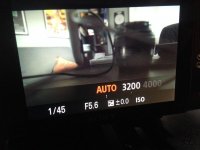
A7s sample footage

Erik, I like the footage. What IRND did you use, if any? Might be best to change the Vimeo setting to playback 1080, currently 720p, thus the 720p120 is less spectacular than normal fit into 1080p finish. Vimeo default upload settings should be 1080, imo, I wish Vimeo would change that. Downloading the orginal to look at now, Erik. Good one!
Thanks!

I used Hoya ProND filters. Truly neutral. I love em! I had to use 7 2/3 and 9 stop with 3200 ISO.
 
There's slight magenta, I pulled it out on the last profile, but ALSO, I prefer starting with a bit more magenta/blue for skin to be honest.

Scratch that, I was looking at the wrong clip. Helps when you don't name them both A7s :Drogar-Dum(DBG): I'm looking at it on an old 17" macbook pro with pro graphics display calibrated with a spyder4pro to 99% sRGB. A7s looks fine, BM very red skin. Now the noise makes sense.
 
I've been exposing up for stills too and man, does that make a difference for noise in a big way. Clearly, it's better to expose ETTR with this camera and the codec can handle a lot more than people gave it credit for.
 
I used Hoya ProND filters. Truly neutral. I love em! I had to use 7 2/3 and 9 stop with 3200 ISO.
I just received the ProND, and I thought the 1000 (10 stop) might be enough, however, forgot about the 3200 ISO. I need the ND200 (7 2/3) generally in the day in AU. They ProND would stop the IR, nice and neutral. Slight magenta in the clouds for a few shots, Erik? I just calibrated the other day, purchasing the SpyderHD linked from your blog, not sure if I am 'there' yet. Is it me? I'll check out ther 1080p original after d/l completes in a while and reconsider.
 
I've been exposing up for stills too and man, does that make a difference for noise in a big way. Clearly, it's better to expose ETTR with this camera and the codec can handle a lot more than people gave it credit for.
Dave Dugdale's test results marry well with this, the two stops up is ok in that instance, much less noise, image looks fine. It may depend on 2 stops up from what, at a certain threshold high up into SLog2, then it will work against the image. A good monitor with false colour might be a good tool to reference the middle grey down to optimal 32% or 32 IRE, skin tones above that (45-60%?), etc, then move everything up 1 or 2 stops to reduce noise, before hitting the threshold of the 8 420 internal codec and the point of no return at the top of the SLog2 compressed DR?
 
* I still plan to overexpose the a7s a couple of stops routinely with respect to what Sony says I should do (i.e. I will think I've set ISO 800 instead of ISO 3200)
* Why higher ISO is cleaner than underexposing and then pushing in post, and not just-the-same: because this camera is applying true analog gain when you increase ISO (up to ISO 100K), not just pushing it digitally (which is what most pro cameras do, e.g. RED). And the read-out noise doesn't increase because of that. Check these graphs.

I just received the ProND, and I thought the 1000 (10 stop) might be enough, however, forgot about the 3200 ISO. I need the ND200 (7 2/3) generally in the day in AU. They ProND would stop the IR, nice and neutral.

I'm waiting till I can test myself with the a7s, but I planned to get the prond 500 (9 stops). Could you run the following test? Set the a7s at ISO 3200 with slog2, 24p, 1/50s (or 1/45s if that's what you prefer), with a lens at f/2.0 and the prond 1000x in front (if all you have is f/2.8, set a 1/25s shutter, this is not a motion test anyway). Go out on a bright day, and shoot bright stuff in direct sunlight (people with a white or bright red tshirt, a white building, etc) (with those settings, you should be overexposing by two stops, i.e. a light meter would tell you to use f/4.0 instead). Then bring the footage to the editor, and look at the waveform: did anything clip? My guess is that nothing will, other than specular highlights in cars and other things that I wouldn't ming having blown out anyway. If that's the case, you are not losing any range by overexposing, you have more range to get people in shadow without getting noise, and you can live with less ND.
 
From what I've seen from all the daylight examples so far the image looks a bit flat if you expose dead on or to the left. Kholi what are you seeing?
 
I'm waiting till I can test myself with the a7s, but I planned to get the prond 500 (9 stops). Could you run the following test? Set the a7s at ISO 3200 with slog2, 24p, 1/50s (or 1/45s if that's what you prefer), with a lens at f/2.0 and the prond 1000x in front (if all you have is f/2.8, set a 1/25s shutter, this is not a motion test anyway). Go out on a bright day, and shoot bright stuff in direct sunlight (people with a white or bright red tshirt, a white building, etc) (with those settings, you should be overexposing by two stops, i.e. a light meter would tell you to use f/4.0 instead). Then bring the footage to the editor, and look at the waveform: did anything clip? My guess is that nothing will, other than specular highlights in cars and other things that I wouldn't ming having blown out anyway. If that's the case, you are not losing any range by overexposing, you have more range to get people in shadow without getting noise, and you can live with less ND.
Samuel, sorry, I was not clear in my post. I have the Hoya ProND filters, however, no a7S. Waiting to consider the package, a7S + Shogun (or other portable monitor/4K recording option), in due course.

Perhaps Erik, Kholi or another forum member with the a7S and ProND's can conduct your test. Interested to see the results, although there are days here in Australia I could use a 10-stop ND and a fast lens wide open, camera at ISO 800 and may clip highlights. Granted, we're talking SLog2, interested to see results of your suggested test. My thoughts are stacking ProND is likely, or contacting Hoya with a suggestion of additional ProND range past 10 stops.
 
You can get in the ballpark of needed ND with Sunny 16.
On a bright sunny day at iso 3200 this will get you an aperture of f16 and shutter speed of 1/3200s for correct exposure. This means 6 stops of ND to take down the shutter speed to 1/50 and 6 stops of ND to open the aperture to f2, for a total of 12 stops of ND. If you shoot at iso 800 (correct exposure at f16 and 1/800s), that's 10 stops of ND to 1/50 and f2.
That said, shooting that wide open under the sun is probably not a very common scenario. Wide open sunny exterior shots look weird to me.

Also, rating at 800 might be too much for this camera. Rating at 1600-2000 seems more realistic. If you want to rate s-log at 800 you are probably better off using the Cine gammas anyway; that's what they seem to do - rate at 500-1000 for exposure eqv. to 3200 in s-log (based on clip point).
 
@Christopher Barry: sorry, I misunderstood :)

@cpc
* Cinegammas do that, and then they clip the shadows, which I don't want to do. I think I want to keep slog2 and just overexpose by a couple of stops (mid grey at around 50%, 4.5 stops of range above, 8+ below). Just a theory yet, though (this wait is kiiilliiiiinng meeeeeee).
* I don't intend to shoot a lot of f/2.0 footage in sunlight, but I do shoot some f/2.8, and a lot of f/3.5 (the point at which all my lenses get sharp), that's why I thought about the prond 500x (9-stops) for my two-stops-overexposed theory. But he has the 1000x (10-stops), that's why I suggested f/2.0 (or f/2.8 with 360º shutter).

As for two stops being too much, I may not have explained this too well: I plan to shoot as follows:
* bright day with subject in daylight: overexpose by two stops (think ISO 3200 is actually ISO 800), I think I won't be clipping anything anyway, by a wide margin
* every other situation: either overexpose by a stop or expose correctly (as per Sony's suggestion of ISO 3200); this includes bright day with subject in shadow (I want to keep the sunlit areas of the image unclipped)
* never underexpose (i.e. put middle grey below 32%), things can get noisy pretty quickly
 
Last edited:
I have a few Voightlander f0.95 in M4/3 mount, useless to me wide open, they suffer from blooming, good if you want a free overdone filter effect. At f1.4, the blooming has diminished significantly, and the image becomes sharper as you stop down from there. I don't like the bokeh so much from a MFT camera with a fast lens, bokeh may appear smeared, less detailed and somewhat blotchy (just my opinion, or my poor camera operation). That is one of the main attractions of the FF a7S. The FF lenses wide open, some at T2.5, others at T2.8, image is much better stopped down, as Samuel pointed out. Prefer not to stack ND, not sure if it affects colour rendition. There is a massive thread on BMCuser where Kholi started some testing and Hook posted a bunch of comparisons of ProND, IRND, non-IRND, etc. Regarding the ProND, I recall you can stack them, however, when comparing, say, a ProND64 to a stacked ProND8 and ProND16, I am not sure if it has any minor effect on colour or the IR cut effect (more?), which may take from red/magenta. At any rate, better to apply one filter, than stack two or more, less optical add-ons the better. I hope the ProND1000 10 stop is enough for some bright-ish day shooting SLog2.

Erik applied a 9-stop stacked with a 7 2/3 ProND for the footage. Not sure what can be moved around to account for dropping 6+ stops and use only a ProND1000 10-stop. Erik, if I may ask, what f-stop range did you shoot for most of Sunset Cliffs?

Samuel, as cpc pointed out, there's always Sunny 16, just a click (or clickless) away... :)
 
Last edited:
@Christopher Barry: sorry, I misunderstood :)

@cpc
* Cinegammas do that, and then they clip the shadows, which I don't want to do. I think I want to keep slog2 and just overexpose by a couple of stops (mid grey at around 50%, 4.5 stops of range above, 8+ below). Just a theory yet, though (this wait is kiiilliiiiinng meeeeeee).
* I don't intend to shoot a lot of f/2.0 footage in sunlight, but I do shoot some f/2.8, and a lot of f/3.5 (the point at which all my lenses get sharp), that's why I thought about the prond 500x (9-stops) for my two-stops-overexposed theory. But he has the 1000x (10-stops), that's why I suggested f/2.0 (or f/2.8 with 360º shutter).

As for two stops being too much, I may not have explained this too well: I plan to shoot as follows:
* bright day with subject in daylight: overexpose by two stops (think ISO 3200 is actually ISO 800), I think I won't be clipping anything anyway, by a wide margin
* every other situation: either overexpose by a stop or expose correctly (as per Sony's suggestion of ISO 3200); this includes bright day with subject in shadow (I want to keep the sunlit areas of the image unclipped)
* never underexpose (i.e. put middle grey below 32%), things can get noisy pretty quickly


I'm not so convinced with Slog2 at the moment on this camera, i did some transmission wedge tests, very quick and dirty (i will do them again properly though).

There's perhaps a 2 stop advantage in Slog2 (maybe 12 overall). But the distribution of those stops in Slog is fairly flat, which is what you want in high range situations. But the black level is higher than it is on the FS700 - it's riding around 25/30 code values for me (unless i'm doing something wrong). This means that your useable range is 25 to 255, split into 11/12 stops, so 20ish code values per stop. Whereas with cine4, yes the blacks roll off quicker and the highlights have a knee but the blacks in Slog are *very* noisy, so first stop unusable IMHO, lots of purple(!) blobs. So you're going to crush those blacks anyway. Then, depending on subject, the last few stops might just be specular.

So with cine4's 10ish stops divided into 0-255 the distribution for skin/interiors may have more tonal details, plus you can mix and match colour spaces.

I'm not saying there are any problems with Slog2 but it's not a be all and end all, IMHO at this early stage, it's implementation is worse than it is on the FS700. If only Sony did 10bit, then it probably would be the ideal way to shoot. Why... why.... why....

cheers
Paul
 
RE: Hoya ProNDs --

I have two sets, one that goes up to 1000x.

Outside, broad daylight, I was completely fine with just the 64x. Not going to try to shoot at 1.4, and of course 5.6 is still shallow enough. Using the ISO to drive incremental exposure kinda made it all around, so there wasn't much of a need to use more than that. The 100 is probably fine as well.

I also have a Hoya Circular Grad, same stuff that the ProNDs use. It works great.

On Hoya ProNDs in general, if you aren't on a mattebox they are hands down the best NDs you can buy. There's a thread on BMCuser that I started when I discovered them last year if you want to go and do some research.
 
Kholi, I don't have an a7S, been reading the manual and the How to Use PDF documents. Reading, compared to clicking buttons and observing results, I have a question, it may have been answered already, I may have missed. Just so I understand the process, while SLog2 is rated at ISO 3200, ISO is not locked off or greyed out from being adjusted when selecting PicPro7? If so, when shooting for your PicPro development tests during the day in direct sunlight and utilising only the ProND64, approximately what was your ISO setting/range, assuming well below ISO 3200? Thank you, Kholi.
 
Just so I understand the process, while SLog2 is rated at ISO 3200, ISO is not locked off or greyed out from being adjusted when selecting PicPro7?

I hope Im wrong, but as I ve understood from what I ve been reading here, you can't go lower than 3200 ISO while in SLog2. I d like to know for sure though...obviously I also dont own the camera.....:)
 
I hope Im wrong, but as I ve understood from what I ve been reading here, you can't go lower than 3200 ISO while in SLog2. I d like to know for sure though...obviously I also dont own the camera.....:)

Correct. When shooting in S-Log the lowest ISO setting is 3,200.

photo (1).jpg
 
I just commented in that video: "I think the extra sharpness you see is actually false detail, a byproduct of aliasing, created by a bad downscaling algorithm."
 
Back
Top