5D MKIII specs

+1 with the philosophy and +2 with your posts concerning the helping and searching about the 5dmk3 image. Page 106 guys. And not one post saying, GO BUY THIS CAMERA. Thanks JCS. The things you have posted here are exactly what I am finding playing with this camera.
+1 ;)

I am not mod here, but I could. I have credits enough for : )

So, seconding what David already posted here, let's keep it to help all of us to understand the limitations and shinnings of each capture device. No trolls, only tools please :-)
 
Epic hasn't been out for four years. Unless we just hit a time warp? Lol

Of course I've done my share of pixel peeping 5K. Countless hours in countless ways. I've also seen

We disagree (as usual), that's cool. Still stands that the claim to have to sharpen epic footage is glass.
Well I've done my share of pixel peeping in 8K, 10K, 12K and so on (high quality drum scans from 8x10in film, were I came from many years ago). I used sharpening on every single file to different extend and use (print ads, billboard, web, etc.). I've shot with 60mp backs and 5MP point and shoots. All of them in the end had sharpening applied if shot raw. I always save an edited version of a still raw covert without sharpening because in print world that are many different sharpening uses and applications.
 
How is sharpening a 5D III image better than sharpening a 5d ii with AA filter image if both only resolve under 800 lines in the raw file? Is the argument that the 5d III resolves 900+ lines, but appears soft due to no aliasing? Because if that were the case, the raw clips would still have more visible detail... and that isn't apparent in the clips being posted. Sharpening exaggerates detail that is already there. I'm not seeing that initial detail.
 
Last edited:
Comments regarding 5K footage at 100% are right on: it will look soft if properly anti-aliased. That's a good thing: it means as much information that was available in the original signal was captured. Low pass filtering (blurring) and downsampling (decimation) is a common way to anti-alias an image (http://en.wikipedia.org/wiki/Multisample_anti-aliasing: your video card does this for most modern games). That's why 5K downsampled to 2K looks excellent. Anti-aliasing will make an image look softer, however it will prevent moire and aliasing artifacts as the image moves through the fixed pixel grid. http://en.wikipedia.org/wiki/Spatial_anti-aliasing
Lanczos is an excellent sinc based interpolating filter for downsampling and maintaining detail. Cubic filters such as Mitchell-Netravali also work well. More info here: http://pixinsight.com/forum/index.php?topic=556.0
All of these concepts relate to analog signal and digital sampling theory. We're trying to capture an analog signal, store it, then reconstruct it as closely to the original signal as possible. Pixels have finite resolution, so neighboring pixels need 'coverage' (can look like blur, see the anti-aliasing link above). Without this 'coverage', as a line moves for example, pixels will abruptly 'snap' to the next pixel and this is the root of aliasing. Anti-aliasing 'coverage' allows parts of the line to fade in on the leading edge of motion and fade out on the trailing edge as it moves. This makes the line appear to move smoothly, with no 'snapping' or shimmering. The line will look softer, however. As display resolution increases, we'll get closer to sharp images with no visible aliasing.
 
How is sharpening a 5D III image better than sharpening a 5d ii with AA filter image if both only resolve under 800 lines in the raw file? Is the argument that the 5d III resolves 900+ lines, but appears soft due to no aliasing? Because if that were the case, the raw clips would still have more visible detai... and that isn't apparent in the clips being posted. Sharpening exaggerates detail that is already there. I'm not seeing that initial detail.

Apparently simple logic no longer applies to the 5DIII... Hope you got your body before everyone learns that it can also create wormholes.
 
How is sharpening a 5D III image better than sharpening a 5d ii with AA filter image if both only resolve under 800 lines in the raw file?

This is a good question. Actually, as I am currently working on a review of that filter it's also an important question. Unfortunately, living in France I haven't been able to get my hands on this new camera.

Anyone out there want to do a comparison test?

The real question is how Canon achieved the anti-aliasing and anti-moiré? Is is it a digital fix, or a hardware one? Is it thanks to a proper downscale from exactly 3x pixel specs?
My conclusion thus far is that the Mosaic filter cures about 90% of the pattern issues, but it is not perfect. I suspect that the Canon solution is an electronic one, with some kind of pixel blurring going on. Which would explain the perceived softness. It is not perfect either. In either case, by filtering out the artifacts it allows for a cleaner rendering of what IS there.
In other words it does not provide more information, it simply allows for better exploitation of the information that is already there.

It also means that our working methodology has to change in order to properly use this new tool.

Lastly, might I point out that all the arguments that are being pitched here against the Mark III due to it's related softness in comparison to the Mark II, are exactly the same arguments that were used against the AF100 vs. the GH1/2. There is an OLPF on the AF100. We know that it was a hardware solution. Guess what? It looks soft compared to an unhacked GH1/2. Well it turns out that today people prefer a slightly more aliased image because of the perception of sharpness. Welcome to the DSLR generation.
 
Last edited:
Lammy- the perception of fine detail is enhanced due to the aliasing provided by the GH2. If you and your clients and/or customers prefer that look, makes perfect sense to keep using it. Other folks prefer a filmic look, sometimes to the point of zero aliasing: this is tough to do and the result will look less sharp. That's just the way the eye and brain work. However, the anti-aliased image actually carries more information. That's why it's possible to throw it away via filtering to increase the perception of sharpness. When we do that, we get an aliased image.

5D2 and 7D footage do not carry this extra information and sharpening them enhances existing aliasing artifacts (see Sebastian's footage on Cinema5D: it clearly shows the sharpened 5D3 footage much sharper and cleaner vs. sharpened 7D footage).

My goal with the Veyron and brick wall tests was to show that it's possible to tune 5D3 footage to have a nice balance of low aliasing and sufficient sharpness. My tests and posted images show the sharpened 5D3 closely matches the GH2, while having less aliasing. The images and videos speak for themselves. It's OK if you prefer the GH2 footage: it's an excellent crop frame tool.

Hi jcs, thanks for the response.

I'm aware of the theory on how it should work but I'm not quite sure on the extent of it. I can't be sure of until I see more footage. For example, you say 'filmic look', but to me it looks filmic up to 720p. Same with my D90's, filmic up to 480p. Above that, due to excessive sharpening and upscaling to 1080p, I'm seeing the 5D3 has halos, chunky lines and blocky noise patterns. What were the results of your resolution chart for the 5D3?

I believe Barry's test charts, the previous 5D2 had something like 600ish lines, and the GH2 and something like 850ish lines before aliasing appeared. GH2 resolution chart:http://vimeo.com/17980144 Is the extent the 5D3 actually resolving above 720 for sharpened anti-aliased footage?

My original basis and point was, if indeed it matches 850-1080 lines, then hell yeah I'm buying a 5D3!
 
This is a good question. Actually, as I am currently working on a review of that filter it's also an important question. Unfortunately, living in France I haven't been able to get my hands on this new camera.

Anyone out there want to do a comparison test?

The real question is how Canon achieved the anti-aliasing and anti-moiré? Is is it a digital fix, or a hardware one? Is it thanks to a proper downscale from exactly 3x pixel specs?
My conclusion thus far is that the Mosaic filter cures about 90% of the pattern issues, but it is not perfect. I suspect that the Canon solution is an electronic one, with some kind of pixel blurring going on. Which would explain the perceived softness. It is not perfect either. In either case, by filtering out the artifacts it allows for a cleaner rendering of what IS there.
In other words it does not provide more information, it allows for better exploitation of the information that is already there.

It also means that our working methodology has to change in order to properly use this new tool.

Thats kinda the thing Yoclay. THe camera is so new and in so few hands that we're just still figuring out it's engine. But some seem really quick to pass judgement before we can break it all down. As time passes, I'm sure more discoveries will be found and thus better understanding. New processes and settings. ALthough I haven't tested, but so far I'm not doing the 160, 320, 640 thing. I'm in the boat of letting it develop with user findings. One thing I can state is that with some easy post sharpening I'm liking what I see.
 
How is sharpening a 5D III image better than sharpening a 5d ii with AA filter image if both only resolve under 800 lines in the raw file? Is the argument that the 5d III resolves 900+ lines, but appears soft due to no aliasing? Because if that were the case, the raw clips would still have more visible detail... and that isn't apparent in the clips being posted. Sharpening exaggerates detail that is already there. I'm not seeing that initial detail.

The 5D2 performs line skipping the 5D3 does not. My informal test chart shot (http://cinema5d.com/viewtopic.php?f=30&t=39795) looks like somewhere between 800-900 horizontal lines of resolution. At some point someone with a proper line chart and equipment will post the results of a video resolution test. Also see the closeups of sharpened 7D footage compared to the 5D3 here: http://cinema5d.com/viewtopic.php?f=88&t=39809. Perhaps someone with a VAF filter can post a comparative post sharpened shot.
 
or maybe canon did not want to give as c300 FF level camera for 5X less money ....
And if you were Canons CEO, would you threaten a spanking new department with a $3500 camera that wipes out all the R&D of the EOS Cinema division? I wonder just how many millions of dollars went into creating and supporting the C300 and it's future.
 
Lastly, might I point out that all the arguments that are being pitched here against the Mark III due to it's related softness in comparison to the Mark II, are exactly the same arguments that were used against the AF100 vs. the GH1/2. There is an OLPF on the AF100. We know that it was a hardware solution. Guess what? It looks soft compared to an unhacked GH1/2. Well it turns out that today people prefer a slightly more aliased image because of the perception of sharpness. Welcome to the DSLR generation.


Same exact thing, indeed. AF100's OLPF is way too aggressive IMO, but it's for the exact same reason why MKIII has reduced aliasing: that's what everyone kept complaining about, so the companies actually listened and did something about it, but maybe they went too far. If anyone says that these guys aren't listening then they aren't paying attention at all.

What WOULD be interesting is if someone strapped some Master Primes on the MKiii. But, EF glass is plenty sharp to begin with, especially the the money primes, so maybe it wouldn't make that much of a difference at all.
 
This is a good question. Actually, as I am currently working on a review of that filter it's also an important question. Unfortunately, living in France I haven't been able to get my hands on this new camera.

Anyone out there want to do a comparison test?

The real question is how Canon achieved the anti-aliasing and anti-moiré? Is is it a digital fix, or a hardware one? Is it thanks to a proper downscale from exactly 3x pixel specs?
My conclusion thus far is that the Mosaic filter cures about 90% of the pattern issues, but it is not perfect. I suspect that the Canon solution is an electronic one, with some kind of pixel blurring going on. Which would explain the perceived softness. It is not perfect either. In either case, by filtering out the artifacts it allows for a cleaner rendering of what IS there.
In other words it does not provide more information, it simply allows for better exploitation of the information that is already there.

It also means that our working methodology has to change in order to properly use this new tool.

Lastly, might I point out that all the arguments that are being pitched here against the Mark III due to it's related softness in comparison to the Mark II, are exactly the same arguments that were used against the AF100 vs. the GH1/2. There is an OLPF on the AF100. We know that it was a hardware solution. Guess what? It looks soft compared to an unhacked GH1/2. Well it turns out that today people prefer a slightly more aliased image because of the perception of sharpness. Welcome to the DSLR generation.
I can provide you with raw footage of the filter if you or anyone else wants to compare.
 
And if you were Canons CEO, would you threaten a spanking new department with a $3500 camera that wipes out all the R&D of the EOS Cinema division? I wonder just how many millions of dollars went into creating and supporting the C300 and it's future.

Oh come on now! Millions of dollars! The C300 is just a large sensor XF300 with new housing! Canon really knows how to give people the run-around with marketing... I'll give them that.
 
Hi jcs, thanks for the response.

I'm aware of the theory on how it should work but I'm not quite sure on the extent of it. I can't be sure of until I see more footage. For example, you say 'filmic look', but to me it looks filmic up to 720p. Same with my D90's, filmic up to 480p. Above that, due to excessive sharpening and upscaling to 1080p, I'm seeing the 5D3 has halos, chunky lines and blocky noise patterns. What were the results of your resolution chart for the 5D3?

I believe Barry's test charts, the previous 5D2 had something like 600ish lines, and the GH2 and something like 850ish lines before aliasing appeared. GH2 resolution chart:http://vimeo.com/17980144 Is the extent the 5D3 actually resolving above 720 for sharpened anti-aliased footage?

My original basis and point was, if indeed it matches 850-1080 lines, then hell yeah I'm buying a 5D3!

I'm still trying to make sense of the "filmic" look justification for soft images coming from cameras being thrown out there more now.

Film at the very least resolves at about 5k when scanned before it becomes pretty blurry any higher than that (and possibly more with updated stocks). Downsampled to 2k (especially modern Kodak 500T class and Fuji s16mm stocks), film has an insane amount of resolution to offer. Sat next to DSLR footage, it still carries more resolution detail that's only been attanable with updated sensors from the Alexa, C300, F3 and even the GH2. Perfect example: Aranofsky's "Black Swan" on s16mm, and then the train station shots on the 7D. It's pretty obvious which is which.

Personally I believe the "filmic" look is a myth. People tried to use it for shallow depth of field, even though classic films like Citizen Kane and Sunset Blvd didn't use it (among hundreds of other examples) and now they're trying to say the same thing for lack of resolution. Apparently, soft=filmic, despite the fact that film resolves high detail and sharpness (which can even vary from stock to stock).

Even a Bluray of a film proves that, downsampled to 1080p from a 2k film scan. Check out something like Citizen Kane, Dog Day Afternoon or Inglorious Basterds and use the same rhetoric "...it has a film look...".

Doesn't even make any friggin' sense :)
 
I believe Barry's test charts, the previous 5D2 had something like 600ish lines, and the GH2 and something like 850ish lines before aliasing appeared. GH2 resolution chart:http://vimeo.com/17980144 Is the extent the 5D3 actually resolving above 720 for sharpened anti-aliased footage?

My original basis and point was, if indeed it matches 850-1080 lines, then hell yeah I'm buying a 5D3!

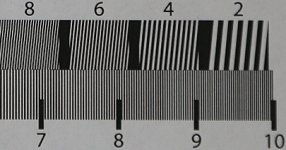
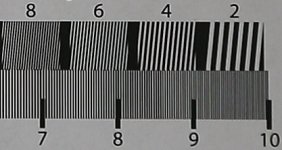
I don't have a full/real resolution chart- I printed a section of the ISO 12223 chart using a 600-2400 dpi laser printer. I then took a still shot for reference, which was downsampled to 1920x1080: this would be the ideal reference. I then compared the downsampled still to the 5D3 video (both sharpened to remove as much anti-aliasing information as possible to make the results more clear):

Click on the images to see full size.

1000+ lines: we can see alternating black and white lines up to 10 (x100):
5D3S_Sharpen.jpg
Up to interpretation, looks to me somewhere between 800-900 (see also diagonal '8' region):
5D3V_Sharpened.jpg

Compared to the GH2 resolution video, the 5D3 appears to be higher resolution. To be fair, a 5D3 has to be tested under the same circumstances. Likewise, the GH2 can be tested using this comparative method using a high-resolution laser printer and the ISO 12223 chart: http://www.bealecorner.org/red/test-patterns/. From Andrew's bear test, it appears the resolution between the two cameras is close.

There are no halos when in-camera sharpening is turned off.
 
Last edited:
Personally I believe the "filmic" look is a myth. People tried to use it for shallow depth of field, even though classic films like Citizen Kane and Sunset Blvd didn't use it (among hundreds of other examples) and now they're trying to say the same thing for lack of resolution. Apparently, soft=filmic, despite the fact that film resolves high detail and sharpness (which can even vary from stock to stock).

Oh it's not a myth... the filmic look is just whatever the traits of the new Canon cams happen to be.

And seriously people... the GH2 does not have that much "false detail". It's an honest 900-1000 lines. Watch that GH2 vs Scarlet video... false detail and aliasing are not enough to make an image comparable with Red at 2k. It's real detail folks. And it's not as technically fantastic as you're making it seem to be. It's not that hard for a DSLR priced camera... canon just didn't do it for some reason. If you really don't see the extra detail between that EOSHD tokyo clip and the new 5DIII stuff, then you have A. Poor eye sight or B. or not viewing it on a 1080p monitor. And BTW, I'm not a GH2 fan-boy, that's just what I used at the time of creating my account. It's a play on the "DVXuser" title of this site... jeees.

Compared to the GH2 resolution video, the 5D3 appears to be higher resolution.

Ok, now we've official entered the twilight zone. This is getting nutty. It seems like people really have some deep emotional connection to the 5DIII are cannot actually look at things objectively anymore.

*Oh by the way... I just figured out that the 5DIII actually has 4k worth of detail in the original 1080p All-I mode. All that codec-fuzz is actually "buried" information. If you blow the files up to 4k... then use sharpening... you'll actually see a real 4k image!!! It even looks better than an Epic at 5k! Hooray!
 
Last edited:
I can provide you with raw footage of the filter if you or anyone else wants to compare.

Thanks Hans. Actually I have two filters already myself. But I don't have a Mark III, yet. (So you see I have an investment in this debate and people's conclusions here :-) )
However what I really need is a side by side comparison in a typical moiré situation like a brick wall between the two options, the Mark III straight up and the Mark II with the VAF-5D2 filter.
 
Back
Top