5000 watts of light for $90.00!!! Stop buying work lights!

I use R40s (mostly 300w floods that I can no longer find...the Halcos look like a great replacement) with my ancient Lowel tape up kit. Basically a socket that also has an aluminum slip on ring with 2 barn doors. I clip frost or gels to the doors.
You might be able to find one of these kits on ebay, etc. The flat aluminum plate has notches for mounting to the upright of a light stand or for gaffer taping to walls, etc. Designed back in the days before Halogen "quartz lights" these were a location staple. I still use at least 1 on every shoot.
Hope this helps,
Ken
 
They would call for a generator no? I think the limit here in DK is just under 3k w per fuse... arrays like this would max it out fast :D hehe

Well they have 500 watts of output or draw just over 4 amps. in the 4 light configuration they would draw over 16 amps (Like any 2K incandescent light). Most residences that I have had to deal with have 100 amp services and usually have at least two 20 amp circuits. I would not use but one 2K set up on one 20 amp circuit. I would be comfortable using a two light set up (1k) plus a single bulb configuration (500 Watt) on a 15 amp circuit. We are going to be using generators for the night exterior though.

I use R40s (mostly 300w floods that I can no longer find...the Halcos look like a great replacement) with my ancient Lowel tape up kit. Basically a socket that also has an aluminum slip on ring with 2 barn doors. I clip frost or gels to the doors.
You might be able to find one of these kits on ebay, etc. The flat aluminum plate has notches for mounting to the upright of a light stand or for gaffer taping to walls, etc. Designed back in the days before Halogen "quartz lights" these were a location staple. I still use at least 1 on every shoot.
Hope this helps,
Ken

Oh yeah, the original Lowell Light. I haven't seen one of those in a long time. I would like to find some used real cheap. It is getting harder to find powerful incandescent lights. I have a bunch of 300 watt R-30 shaped bulbs (Photofloods) and they are not replaceable.
 
Not to be critical but I have seen a 500w halogen work light for $7.99 ready to run. Don't forget to factor in the price of a cord/fixture for the bulbs in question, so double your price to make these work. Which in all honesty is still not bad at all.

Good find!

Of course at that price, you can just throw them away after a shoot. I have purchased quite a few cheapo work lights for my shop, and without fail, the ceramic light bases are damaged by overheating and fry the bulbs due to increased heat and resistance. Once the bases are damaged, a new bulb can fail within minutes of replacement. This has happened in as few as two hours, but ALWAYS happens at some point, YMMV. I'm sure others have had success with them, but the point is you never know how good the fixtures are. In my experience, the reliability of cheapo shop lights just isn't worth the risk of failure.

Grant
 
Good point. I don't use shop lights for shoots, but was just pointing out an even cheaper solution.

My wife is out of town at a conference so I have been a bad boy buying used Mole lights on eBay to fill out my kit.
 
Oh yeah, the original Lowell Light. I haven't seen one of those in a long time. I would like to find some used real cheap. It is getting harder to find powerful incandescent lights. I have a bunch of 300 watt R-30 shaped bulbs (Photofloods) and they are not replaceable.

Thanks to 'energy saving madness' being legislated...

Even then, I'd have to 'special order' a CFL that is in the color temperature I desire at the local Home Depot... they have a '300W equivalent'... but its about 2800K... rather than the 5500K (or so...) that I'd like to have.
 
Good point. I don't use shop lights for shoots, but was just pointing out an even cheaper solution.

My wife is out of town at a conference so I have been a bad boy buying used Mole lights on eBay to fill out my kit.

I bribe the UPS driver to deliver while my wife is at work. I don't suppose I am really fooling as she is much more clever than I.
 
Thanks for the heads up on these, great to have another bulb in the tool kit- especially one that is soft-er, and VERY affordable! :)
 
Are you running all 500w lights on that 4 light bar?

Yes. That is 2000 watts of light, and it really needs to be powered from a 20 amp circuit. They get VERY HOT, so an extra safety sense is needed when using them. I did not get to use them on the large night exterior that I was planing in the OP. On the project, the producers obtained access to a large professional sound stage and we set up in there, shooting most of the planed night exteriors on very stylized sets. The sound stage we used was a special effects stage and floor to ceiling blue screen for a full 360 degress. We set up some large blue screen shoots and I used the Halco 500 watt lights, in 2 4 socket fixtures, to light the blue screen. I screwed a 5/8" spigot into the 1/4 20 mount holes on the fixtures and mounted them to stands with a grip head. I placed each of the 4 light fixtures on opposite sides of the blue screen needed and oriented them to be as smooth as possible. I found that the high power and smooth beam spread of the Halco lights made evenly lighting the blue screen a very painless procedure.

I also set up a single 4 light fixture into a bounce source for fill light in another scene in the studio. It worked great. Now these lights are specialty lights, but for power for a low cost, they can't be beat.
 
Last edited:
I just bought some more of these light bulbs and the price has come down. They are now $7.81 a piece, so the price for 5000 Watts of light has dropped to $78.10!!
 
I love your approach, David!

Man, I really appreciate that! Thank you.

I get so frustrated when I see all of these post where young filmmakers, who have put together the best HD-DSLR camera kit, or what ever that they can, ask for advice about buying a $1000, or more, light kit and are hoping that it will make all of their filmmaking dreams come true. Now I absolutely, positively, without a doubt, agree that a person that is setting up a film or video business on the professional level should spend the money necessary and invest in professional lights and gear. However, if you are a filmmaker who has scraped together cash that, really, you can't spare to buy filmmaking gear and you want to make fictional narrative films then buying a new light kit from B&H, or whoever, is a huge mistake. It ain't enough! I am a huge fan of eBay and Home Depot. If you want to creatively light very low budget fictional narrative films I am of the opinion that you really need to learn how to light with Home Depot clamp work lights and eBay available used movie lights.

Thanks again!
 
Absolutely, go for Home Depot Lights.but steer clear of the tungsten lights. Too hot, too fragile for transport,

I have used two stands total of 2 x 2 x 300 w and each time you go out you may need new bulbs. I plan to shift to the 108 LED lights that cost $ 47 each. Anyone tried these?
 
Last edited:
Why oh why do people who took great care and research in selecting their cameras insist on trying to work with cheap tripods and head, horrible microphones and quantity rather than quality lighting? It just doesn't make any sense to me. I have two 500W floodlights that light up my garden if I need to go out there at night. I don't use my video and theatre kit for my garden, and I don't use 500W floods for my video or theatre work. Each tool has it proper job, and swimming pool lights for video make sense if you are lighting a swimming pool, or a car park, or want the shot to look like it's lit with work lights!
 
Last edited:
Two reasons.
1. We look at a camera or a monitor, decide we can't make one ourselves (most of us) and figure we are getting good value for money,
2. We look at light systems, fIgure they are not good value far money (subjective assessment) and decide we can make one .
 
Why oh why do people whop took great care and research in selecting their cameras insist on trying to work with cheap tripods and head, horrible microphones and quality rather than quality lighting? It just doesn't make any sense to me. I have two 500W floodlights that light up my garden if I need to go out there at night. I don't use my video and theatre kit for my garden, and I don't use 500W floods for my video or theatre work. Each tool has it proper job, and swimming pool lights for video make sense if you are lighting a swimming pool, or a car park, or want the shot to look like it's lit with work lights!

paulears, I nothing but the greatest respect for your opinion and have learned a great deal from your posts; thank you for that. However, I think that you may not understand my approach to lighting in this post and others, or, probably more likely, I failed to clearly communicate the approach that I am advocating. Yes, standard professionally manufactured motion picture, video and theatre lighting fixtures and gear are usually the best tools for the job and are, in most instances, well worth the high cost that they command. The thing is, they are not the only tools that can do the job.

500 watt R-40 bulbs have been used for filmmaking since at least the 1950s. In 1959 the original "Lowel Light", that kplo cited in post #21, was introduced. It was specifically designed to work with 500 watt R-40 bulbs. The Lowel Light was a hit with low budget filmmakers. It is my understanding that Stanley Kubrick and John Alcott BSC used Lowel Lights, with 500 watt R-40 bulbs, on "A Clockwork Orange" and "Barry Lyndon". I also believe that Francis Ford Coppola and Bill Butler ASC used the Lowel light on "The Rain People". It is also my understanding that the Lowel Light, with the 500 watt R-40 bulbs, was a popular light with filmmakers of the French New Wave and the British "Kitchen Sink Realist Drama" films of the late 1950s and 1960s. Those are just a few examples of the popularity of the 500 watt R-40 light for filmmaking. Now the 500 watt R-40 bulbs used in the Lowel Light, and other fixtures back in the day, were photofloods. As I am sure you know, photofloods had some big issues. They had a very short lifespan (10 hours or less was common) and were known to have a color temperature change over that short lifespan (They become noticeably warmer). The 500 watt photofloods from back in the day were also clear glob reflector floods and while that made their pure light output higher than a frosted glob bulb the light quality and beam spread was very harsh and uneven. The Halco 500 watt R-40 bulbs are not photofloods so there is no color change overtime and their rated life is 2,000 hours. Now they are not 3200K. They are 2900K. That is a very inconsequential issue. The big plus, IMO, of the Halco 500 watt R-40 bulbs is the frosted glob. The frosted globe gives the Halco 500 watt R-40 bulbs a very even and, I would say, beautiful beam spread. Also, I do not know if the 500 watt R-40 photofloods are even made these days. I honestly believe that these 500 watt R-40 bulbs by Halco are a very viable tool for filmmaking. Are the lights using these bulbs the best lights available or are they suitable for every filmmaking scenario? Of course they aren't. They are just another tool, available at a low cost, for filmmakers to use.

By the way, re-purposed and DIY lighting equipment has been used by some of the most talented and acclaimed cinematographers.

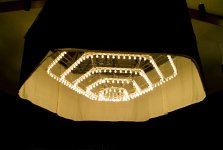
Roger Deakins ASC, BSC had the below rig made to light a location on the Coen brothers movie "A Serious Man"

Deakins hexRig.jpg

On his website he says that that is: "This was a light I had made which consists of 5 concentric hexagonal aluminum strips holding 200 odd 75 watt household bulbs. The largest hexagon is 15' across and the smallest 3' 6" across. It was controlled by a dimmer system and a skirt of ultrabounce acts as a cut as well as an interior reflector." The whole post can be viewed here.

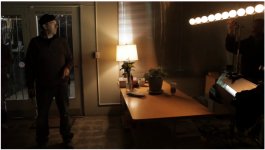
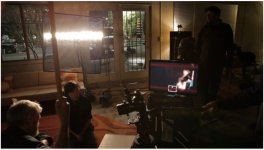
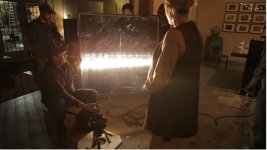
Roger Deakins ASC, BSC and Shane Hurlbut ASC have both spoken about lighting using a "Batten light" which is a DIY light made up of multiple regular household light sockets bulbed with, I believe, regular 100 watt household R-30 bulbs. Here are a few pictures of one of the batten lights that Shane Hurlbut ASC has used:

Hurlbut Batten Light 2.jpg

Hurlbut Batten light 3.jpg

Hurlbut Batten light 4.jpg

It is my understanding that Roger Deakins ASC, BSC used similar lights extensively in night exterior scenes in the movie "Jar Head".

Shane Hurlbut ASC has also posted on his blog about his use of re-purposed and unconventional lighting. Here are the links.

http://www.hurlbutvisuals.com/blog/2011/11/lighting-basics-going-with-what-is-available/

http://www.hurlbutvisuals.com/blog/2011/11/building-the-perfect-key-light/

http://www.hurlbutvisuals.com/blog/2011/12/lighting-with-home-depot-lights-part-2/

Vittorio Storaro, A.S.C., A.I.C. is also known to have used re-purposed high intensity air craft landing lights for lighting his films; most noticeably the film "Bulworth".

These are just some examples of highly regarded and acclaimed cinematographers who have chosen to use tools that are not normally considered for professional motion picture production. There are many others I am sure. I think that the 500 watt R-40 bulbs from Halco are just another tool available to use. I was just making that suggestion.
 
I understand, but these specials are made to very specific things. Big clusters produce bright wide and almost shadowless lighting. The pool and snooker people use very similar techniques. What worries me is that it's not so much the lamp type but how appropriate it's output is. I remember very well the era of photoflloods and the very stark lighting they produced. If you look at the huge range of products available, the popular ones just produce better quality light. In a Fesnel you can change beam angles, have rotating barn doors and a nice soft edged beam that can blend nicely. A conventional soft light provides an even field and no hot spots. LEDs and light clusters can be even if they're designed properly, and if the lamps we're talking about are close together then they blend into a single source, but if they're spread about on a bar then you start to get fringing in the horizontal plane but sharper shadows in the other, or vice versa. I just wonder if it's cost effective for what use it is. Physically what a lot of faffing around, very difficult storage, problematic storage and as for breakages? I can see the effect being useful for certain looks, but unless you specialise in this genre how useful is it. I really do think quality of light, not the equipment is paramount. Perhaps 50 of these would look good, but a mere handful are just illumination.
 
Heck, tungsten light is tungsten light and if you can find a good way to get more of it on a household circuit I think that's great. We use to use something that's pretty similar to your fixture, we called it the p-can pie. It was two or four par cans mounted on a baby double header and we shot that through a 4x4 frame. Sometimes we were trying to do a warm push for interiors during the day and needed lots of punch, other times it was just for night ext. or night int. where a bigger source was needed. We would always diff it which I think is the missing ingredient here, not something I would ever use bare.

This just looks like a good cheap way to get a lot of light, and while it's not always appropriate, it works when it works.
 
In a Fesnel you can change beam angles, have rotating barn doors and a nice soft edged beam that can blend nicely.
This is an oft recurring point that you've made, and while I understand where you're coming from, I don't see gaffers think about it in practice. For one thing, on location, typically the smallest HMI fresnel you'll come across on bigger jobs is a 12k, everything else is a PAR. I very frequently see multiple PARs or M series lights spaced several feet, or even yards apart, blasting through windows to mimic daylight in the exact same way that a bunch of 2k, or 5k or 10k fresnels will blast through windows of a set on a stage. I've even seen maxi brutes with full CTB blasting through windows on a location. Blending of the beams never seems to be an issue with PARs. And if a light isn't going through a window (and often even if they are), they'll almost always get bounced or diffused anyways, so the fixture itself doesn't make any difference except if the spill becomes a problem and the grips have to set an extra flag or two. I'm not denying what you're saying at all, but the huge efficiency of PAR's (for example, a firestarter is just about as bright as a 5k at full spot) tends to outweigh the fact that fresnels have a cleaner beam.

With regards to the original topic, another thing to consider is that 9 light fays can be rewired to run off 3 edison plugs, the pair that I got from the TCI auction came like that. This means I have to use a fanout or a woodhead with a few extension cords to power it off a bates plug on jobs that have a real distribution package, but it's nice to have that flexibility for smaller gigs running off house power.
 
By the way, re-purposed and DIY lighting equipment has been used by some of the most talented and acclaimed cinematographers.

Roger Deakins ASC, BSC had the below rig made to light a location on the Coen brothers movie "A Serious Man"

View attachment 81224

On his website he says that that is: "This was a light I had made which consists of 5 concentric hexagonal aluminum strips holding 200 odd 75 watt household bulbs. The largest hexagon is 15' across and the smallest 3' 6" across. It was controlled by a dimmer system and a skirt of ultrabounce acts as a cut as well as an interior reflector."

Something else to think about when constructing lights like this, is the available power.

For example, most folks don't have 15,000 watts handy to power a light like this. :)
 
Back
Top