C200: $1,000 Price Drop.....C500MKII coming soon?

I've shot solo with my Amira. Yeah, easier to shoot solo with a stripped down C300 as it's smaller and lighter, can also use a lighter tripod, can fit spare L-series lenses in a shoulder bag with small spare batteries, etc. But a Varicam LT is pretty similar weight and ergonomics to an Amira, and somewhat also for a Red, as they both have high power draws and need large batteries, often have large lenses on them, etc., so I don't really see how an Amira needs an AC more than those two cameras.

Perhaps I should consider myself fortunate that I'm six foot tall, relatively young, and in decent shape, so I don't relate very well to those who think an Amira is too heavy.
 
The C500II is aimed at the REDs and others for features as well as for docs and other genres. Even though C500 was not a success, people know which category of work it was aimed at. The C500 II will build on that. I don't know why some people believe that C500 II is not meant for narratives and an older generation RED is better. Shoot with whatever works for you. If your mind is programmed to believe that a RED camera can only create great narrative work, then there are many cheap second hand red cameras in the market. You can also find guys offering to shoot with their complete RED packages with cinema lenses for $500 a day all inclusive. Clearly some people thought investing in Red cameras is a way to success and found that is not necessarily true.
 
I don't understand this perception and train of thought and wish people would stop perpetuating it. Pretty much what you can do with one, you can do with the other, with the same amount of people. During our coverage of the race yesterday, we had, I believe 12 cameras. Five were C300/C300II's, and the other seven were a combination of Arri Amira's, Alexa and an Alexa Mini. The guy with the Alexa had no assistant. None of us did(three of the cams did have audio ops, though).

I think people place Alexa's up on a pedestal that they don't necessarily need to be on, in regards to how many people you need to have on a crew to use one. It's a dead simple camera to shoot. Is it heavy and use a lot of power? Yes, but so were our ENG cameras that we ran around with SOLO.

To me it’s all about what you need in your kit and how easy you find things to use for the jobs you’re doing. I was just last month shooting in Colorado in conditions where I appreciated the Red and 1DC cameras we were shooting on being relatively light and small. We threw extra batteries in a backpack and shot handheld and on a 75mm bowl tripod it looks great. When I think about doing that on an Alexa Plus, which weighs 17lbs before accessories according to what I just looked up, and is what you’re going to get if you’re spending $16k, that shooting scenario gets a lot harder for me. Especially so when you factor in transporting the gear around and the support gear needed for heavier cameras.

So yeah while you *can* do the same with one or the other, is it the same experience actually doing the work with a camera that weighs twice as much and needs a lot more power and support? If I were shooting on sticks more than I do maybe my answer would be different than it is?

For the record one of the major factors in my latest purchase being a red and not the Varicam was that the red can be stripped down smaller and lighter than the Panasonic.

Would love to own an Alexa Mini though, and the amira seems like it weighs much less than the Plus/Classic.
 
Last edited:
I may be in the minority here, but I think you should buy whatever camera gets you the most excited about shooting. And I think superficial reasons are completely valid - if buying a used Alexa Classic instead of a C500MKII will help you feel like you've arrived and will cause you to start taking yourself more seriously as a cinematographer then that's definitely the camera you should buy. As you progress in your career you may realize down the road that the camera (or name brand) doesn't matter as much, but that's totally OK to come to that belief later down the road and not now. If owning a RED gets you excited and helps you commit to taking yourself more seriously do it. If learning how to shoot on a full frame sensor like the C500MKII will re-invigorate your curiosity where you've gotten complacent in your cinematography with your current super 35mm sensor and help you explore new territory or techniques, then do it.

At the end of the day, getting out and shooting will always produce better results than a camera on a shelf that is not shooting, so in summation:

I totally agree with this!
 
I've shot solo with my Amira. Yeah, easier to shoot solo with a stripped down C300 as it's smaller and lighter, can also use a lighter tripod, can fit spare L-series lenses in a shoulder bag with small spare batteries, etc. But a Varicam LT is pretty similar weight and ergonomics to an Amira, and somewhat also for a Red, as they both have high power draws and need large batteries, often have large lenses on them, etc., so I don't really see how an Amira needs an AC more than those two cameras.

Perhaps I should consider myself fortunate that I'm six foot tall, relatively young, and in decent shape, so I don't relate very well to those who think an Amira is too heavy.

An Amira is similar to the Panasonic and a built up Red, but not the Arri you get for $16k, which is a full size and weight Alexa Plus. I think most would be good with an Amira, which is 9lbs.

What I like about Red is you can strip it down to half that weight if you want.
 
An Amira is similar to the Panasonic and a built up Red, but not the Arri you get for $16k, which is a full size and weight Alexa Plus. I think most would be good with an Amira, which is 9lbs.

What I like about Red is you can strip it down to half that weight if you want.
I bought my third Arri Amira used for $16.8k. I think it's way better for narrative and commercial work than a new C500 Mark II, though my C300s rent more (at lower rates) and are easier to work with on doc and corporate shoots.
 
Eric, you mention the C500 has inferior image quality to other cameras. From the footage I've seen so far of the 500, which isn't much, it appears to have maybe one stop less of DR than the Alexa Mini. The color looks great, motion looks great. What is so inferior about it? A new Arri is $40k, and Reds are far above the 15k price bracket with all their proprietary accessories.
 
I bought my third Arri Amira used for $16.8k. I think it's way better for narrative and commercial work than a new C500 Mark II, though my C300s rent more (at lower rates) and are easier to work with on doc and corporate shoots.

Based on my limited experience with the Amira and no experience whatsoever with the C500 II, I would expect that the C500 MK II would be better than both the C300 and the Amira for doc and corporate work. It will also be the best Canon camera for narrative and commercial work unless you need the prores abilities of the C700. Basically, I've never really thought of Canon cameras as being the right choice for larger crew narrative work, but I've used mine for the rare narrative work I do in between the time I'm trying to use the cameras to actually make money. Really, if you are just looking at cost vs benefit ratio (IQ or joy of use) for choosing a camera for narrative work, I would be hard pressed to suggest a Canon over any other camera. Narrative isn't really Canon's market.
 
Eric, you mention the C500 has inferior image quality to other cameras. From the footage I've seen so far of the 500, which isn't much, it appears to have maybe one stop less of DR than the Alexa Mini. The color looks great, motion looks great. What is so inferior about it? A new Arri is $40k, and Reds are far above the 15k price bracket with all their proprietary accessories.

....And what you've seen so far that reflects that DR difference, is based on a WYSIWYG / stock LUT. While certainly ARRI has some magic pixie dust as to how it deals with both highlights and shadows, the Canon's have much more DR available than what was shown in the CVP piece, and the canon image can certainly be tuned to flatten out the highlights in the same way Arri does. I have a hard time with Eric's statement that the Amira is "way" better for narrative / commercial work, than the Canon camera I doubt he's used. Yes the Amira is built (somewhat) for larger camera crews, although that's not it's forte (it is by design a doc camera), and yes it has the Arri Feature set, but compared directly to the C500II...it's not 4k so it can't even be used on a certain network's narrative work. The new canon has the flexibility of full frame or super35. 5.9k raw or supersampled 4k compressed. it can be stripped down when needed, and dressed up when needed. If I was working on an indie feature and I had a choice between an Amira and this camera (that I haven't seen or used), I don't think it would be a slam dunk in favor of the Arri. Will we see the C500II on major film sets...probably not. It's an owner-operator camera...and from a owner-operator's standpoint, frankly, the competition isn't with an Amira ...it's with the Mini LF, which really isn't an owner operator ( $16.8k used) type of camera.
 
Based on my limited experience with the Amira and no experience whatsoever with the C500 II, I would expect that the C500 MK II would be better than both the C300 and the Amira for doc and corporate work. It will also be the best Canon camera for narrative and commercial work unless you need the prores abilities of the C700. Basically, I've never really thought of Canon cameras as being the right choice for larger crew narrative work, but I've used mine for the rare narrative work I do in between the time I'm trying to use the cameras to actually make money. Really, if you are just looking at cost vs benefit ratio (IQ or joy of use) for choosing a camera for narrative work, I would be hard pressed to suggest a Canon over any other camera. Narrative isn't really Canon's market.

Since you are talking about ProRes - I am correct to assume that the internal XF-AVC of the C500 would be equivalent quality-wise to ProRes HQ? It may not be as industry standard, or as easy to work with, but the actual image captured should be just as good - yes?

And Barry - Does the Amira that is sold with the UHD license for $40k not have an actual 4k sensor, it's 2k upscaled in-camera? If so I don't know why that camera is being compared to the C500. The Mini LF isn't out yet, and is $57k just for the body. I'd say the C500 Mark II is in a pretty good place competition-wise.
 
I do not believe Arri currently makes a 4k super35 sensor. Not sure the Amira's specs, but I'd imagine it is 3.2k.
 
If this is the case, why were there any C series cameras on the shoot? Why weren't you shooting on all Alexas? If they were hires, why weren't just Alexas hired?

Why even buy a C series?

Since the IQ is soooo much better on the Alexa n'all.

People should stop perpetuating the idea of buying C series cameras.

Yeah, because camera models don’t get mixed for shoots, ever.

Money. The production company owns the five C’s and three of the Amira’s. One of the shooters owns the ALEXA, two own Amira’s and the mini was a rental.
 
Ditto on that.

I know Drifting preaches it's a business, and I agree.

But I have an old BMPC that I've hung onto because of the global shutter.

I'm planning on doing some stuff with it in the next weeks, that I just can't get from a camera with rolling shutter.

I know it's a passion project, but like Chris says, it helps to be shooting with something that inspires you as well.

And if he gets a C500II, I'll be jealous in a good for him kind of way.

And to RnG, how's that excellent autofocus workin on that Alexa, n'all?

Just like in the days of SOLO.

Uh huh.

I’ve played with the autofocus on 300II’s with my 17-120. It’s nothing to write home about and doesn’t work in high frame rate, when it could really be useful.
 
Since you are talking about ProRes - I am correct to assume that the internal XF-AVC of the C500 would be equivalent quality-wise to ProRes HQ? It may not be as industry standard, or as easy to work with, but the actual image captured should be just as good - yes?

And Barry - Does the Amira that is sold with the UHD license for $40k not have an actual 4k sensor, it's 2k upscaled in-camera? If so I don't know why that camera is being compared to the C500. The Mini LF isn't out yet, and is $57k just for the body. I'd say the C500 Mark II is in a pretty good place competition-wise.

No, it does not have a 4K sensor. Supposedly ARRI is working on a 4K s35 sensor/camera, but none of their s35 sensors are 4K, currently.
 
I’ve played with the autofocus on 300II’s with my 17-120. It’s nothing to write home about and doesn’t work in high frame rate, when it could really be useful.

I agree that DPAf on the 300 II is a crapshoot (better in clog3 than clog2, works great in interview situations where there is nothing bright behind the subject, but is less reliable in the wild and at distance). From what I've seen, canon improved it a LOT with the C200, and it sounds like there have been some additional improvements with the C500 II.
 
I always have the C300 II manual focus assist enabled. It does work in 60p, but I guess it doesn't work in in the SFR modes. The problem with the manual focus assist is that it only works in at least moderate contrast situations with a decent level of exposure. If the manual focus assist isn't giving you an indicator, focus peaking wouldn't be of any use either. Really, I'm just happy not to have to worry about critical focus on interviews anymore. There is nothing worse than learning you that you've buzzed focus for an entire interview despite it looking fine on the monitor.
 
Eric, you mention the C500 has inferior image quality to other cameras. From the footage I've seen so far of the 500, which isn't much, it appears to have maybe one stop less of DR than the Alexa Mini. The color looks great, motion looks great. What is so inferior about it? A new Arri is $40k, and Reds are far above the 15k price bracket with all their proprietary accessories.
Colors, tonality, dynamic range, magic, highlight roll-off, richness of the shadows, magic, a LUT that actually works 95% of the time instead of 50% of the time, me looking at the image when bringing it into the computer and going, "Wow, that's beautiful (which typically doesn't happen with the C300)," and magic.


Based on my limited experience with the Amira and no experience whatsoever with the C500 II, I would expect that the C500 MK II would be better than both the C300 and the Amira for doc and corporate work. It will also be the best Canon camera for narrative and commercial work unless you need the prores abilities of the C700. Basically, I've never really thought of Canon cameras as being the right choice for larger crew narrative work, but I've used mine for the rare narrative work I do in between the time I'm trying to use the cameras to actually make money. Really, if you are just looking at cost vs benefit ratio (IQ or joy of use) for choosing a camera for narrative work, I would be hard pressed to suggest a Canon over any other camera. Narrative isn't really Canon's market.
For doc and corporate work, it depends on your workflow. If you're building your doc camera up to a shoulder mount camera, slapping a cinema lens on it that either doesn't have autofocus or has poor autofocus (I've never heard rave reviews of the 17-120 autofocus which uses a different method to focus than L-series lenses), then I'd choose an Amira over the C500 Mark II for the better image quality. The C500 Mark II has higher high ISO capabilities, so if I was shooting very low light a lot I'd choose the C500 Mark II. I'd say the Arri blacks are cleaner than Canon blacks, so at 1600 ISO I'd likely prefer the Arri image, but if it's super low light, Arri starts getting noisy after 1600 and is limited to 3200, so if say 8000 ISO is needed to get exposure, then the Canon would be the clear choice.


....And what you've seen so far that reflects that DR difference, is based on a WYSIWYG / stock LUT. While certainly ARRI has some magic pixie dust as to how it deals with both highlights and shadows, the Canon's have much more DR available than what was shown in the CVP piece, and the canon image can certainly be tuned to flatten out the highlights in the same way Arri does. I have a hard time with Eric's statement that the Amira is "way" better for narrative / commercial work, than the Canon camera I doubt he's used. Yes the Amira is built (somewhat) for larger camera crews, although that's not it's forte (it is by design a doc camera), and yes it has the Arri Feature set, but compared directly to the C500II...it's not 4k so it can't even be used on a certain network's narrative work. The new canon has the flexibility of full frame or super35. 5.9k raw or supersampled 4k compressed. it can be stripped down when needed, and dressed up when needed. If I was working on an indie feature and I had a choice between an Amira and this camera (that I haven't seen or used), I don't think it would be a slam dunk in favor of the Arri. Will we see the C500II on major film sets...probably not. It's an owner-operator camera...and from a owner-operator's standpoint, frankly, the competition isn't with an Amira ...it's with the Mini LF, which really isn't an owner operator ( $16.8k used) type of camera.
Well yeah, I haven't used the C500 Mark II, but I've owned C300 Mark II's for awhile and shoot on them regularly, and everything I've seen from the C700 (same sensor as the C500 Mark II) looks very similar to the C300 Mark II. To me it was basically Canon saying, "Hey everyone, you know that mediocre image we've been giving you for years? Well, now you can get that same mediocre image but with higher resolution 6K and RAW and on a larger sensor." So, still mediocre, just with some benefits.

Meanwhile, Arri is giving a 3.2K ProRes (though the Amira can now do 2.8K RAW with a license, and 3.4K RAW for the original Alexa Mini), but with an image that in my opinion is considerably better than 5.9K full frame RAW from the C700. The C500 Mark II cannot do uncompressed RAW like the C700, so technically the image quality is a bit of a step below the C700 image.

Now, consider that pretty much no feature films ever adopted the Canon C700, I believe because the image quality was considered inferior to the competition, because as far as featureset, the C700 had good features (not to be confused with feature films, which it didn't have). Which means, no features of a decent budget will adopt the inferior for feature work C500 Mark II, and therefore the C500 Mark II will only be used on low budget features that couldn't afford a camera costing more than $20k.

The C500 Mark II is more versatile than the Amira since it can be stripped down, put a small battery with an L-series lens and auto-focus and use it for a small event one day, rig it up for a feature film the next day. But if features and commercials were my bread and butter and I didn't do other types of work, I'd take a used Amira (assuming it was in decent condition) for $16k over a C500 Mark II.

If I did, as I do, a variety of work, corporate, doc, features, events, etc., and I could only afford one camera, I'd likely go with the C500 Mark II over Arri, because the C300s rent well and I make more money off of them, and the C500 Mark II is a more versatile camera. Though, at this stage, since producers don't know the C500 Mark II, the C300 Mark II may be an easier sell. As it is, I have Arris for narrative, commercial, and occasional doc and corporate work that demand the best image quality, and C300 Mark IIs for standard doc and corporate work, so for me personally that doesn't leave me with much demand for the C500 Mark II, which is not much better for corp and doc work than the C300, a good bit better for narrative and commercial work than the C300, but still not as good as Arri for narrative and commercial.

Since you are talking about ProRes - I am correct to assume that the internal XF-AVC of the C500 would be equivalent quality-wise to ProRes HQ? It may not be as industry standard, or as easy to work with, but the actual image captured should be just as good - yes?

And Barry - Does the Amira that is sold with the UHD license for $40k not have an actual 4k sensor, it's 2k upscaled in-camera? If so I don't know why that camera is being compared to the C500. The Mini LF isn't out yet, and is $57k just for the body. I'd say the C500 Mark II is in a pretty good place competition-wise.
Amira does 3.2K ProRes from a 3.2K sensor, it obviously can do 2K as well which looked great and which I use for 48 Hour Film projects to save time in editing, it can do RAW at 2.8K, it can also do in-camera upscaled UHD (3.8K), which I personally rarely use as to me it's just wasting memory card and hard drive space when you can upres in post, though I've heard some opinion's that Arri's in-camera upscale methods are superior to say Adobe Premiere, I'm skeptical and have never seen or heard anything beyond speculation on that matter. From what I've seen, most big budget features using the Mini shoot in 3.2K and not upscaled 4K. The regular Alexas such as the SXT as far as I know do not offer in-camera upscaled UHD.


We just have to remember that specs often don't mean much, and straight up image quality is key. Blackmagic has been beating Arri at the spec wars for years with their cheap 4K RAW cameras from several years ago, but I'd take Arri 2K ProRes over 6K RAW from most other cameras any day, simply because the image looks better. Specs mean nothing if the image is inferior.

And then the Netflix mandate which applies to like, pretty much no one on DVXuser cause I haven't seen people talking about the latest Netflix commissioned project they DPed which had to follow those requirements. But yeah, obviously if you're one of the rare people DPing a Netflix commissioned project and they want to rent the DP's camera, get a true 4K camera. I don't think the C500 Mark II will be popular for Netflix outside of documentaries, particularly with the Alexa Mini LF now available.

At this point I'd say the Sony Venice seems to be the only real competition Arri has as I've seen it rising in popularity, while Red and Panasonic seem to be dwindling, and Canon has no presence in the high end since the C700 was a failure. Of note, one thing that makes the Sony Venice more popular at the high end is Sony Pictures makes a lot of movies, and I've heard they encourage their movies to use their cameras.
 
Last edited:
Two notes :

the new auto focus on the RF-mount is AI aided and is far more accurate than the older Dual-Pixel ... whether it'll appear on C500 MKII hasn't been announced, IIRC

and, just because C500 MKII has the same sensor as C700 doesn't mean it will have the identical look... it could have a different color filter array, it could have different processing ... I thought, with Cooke lenses, the image quality was excellent ...
 
Definitely a perplexing situation for documentary, commercial, corporate, and event filming. For narrative the consensus seems to be you have to have an Arri, Red, or Venice. Almost all of which are way out of the price range of this discussion, buying new. I don't see myself making any money in the narrative market in the foreseeable future frankly anyway. The large payouts for me come from documentary, event, and corporate work. I was set on getting the C500 II as i'm ready to move into that price point, but now I'm rethinking the whole endeavor.

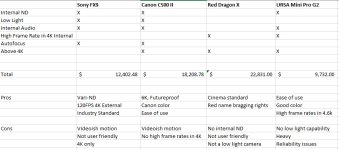
I believe the cameras that are competitive in this particular segment are as follows:

Sony FX9, Canon C500 II, Red Dragon X, URSA Mini Pro G2

The Red Dragon X I think is a stretch due to the price and lack of internal audio, so it's not really a solo camera unless you strap on some odd accessories. I also didn't include z-cam as they are still in their infancy and I don't trust them right now.
I didn't put the Amira on here because it's over $30k for a new one. I can't justify $15K for a used camera, and it doesn't shoot 4K which I also can't justify going backwards in resolution for.

A complete built out camera ready to shoot, matched with the needed accessories are as follows:

Sony FX9: $12,500
Canon C500 II: $19,000
Red Dragon X: $23,000
URSA G2: $10,000

That includes power, 1TB of media, and basic things like a handle, monitor, evf to match them with each other.
The only one that is at a disadvantage usage wise here is the Red Dragon, which does not have internal ND, and does not have internal audio.

I think the URSA G2 & FX9 are the best bang for the buck. The URSA specifically shoots above 4K and produces a great image.
I'm a Sony FS5 user currently, and I've hated almost everything about it since I got it. The color, the menus, the ergonomics, it's not fun to use. It gets the job done and that's it.
I used to have a C100 and loved everything about it, so that's why i'm excited about the C500 II. I'm also excited about having usable auto-focus.

The Red Dragon looks interesting, and isn't much more than the C500 II, but in order to put it into the same segment, i'd have to rig it up with all kinds of weird addons to get basic audio inputs and ND. I don't want to use a matte box, I don't want to run external audio, I just want the camera to work.

For low light, it would have to be the C500, the others don't come close.
For high frame rate, the Red and the URSA G2 win.
For color, motion, and cinematic look, the Red wins, with I believe the Canon coming in second.

Not sure what the answer really is at this point.

cQ9RTFg.jpg
 
The rule of thumb is that the middle of market, however defined, will deliver the best bang for the buck. (your typical Honda Accord, Toyota Camry territory)

Which is great, if someone is aiming for that niche. Eric aims at the very top of the market with an LF and the tippy top glass. PureDrifting and ChrisF have C200, which worked out very well for them. Quite possibly, there'll be a C300 MKIII announced soon too.
 
Back
Top