IATSE - 10 Days To Go

That's right. Due to the streamer's financial losses, there is a significant decline in production, which starting before the strike. The strike and it's resulting contract had nothing to do with that. But, if a company is losing money and needs to cut production expenses and someone says "It's going to cost you 14% more to use us", well, that's 14% they can't afford. So what do they do?

No, I haven't read anything about the consequences of the new contract. But each bite into the profit/loss statement has the same effect: a need to find ways to reduce costs or improve revenue. Revenue is not improving, so reduce the number of productions and lower the cost of production by not hiring stars, doing less lavish productions, sending more work overseas.

Any increases in cost of production by a new IATSE agreement won't help the situation. The high-flying days of endless money to ramp up streaming company's shot at making this a business is over. Like any bubble, when it bursts, it is very painful.

I went through the same thing in the dot-com bubble. Money was flowing like crazy. Huge bonuses, lavish parties, people jumping ship to go to start-ups hoping to get rich. And then the bubble burst and it burst quickly. I'd say half the people I knew, who had careers in technology all their lives, had to find a new way to make a living. Easily 40% of the jobs went offshore. Just like this, people lost houses, moved to other states, took jobs at Home Depot to make ends meet. It was ugly.
Yeah, it's really sad what happened to the high tech industry. There are no internet companies anymore.

It's a 14% raise on one component of production. A smaller overall increase on production costs. And that's just for writing. They could offshore the writing to India (lol) and keep the production in the US and dodge that cost.

But the bigger question is if they can offshore to begin with. And you think a marginal cost increase will change that calculus? If they can, they will. If they can't (and they certainly can't for everything) then they'll pay.

I think the bigger issue is they're not willing to maintain huge losses anymore. And I'm guessing that the huge increase in the cost of debt flipped a switch in the industry that may have otherwise been flipped later or not for everyone all at once.

But inasmuch as there was a glut of production before that was never going to last, there was always going to be a contraction in the industry. The only question was how big and when.

Whatever happens with IATSE rates will have a marginal impact on production either way.
 
As they say, don't do the crime if you can't do the time. Sure, Luke would be a fun guy to hang out with, and he's a great movie character, but he kept doubling down on stupid and brought about his own demise.

Just to be clear, I think the movie is one of the best ever made, and is on my list of top 100 films. But Luke was an a-hole and his own worst enemy. He wasn't wrongfully convicted. He did the crime and deserved punishment. It doesn't matter if his crime of vandalism didn't gain him anything personally and didn't hurt another person, he still wasted tax payer money by destroying public property, the cost of bringing him to trial, and the cost of incarcerating him for two years, and multiple manhunts after he repeatedly escapes. Yeah, a great guy. Our socienty would be so much better with more guys like him.

The rules and expectations of the prison camp were explained to him in a calm and reasoned manner. Conditions at the camp didn't seem too bad. But He chose to buck the system for no other reason than he doesn't like being told what to do. Too bad. You broke the rules, now you have to suffer the consequences and be told what to do more than ever before. And you can either learn your lesson and get back in line, or continue acting as a child would act and facing escalating punishment until you get what you really wanted - suicide by cop.

Two years might seem harsh for decapitating a few parking meters, but I'll bet that's not the whole story. There's no way a Florida judge is going to throw the book at a clean-cut white war hero for such a simple crime unless he: 1) Had a prior arrests. 2) Showed no remorse. 3) Acted like an ass in court. I think it was probably all three. But that's just my guess. The movie doesn't cover it (nor should it) but maybe the book does. I haven't read it.

Don't confuse Luke with people like Andy Dufresne, Spartacus, Tom Robinson, or Richard Kimble, who had every right to buck the system. Luke was just a charming loser who got what he deserved. There's nothing worse than someone who thinks rules don't apply to them.
It wasn't enough for them to deprive him of his freedom. They wanted to break his spirit.

But the turning point in the film is when they won't let him attend his mother's funeral. In fact, they put him in solitary confinement (which was a torture cell) during her funeral. Only after that does he try to escape, if I recall correctly.

It was a dehumanizing system
 
Abe, you have a... a... (I can't find the right adjective) way of tossing things off. The DGA, the writers, SAG-AFTRA, and IATSE; do you really think the salary and benefit increases they get are small potatoes on a movie budget? Truely? Do you mean to say AMPTP put the entire entertainment industry on hold for months for small potatoes?
 
Abe, you have a... a... (I can't find the right adjective) way of tossing things off. The DGA, the writers, SAG-AFTRA, and IATSE; do you really think the salary and benefit increases they get are small potatoes on a movie budget? Truely? Do you mean to say AMPTP put the entire entertainment industry on hold for months for small potatoes?
Yes, collectively they are substantial. Any single one is not.

AMPTP put the industry on hold so it could back out of its contracts with specific people
 
But the turning point in the film is when they won't let him attend his mother's funeral. In fact, they put him in solitary confinement (which was a torture cell) during her funeral. Only after that does he try to escape, if I recall correctly.

They put him in the box for his own good, not to punish him:
"When a man's mother dies and, uh, he gets to thinking about her funeral and paying respects, before he knows it his mind ain't right. He's got rabbit in his blood and he runs. We keeping you off the road for a while. I'm gonna say a prayer for your ma, Luke. Sorry, Luke."

And if you notice, the day they let him out he runs off anyway. So they were right. They tried to save him from himself and let him cool down for a few days, but no, Luke is too cool to cool down. As the Captain says:
Some men, you just can't reach. So you get what we had here last week -- which is the way he wants it. Well, he gets it. And I don't like it anymore than you men.

The prison was anything but dehumanizing. Go back and watch how the the guards are mostly respectful and polite. The only time they hit him was a couple of times when he pissed someone off and they whacked him in a burst of rage. And then that was all. Should they have hit him, no, but that's life and I'm sure reality in a southern chain gange was far worse than portrayed in this fictional film.

BTW, forcing him to repeatedly dig and fill the boss's ditch was not cruel, just really hard work to teach him a lesson. Once he acted contrite, they let him go back to the barracks. That's called disciplining a prisoner. It ain't a country club.
 
They put him in the box for his own good, not to punish him:
"When a man's mother dies and, uh, he gets to thinking about her funeral and paying respects, before he knows it his mind ain't right. He's got rabbit in his blood and he runs. We keeping you off the road for a while. I'm gonna say a prayer for your ma, Luke. Sorry, Luke."

And if you notice, the day they let him out he runs off anyway. So they were right. They tried to save him from himself and let him cool down for a few days, but no, Luke is too cool to cool down. As the Captain says:
Some men, you just can't reach. So you get what we had here last week -- which is the way he wants it. Well, he gets it. And I don't like it anymore than you men.

The prison was anything but dehumanizing. Go back and watch how the the guards are mostly respectful and polite. The only time they hit him was a couple of times when he pissed someone off and they whacked him in a burst of rage. And then that was all. Should they have hit him, no, but that's life and I'm sure reality in a southern chain gange was far worse than portrayed in this fictional film.

BTW, forcing him to repeatedly dig and fill the boss's ditch was not cruel, just really hard work to teach him a lesson. Once he acted contrite, they let him go back to the barracks. That's called disciplining a prisoner. It ain't a country club.
Right...

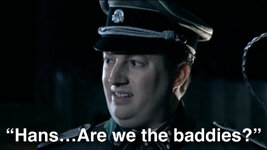
Did you ever see this sketch?
are we the baddies.jpg

You say they put him in the box for his own good, not to punish him...

First of all, the box is torture. It's not just solitary confinement (which some people consider torture). It's too small to lie down in. It's a stress position chamber.

And they're not doing it to punish his transgressions. They're doing it to make their work easier IN CASE he tries to escape.

"Sorry your mom died, Luke. Now we're gonna torture you for your own good during your moment of grief."

His escape attempt after does not justify this punishment. (How could it ever, after the fact?) His mom is already buried. The original reason they punished him is moot.

Even a casual viewer will understand that he decides to escape BECAUSE of the dehumanizing punishment during his mourning. That's the moment he decides to stop participating.

They could have given him temporary leave to attend the funeral. He was a non-violent offender with a short sentence.

"The only time they hit him..." lol

Repeatedly digging and filling the ditch... Sure, it's just hard work...

I think the significance there is symbolic. It's useless toil assigned in a grammatically confused way ("what's your dirt doing in my ditch") and doled out in contradictory instructions. It's a Sysyphean task.

Cool Hand Luke is an existentialist parable with generalizable themes.

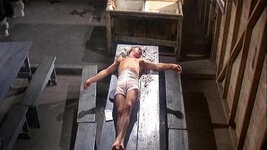
Then, of course, there's the heavy religious symbolism and overt comparison to Christ.
 
One fictional character using symbolism from another fictional character, that's rich.
1967 Cool Hand Luke cruciform.jpg

that's funny. this was after he eats the eggs. then of course he's cornered in a church at the end. I think the final shot is an aerial shot of a crossroads where the gang is working and it looks like a cross

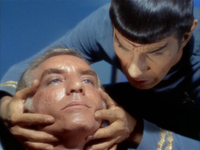
here's man with no eyes and him in his role in star trek: dagger of the mind

CoolHandLuke_009Pyxurz (1).jpg
Simon_Van_Gelder.png
Vulcan_mind_meld.png
 
that's funny. this was after he eats the eggs. then of course he's cornered in a church at the end. I think the final shot is an aerial shot of a crossroads where the gang is working and it looks like a cross
Yeah, real subtle with the so-called symbolism. Kind of silly, don't you think? Maybe you didn't notice that the picture of Luke and the whores is pasted back together -- also in the shape of a cross. Ooooooh, that's deep. If that kind of heavy-handed corny stuff enhances your enjoyment of the movie, then so be it. I choose to ignore it and enjoy the rest of the film. A classic.
 
Yeah, real subtle with the so-called symbolism. Kind of silly, don't you think? Maybe you didn't notice that the picture of Luke and the whores is pasted back together -- also in the shape of a cross. Ooooooh, that's deep. If that kind of heavy-handed corny stuff enhances your enjoyment of the movie, then so be it. I choose to ignore it and enjoy the rest of the film. A classic.
the symbolism is significant because it contextualizes how the storytellers view the character. it leads your interpretation of him and causes you to draw parallels and contrasts between him and Christ. I'm not saying that more symbolism equals more better. and yes, I agree it's a bit heavy-handed. but people sometimes do that when they don't want their point to be missed.
 
the symbolism is significant because it contextualizes how the storytellers view the character. it leads your interpretation of him and causes you to draw parallels and contrasts between him and Christ. I'm not saying that more symbolism equals more better. and yes, I agree it's a bit heavy-handed. but people sometimes do that when they don't want their point to be missed.
Utter nonsense. Symbolism is nothing but pretentious horseshit and can be applied to everything and anything in a story if someone wants to feel like they have some kind of special insight into the mind of the director/author. Do you want me to tell you what Luke eating the eggs represents? How about his mother in the riding in the back of a pickup truck? How about the pepper and curry he spreads on the ground to screw with the bloodhounds? How about the prisoner's preoccupation with "cold drinks"?

And I must say, the Christ stuff is about as lazy as "symbolism" can get. Personally, I reject symbolism in all film and literature. I just want an entertaining story.
 
The eggs are obviously a reference to Easter/rebirth and eating 50 is like a miracle (loaves and fishes but sort of in reverse).

Disliking symbolism is like disliking adjectives and adverbs. People use them. They're a part of communication. They enrich the dialogue and you've only impoverishing yourself by ignoring them. Or maybe the more literal analogy is that symbolism is like analogies.

On one level, it's just kind of a joke. It's funny to compare a purposeless vandal to Christ, especially for eating 50 eggs.

On another level, the author probably had the story of Christ ingrained in him, so its facets came readily to his mind.

And then something interesting happens when the viewer makes the connection and overlays whatever associations they have with Jesus onto Luke, complicating their relationship to the character.

And there are clear parallels. Like Christ, Luke was a threat to authority. His indomitable spirit was the true problem. Not his actual crimes.

I don't give a tinker's dam about gaining insight into the writer's mind or scoring points by guessing their intent. But in this case the intent is apparent.

I think that stories take on a life of their own outside the writer and beyond their intentions. Some of the meaning probably isn't even consciously known to them. But I think it's worth noting that the writer probably had a positive outlook on the character.

Another movie that comes to mind because it's chock full of symbolism is Get Out. In Get Out, he escapes his fate by plucking the stuffing out of his chair and plugging his ears. He literally has to pick cotton to gain his freedom. The irony is palpable since African-Americans were enslaved to pick cotton.

is that symbolism, per se? I dunno. But it's funny. And it's a good plot device.

These things are complicated and fluid. Cool Hand Luke is a rich, multilayered text.

What does it mean that they drive over the sunglasses at the end? That's obviously symbolic or at least ironic.
 
Driving over the sunglasses and breaking them is supposed to indicate that Luke broke his overseers. In some way, he beat them. And fractured their emotionless facade.
 
Driving over the sunglasses and breaking them is supposed to indicate that Luke broke his overseers. In some way, he beat them. And fractured their emotionless facade.
Are you serious? Luke won? How ridiculous.
Is this more stuff you just found online, or are these your original thoughts? Either way, I'm not going to waste my time explaining how wrong you are.
 
Are you serious? Luke won? How ridiculous.
Is this more stuff you just found online, or are these your original thoughts? Either way, I'm not going to waste my time explaining how wrong you are.
He's smiling as they drive away. Do you think he wanted to live a long, happy life and settle down? And no, I didn't find any of this online. But when I searched for the shot of him as Christ, there's a wealth of commentary discussing the religious significance.

I mean, it's obvious. They shot and edited in a CU of the iconic sunglasses of the man with no eyes being crushed by the car that takes him away. Right after he very pointedly turns and smiles at the camera.

Whether or not you choose to acknowledge it, there is meaning being communicated there.

I'm not saying it's not a tragic ending. He's a tragic figure. But, like Christ, he may have willfully accepted his fate (engineered it, even). The plot of Jesus Christ Superstar (which is where I learned most of what I know about Christ) hinges on the idea that Christ had to die to cement his legacy. He was a willing participant in his own demise, and Judas' betrayal was a necessary part of the plan.
 
Back
Top