
Navigation
Install the app
How to install the app on iOS
Follow along with the video below to see how to install our site as a web app on your home screen.
Note: This feature may not be available in some browsers.
More options
You are using an out of date browser. It may not display this or other websites correctly.
You should upgrade or use an alternative browser.
You should upgrade or use an alternative browser.
IATSE - 10 Days To Go
- Thread starter Paul F
- Start date

Doug Jensen
Carbonite Member
Unfortunately, that's not a metaphor. You better look up the meaning.
The glasses getting crushed is just a cool shot to end the scene on. Why can't that be good enough for you?
Luke died, but the guard broke his cheap aviators. Yeah, I guess Luke was the winner.
Do you believe in apophenia? Apophenia is a term used to describe the human behavior of finding meaning in instances where no such meaning exists. Based on your comments on this thread and the previous thread about that awful Julia Roberts movie (who can even remember the name??), I think you have a bad case of apophenia.
The glasses getting crushed is just a cool shot to end the scene on. Why can't that be good enough for you?
Luke died, but the guard broke his cheap aviators. Yeah, I guess Luke was the winner.
Do you believe in apophenia? Apophenia is a term used to describe the human behavior of finding meaning in instances where no such meaning exists. Based on your comments on this thread and the previous thread about that awful Julia Roberts movie (who can even remember the name??), I think you have a bad case of apophenia.
Last edited:
Doug Jensen
Carbonite Member
You might learn something from this article:

 johntreed.com
"Oprah had Cormac McCarthy on her show, I think to discuss The Road; it was one of his only interviews as he is apparently not given to speaking in public. Oprah kept trying to get themes out of McCarthy and finally he turned to her and said something like, "Sometimes a book is just a good yarn." End of discussion."
---
" . . . my entire class was assigned to read To Kill A Mockingbird by Harper Lee. After we read it and discussed it in class, including many of our instructors urging us to find and discuss the symbolism in it, Harper Lee came to our college and addressed an assembly of our entire class. After her remarks, she took questions. Many were asking her about the symbolism of various things in the book. She denied there was any symbolism. As the questions persisted, she became testier and said she was just trying to write a book that a publisher would buy and publish and hopefully sell the movie rights as well. She was a starving writer trying to make a buck, she explained. Starving writers have no time for symbolism and are darned sure not going to risk getting rejected to put hidden meanings into a book. She was just trying to write a good, salable story, she insisted. In spite of those remarks, yet another student insisted on asking, But what about the fact that a number of the characters were named after Confederate generals. Surely there must be symbolism in that? In a voice as cold and angry as a red-necked, Alabama sheriff confronting a civil rights marcher, she said, "Those characters in the book were white trash. In the South, all the white trash are named after Confederate generals."
The silliness of looking for symbolism in literature
I hate people who look for symbolism in literature. I especially hate English teachers who did that and who tried to make me and/or my sons find symbolism.In the vast majority of cases, there is none.To Kill a MockingbirdWhen I was a junior in college, my entire class was assigned to read To...
johntreed.com
"Oprah had Cormac McCarthy on her show, I think to discuss The Road; it was one of his only interviews as he is apparently not given to speaking in public. Oprah kept trying to get themes out of McCarthy and finally he turned to her and said something like, "Sometimes a book is just a good yarn." End of discussion."
---
" . . . my entire class was assigned to read To Kill A Mockingbird by Harper Lee. After we read it and discussed it in class, including many of our instructors urging us to find and discuss the symbolism in it, Harper Lee came to our college and addressed an assembly of our entire class. After her remarks, she took questions. Many were asking her about the symbolism of various things in the book. She denied there was any symbolism. As the questions persisted, she became testier and said she was just trying to write a book that a publisher would buy and publish and hopefully sell the movie rights as well. She was a starving writer trying to make a buck, she explained. Starving writers have no time for symbolism and are darned sure not going to risk getting rejected to put hidden meanings into a book. She was just trying to write a good, salable story, she insisted. In spite of those remarks, yet another student insisted on asking, But what about the fact that a number of the characters were named after Confederate generals. Surely there must be symbolism in that? In a voice as cold and angry as a red-necked, Alabama sheriff confronting a civil rights marcher, she said, "Those characters in the book were white trash. In the South, all the white trash are named after Confederate generals."

ahalpert
Major Contributor
the sunglasses are iconic. there's a reason we call that character the Man With No Eyes and there's a reason the shot of his sunglasses has been copied and parodied elsewhere, such as in the Simpsons

ergo I believe breaking the sunglasses has a greater significance than the monetary loss for the character. the sunglasses are part of the authority. cold, steely, reflecting the world, obscuring his humanity.
the thing is -- I know for a fact that writers/filmmakers communicate in symbols and metaphors. Maybe not all of them do. Although that would be odd. But I'm not looking for meaning and connections where there isn't any. This is part of the language. A language that you choose not to speak.
I'm not the only one:
 www.filmycks.com
ergo I believe breaking the sunglasses has a greater significance than the monetary loss for the character. the sunglasses are part of the authority. cold, steely, reflecting the world, obscuring his humanity.
the thing is -- I know for a fact that writers/filmmakers communicate in symbols and metaphors. Maybe not all of them do. Although that would be odd. But I'm not looking for meaning and connections where there isn't any. This is part of the language. A language that you choose not to speak.
I'm not the only one:
The mirrored aviator glasses of the head guard 'No Eyes' reflect the chain gang and become a metaphor as they fill the screen, the cold, god-like gaze of 'No Eyes' will haunt Luke the remainder of his stay.
Filmycks » Cool Hand Jesus? or, Old 'No Eyes' is back
A review of Cool Hand Luke by Michael Roberts
www.filmycks.com
at 7:45 from an interview with the author -The true subject had nothing to do with prison or criminality, as a matter of fact. It was the condition of the human race.
Doug Jensen
Carbonite Member
You are in denial. Seek help. I am done with this conversation because I can't help you.But I'm not looking for meaning and connections where there isn't any.
ahalpert
Major Contributor
Everyone and his uncle sees the Christ symbolism in the movie. It's lousy with it. Christ symbolism is also just super common in Western storytelling. Get a grip!You are in denial. Seek help. I am done with this conversation because I can't help you.
.... Either way, I'm not going to waste my time explaining how wrong you are.
I am done with this conversation because I can't help you.
Doug Jensen
Carbonite Member
Just when I thought I was out, they pull me back in.C'mon now Doug, Don't stop now. The third time's a charm.
I am enjoying this exchange. But I don't understand the expression of frustration on your part. Abe's brain works different from yours. Vive la différence.
Some men, you just can't reach. So you get what we have here in this thread. Abe wants to see symbolism in every shot and he believes somehow that makes the movie more enjoyable. Well, he gets it. But I don't like it anymore than you men, who just want to enjoy a good movie and leave the silly ham-handed Jesus references at the door.

CharlesPapert
Director of Photography
Paul, you just described the state of the industry right now. I personally have a number of colleagues who are driving Ubers, have left the business and moved out of LA or planning to soon. It's tragic.
It is tragic. The stress these people go though. It can be suicide level stress. They wallow around for a couple of years trying to find solid ground. Going to school for a new career, too old to start over, taking what they can get. It takes a toll. Some recover, but many I know; their financial position never recovered.
Last edited:
ahalpert
Major Contributor
It's a goddamn shame. I suppose that after the dust settles, whoever is left should be able to find enough work in the new equilibrium... But it's terrible what's happening to people.Paul, you just described the state of the industry right now. I personally have a number of colleagues who are driving Ubers, have left the business and moved out of LA or planning to soon. It's tragic.
By the way, I wanted to apologize about the crack I made in the LED vs tungsten thread about huffing copium and whatever helps you sleep at night. I hope you know how much I respect you and your work. And I'm sure the difference is minor now and I might fail a blind comparison test. It was said in jest but I realized that on the surface it was a rude comment and I wanted to clarify the intent.
CharlesPapert
Director of Photography
Oh no worries Abe, I wasn't bumped at all. You were probably just chippy fresh from sparring with Doug about "Cool Hand Luke"...! I meant to respond with something like "is Copium avail on Amazon? Could use some help sleeping" but forgot. I'll take any good natured ribbing from the regulars here, after all we gotta have some fun with all this terribly serious talk about COB's and Bayer sensors.
I was just thinking what it would take to put together that blind test...Maybe while prepping gear for my short film I can get around to busting it out. I'm curious myself. I have constantly been fooled by such things in the past, and it really forced me to re-evaluate my attachment to certain types and brands of gear. What's funny is that I've seen many people over the years turn down the opportunity to try such things, whether film related or food/drink. They don't want to know that they might end up picking the thing they have always considered inferior, so they just won't engage.
I was just thinking what it would take to put together that blind test...Maybe while prepping gear for my short film I can get around to busting it out. I'm curious myself. I have constantly been fooled by such things in the past, and it really forced me to re-evaluate my attachment to certain types and brands of gear. What's funny is that I've seen many people over the years turn down the opportunity to try such things, whether film related or food/drink. They don't want to know that they might end up picking the thing they have always considered inferior, so they just won't engage.
The most famous of these on DVXUser being the Zacutto camera tests. Talk about people falling apart. It was all happy banter as the blind tests were shown and everyone was guessing what clip was from what camera. Then it got ugly very fast when the cameras were revealed. It was shameful how people behaved.


Abe, did you see this symbolism when you watched the movie? Did you instantly recognize Luke as Christ when he was laying on the table?the symbolism is significant because it contextualizes how the storytellers view the character. it leads your interpretation of him and causes you to draw parallels and contrasts between him and Christ. I'm not saying that more symbolism equals more better. and yes, I agree it's a bit heavy-handed. but people sometimes do that when they don't want their point to be missed.
I'm most-curious about this as my brain works like Doug's. I don't see symbolism when I watch movies and I don't get the point of symbolism. I found your explanation of why it is there to be useful. But I still don't get it. I mean, if you can't get your message across on it's own, symbolism, well, it seems pointless to this brain. Like Coppola and his stupid oranges in The Godfather. There's no way anyone saw any relationship between oranges and death. What's the point? An inside secret?
As a side note, for my short, I put oranges in each scene that preceded a death. The cast a crew all asked "What's with the oranges?". When I told them it was an homage to Mr. Coppola, they all thought it was cool. I think it's stupid, but fun.
ahalpert
Major Contributor
I can't remember what i noticed the first time i saw it as an adolescent. I definitely didnt notice the cross-shaped tape-job on his photo which the internet brings up. That's a very weak signal, sort of a kitchen sink approach.Abe, did you see this symbolism when you watched the movie? Did you instantly recognize Luke as Christ when he was laying on the table?
I'm most-curious about this as my brain works like Doug's. I don't see symbolism when I watch movies and I don't get the point of symbolism. I found your explanation of why it is there to be useful. But I still don't get it. I mean, if you can't get your message across on it's own, symbolism, well, it seems pointless to this brain. Like Coppola and his stupid oranges in The Godfather. There's no way anyone saw any relationship between oranges and death. What's the point? An inside secret?
As a side note, for my short, I put oranges in each scene that preceded a death. The cast a crew all asked "What's with the oranges?". When I told them it was an homage to Mr. Coppola, they all thought it was cool. I think it's stupid, but fun.
I'll rehash what I remember (some of which has been reminded by looking the movie up for the purpose of debating with Doug). Spoiler alert.
In the scene where Luke is cornered in a church at the end of the film, he speaks directly to God and asks him angrily if this was his plan for him. Something like that. I think Jesus angrily confronted God in a similar fashion (at least he did in Jesus Christ Superstar.) Luke is shot and killed at the end of the scene.
Speaking to God in a church before his murder is a strong indicator that this is an important theme. I don't remember anything like this happening in Butch Cassidy or the Sting (two other Paul Newman movies).
So it's hard not to see the parallel between him being cornered in a church and Christ being arrested I'm the garden of Gethsemane. Luke even has a disciple with him who goes on to tell the story (gospel) of Luke after his death (this happens at the very end of the film).
Those facts alone make the story a strong Christ allegory.
And his inmates do indeed become his disciples. They don't think much of him when he first arrives. By the end of the film, they're his followers. The inmate with him at the end even follows him on his final escape attempt.
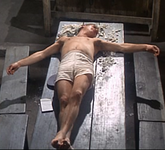
Then of course there's the cross position he's laid out in after he eats the 50 eggs, on top of a wooden table when everyone leaves him alone there (for no reason) at the end of the scene.
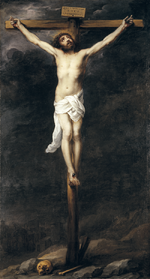
He even has crossed ankles as in this image of christ on the cross (the first Google hit)
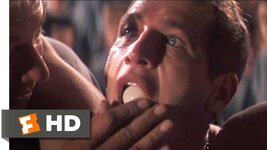
As I mentioned, eggs are associated with Easter. Eating so many could be considered a miracle in a similar vein to multiplying the loaves and fishes. And they're fed to him by his fellow inmate in a manner akin to receiving communion (which isn't that important on its own but contributes to the general religious symbolism)
Then there's the scene where the wardens make him dig until he's so tired that he passes out into the ditch he's dug. He has fallen (into his grave) but will rise again.
Then there's the scene where he fights his fellow inmate and won't stay down. He keeps getting up to get hit again (could be a reference to turning the other cheek).
Then there's the use of music. The song I remembered was that after his mother dies he sings a song about Jesus that includes the lyric "going 90 but I ain't scary because I got the virgin Mary assuring me that I won't go to hell".
I recently rewatched the scene where his mom visits and someone in the background is singing a song about walking with God.
Then there's the image of the crossroads as the final frame of the film, which I do think is a noticeable cross unlike the photo. When I looked it up to find the image, I found it on a blog that said the shot is like the apotheosis of Luke because the camera is rising up to heaven in an aerial shot after his death. And it's true that it's a notable aerial shot and movement. I'm not sure there are any others like it in the film.

Even cutting the heads off parking meters has a vague parallel to throwing the money changers out.
And I'm sure there's symbolism I've forgotten or didn't occur to me. Some of it is trivial (kitchen sink) and some of it is unmistakable.
I think the purpose is to make you question the meaning of Luke's actions and the system he operates in. And that law and order conservative viewers who just see him as an a-hole might draw parallels to another famous outlaw murdered by the state whom they have very different feelings about.
As for Luke's philosophy, he was definitely an anarchist. Destroying the parking meters to "free" parking. And being a war hero and getting promoted only to be demoted back to private. He was capable neither or giving nor taking orders. Anarchists don't necessarily want chaos. They want to live in a sort of informal, pre-governmental society. Not that dissimilar from libertarians.
As for the glasses breaking at the end -- Luke's victory is that they didn't break him. They didn't want to kill him. And they didn't want to just imprison him. They wanted to condition his mind to be obedient (as with the main character at the end of 1984). And there's a moment in the film after Luke is recaptured that he pretends to be docile and obedient. It's a bit sickening. But he dies with his true freedom intact, which is why he's smiling at the end.
Last edited:
ahalpert
Major Contributor
To be honest, I didn't fully realize what the movie was trying to say until I tried to explicate it here in rebuttal to Doug
I think you could compare the theme to One Flew Over the Cuckoo's Nest, where it was preferable to die than to live like a zombie. Or A Clockwork Orange, where the main character was truly bad, the lowest scum, and yet depriving him of his free will was even worse.
I think you could compare the theme to One Flew Over the Cuckoo's Nest, where it was preferable to die than to live like a zombie. Or A Clockwork Orange, where the main character was truly bad, the lowest scum, and yet depriving him of his free will was even worse.
Last edited:
Thanks for the extended notes. But they don't address the points I'm interested in.
1 - Since it was too long ago, and you were young, my first question is moot. What symbolism did you observe the first time you saw it?
2 - But let's ignore that question and pretend you did see the symbolism. What do you get out of seeing the symbolism. Maybe that's not the way to phrase it. How does symbolism enhance the movie?
3. Regardless of whether you saw the symbolism or not, what's the point of it? Yes, you explained "the symbolism is significant because it contextualizes how the storytellers view the character." ....... To what end? What value does that have..... that Luke is like Christ?
4. Ok, this one is a stretch - What percentage of people do you think observed this symbolism the first time they saw the movie?
1 - Since it was too long ago, and you were young, my first question is moot. What symbolism did you observe the first time you saw it?
2 - But let's ignore that question and pretend you did see the symbolism. What do you get out of seeing the symbolism. Maybe that's not the way to phrase it. How does symbolism enhance the movie?
3. Regardless of whether you saw the symbolism or not, what's the point of it? Yes, you explained "the symbolism is significant because it contextualizes how the storytellers view the character." ....... To what end? What value does that have..... that Luke is like Christ?
4. Ok, this one is a stretch - What percentage of people do you think observed this symbolism the first time they saw the movie?