XL2 - low light performance really poor?

paulears

Veteran
I've never used an XL2 (or any Canon to be fair) myself, but last night I was PM for theatre show where the visiting company had a rear projected screen and an onstage XL2 so that the performer (a spiritualist) could talk to somebody in the audience, and they, with a radio mic could talk back, with their face being seen on the on stage screen. I've done this kind of show many times in the past with the visitors providing many different cameras, but the Canon simply had no picture at all with the in-house lighting in the auditorium. I added 2 Fresnels to the hanging lighting truss to light the audience - both were 2Ks with 10" lenses. They managed to produce enough light for the first 12 rows or so, but further back was still missing, so I added 2 more 2Ks to cover the further rows - but sitting in the seats was very unpleasant - a 2k shining straight at you makes you squint a bit! I ended up moving these to the sides to clear them from the eyeliner, but this meant the Canon needed 8K of extra light, over and above the normal house lighting to function! This was with what appeared to be 18db gain - as seen in the viewfinder.

I've always read about people really liking these when they were new. Was the low light performance always this bad? The last show had a couple of EX-1s and they were super with no added lighting.
 
Yes. Under tungsten lights the effective ISO of my GL2, same 3-chip sensor and processing as the XL2, is about 50-100 ISO at 0 gain. I was shooting an art studio demonstration last week under mixed tungsten and fluorescent lighting that measured 40 foot candles and optimum exposure by the incident light meter at 100 ISO 1/60sec shutter and 0 gain was f1.4. I was shooting 2 stops under by the camera meter at 0dB gain f3.2 to get adequate depth of field. I Never use 18dB gain as it is too noisy and you lose to much DR.
 
Last edited:
The particular user used to have a couple of older Sony cams, and bought these canons from another act doing the same kind of things - so can't see what the problem is - but many auditoriums nowadays run at lower light levels than in the past as they swap to more energy efficient light sources, and I'm not sure every venue would be able to find this much extra light for the auditorium. At least I know it wasn't me being unable to find some magic gain feature! My JVCs even though noisy at the high gain settings would at least have managed to produce a colour output - the Canon just produced an unsaturated weakish colour in the event - even with the gain in. Thanks for the update. Paul
 
I evolved through Canon's DV cams from the XL1, XL1se, and XL2... I agree the working ISO of the XL2 was somewhere around 120-200 since when I used it with a 35mm adapter and would lose 1-2 stops of light and my working ASA become 60-80. A much better camera in those days for low light was the VX2000 and even better the PD-150.

Having said all that, if my math is right it equates to needing around 336 foot candles of light to get around f4.

Now go look up the specs of your lighting and see at how many feet how many foot candles you would have.. . the results are probably quite shocking and confirm your conclusions on the amount of power needed for the XL2.
 
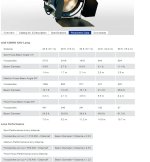
Below are ARRI 12,000W fixture specs. Note the photometric data. At around 50 feet in distance and with a beam diameter of 26.8 feet, you are getting about 222 foot candles. But flood that light out wider to a beam diameter of 60ft and soon you are down to only 87 foot candles.

With a modern camera at 800ISO 87 foot candles will give you around f5.6.

arri12000.jpg
 
Back
Top