Other: XAVC Long GOP 4K 10Bit 4:2:2 200Mbps ANNOUNCED

See the answer above. Smaller is not a desirable feature for ENG cameras. Function dictates form and the Betacam/F800/F900/Z450 form factor is just about perfect for handheld shooting and even by far the best for tripod.

Yes. You are correct, sir.
 
agreed .. a doc/news camera .. you cant put on your shoulder with a side mounted EVF.. you might as well just go straight to the hospital and book yourself in for back surgery ..
 
Forget the codec, it's the camera that is the real news. I've already seen it at NAB and it is killer. 4K, 3-chip, CMOS, global shutter, S-LOG, native B4 mount, with all the bells and whistles of a traditional ENG shoulder-mount camera. This camera will become the go-to camera for sports, wildlife, news, run & gun, etc. I'll have one in my hands soon for testing and I'm already thinking my F55's days might be numbered. I'm so looking forward to getting back to an 22x servo zoom lens. Sadly it won't have variable ND, but I lived without that for 40 years so I'll manage.

I've had the F55 since 2013, already ridden its probable market value to the bottom, that can only continue, yet it's still a higher tier camera than 95%+ that's out there regardless of spec. It's a known quantity that I've taken care of, it's taken care of me, why unload it now?

I can hear the 2/3rd's shoulder mount nostalgia in your voice, a shoulder mount eng shooting style I liked too but its targeted for live broadcast, live events, news. I can't use it because it's too big for weddings, none of my peers would dare try, pan it to the right and slap a guest on the cheek with the lens, bang it on the walls inside the dressing rooms. The F55 is too big as well but you can plop it on a tripod for long reach shots of the ceremony, same as a shoulder cam. For stock footage shoulder cam can work well but its connectivity features go under utilized. I wish there was an answer, but the F55 is still relevant, it's not a dog and I'm not putting it down. :happy:
 
If I had an F55 there is no way I would be ditching it. Or my FS7 for that matter. The F55 is a beautiful dog. But there again there is certain TV work where they just don't want S35 type material and where they still request of all things my PDF XDCam. It sits there looking quite forlorn at times but hell when I work with it with its beautiful 22 x parfocal lens I do have to admit that from a point of pure functionality it just about kills anything else in ergonomics. If I have close quarters cramped shooting, like in the cab of construction tower crane way above the cityscape even an FS7 or F55 is a lump to work with. I got face shots of the crane operator with a Z90 in spots I couldn't even fit the bigger cameras in. Funny you mention slapping a guest on the cheek with an ENG camera. Years back on a presser I turned around with a Beta camera on my shoulder just in time to smack the Australian Governor General in the head with the V Loc battery. Security descended on me from every direction. I apologized and the GC looked at me somewhat awry with a grin and waved security away. A touch embarrassing I must admit.

Chris Young
 
That Z750 looks like a very solid performer. And certainly love the ENG form factor. They say... " In fast-moving applications where capturing a second shot is not possible, the Z750 is the ideal choice.” But at the price range this will be - seems odd that Sony left off the variable ND and even dual ISO.
In very related news - Fuji announced two new 2/3-inch UHD broadcast lenses - https://www.newsshooter.com/2019/08/24/fujinon-announces-two-new-2-3-inch-uhd-broadcast-lenses/
 
I think for 2/3” ENG cams variable ND isn’t as big a deal. I love vari ND and do believe it’s an amazing advancement in the tech, but it’s really a tool for applications where you don’t want to mess with your depth of field. With ENG that’s not really a thing, most stuff is so fast moving and fluid that your fingers are always on the iris riding it, and regardless of the situation you’re not going to get a super shallow dof with that sensor.

I like the Amira as the bridge between the 2/3” world and the S35 world. With the proper lens it can give you the same balance, it has physical switches where you want them, and you don’t need to rig it out. Throw it in a camera bag and go.
 
If I had an F55 there is no way I would be ditching it. Or my FS7 for that matter. The F55 is a beautiful dog. But there again there is certain TV work where they just don't want S35 type material and where they still request of all things my PDF XDCam. It sits there looking quite forlorn at times but hell when I work with it with its beautiful 22 x parfocal lens I do have to admit that from a point of pure functionality it just about kills anything else in ergonomics. If I have close quarters cramped shooting, like in the cab of construction tower crane way above the cityscape even an FS7 or F55 is a lump to work with. I got face shots of the crane operator with a Z90 in spots I couldn't even fit the bigger cameras in. Funny you mention slapping a guest on the cheek with an ENG camera. Years back on a presser I turned around with a Beta camera on my shoulder just in time to smack the Australian Governor General in the head with the V Loc battery. Security descended on me from every direction. I apologized and the GC looked at me somewhat awry with a grin and waved security away. A touch embarrassing I must admit.

Chris Young

I live in a world where I straddle the line and time is split between my F55/C300 and my (2/3”)P2 VariCams. Outside of sit-downs, when I’m shooting, I’m at my happiest with my Vari’s. Nothing beats the ergonomics, operability and lens range.
 
I am shooting with my Z280 more often than my F55 or FS7 for the very same reasons. The Z750 makes a lot of sense and I'd just keep the FS7 around for interviews and specialty shots. But really, even interviews are not that hard to make look nice with a 2/3". We all did it for decades with Betacam and now daylight balanced LEDs have made things even easier. The lure of 2/3" ENG cameras and lenses is hard to resist for those who have used them before.
 
+1. A good read DJ. Makes a lot of sense to me. I would rather have a 422 10-bit AVC H.264 codec to work with any day over a 420 10-bit HEVC codec. The 10-bit aside when it comes to hard grading or chroma keys the H.264 422 color depth just stands up so much better to pushing around and is infinitely easier to work with even in Resolve on a decent platform.

Chris Young
 
Thanks for sharing the Sony document Doug. I think it`s wise to stick with H264 as it is easy to edit compared to HEVC.
 
This thread is a little confusing to me as it is not clear if it is about the camera or the codec (I assume the camera has the codec)

My interest was if the codec might come to the Sony mirrorless cameras, which might push them into a new class (a class that would suggest they might properly intercut with my FS7)

Any thoughts?
 
This thread is a little confusing to me as it is not clear if it is about the camera or the codec (I assume the camera has the codec)

My interest was if the codec might come to the Sony mirrorless cameras, which might push them into a new class (a class that would suggest they might properly intercut with my FS7)

Any thoughts?

I highly doubt it will ever come to the domestic/prosumer mirrorless market cameras as all Sony's professional codecs are MXF based which means they have the capability to maintain an audit line from camera metadata through to production, distribution and transmission for program traffic monitoring and copyright payments. Really not a requirement for the mirrorless market.

Last but not least is that MXF is now almost the de-facto standard for broadcast servers. Sony's XDCAM MXF is supported by Adobe After Effects, Adobe Premiere Pro, Apple Final Cut Pro X, Autodesk Smoke, Avid, Capella systems, Dalet, EVS, Imagine Communications Corp., Omneon, Quantel, Rhozet, Root6, Sony Vegas Pro, Sorenson Squeeze, Telestream FlipFactory, GrassValley EDIUS, Grass Valley K2, and Merging Technologies VCube. That goes a long way towards acceptance of a standard as it is recognized by SMPTE and the EBU. Again this is not an area where mirrroless cameras are used in the mainstream of production.

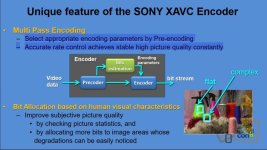
With the case of the Sony mirrorless cameras they are all base H.264 which doesn't comply with current broadcast requirements for a transparent material exchange format (MXF) wrapper. For all new cameras to comply with the SMPTE MXF wrapper the codec and wrapper have to be submitted to SMPTE for ratification. Can't see Sony ever doing that with the mirroless cameras. Before they could go there the codec on the cameras would most likely have to be 422 10-bit to even meet the most basic of SMPTE's MXF certifications I would expect. Currently all Sony mirrorless are based around the bog stock standard H.264 or MPEG-4 Part 10, Advanced Video Coding (MPEG-4 AVC) base. This is miles away from the Multi Pass pre-encoding that's done in real time by cameras that record in the full XAVC-L and I codecs in HD or 4K. This pre-encoding does not happen with the lower order XAVC-S codec/wrapper cameras. In breakdown tests the Sony 422 10-bit 50Mbps XAVC-L codec performs on a par with single pass MPEG-4 Part 10 at around 150Mbps. That's why I find it it a bit disingenuous when you hear people comparing one camera's bit rates to another camera's bit rates. You cannot just base image quality comparisons on bit-rate alone. So many people fall into that trap. How the signal is encoded has a massive effect on the end result especially when it comes to complex motion prediction which is part of the strength of the XAVC-L and I MXF pre-encoding techniques found in the 'broadcast' codecs as opposed to the broadcastable codecs in other cameras. Getting on in years but a better understanding of the Sony XAVC codec as it applies to the MXF world can be found here if anyone wants to know more.

Chris Young

https://bento.cdn.pbs.org/hostedben...3/04/18/gaggioni_xavc-pbs-conf-2013-v05_1.pdf

and page 12 here

https://www.xavc-info.org/xavc/share/data/XAVC_SpecificationOverview_Rev2_2.pdf

Sony rarely mention it but pre-coding was also mentioned here at 06:12:

https://vimeo.com/138861804

and with the most in depth explanation here at 11:12:

https://vimeo.com/84539333

Sony XAVC precoder.jpg
 
Last edited:
My interest was if the codec might come to the Sony mirrorless cameras, which might push them into a new class (a class that would suggest they might properly intercut with my FS7)

Any thoughts?

I doubt this as well... but man oh man... if Sony wants to really shake up the game....DO IT ! (Sam - I don't have any problems getting my a6300 (for gimbal) & FS7 to "match").

That's why I find it it a bit disingenuous when you hear people comparing one camera's bit rates to another camera's bit rates. You cannot just base image quality comparisons on bit-rate alone. So many people fall into that trap. How the signal is encoded has a massive effect on the end result especially when it comes to complex motion prediction which is part of the strength of the XAVC-L and I MXF pre-encoding techniques found in the 'broadcast' codecs as opposed to the broadcastable codecs in other cameras. Getting on in years but a better understanding of the Sony XAVC codec as it applies to the MXF world can be found here if anyone wants to know more.

Chris Young

Chris - another excellent post that's a definite +1. I'm not a Sony fanboy - but lots of folks forget that a huge part of the FS7 success is the codec options available. And I think Doug and others have proven on this forum that one doesn't gain a whole lot by shooting Raw instead of XAVC-I.
 
This thread is a little confusing to me as it is not clear if it is about the camera or the codec (I assume the camera has the codec)

My interest was if the codec might come to the Sony mirrorless cameras, which might push them into a new class (a class that would suggest they might properly intercut with my FS7)

Any thoughts?

Just thinking that the combination of the PreCoder and the Encoder may generate more heat than the small A7 bodies can reasonably dissipate???
 
And I think Doug and others have proven on this forum that one doesn't gain a whole lot by shooting Raw instead of XAVC-I.

I thought that for a while too based mostly on what was being said, but I think Sony 16 bit RAW is much cleaner now that I've used it. Not sure if apparent in these videos or not, but the F55 16 bit RAW was superior imo. I shot them all from house-left to stage-right during TEDxBoulder 2019 Spring "Within and Without." All are tighter shots made with Red 300mm Pro Prime PL. The other shooters were shooting wide. The 16 bit raw was powerful. I'll be shooting this again October 19th at Mackey Auditorium. All were in 4k-UHD but the client posted the videos in 1080p.

https://tedxboulder.com/videos
 
And I think Doug and others have proven on this forum that one doesn't gain a whole lot by shooting Raw instead of XAVC-I.

Thanks for the kind words markfpv. XAVC vs RAW, IMHO RAW most assuredly has the edge but from a practical economic time wise viewpoint for 99% of my work RAW is not a justified workflow. As you say DJ and many others have found that XAVC and others when using P2 AVC from Panasonic have long proven these to be very efficient high quality 10-bit codecs and when used correctly prove that a very high quality product can be delivered at reasonable bit rates with reasonable file sizes.

For many years I did all the maintenance on our analogue equipment. When we went to digital VTRs and cameras I realised how little I know of the digital domain. I like knowing how things work so back to college in the evenings to study television engineering. Four years later when qualified I became a registered member of SMPTE. SMPTE opened up a whole new world on the digital development front for me with and gave me access to all their white papers. Codec technology is the leading edge of image capture and distribution so it became a very fascinating area for me. The quality that came about when Panasonic introduced digital tape recording was a revelation after years of analogue. We shot so much Panasonic digital during the 2000 Olympics here in Sydney that I became a digital convert. This digital revolution then moved to solid state with P2 which was subsequently followed by Sony and others with their own proprietary developments. Love seeing the images I capture right through to the end with whilst working to maintain the best quality possible so understanding codecs their wrappers and how it all works makes that easier for me to achieve.

When I hear people say such and such a codec is crap and I know it isn't I usually find they are having problems unrelated to the codec. On investigation generally speaking if the problems are with modern Sony and Panasonic 10-bit codecs the problem is usually in the graphics path in their work stations. So many are using 10-bit codecs that are being emasculated with 8-bit signal paths via their NLEs, graphics cards and 8-bit panels. Two examples below. EXACTLY the same still image from the timeline. Both images come from 50p HD XAVC-I. One from an 8-bit timeline through a 32-bit graphics path to an 8-bit panel. The other from a 32-bit floating point timeline, 10-bit in other words, through a 32-bit graphics path via a 10-bit Display Port to a true 10-bit panel. Both images have the blue sky pushed 100%. These images are both 8-bit JPGs. One has a fairly decent looking 100% increased blue sky and the other has a badly banded 100% blue sky. Just use your CTRL and + key on Windows and zoom right in (CMD on Mac?) and it's very obvious which is which. I'll leave it to you do decide that! :) So many people lay the blame for their quality issues on the codec and not where the real problem lies.


Chris Young

8--bit path10-bit XAVC HD 50p.jpg
32-bit 10-bit path XAVC HD 50p.jpg
 
Last edited:
Back
Top