Why can't my F3 do this?

lasikdenver

Well-known member
I was checking out the RED site and was jealous when I saw a new product which is an adapter to their Epic and Scarlet that allows a Nikon lens to be used with smart connections allowing both iris control and autofocus from the camera. It is only $800 (or $2200 for titanium). It works with a large number of lenses, most of the current ones. They also have a Canon version. Why can't I have this for my F3? I have a Nikon D4 and sometimes use it to shoot video. It is really nice to have control of the lenses through the camera, and so much easier to focus and change iris settings electronically. Maybe these are not "pro" features, but it would be nice.
 
We all waited on Birger to long... honestly I think the user base for the F3 is to small for an other company to pick up the ball and give us true Nikon or Canon control on the F3.
 
I think it's mostly down to being able to get away with simpler mechanical solutions (something you can't do with the Canon EF glass). They're cheaper, more straight-forward and get the job done - so anyone who needed a Nikon mount got one anyway, so the clamouring for a more elegant electronic solution simply wasn't there.

It sure would be nice though, my Nikon 17-55mm f/2.8 appears to be parfocal, so it would make a perfect 'standard' lens on the F3, but without knowing what your iris is set to, it's a bit of a pain.
 
It sure would be nice though, my Nikon 17-55mm f/2.8 appears to be parfocal, so it would make a perfect 'standard' lens on the F3, but without knowing what your iris is set to, it's a bit of a pain.
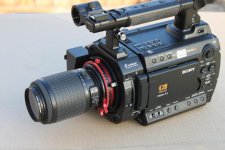
our Nikon ProLock mount has a calibrated iris scale for Nikon "G" lenses so you know what stop you're on... mechanically. No matter what we'll do with the focus control in the future- the iris will most likely remain manual on the Nikkors..
 

Attachments

  • prolockwlens.jpg
    prolockwlens.jpg
    79.4 KB · Views: 0
Most of these lenses have extremely short focus throws and often lack hard stops.
So in the end the convenience is a bit limited.

Another thing kind of important is that once you have established a look for a series of shots, generally it is wise to keep the same aperture in order to match well.
Thus if I am traditionally somewhere around f4.5, I can just set that aperture on all my Canon lenses for instance using a Canon body and that aperture stays.
From a cinematic point of view this is kind of a good challenge to stick to anyhow. The rest of the time it is to the ND's and lighting to do the work.
 
our Nikon ProLock mount has a calibrated iris scale for Nikon "G" lenses so you know what stop you're on... mechanically. No matter what we'll do with the focus control in the future- the iris will most likely remain manual on the Nikkors..

Jacek I've heard nothing but praise for your prolock system so far. Can you shoot me a PM with pricing?
 
Me too on ProLock. Well built hardware and works great. The only complaint I have with working with it is the crazy short aperture throw but that would be the case with any nikon lens.

If I had to start all over again, I might forgo the Sony primes, build a good collection of Nikon primes and zooms and leave the prolock on there.

Pay the price and only cry once.
 
Recently, I have started using and preferring the kit lenses that came with the F3 and with a PL mount, and the longer focus and iris throws, they work well manually. So for PL lenses, I agree that manual is the way to go. I have the Prolock also, and for Nikon lenses it is the best thing we have and it works great. With the Prolock, as long as you are adjusting iris based on scopes, it is fine, but with a light meter, it is difficult to be sure you are exactly where you want to be. The Nikon lenses, although they are optically good, it is frustrating that the focus pull is so short, especially at the far end. Even the Rokinon has the same issue, they are obviously not geared for video use. With the Nikon lenses on a Nikon camera, pick a focus point and you can achieve critical focus very easily.

I am suggesting that Sony should make mounts to electronically integrate with Nikon and Canon lenses, it would open up a much larger market for them, and they are really not in the lens business anyway (except stills). Also, is the possibility of activated VR which for handheld would be fantastic. The fact that RED has decided to take this approach should at least make Sony think about it. It would be a nice alternative to very expensive PL glass. It certainly makes me consider what brand of camera to buy next.
 
What I would love to see, but don't expect to, is an adapter that would allow the Nikon lenses to engage VR image stabilization. This would make a big difference to hand held work and is available with canon lenses on Canon cameras. For many people it is the deciding reason to buy a C-300. As I understand it with Nikon lenses VR resides in the lens so it should be technically feasible. I would pay for that option in a second.
Can you do that Jacek?
 
I'd love to see an electronic follow focus control unit, that interfaces with the AF system in the lenses to provide spread-out, controllable, repeatable focus movement (something that's near impossible with the Nikon G lenses' manual focus rings).

Hell, a man can dream can't he?!
 
Another thing kind of important is that once you have established a look for a series of shots, generally it is wise to keep the same aperture in order to match well.
Thus if I am traditionally somewhere around f4.5, I can just set that aperture on all my Canon lenses for instance using a Canon body and that aperture stays.
From a cinematic point of view this is kind of a good challenge to stick to anyhow. The rest of the time it is to the ND's and lighting to do the work.

This is a choice, but not a hard and fast rule--it may be important to keep the exposures similar within a scene, but that's not necessarily the same as keeping the aperture the same. One example would be going from a wide focal length to telephot; it may be that you want a shallow look to the wide shot, using a minimal stop, but maintaining that stop for a telephoto shot may result in such shallow focus that it is jarring in comparison, and certainly tough to hold focus. In this instance it may make sense to start the scene on the wide end with ND in place, and then back out the ND and compensate by stopping down as you go longer. I regular do this to give my AC's more of a chance to nail focus.
 
Lasik,
Forget it--Sony is more interested in pumping out endless iterations of cameras with vague promises of 4K and lenses that are near worthless. They just don't get it, Red does.
Both the Canon and Nikon mounts for the Red work really well and are made for pros.

Grug,
Take a look at Magic Lantern for Canon DSLRs. It has rack-focusing capability built-in (not sure how well it works) but it's FREE! :love4:


I was checking out the RED site and was jealous when I saw a new product which is an adapter to their Epic and Scarlet that allows a Nikon lens to be used with smart connections allowing both iris control and autofocus from the camera. It is only $800 (or $2200 for titanium). It works with a large number of lenses, most of the current ones. They also have a Canon version. Why can't I have this for my F3? I have a Nikon D4 and sometimes use it to shoot video. It is really nice to have control of the lenses through the camera, and so much easier to focus and change iris settings electronically. Maybe these are not "pro" features, but it would be nice.
 
Interesting that you say in this thread that the lenses are "near worthless" while heaping praise on them in your For Sale post trying to sell them ;)
 
Electronic Follow Focus

Electronic Follow Focus

I'd love to see an electronic follow focus control unit, that interfaces with the AF system in the lenses to provide spread-out, controllable, repeatable focus movement (something that's near impossible with the Nikon G lenses' manual focus rings).

Hell, a man can dream can't he?!
And your dreams come true sometimes:)
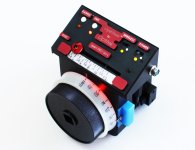
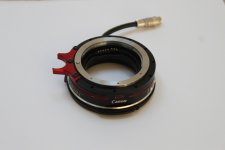
Here you go: electronic follow focus combined with positive locking smart mount for Sony F3, F5, F55 cameras.
It instantly turns Canon EF mounted lenses (OEM and off brands) into true cine glass.
Link to a quick video we made http://www.youtube.com/watch?v=TJrgfYLhVpk&feature=youtu.be
 

Attachments

  • optitron.jpg
    optitron.jpg
    124.3 KB · Views: 0
  • F3 mount.jpg
    F3 mount.jpg
    114.3 KB · Views: 0
Some questions:

How many steps per stop are there in the iris control?
Are focus marks truly repeatable, i.e. if you mark 20 feet and rotate the knob to one or the other end, will it land at 20 feet when you return to that mark? You can't do this with the focus ring on the Canon EF's for instance--due to the drive-by-wire it tends to slip.
What kind of range is typical with the unit?
Projected price and delivery date?

thanks!
 
The iris control is limited to the lens increments- 1/4 stop
The focus marks are 100% repeatable- they have to be.
If you mark the marking ring for a particular lens- it stays true to that lens forever.
In fact it stays true to any copy of the same lens. But I haven't tested that thoroughly for multiple copies.
They are available now (actually 10 days or so)
Contact me directly for more info.
Once we launch the wireless receiver (little later as we have to get satisfactory evaluation on the unit wired operation- just playing safe)
The range should go to about 100meters (300 ft) -that's what the wireless module is rated for...
jacek@optitek.org
 
Back
Top