Which was better, VHS or Video8?

Haha, "they" is kind of funny--yes I can indeed discuss what "they" were using!

For Aerobics Meltdown we (!) used SDX900's, Panasonic's last 2/3" SD camera, which had 24p capability. I can't remember now if we recorded to internal tape (DVCPRO I think?) or SDI out to external file recorders but I think both, with the tape as backup. For the opening of the sketch the post dept ran the footage through two generations of VHS to add some tape artifact. When it returns to those cameras later on, it was the straight footage from the camera sans tape effect.

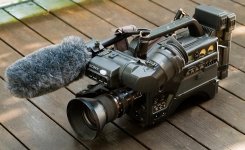
We did indeed use vintage cameras on other sketches; KY1900 3-tube cameras for "Tackle and Grapple" "Mr. T PSA" and "Funky Nonsense". For "Obama College Years" it was a similar vintage Magnavox home video camera which I had built out with an old Datavideo DV recorder (like a Firestore) on the back, via its composite video dongle. Still have all of those cameras and hope to use again someday!

A few months ago I had opportunity to play in vintage sandbox again on "A Black Lady Sketch Show", with footage that was meant to resemble an 80's sports broadcast. I hunted for the SDX900's but was unable to find any left in Los Angeles. I instead opted for a couple of HDX900's which were pretty much the same camera with 1080i/720p capability, which will hopefully get a little post treatment to further age down the footage. Since the 80's saw the transition from tube to chip cameras this was an acceptable compromise, but I would have loved a bit more artificating in the image!

haha, sorry.

Online forums and actual television production generally seem so far apart that I subconsciously referred to the people working there (YOU!) as they.

And TY. Cool cameras!

@NorBro, check out Charles’s epic K&P thread in the Cinematography section. Excellent lighting breakdowns and some camera notes, including that one.

http://www.dvxuser.com/V6/showthrea...Papert&p=1986496357&viewfull=1#post1986496357

TY. I used to visit here and there when it was really active back then. (I never saw post #78!)
 
... I instead opted for a couple of HDX900's which were pretty much the same camera with 1080i/720p capability, which will hopefully get a little post treatment to further age down the footage. Since the 80's saw the transition from tube to chip cameras this was an acceptable compromise, but I would have loved a bit more artificating in the image!
From what I recall reading - the major switch in video quality took place around 1978, when the Germans (I think it was Telefunken) upped the quality to the next level. In the US, RCA TK 76 and 47 were big into the late 1980's.

I remember watching the 1974 and the 1978 World Cups and the difference was quite striking. The quality then stayed fairly constant until the 2002 WC when the hosts (Japan Korea) recorded some matches in HD. With the WC's and the Olympic games often serving as the showcase for the new pro gear, one could revisit the old highlights and see the steps from one era to the next.
 
For gits and shiggles.

The 1970 WC final highlights of Brazil vs Italy. Obviously, digitally restored, by FIFA but a lot of noise in the image. It was uploaded last year during the pandemic.


1974 West Germany - Netherlands. Feels like a different era.


1978 - Argentina-Netherlands (from FIFA but an old upload in 480p)


1982 - semi-final West Germany - France (a 480 upload, minor improvement if any)

 
I can't say I see much of a difference between 1970 and 1982 (besides the change in time/people/atmosphere).

Very little if anything, tbh.

Maybe not the best examples, but in hindsight it's probably because of the minor IQ increases that we live through that we don't really see much of the overall major IQ transition until many years later. (Some improvements are more noticeable than others.)
 
Haha, "they" is kind of funny--yes I can indeed discuss what "they" were using!

For Aerobics Meltdown we (!) used SDX900's, Panasonic's last 2/3" SD camera, which had 24p capability. I can't remember now if we recorded to internal tape (DVCPRO I think?) or SDI out to external file recorders but I think both, with the tape as backup. For the opening of the sketch the post dept ran the footage through two generations of VHS to add some tape artifact. When it returns to those cameras later on, it was the straight footage from the camera sans tape effect.

We did indeed use vintage cameras on other sketches; KY1900 3-tube cameras for "Tackle and Grapple" "Mr. T PSA" and "Funky Nonsense". For "Obama College Years" it was a similar vintage Magnavox home video camera which I had built out with an old Datavideo DV recorder (like a Firestore) on the back, via its composite video dongle. Still have all of those cameras and hope to use again someday!

A few months ago I had opportunity to play in vintage sandbox again on "A Black Lady Sketch Show", with footage that was meant to resemble an 80's sports broadcast. I hunted for the SDX900's but was unable to find any left in Los Angeles. I instead opted for a couple of HDX900's which were pretty much the same camera with 1080i/720p capability, which will hopefully get a little post treatment to further age down the footage. Since the 80's saw the transition from tube to chip cameras this was an acceptable compromise, but I would have loved a bit more artificating in the image!

I still have my two Betacams(one 1/2" 3CCD 4:3 and one 2/3" 3CCD 4:3/16:9 switchable) and tape VariCam(2/3" 3CCD 720P) in my gear closet in my office. And a CD nanoFlash in a case in my truck.
 
I can't say I see much of a difference between 1970 and 1982 (besides the change in time/people/atmosphere...
1970 was upscaled but with a lot of noise still in the image. Others were left as is.

This is from 1981, looks close to the original.


These are clips from the 60's and the 70's (the 70's are in color)


1983

 
Thinking about the history of video production makes you really appreciate the wonder of cinema and film and what people have been able to create with it for the last century.

It's all really interesting the more I think about it because for a very long time moving images solely depended on access to limited technology, your financials, and your understanding and knowledge of properly handling what you just captured (film or digital). [Still does with digital today but it's much easier.]

With color, there are creations from each decade that are visually superior, but looking back I think there was a lengthy IQ stagnation for a very long time. If you muted the audio and focused on the visuals, your brain would recognize the change in people, the clothes, the collection of matter - but the resolution and colors, collectively, barely improved until more resolution was introduced and available to be seen.

Cinema aside (because of the gauges and stocks), television continued to appear slightly sharper, a bit more saturated, and maybe overall more pleasant - but you could also easily mix and match a variety of work from each decade if you were unable to identify the time period.

The turning point with widely available high-definition screens (with modern broadcasting) and the ALEXA were possibly the greatest achievements in this industry's history. Such defining tools and the best major improvements in visual image quality consuming and acquisition.

___

On a side note, it's funny how life works. With the exception of cinema's best-of-the-best:

Pre-ALEXA --> Mostly everything looked the same because of limited technology and money.
Post-ALEXA --> Mostly everything looks the same because of practically no barrier to entry and superior technology.

___

Visually, everything is so incredibly boring today. Everyone's work looks the same on YouTube.

Another IQ stagnation, IMO.

I'm realizing that the older I become the more I find myself really loving film and classic cinema (I guess that happens to a lot of us), but I'm also very interested to see what happens with 8K and beyond.
 
It's peaks and valleys in term of image quality. The late 1930's saw a jump to color (AGFA and its US subsidiary), then there was a pause until the 40's/early 50's, when TV arrived en masse and the film studios felt compelled to go with 65mm and Vista Vision. Then the film was fine but, in the late 60's-early 70's, the look of the movies switched to the flatter, more documentary style. Then it rebounded with Spielberg's return to the classic appearance and it's kind of where we were today in theaters, even though the projection is digital.

In home entertainment, the big jump was to color broadcasts in the late 60/s/early 70's, the switch from the OTA to cable in the early-mid-80's and the VCR revolution that came roughly at the same time. Then the rear projection TV's became both affordable and presentable and then HD appeared in small quantities at the turn of the century and that's where the TV is still. Streaming - via YouTube at the beginning and now in 4K - is the king of the hill now.

PS. I saw the Soviet classic "Irony of Fate" on December, 31, 2007/January, 1, 2008 on YouTube in a glorious 240p. It was uploaded by someone from Pasadena in 18 10-min clips, with the image pixelating each time something on the screen moved. Less than a decade later, most "professional" YouTubers upload in 4K.
 
From what I recall reading - the major switch in video quality took place around 1978, when the Germans (I think it was Telefunken) upped the quality to the next level. In the US, RCA TK 76 and 47 were big into the late 1980's.

I remember seeing a demo of a solid state (chip) camera at the SMPTE show in NYC in '84. So I would have to assume that they started making inroads over the next 5 years. I do remember primarily seeing Ikegami HL79's in use for most of that decade still but I was working in smaller markets.
 
Thinking about the history of video production makes you really appreciate the wonder of cinema and film and what people have been able to create with it for the last century.

It's all really interesting the more I think about it because for a very long time moving images solely depended on access to limited technology, your financials, and your understanding and knowledge of properly handling what you just captured (film or digital). [Still does with digital today but it's much easier.]

With color, there are creations from each decade that are visually superior, but looking back I think there was a lengthy IQ stagnation for a very long time. If you muted the audio and focused on the visuals, your brain would recognize the change in people, the clothes, the collection of matter - but the resolution and colors, collectively, barely improved until more resolution was introduced and available to be seen.

Cinema aside (because of the gauges and stocks), television continued to appear slightly sharper, a bit more saturated, and maybe overall more pleasant - but you could also easily mix and match a variety of work from each decade if you were unable to identify the time period.

The turning point with widely available high-definition screens (with modern broadcasting) and the ALEXA were possibly the greatest achievements in this industry's history. Such defining tools and the best major improvements in visual image quality consuming and acquisition.

___

On a side note, it's funny how life works. With the exception of cinema's best-of-the-best:

Pre-ALEXA --> Mostly everything looked the same because of limited technology and money.
Post-ALEXA --> Mostly everything looks the same because of practically no barrier to entry and superior technology.

___

Visually, everything is so incredibly boring today. Everyone's work looks the same on YouTube.

Another IQ stagnation, IMO.

I'm realizing that the older I become the more I find myself really loving film and classic cinema (I guess that happens to a lot of us), but I'm also very interested to see what happens with 8K and beyond.


It is interesting. I wonder what a future film stock would even look like. Seems like Kodak hit its peak with Vision3. I sometimes can't tell the difference between things shot on Vision3 and digital. It's as if the two technologies converged at the same era in time.

I have a love hate relationship with standard definition video. The love comes from the nostalgia. It's the resolution I used for most of my life. But it's not a strong sense of nostalgia because on the flip side, it annoys me that we didn't have anything better for so long. That everyone just stuck with SD. That even when analog HD formats where being developer in the 1980s there wasn't a bigger push for it. Especially since people had a benchmark to compare it all to in the form of film, with its better resolution, dynamic range, and color. For decades.

At the same time, if we decided to stop now at 4K HDR and just chill for next four or five decades, I think I would be alright with that. Probably even prefer it. The quality is so high I don't think we would be missing anything by not having 8K TVs or higher. I think we've hit that point of diminishing returns. I don't see the value in going higher. Better quality TVs in the form of MicroLED or whatever, sure. But I'm kind of hoping we settle down on a new standard definition pretty soon. I want my cameras and editing gear to last me longer and my older productions to not be outdated by their resolution the way my first feature shot on DV has been.
 
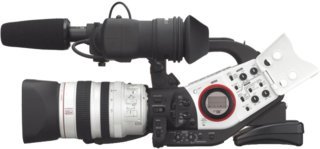
The one is 1991 was called LX-1 (I just looked it up ... again)

It was the LX-1 in Japan but the L1 in the Americas (Canon Museum). I remember it when it came out. It could use any of Canon's stills lenses --- which on its 1/2" CCD were all highly telephoto.

Here is a picture of me in 1995 holding up a picture of the camera I wanted at the time. The Canon L2 I believe.

Yes, the L2 came out in 1994, so you're probably right (Canon Museum).

They were both Hi8, which was sometimes touted as better than its rival, S-VHS. I think the image quality of the two was roughly the same, but Hi8 had digital audio. I saw a lot more indie people and low-budget pros choosing Hi8. The only disadvantage was its dropout rate, as already mentioned.

I remember seeing the Sony EVW-300, a Hi8 camera in a broadcast-style body, for those that couldn't afford Betacams. I think it was about $10,000.

Hi8_3CCD-camcorder_Sony_EVW-300.jpg


The successor to the L2 was the very popular XL2, this time in the DV format.

canon-xl2.left.master.1576684641045.jpg
 
Last edited:
A slight tangent about broadcasts and broadcast cameras.

Prior to 1966 WC, World Cups were broadcast on the radio, with filmed matches then occasionally shown in a highlight form.

In 1966 WC in England, matches were shown live in black&white and without instant replays (in the US, the first instant replay is credited to the December, 7th, 1963, Army-Navy game on CBS).

In 1970, the matches were televised in color, where available, with an instant replay of goals and important saves from the second camera behind the goal.

That was the case in 1974 as well, but with a higher quality video. (I assert)

1978 WC added the main camera replay to the behind-the-net replay.

In the 1984 Olympics, ABC came up with the super slomo but I don't recall it making to the WC's (it could have been a proprietary invention).

1986 WC added the reverse angle to the first and the behind-the-net cameras. But the main cam still missed the offside calls, if its operator didn't rotate fast enough or zoomed in too far.

In 1990, the goal line corner camera was added to the midfield line camera, with its own replay capabilities. Likewise, the number of the replayed moments kept going up.

1994 WC in the US added a bunch of cameras, including the one operated on the sidelines.

2002 was the last WC televised in SD 4/3.

2006 was in OTA HD on ABC but only in SD on ESPN and Univision.

2010, 2014 and 2018 were HD on every channel n the US ... given a dreadful level of the American commentary, I watched most of the matches in Spanish. I am not fluent in Spanish, so its commentators dreadfulness went over my head. 2014 was supposed to have been also recorded on F-55's in 4K but I have never seen any of it in 4K. DirecTV does broadcast the English Premier League in 4K and Fubo allegedly streams it in 4K as well.
 
Thanks, you're right! It was the XL1 that was so popular for so long. Then the XL1S came out with some minor improvements. Was the XL2's major difference its 16x9 sensors? I myself never owned one. It sounds like you knew it better than me, especially based on an article I just unearthed from 2003: XL1S and P+S Technik Mini35 on Seinfeld / Levinson Shoot, by Charles Papert :)

The XL2 added 24p recording. I had an XL1 in 2001 and also shot my first feature on an XL1 in 2003. Today we're stuck with a 60i source for that feature.
 
Reviving an older thread and switching gears just a bit. I wanted to talk about Digital8.

It's a strange format that came out in 1999. I remember when it did. By that year I had moved on to MiniDV. There were just better MiniDV cameras, and more of them. Although the concept of Digital8 was kind of fascinating.

Digital8 used the same DV codec, to the best of my knowledge. Although I always found it strange it only recorded an hour per tape instead of the two hours that Video8 and Hi8 could record. I assume that's because of the lower grade tape stock used in Hi8 compared to MiniDV? So there was likely a need to run the tape faster.

That said, Data8, the data format could store up to 60GBs per tape. According to this wikipedia page anyway. But that's also in 1999, the same year Digital8 hit the market. So I assume we're talking about a huge difference in cost/complexity between tape drives offered in consumer Digital8 camcorders versus those offered in commercial grade data backup systems.

It does make me curious though. Fast forward to today (since you have to with tape, there is no skipping) would companies have been able to put out a two+ (or maybe four+) hour 1080p HDV-like Digital 8 upgrade? I assume at least one hour of HDV footage would have been possible since it was with MiniDV tape. But assuming a higher grade tape being used, Video8 has more physical tape, so I'm guessing greater storage capacity could have been a thing if the will had been there on the part of companies and consumers.

I always liked the Video8 format, just as a physical thing. It's overall size. I had kind of wished it had taken over VHS as a home video format back in the day. And I know that's what Sony had wanted as well. Certainly would have been less wasteful in terms of material usage.
 
It does make me curious though. Fast forward to today (since you have to with tape, there is no skipping) would companies have been able to put out a two+ (or maybe four+) hour 1080p HDV-like Digital 8 upgrade? I assume at least one hour of HDV footage would have been possible since it was with MiniDV tape. But assuming a higher grade tape being used, Video8 has more physical tape, so I'm guessing greater storage capacity could have been a thing if the will had been there on the part of companies and consumers.

I'm gonna say no. Look at professional Digital tape formats like DVCPro, DVCPro 50 and DVCPro HD, each step up the ladder cut the tape run time in half from the previous. Tape would have always been limited by physical constraints. Look at how much high quality HD, 4K and higher video you can put on a memory card literally not much bigger than your thumbnail, today. That was never going to happen with tape. The only thing tape still had going for it at the end was that you could simply pop it and hand it off to the producer or ship it out instead of dumping files to a drive(and it was its own archive). Although if they bring cards, you can simply still walk away.
 
Heh - sets dedicated to the production of 'romance' content aimed at a male audience, perchance?

Feb-March, 1991. I am working in the video section of a large electronics chain in the San Fernando Valley. I see a well known actor/director having already bought both the camera and a lens (for the latter, he had to go to the photo department, so the video salesperson had to coordinate with someone else there) and just loitering around the sales floor while his transaction was being processed. I stop by and casually say to him, "So, John, if I had bought the same big camera with the same big lens, I could be as big of a star as you?". He looks back at me and says, "You need more than a BIG lens".

The kicker there was that I had actually met him about a year earlier at the CES 90 in Las Vegas. He was working the ballroom at the old Sahara, where the rest of his cohorts congregated. I was there with a friend who was interested in the high end audio (or so I assert, numerous signed posters notwithstanding) I said something to him and thought he was quite a dick.

BTW, when we walked into the ballroom - as our last stop at the whole exhibition ... really - the first recognizable face we saw was Russ Meyer's. That, we thought, was a bit of a demotion for Russ. He may have made extra cheesy stuff but, at that point, his shtick was rendered superfluous by the home video revolution. He did have several actresses in his booth, with one of them being a quite appropriately named Beverly Hills. I assume it wasn't her real name.
 
Last edited:
Back
Top