Which was better, VHS or Video8?

roxics

Veteran
I was a teenager and young adult in the 1990s. I used to make movies with my friends on Video8 and VHS in the early to late 90s. Stop motion and live action stuff. Before switching to DV in 1999.
I remember thinking Video8 was better. That it had more resolution or better sound or something. I'm not sure. It's hard to remember now.
We shot most of our stuff on my parents Sony Video8 camera. Though sometimes we used my friend's folk's RCA VHS camera.

After importing many old tapes, I don't know if there was really much of a difference. Doesn't seem like much to me today. But I'm used to HD and 4K today. Maybe the Sony we used had a better front end combo of CCD and lens.

I used to subscribe to Videomaker magazine back then for a while (wish I had kept those), and read up on all of this stuff back then. I remember wanting all the cool Hi8 and SVHS cameras and linear editing decks and stuff. But I was too young and broke for any of that. So as a bonus question, between those two formats (SVHS and Hi8) which was the better of the two for those of you that used them?
 
As far as IQ, I think we’re too past the point to analyze a difference. They are both so low-quality that most people only view them as being similar to an Instagram filter (the “old” look).

Physically, maybe one was more reliable than the other, but IDK.
 
I used VHS, S-VHS and Hi8 in their heyday(s) and they all suck by today's standards(obviously). Even back then, as a teenager who had yet to touch a truly professional format, I knew they weren't that great(not that we didn't have fun with them). Then throw in the fact that most of our exposure and evaluation of the formats were seeing the horribly low rez consumer cameras images recorded on them and... Well... Don't fall into the nostalgia trap. They all suck.

Asking which was better, S-VHS or Hi8, is like asking which would you rather do, get kicked in the stones with football cleats or golf cleats. There might be a tiny bit of difference, but neither one is going to be in any way pleasant.
 
So much of that had to do with what was in front of the tape record heads, but that’s also a truth that largely has not changed. I mean... you can argue h.264 vs. h.265, but if it’s in a $150 palmcorder with a 1/8” sensor, it honestly doesn’t matter.

As analog tape formats go, Hi8 was more robust than 8mm, and S-VHS was more robust than VHS. Neither was as hefty as BetaSP. But at some point, it largely depended on the front section of the camera. The Panasonic SuperCam was actually a pretty well-designed S-VHS camera. Sony had the CCD-V5000 Hi8 camcorder that didn’t do such a bad job. In all things analog and/or SD, three chips were better than one. And even after digital came around, 3 CCD was much preferred to a single CCD.

Sony even had higher-end broadcast cameras like the Hyper HAD DXC-327A, along with a modular Hi8 back (can’t remember the model) that was swappable on broadcast camera front ends that could also accommodate BetaSP. I think you’d be surprised by the kinds of things you were watching on TV back then that were recorded on Hi8.

As a side-note, S-VHS had such highly-regarded sound recording that recording studios popularly used S-VHS video decks to lay back stereo mix archives (audio-only recording).
 
I might need to watch “Trashhumpers” Harmony Korines film shot entirely on vhs . Id be curious to see some of the pixel cam stuff on the big screen again. I believe slacker had a scene shot with it. I could see some of this retro formats popping up as a middle finger to somebody or something. I hope we still have a few folks who appreciate off the wall formats.
 
So much of that had to do with what was in front of the tape record heads, but that’s also a truth that largely has not changed. I mean... you can argue h.264 vs. h.265, but if it’s in a $150 palmcorder with a 1/8” sensor, it honestly doesn’t matter.

As analog tape formats go, Hi8 was more robust than 8mm, and S-VHS was more robust than VHS. Neither was as hefty as BetaSP. But at some point, it largely depended on the front section of the camera. The Panasonic SuperCam was actually a pretty well-designed S-VHS camera. Sony had the CCD-V5000 Hi8 camcorder that didn’t do such a bad job. In all things analog and/or SD, three chips were better than one. And even after digital came around, 3 CCD was much preferred to a single CCD.

Sony even had higher-end broadcast cameras like the Hyper HAD DXC-327A, along with a modular Hi8 back (can’t remember the model) that was swappable on broadcast camera front ends that could also accommodate BetaSP. I think you’d be surprised by the kinds of things you were watching on TV back then that were recorded on Hi8.

As a side-note, S-VHS had such highly-regarded sound recording that recording studios popularly used S-VHS video decks to lay back stereo mix archives (audio-only recording).

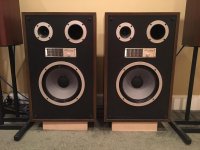
VHS Hi-Fi was very good. I remember watching Tombstone in my college dorm at the beginning of my freshman year in 1995. Zenith Hi-Fi VHS VCR, Zenith/Allegro stereo receiver(AM/FM, cassette, 8-track, turntable) and Zenith/Allegro 3000 speakers. About a minute after the train pulls into the station near the beginning of the movie, I heard a banging on my door. It was the dorm RA. After they figured out it wasn't a real train that made the sound(there were train tracks maybe 50 yards from my dorm that ran right through the middle of campus), they figured out the sound came from my room.

xzu1dqhrv4m11.jpg
*not my actual set

I still have one in storage. I couldn't bare to get rid of it. It's too cool. The other ones cabinet got trashed by water damage when they were in a different storage building.
 
From a long term standpoint, my SVHS homemade tapes have lasted the test of time vs the Hi8 (same with VHS and 8mm), surely due to the larger surface area of the tape. Lots of dropouts with the small gauge formats. Agreed though that was largely about the front end, the cameras themselves used different chips and processing and that had much to do with the visual quality. Theoretically I could do a scientific experiment since I own working SVHS and HI8 decks but haha only so many hours in the day...!
 
Technically speaking, VHS was the worst ... and the most popular because one could pull the tape out of a camcorder and immediately play it on his VCR . Beta was better (or is it bettah?) but, as a format, it was gone by 1987 or so because of the Sony licensing demands. JVC, the holder of the VHS patents, apparently made none.

8mm was slightly better than Beta. Super VHS was considerably better than the VHS but, as a format, it was DOA. Hi8 was as good as one could get on a consumer recording level and matched the quality of the best consumer TV's of the era. In 1991, Canon released a Hi8 model with an interchangeable lens mount and it was used on a lot of sets. In the Valley.

Then there was a series of the Betacams, which were far too expensive for a consumer - up to $50,000 - but were a staple at TV stations before digital.

And we had covered Sony's analog HD camera in a related thread.
 
From a long term standpoint, my SVHS homemade tapes have lasted the test of time vs the Hi8

A question worth asking in that context is whether your Hi8 tapes are evaporated or particle. Evaporated tape theoretically has higher performance (higher coercivity leading to higher signal levels and improved signal-to-noise ratio) but it's a microfine coating that's easy to damage and thus more prone to dropouts. Conversely, all S-VHS (or certainly the overwhelming majority) tape is particle, which is more rugged.

Similar concerns attend Betacam SP. One of the changes over straight Betacam was to move away from positively archaeological ferric oxide tape, which is why SP really needed dropout compensation.

P
 
A question worth asking in that context is whether your Hi8 tapes are evaporated or particle. Evaporated tape theoretically has higher performance (higher coercivity leading to higher signal levels and improved signal-to-noise ratio) but it's a microfine coating that's easy to damage and thus more prone to dropouts. Conversely, all S-VHS (or certainly the overwhelming majority) tape is particle, which is more rugged.

Similar concerns attend Betacam SP. One of the changes over straight Betacam was to move away from positively archaeological ferric oxide tape, which is why SP really needed dropout compensation.

P

If memory serves, the "lower end" UVW series (and maybe PVW series) had to use metal (particle) tape, while the BVW series could use both oxide(in a pinch) and metal tape. Although Metal tape was recommended for best performance.
 
From a pure technical operational point of view I would suggest Video 8 and Video Hi-8 as both of those had two line TBCs built in to correct H and V syncs on playback eliminating tape fluctuations and ripples. As far as longevity on the shelf VHS. Its thicker Oxide coated tape had a much higher magnetic coercivity. As did the original domestic Beta format and then standard Betacam tapes. SP Beta moved to Metal Particle tape which had higher coercivity again. Video 8 and Video Hi-8 used both MP, metal particle and ME, Metal Evaporated magnetic material. When we were using dozens of tapes a day, 99% Beta, Digi Beta and DVC Pro we were constantly recycling tapes through our bulk eraser. A 90 minute SP Beta tape might take two or three passes to totally erase the tape for reuse. When the ME tape technology came out, Video Hi8 and later DV and then DVCam we could put half-a-dozen tapes through the eraser tray in one pass and there would not be a shred of an image left on any of the tapes. DVC Pro tapes were MP tapes like SP Beta and would need around three passes to totally erase all the images. I've got both good old Oxide, MP and ME tapes here dating back as far as the '70 for VHS and U-Matic and in professional formats '82 when the original Betacam format came out. When recovering them and when doing digital transfers for clients the ones that show the greatest pixelization dropouts are the later digital recording ME technology tapes. All really need to be run through a good full-frame TBC to try to squeeze the best out of them when dragging their contents into the modern world.

https://en.wikipedia.org/wiki/Coercivity

Chris Young
 
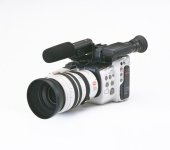
In 1991, Canon released a Hi8 model with an interchangeable lens mount and it was used on a lot of sets. In the Valley.

You mean this one? Lol!
Here is a picture of me in 1995 holding up a picture of the camera I wanted at the time. The Canon L2 I believe.
Interestingly, this picture is a still pulled from a video I captured where I had been video journaling using the Sony Video8 camera. But I bypassed the 8mm tape deck on the camera and went out to my JVC HIFI VHS machine for recording on VHS. I'm not sure why I did this. I can only guess the VHS tape was cheaper or maybe just what I had available that was blank at the time. All I know is the camera kept shutting off and I had to keep turning it back on.

vlcsnap-2021-02-01-13h31m18s796.jpg
 
From a pure technical operational point of view I would suggest Video 8 and Video Hi-8 as both of those had two line TBCs built in to correct H and V syncs on playback eliminating tape fluctuations and ripples. As far as longevity on the shelf VHS. Its thicker Oxide coated tape had a much higher magnetic coercivity.

From just importing old tapes over the years this has been my experience. Though I've surprisingly lucked out pretty well with all three formats I have (Video 8, VHS, and DV), I did notice that VHS seems to be the most robust. So even though the quality wasn't great it's lasted a long time and been pretty easy to playback considering all the VHS machines still out there.
 
The one is 1991 was called LX-1 (I just looked it up ... again)

View attachment 142558

The college program I was in had one of the Canon’s and of course I thought it was bad-@ss(remember seeing it in ads in Videography Magazine at the time)(and 20+ years later, it would become the C300). I may have picked it up once. And I never shot with it. But my desire to actually shoot with it soon passed, because within about a year and a half or so of starting this particular program, I had already bought my first Betacam and was freelancing.

Your motivation to get-up and go to class really goes out the window when you’re already doing what you are going to school to try to accomplish in the first place.
 

This was a tape shot at a Sony session here in the UK. I took a hi-8 tape with me to the event, and stuck it in the camera so I could try it in my domestic hi-8 machine. I bought the camcorder afterwards - which had a separate hi-8 back end. It is still with me - although not been out of the box for 20 years! No idea if the beast even works now!
 
Technically speaking, VHS was the worst ... and the most popular because one could pull the tape out of a camcorder and immediately play it on his VCR . Beta was better (or is it bettah?) but, as a format, it was gone by 1987 or so because of the Sony licensing demands. JVC, the holder of the VHS patents, apparently made none.

8mm was slightly better than Beta. Super VHS was considerably better than the VHS but, as a format, it was DOA. Hi8 was as good as one could get on a consumer recording level and matched the quality of the best consumer TV's of the era. In 1991, Canon released a Hi8 model with an interchangeable lens mount and it was used on a lot of sets. In the Valley.

Then there was a series of the Betacams, which were far too expensive for a consumer - up to $50,000 - but were a staple at TV stations before digital.

And we had covered Sony's analog HD camera in a related thread.

What DLD said :) The difference between Hi8/SVHS vs VHS and 8mm when watching on an S-video capable monitor and when dubbing/editing/copying was significant.
I'll also add that if someone was trying to choose which one to fiddle with today, that SVHS decks were available for less $ whereas the 8mm decks were not as common and generally more expensive. I used S-VHS and Hi8 quite a bit back in the day as well as D8 (Digital 8) and I certainly prefer D8 out of all the formats listed. I still have 2 expensive VHS, 2 S-VHS, and 2 Hi8/D8 decks and all still work. The 30 year old VHS tapes are fading in image due to age but the others seem to hold up better.
 
From a long term standpoint, my SVHS homemade tapes have lasted the test of time vs the Hi8 (same with VHS and 8mm), surely due to the larger surface area of the tape. Lots of dropouts with the small gauge formats. Agreed though that was largely about the front end, the cameras themselves used different chips and processing and that had much to do with the visual quality. Theoretically I could do a scientific experiment since I own working SVHS and HI8 decks but haha only so many hours in the day...!

Been watching K&P marathon all day...

If I may, do you know what they used for the S4:E9 "Aerobics Meltdown" dancing part?

I'm sure they had vintage cameras on other episodes here and there (like the Obama college years) and sometimes only post-production filters, but this one looked so good like an original late 80s/early 90s broadcast.
 
Been watching K&P marathon all day...

If I may, do you know what they used for the S4:E9 "Aerobics Meltdown" dancing part?

I'm sure they had vintage cameras on other episodes here and there (like the Obama college years) and sometimes only post-production filters, but this one looked so good like an original late 80s/early 90s broadcast.

Haha, "they" is kind of funny--yes I can indeed discuss what "they" were using!

For Aerobics Meltdown we (!) used SDX900's, Panasonic's last 2/3" SD camera, which had 24p capability. I can't remember now if we recorded to internal tape (DVCPRO I think?) or SDI out to external file recorders but I think both, with the tape as backup. For the opening of the sketch the post dept ran the footage through two generations of VHS to add some tape artifact. When it returns to those cameras later on, it was the straight footage from the camera sans tape effect.

We did indeed use vintage cameras on other sketches; KY1900 3-tube cameras for "Tackle and Grapple" "Mr. T PSA" and "Funky Nonsense". For "Obama College Years" it was a similar vintage Magnavox home video camera which I had built out with an old Datavideo DV recorder (like a Firestore) on the back, via its composite video dongle. Still have all of those cameras and hope to use again someday!

A few months ago I had opportunity to play in vintage sandbox again on "A Black Lady Sketch Show", with footage that was meant to resemble an 80's sports broadcast. I hunted for the SDX900's but was unable to find any left in Los Angeles. I instead opted for a couple of HDX900's which were pretty much the same camera with 1080i/720p capability, which will hopefully get a little post treatment to further age down the footage. Since the 80's saw the transition from tube to chip cameras this was an acceptable compromise, but I would have loved a bit more artificating in the image!
 
Back
Top