When will we get RAW?

Sorry I didn't make that clear, I don't mean 5K uncompressed video, I mean recording all the color information straight from the sensor.
So it looks like this:
whz1ua.jpg
 
That is slog, which will probably never come to DSLRS.

Try the Technicolor cinestyle and see if that works for you.
 
it's just a matter of time

I did some math a while ago, but it was not fine because I got my debayering stuff wrong; let's try to get it right this time:

a RAW still from my 550D is around 25MB, which is about 200Mbits/frame, I assume including lossless compression, which from my calculations turns out to work at 1:1.25 (18M*14bit/8bit=31MB/frame)

that is 3:2, if I can discard the top and bottom bits and live with 16:9, I'd get around 169Mbits/frame

if you want to record that at 24fps, you need 4000 Mbps; but that's with intra-frame lossless compression; how much can you save by going to inter-frame lossless compression? (using the fact that each frame is very similar to the previous one) I'm not sure, but I guess an additional 1:2 (1:2.5 in total) sounds conservative; with that you would still need 2000 Mbps; sounds huge, but it's well within the reach of modern SSDs, so that's already sounding feasible, all you need is a sensor that can sustain 24Hz full readouts, and a digic processor that can move all that data around at these huge speeds... (more on this later)

add in some non-aggressive lossy compression (a simple configurable quantitizer after a discrete cosine transform), and you can get 1:10 instead of 1:2.5, with extremely nice quality, which means 250 Mbps and you're still at 14 bit in full resolution and without color subsampling

that's with a 5.2K bayer sensor, which, when debayered, would give you a sharp 4K image

now, the problem: that's insane; have you seen any DSLR shooting 24 frames per second recently? I havent; that means it is not easy at all; but there's a way out: I don't need that much resolution

I want RAW 14-bit color information directly from the sensor, but I don't mind binning every 4 same-color photosites together; that way, I'd get a 2.6K bayer thing that would deliver a sharp 2K image; this solves a lot of issues with the sensor and the image processor, if the binning can be done in-sensor

that leads to 1000 Mbps with lossless 1:1.25 intraframe compression; with the previous 1:2.5 ratio, you'd get 500 Mbps with interframe lossless 14 bit love; with 1:10 for mildly lossy compression, you're at 125 Mbps

are those 1:2.5 and 1:10 compression ratios too optimistic? I don't think so, that 125 Mbps number is not too far away from what you'd get on a RED shooting at 3K

all in all, it doesn't seem too farfetched to me; I give it one generation more: 5Dmk4, the one whose first stages of design, for both the sensor and the digic processor, are being taken now, and which should come out around 2013-2014

edit: that's all for 24fps; increasing the fps means less-than-linearly increased data rate, as the efficiency of the compression would be higher

edit2: the big question is whether they'll want to put this in to a DSLR; maybe itt'll be reserved for 1D territory (and prices), or for video cameras; if that's the case, just wait 3-4 more years and it's cheap enough that you'll have it on DSLRs too, just because they can
 
Last edited:
it's just a matter of time

I did some math a while ago, but it was not fine because I got my debayering stuff wrong; let's try to get it right this time:

a RAW still from my 550D is around 25MB, which is about 200Mbits/frame, I assume including lossless compression, which from my calculations turns out to work at 1:1.25 (18M*14bit/8bit=31MB/frame)

that is 3:2, if I can discard the top and bottom bits and live with 16:9, I'd get around 169Mbits/frame

if you want to record that at 24fps, you need 4000 Mbps; but that's with intra-frame lossless compression; how much can you save by going to inter-frame lossless compression? (using the fact that each frame is very similar to the previous one) I'm not sure, but I guess an additional 1:2 (1:2.5 in total) sounds conservative; with that you would still need 2000 Mbps; sounds huge, but it's well within the reach of modern SSDs, so that's already sounding feasible, all you need is a sensor that can sustain 24Hz full readouts, and a digic processor that can move all that data around at these huge speeds... (more on this later)

add in some non-aggressive lossy compression (a simple configurable quantitizer after a discrete cosine transform), and you can get 1:10 instead of 1:2.5, with extremely nice quality, which means 250 Mbps and you're still at 14 bit in full resolution and without color subsampling

that's with a 5.2K bayer sensor, which, when debayered, would give you a sharp 4K image

now, the problem: that's insane; have you seen any DSLR shooting 24 frames per second recently? I havent; that means it is not easy at all; but there's a way out: I don't need that much resolution

I want RAW 14-bit color information directly from the sensor, but I don't mind binning every 4 same-color photosites together; that way, I'd get a 2.6K bayer thing that would deliver a sharp 2K image; this solves a lot of issues with the sensor and the image processor, if the binning can be done in-sensor

that leads to 1000 Mbps with lossless 1:1.25 intraframe compression; with the previous 1:2.5 ratio, you'd get 500 Mbps with interframe lossless 14 bit love; with 1:10 for mildly lossy compression, you're at 125 Mbps

are those 1:2.5 and 1:10 compression ratios too optimistic? I don't think so, that 125 Mbps number is not too far away from what you'd get on a RED shooting at 3K

all in all, it doesn't seem too farfetched to me; I give it one generation more: 5Dmk4, the one whose first stages of design, for both the sensor and the digic processor, are being taken now, and which should come out around 2013-2014

edit: that's all for 24fps; increasing the fps means less-than-linearly increased data rate, as the efficiency of the compression would be higher

edit2: the big question is whether they'll want to put this in to a DSLR; maybe itt'll be reserved for 1D territory (and prices), or for video cameras; if that's the case, just wait 3-4 more years and it's cheap enough that you'll have it on DSLRs too, just because they can

Thank you for the info!

That is slog, which will probably never come to DSLRS.

Try the Technicolor cinestyle and see if that works for you.

I tried the CineStyle profile but picture profiles can only go so far.
Do you think S-Log could be done through a camera firmware hack?
 
In terms only about resolution, not necessarily color style and compression, we currently have this progress happening from 2 directions. The DSLRs, which have HUGE resolution sensors and scans them for HD video resolution and records it that way. And the large, but lower resolution sensors used in AF100 (four-thirds, nearly 2k (1080p) sensor), Red One (Super35, 4K), Red Epic ( super35, 5k), and Arri Alexa (35mm, 3k). So obviously, there are equivalents out there. But the price range is the difference.

Norman went thru and gave the super technical side of it and raised the real question in the end. WILL it ever be put in a DSLR?

I would think it will be, but only as a reaction to a convergence with DSLR filmmakers and the other 'digital film' options on the market. But as of now, it would take some side-stepping or backstepping on the photo aspect of DSLRs, which is why I don't think it will happen yet.

First off, think of this, an 18MP sensor (7D, 60D, Rebel T2i/T3i) has become a 'standard' resolution for DSLRs. As for film, that is overkill, a 4k image is something like 8.8MP. This means that if we were to get true RAW or full resolution video, we would actually be getting more information than we would need (theaters are 4k at best, a surprising number are 2k).

The camera would actually record every other line of information from the sensor (on average) to resize for 4k. This is the current method used except it's every 3-4 lines (hence why DSLRs are infamous for aliasing). Now this would already be using some (albeit likely small) amount of processing power to just go thru the process of removing lines of information from the sensor as it records. So a better option is the route many of the purpose built digital cameras are doing, Panasonic's AF100 being a prime example. They are taking the large sensor of a four-thirds still camera, and are making it lower resolution, which allows for many things, like it's low light ability, but also a full resolution video image off of a large sensor is easier to process then resizing or compressing as it reads so it actually is less processing load.

So, an ideal DSLR would have about a 9MP sensor, but who would buy a brand new DSLR with half the resolution if they are trying to take pictures? Most likely, no one, or at least not a market share that would prove cost effective.

So my conclusion is that it won't come to DSLRs anytime soon. But the more likely alternatives; Canon decides to throw their hat in the 'Digital Film' ring and bring their APS-C or 35mm sensor, make it 4k resolution, and drop it in a video camera body and make it less than the AF100. Or, some other manufacture decides to start making their price points more competitive with DSLRs with a 4k sensor. I personally hope Canon does this, because I hate Panasonic's interfaces, I wouldn't mind Red since I like their modular design, and I have almost no experience in actual film so I hold no loyalty to Arri.

The other possible player in the game I would find to be totally awesome and cool would be Hasselbad. Medium format film!
 
Last edited:
My guess would be we will get RAW in a DSLR at around about the same time DSLR's start shooting RAW stills at 24fps.

Videographers only make up a tiny proportion of DSLR sales, and that means video will never be the main event in DSLR's. They will always be limited by what the still photographers demand and are willing to pay for. If still photographers never want anything faster than 10-11 fps, then sensor readout time/buffer/write speed will never improve to the point that 24fps RAW video is possible. The companies will not waste millions of dollars on R & D (consequently raising the retail price) to implement a feature that 99% of it's users will never use.

Having said that, I am not disqualifying the possibility of an entirely different product (not a DSLR) coming along and capitalising on the market that Canon have created.
 
haha too true john.

Plus then when camera are shooting at 24fps, that means the mirror is moving at 24fps, so shooting video could theoretically could use the mirror while shooting for shutter speed control vs the current digital shutter. While this would ruin audio it would be like a flashback to classic film shooting! haha.
 
How about windowing a FF35 sensor down to s35 or C? that way you'd still have a high mp sensor for photography and a more cine-size sensor with 8.8-9mp for movies.
Dave
 
5 to 7 years, we will have 2k raw cameras under $2,000. > I just made that up, but it sounds reasonable.
 
a 18mpix DSLR sensor is nearly perfect for 4K video recording

on my 550D, it is a 5184x3456 bayer pattern; if you don't want 4:3 but 16:9, you can discard the top and bottom and you have a 5184x2916; if you try to extract a 5000x2800 RGB image out of that bayer pattern, it will be soft; but it is perfect if you want to extract a 4096x2304 image after debayering

if you bin every 4 photosites together, you have a 2592x1728 bayer pattern; crop to 16:9 and it is 2592x1458, perfect for debayering into a 1920x1080 RGB image

still, I feel the problem with RAW video on DSLRs is whether they'll want to implement it: which feature do you think Canon is working the hardest to get into their next generation of DSLRs, RAW video or an autofocus system that's good enough for soccer moms? I know RAW video will eventually come to DSLRs, it's just a matter of time; but before it gets here, we may be forced into a lower bitrate H.264 codec, just because everybody except us prefers it that way
 
still, I feel the problem with RAW video on DSLRs is whether they'll want to implement it: which feature do you think Canon is working the hardest to get into their next generation of DSLRs, RAW video or an autofocus system that's good enough for soccer moms? I know RAW video will eventually come to DSLRs, it's just a matter of time; but before it gets here, we may be forced into a lower bitrate H.264 codec, just because everybody except us prefers it that way

What is this referance to, what do you call them ? oh yes, "Soccer Moms"?

Sorry, but the autofocus is an important facet of the modern DSLR, a place where the 5D series has been notoriously weak, and on the scale of importance to photographers a fast, accurate autofocus rates higher than raw video. So, given a certain development budget, and final cost of product, I know what will win out, sorry, but that's the way it is.

Dave
 
What is this referance to, what do you call them ? oh yes, "Soccer Moms"?

Sorry, but the autofocus is an important facet of the modern DSLR, a place where the 5D series has been notoriously weak, and on the scale of importance to photographers a fast, accurate autofocus rates higher than raw video. So, given a certain development budget, and final cost of product, I know what will win out, sorry, but that's the way it is.

Dave
Norman was making your point exactly - Canon would rather improve it's AF for photographs, and it's video AF system for "soccer moms" than to implement RAW video for the much smaller film community.
I do believe Canon has learned that the video function has become VERY popular and is a huge spike to their sales across all models....they really didn't HAVE to put 24P, 30P and 60P,manual audio level controls (on some models) into these cameras, because if they thought the video was just selling to CASUAL users like soccer moms and dads, they wouldn't have bothered.
Canon's NO 1 priority is photographers, but they're catering to the video crowd as well, because it'd be silly not to. They're destroying the competition at least partly due to their attention to the video side and I seriously doubt they want to lose that lead.
They'll do whatever is economically feasible to continue this area of new growth. I think first we'll see a proper method of getting 1080 from the sensor and a better codec....and then down the road some form of raw video. I hope it's not true that the masive delays means the 5DMK3 will be pushed to 2012....very anxious to see what they have done.
More from a standpoint of using it as a barometer to measure just HOW serious Canon will get with video in the DSLR platform. The 7D specs blew me away when I first saw them - you have to remember - many "proper" video cameras were not PAL/NTSC switchable with TRUE 24P, 30P, 60P recording (and the PAL alternatives)........then we all saw the aliasing/moire.
I think the 5DMK3 specs will be great as well, but of course no RAW video.
 
If Norman had said "video autofocus good enough for soccer moms" I might not have been so acerbic in my reply, sorry I thought he was implying that autofocus itself was for soccer moms (A term still foraign to me).

Granted video in DSLRs has become much more important than when it first cropped up, and Canon's firmware upgrades make that point.

I'm thinking, the 5D series isn't a camera for the casual user, but for serious enthusiasts and pro 'togs, either hard up ones who can't afford a 1D or as a second body for those who can. Therefore such a user base might be more accomodating, not to say demanding, of serious video quality, so, if a better codec and improved processing make it to any DSLR it will be to the 5D, at least at first. I think the XF codec is very possible, raw not yet. I have my doubts as to how far down the product line it will extend, the 7DII almost certainly if the 5D gets it, lower ? I don't think so, certainly not as far as tripple digit cams.

Given that PMA has been cancelled this year, I'm not holding out for an Oct-Nov release, it may be more like Mar-Apr 2012 now. Depressing? Yes but Japan has been under a lot of pressure lately and there may not be the resorces available.

Dave
 
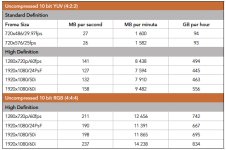
Considering that uncompressed 10-bit 1080 24P video requires about 11 GB to store one minute of footage, I can't see RAW video being a possibility until DSLRs have the processing power to handle real-time compression with a good intra-frame CODEC. ( Maybe in 10 years )

UnComp_10bit.jpg
 
sorry, I meant "autofocus during video recording"

@TheDingo:
10-bit 1080p 4:4:4 requires 30 bits for every one of those 1920x1080 pixels, thus 7.4 MB/frame (which leads to 178MB/min, plus some overhead and you get to that 190MB/min number in the table you posted)
a 2592x1426 bayer pattern with 14-bit color, which will deliver great 1920x1080 images when debayered, requires 14 bits for every one of those 2592x1426 photosites, thus 6 MB/frame
so RAW actually requires lower bandwith than uncompressed RGB or YUV, even with higher color depth
 
For Daveswan

When we're referring to "soccer moms" we're usually talking about middle to upper middle class women who often get these higher end consumer models because they can afford to do so. They like the "hip" factor of this stuff, but really....they just want to point and shoot (for example, their kid's soccer match) and have it come out looking good.
I'm generalizing of course.
 
Back
Top