VaricamLT: Varicam LT, Scarlet-W or something else?

So the Gratical Eye is more heavy than the 502 and not better for focusing? I thought it would be easier to focus and lighter with the Gratical Eye. It has been praised by so many as a great EVF but I guess I'll have to try it out myself somehow. Zacuto representatives are actually coming to Stockholm next week to show their products, so I might just attend and hope they have the Gratical Eye there for me to try out.

So you're mostly shooting handheld I guess? When on the shoulder I think it benefits having a heavy battery on it, for balance.
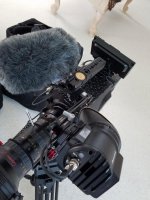
 
Hey Milan. The 502 is a little more than half the weight of the Gratical. But, mounting an EVF requires more rigging. So add that weight on top. By all means you should try it if you have the chance. I actually think that the biggest benefit for an EVF is that it acts as the 3rd point of contact (for stability). For focusing, remember that it is only 720P. So don't expect focusing to be that easy without any peaking function help.
For sure a battery would counterbalance really nicely for shoulder work. Others might disagree, but I really don't think that the LT is an ideal camera for shoulder mounting. It is too short from front to back and a bit too high. The Varicam 35 would be better for that I think as it is low and long. With a special handmade rig, I hold the camera against my chest. Quite unusual. Think of a Hasselblad. That is why I take the battery off. Works for my purposes where a take is never longer than 5 minutes. Not really a good system for documentary work and such. But I feel that it gives me much more stability than a shoulder rig. If you will buy the Panasonic shoulder mount, I think an EVF is a must. Again, it's that 3rd point of contact that makes a big difference is stability.
 
The 502 with the EVF on is pretty big, heavier and lower res than the full monitor. It also has a pretty bad optical design in my opinion giving the images barrel distortion. The gratical eye seems really nice.
 
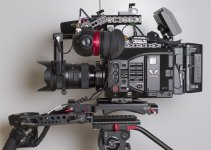
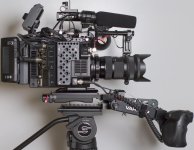
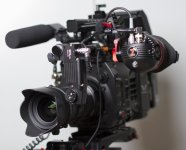
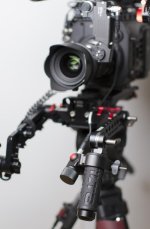
The LT is working well for me as a shoulder-mounted documentary camera. I've got an Angenieux zoom on the front with a clip-on two stage matte box, an Anton Bauer Hytron 140 on the back (simpler for air travel these days), Wooden's LT plate and NATO handle on top holding Panasonic's EVF, a cold shoe on the Wooden top plate for a wireless audio receiver, Panasonic's mic holder and stereo mic on the Wooden top plate, Zacuto's VCT shoulder rig on the bottom, and Zacuto's rosette grip relocator holding the LT's grip. It all balances very nicely - though about as heavy as a regular ENG camcorder rig set up similarly. I like that I can strip things down - smaller lens/smaller battery, etc. - and run lighter if need be.
 
The LT is working well for me as a shoulder-mounted documentary camera. I've got an Angenieux zoom on the front with a clip-on two stage matte box, an Anton Bauer Hytron 140 on the back (simpler for air travel these days), Wooden's LT plate and NATO handle on top holding Panasonic's EVF, a cold shoe on the Wooden top plate for a wireless audio receiver, Panasonic's mic holder and stereo mic on the Wooden top plate, Zacuto's VCT shoulder rig on the bottom, and Zacuto's rosette grip relocator holding the LT's grip. It all balances very nicely - though about as heavy as a regular ENG camcorder rig set up similarly. I like that I can strip things down - smaller lens/smaller battery, etc. - and run lighter if need be.

Could you share a photo?
 

Thanks for sharing. This is the inspiration that I need to start brain storming my rig.
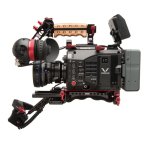
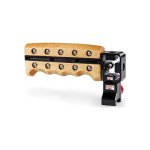
Is there any reason you went w/ the wooden camera handle, and not one of the zacuto wooden handles?
i've been considering their 'next generation' recoil system, it looks light weight and pretty compact. I havent used their gear yet, but their prices are a little more affordable than Panasonic stuff. I am interested in them compared to Panasonics extra bits,
Thanks again! have a great week end.

varicam-recoil2.jpg
 

Attachments

  • zczqth_3.jpg
    zczqth_3.jpg
    31.2 KB · Views: 0
  • zczrch.jpg
    zczrch.jpg
    27.4 KB · Views: 0
Last edited:
I tried a demo of the Zacuto top handle, but couldn't get enough forward displacement for the EVF given the zoom lens to put the shoulder balance below at the correct neutral point. Also, the handle itself is a bit large, in my opinion, and if I recall didn't have the sideways NATO rail flexibility of moving the handle itself laterally to accommodate placement of thing such as the camera mic and its mount. Wooden's top plate also has a lot of screw-in mount points. Zacuto's bottom rigging solutions were far more flexible for balance, handles, and moving from tripod (VCT) to handheld (baseplate shoulder mount) as fast as popping the release lever on the VCT tripod plate. Wooden also makes an extra-long rail for the EVF mount that can put the EVF itself far backward for long tripod-based interviews, for example, so one need not hunch over the camera.

And remember that for handheld work in many lens/body combinations the sensor plane hook on the operator's side will jut into your face or neck. You can use a pair of pliers to twist it off - I consulted with a Panasonic engineer before doing so.
 
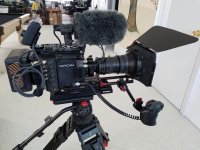
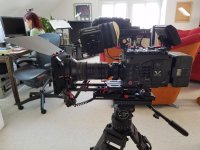
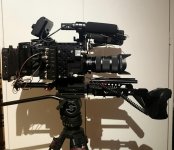
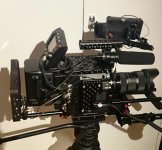
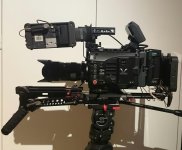
_20161104_204854.jpg_20161104_205050.jpg_20161104_205201.jpg

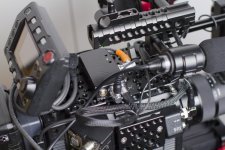
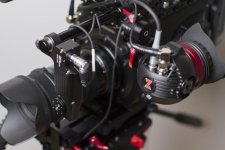
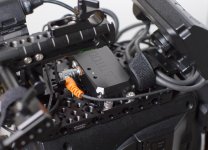
I received the Wooden Camera top and side plates from CVP today. I also bought the Panny handle and a viewfinder bracket from Vocas (similar to the one from Wooden Camera). A couple of weeks back I got the Vocas USBP-19/15D shoulder base plate, which the camera is mounted on. The reason why I chose that particular shoulder base plate is because I'll be able to mount focus motors on the lower rods (if needed) and will be able to reach focus, iris and zoom and still be able to place the camera further back for better balance. Also the rosette mounts are placed a bit wider, so I won't need to have any adapters for better balance and control. The only problem with this is that the rods are not in the correct height if using a mattebox, but if a clip on is used then that won't matter. The handle on top is a model that I believe is new, from Small Rig. I like it since it has two places to mount rods and also nice placements for attaching accessories with a cold shoe. For now I use the SmallHD 502 with the viewfinder, because that's all I have at the moment. I'll probably get the Gratical Eye in a couple of weeks. Also I'm about to receive my order from RT Motion, so then I'll be able to control focus with a thumbwheel control (and zoom, I ordered two motors, I just need to find a way to mount the thumbwheel control on the Panny handle) or with a wireless remote. The left handle is from a Tilta shoulder mount system I already own. I thought I could use that shoulder mount at first, but it turned out that the camera get's wobbly if not placed "directly" on the shoulder mount, which makes it impossible to have rods underneath the lens, and still then it's a bit too high up.
As you can see I also mounted the O7Q on the back. In that configuration the camera is far from light, but if raw is needed then it's possible to do it and it still is a set up that works. I'll just need to get shorter SDI-cables with angled connectors, as it is now the camera can't be put down on a flat surface. It would be good if there also was an angled power cable for the O7Q, but as far as I have seen there aren't any.

 
Last edited:
It's far from good but works with the different focus assists in the camera. Can't wait to change it though. :)
 
IMG_8536.jpgIMG_8538.jpgIMG_8539.jpgIMG_8543.jpgIMG_8546.jpgIMG_8547.jpgIMG_8548.jpg

I finally bought a Gratical Eye and an additional 256 GB P2 card and as you can see there's also a thumbwheel control, a motor and a Latitude receiver from RT Motion on it. Even though it's easy to pull focus by hand it's more convenient with this set up, since I can just pull some cables, take the camera off the shoulder plate, take the Gratical Eye off the camera and place the camera on my stabilizer and connect the stabilizer monitor. On the stabilizer gimbal handle there's another thumbwheel control which just needs to be connected with a cable after the system is balanced and then slightly adjust the balance after the cable is attached. This takes just a couple of minutes if the stabilizer has been balanced beforehand, so it' saves time when changing from shoulder mount/tripod to stabilizer.

Now I only need to save money to buy some nice cine lenses, or even better - a light weight cine zoom. :)
 
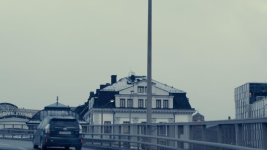
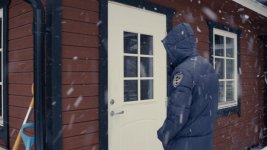
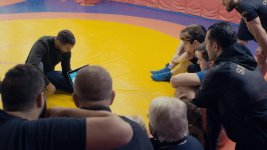
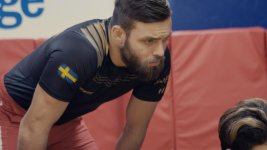
I recently shot a form of mocumentary with a friend. It's intented to be a prank on a birthday party next week. A former Greco-Roman wrestling world champion is a very good friend of my friend with whom I made the film and the film is about my friend finding out things about him and showing it to his friends and family. Since there are some really stupid people around and someone might believe what's said in the film is true, we won't make it public, but I'll put some frame grabs here for you to see how the camera performs in available and mixed light. The only scene where the lighting was arranged was the first one (with just a small LED), the rest is just available light. I haven't spent much time on grading it, I just used a preset in Premiere and then adjusted the levels and colour to create a suitable look for the mood of the film.

In the scene with the two men sitting in a kitchen I had to lighten the shadows and darken the highlights since my friends face was completely in the shadow there and the other man's face was lit by a kitchen lamp and light from a window.
The wrestling club was really nasty, since the yellow from the wrestling mat was very intense and it reflected everywhere, so those images might look a bit weird. I had do reduce the yellow saturation a lot there.
I used a Sigma 18-35 f1.8 in the first scene, the rest is shot on an "old" Canon 24-70 f2.8.


Jimmy 40 sekv.00_00_16_02.Still001.jpgJimmy 40 sekv.00_00_39_03.Still002.jpgJimmy 40 sekv.00_02_36_24.Still003.jpgJimmy 40 sekv.00_02_42_08.Still004.jpgJimmy 40 sekv.00_02_47_22.Still005.jpgJimmy 40 sekv.00_02_49_23.Still006.jpgJimmy 40 sekv.00_02_55_03.Still007.jpgJimmy 40 sekv.00_03_23_22.Still008.jpgJimmy 40 sekv.00_03_39_19.Still009.jpgJimmy 40 sekv.00_05_23_22.Still012.jpgJimmy 40 sekv.00_05_26_07.Still013.jpgJimmy 40 sekv.00_06_37_16.Still014.jpgJimmy 40 sekv.00_06_48_11.Still015.jpgJimmy 40 sekv.00_07_00_17.Still016.jpgJimmy 40 sekv.00_07_12_05.Still017.jpgJimmy 40 sekv.00_07_55_07.Still018.jpgJimmy 40 sekv.00_08_37_18.Still019.jpgJimmy 40 sekv.00_08_42_03.Still020.jpgJimmy 40 sekv.00_08_48_05.Still021.jpgJimmy 40 sekv.00_08_56_01.Still022.jpg
 
Hey Milan! Thanks for sharing. One thing that really jumps out is how awesome the skin tones are in all the different lighting situation. I also really like how the blues pop in the kitchen scene.

I have a couple of questions
1) Did you shoot any of this stuff at 5000 base?
2) Which do you prefer the Sigma or the Canon look on the varicam sesnor? It seems like the Canon glass gives something interesting. I am asking because I saw on friday the new sigma cine lenses which are impressive. I also saw the new 21-100 Zeiss Cine Zoom. I'm finding that my 18-35 and 50-100 are a little to sharp, and a little flat in the skin tones department, so maybe zeiss or canon might be the move in 2017.

Good work on your project!

-Alex
 
Thanks Alex!

Yes, they both had blue shirts and also the watering can is blue. That wasn't planned at all (we just planned the story), but as you say the colours are vivid.

To your questions:

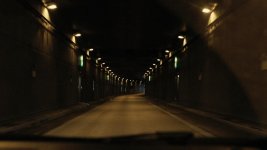
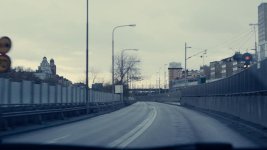
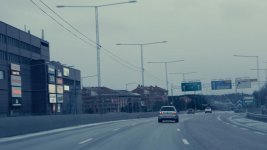
1) Yes I did, but can't remember exactly all of them. The second screenshot is definitely shot in the 5000 base, but the ISO set at 2000. That shot is also done with the Sigma 18-35 (the first two are), I forgot that when I wrote the former post. The kitchen scene might also be shot in 5000 base with ISO set at 2000, but I can't really remember. It was a very cloudy day and it was dark as you can see from the shots from the car, so it might have been dark enough inside for me choosing to do that. But, I also might have shot it in 800...
By the way I shot it in 1920x1080 AVC-Intra 4:4:4.

2) It's hard to answer what I prefer. I haven't really compared them side by side, but I was positively surprised by the Canon 24-70. I hadn't used it for a while. First I thought that the image would be too soft, but when I looked at the image I kind of liked it. I mainly used it since my Sigma 24-105 is an f4 lens, and I thought that the extra stops might come in handy if I wanted to have a more shallow DOF in a wider angle. The 18-35 can do that of course, but this was all done very hasty so I didn't spend so much time in setting things up. I have bought a really nice camera bag (Think Tank Video Rig 24) which lets me put almost the whole camera kitted out with shoulder mount, arms, EVF, lens and wireless microphone receivers into the bag directly. I only need to attach the battery and "extend" the arms and EVF to their right positions and I'm ready to shoot. It only takes a minute or so. So I mostly kept the Canon 24-70 on. The thing that's bad with it is that it's not wide enough on a S35 sensor and that the lens size varies depending on the focal length, while the Sigma is the same size all the time. So for shooting on a stabilizer the Sigma 18-35 is the obvious choice, if I then need to switch to tripod or shoulder mount I'd keep using the Sigma, I wouldn't mix those lenses since they look different. In this project it worked fine since the settings and shots were so different, and it's just a prank film (the intended audience won't see the difference). I needed to have the zoom range of the 24-70 since I zoomed in quite a lot during the shots. Everything was done in one or two takes. If there was a lens like the 24-70 in the range of 18-70 I would probably buy it. Canon has the 17-55 which I have considered getting, but I've decided not buying a lot of things that are okey (I've done that too much already) and instead saving up and buying things that I'm really happy with. So far I'm really happy with the Varicam LT. I'm not so keen on using the FS700 anymore. :)
Canon of course has the new 18-80, and I could probably live with it being T4.4 but I don't like the fact that there aren't any hard stops on the focus ring, so I'll have to buy a proper cine lens to get that. I'd really like to get my hands on the Canon 15.5-47 T2.8. It seems like a nice lens.
 
Milan with the camera mounted at the front like that, do you experience any bounce in the camera?
 
Milan with the camera mounted at the front like that, do you experience any bounce in the camera?

Yes Noel, unfortunately I do, but only when on the tripod. I have an idea for a solution: Some sort of screw that is screwed into the shoulder mount (there's a space in the shoulder pad where the camera is attached). This would let the camera slide onto the ARRI dovetail but still keep it stable (I think). Another solution would be to press a sponge or some sort of rubber ball in the space between the shoulder pad and the ARRI dovetail.

It's actually kind of strange that Vocas don't seem to have a solution for this. I guess there's a reason why people use the Sony VCT quick release base plates. I like the ARRI dovetails, since they are smaller and less bulky, but the lack of support on the rear of the camera is a problem. I usually don't shoot in places with a lot of vibrations, but in a scenario like that it would cause the camera to shake. Also, if the camera is bumped it'll start to shake.
 
If you're interested in a budget lens combination for the LT that yields cinematic images and complements the way the Varicam subtly renders colors I'd recommend you try some of the older Nikon glass

Nikon 17-55mm f/2.8 DX
Nikon 24-70mm f/2.8
Nikon 80-200mm f/2.8 (most of the 1st jason bourne film, the bourne identity was shot with this lens)

Just throw a novoflex nikon to Canon adapter and you're good to go on the LT, or if you own the lens do what I did and get the Leitax mounts for Nikon and permanently convert the lenses to EF mount.
I've projected these lenses and done tests with the LT on a 4k projector and the Nikon glass does laps around the EF and sigma.
I find that sigma Glass isn't exactly sharp but rather high contrast (which is often perceived as sharpness) and the amount of focus breathing very distracting, but I'm an admitted Glass snob.
although I'm partial to primes, doing more quick turn around stuff I've been relying on these Nikon zooms a lot more, as well as the tokina 11-16.

I've tried the 18-80 from canon on the LT and it's a decent lens but the fact that the focus ring has no stops is a deal breaker.
the Zeiss 21-100 is an amazing lens.

I think the Varicam LT lets you get away with using almost any glass but if you want the best image you should certainly get the best glass for the camera.
If you're using stills glass I definitely suggest trying some of the Nikon offerings, the 3 I recommended are a good starting point.

when i get a chance I'll post a ridiculous picture of one of my set ups with a LOMO 25-250 zoom on my Varicam LT
 
If you're interested in a budget lens combination for the LT that yields cinematic images and complements the way the Varicam subtly renders colors I'd recommend you try some of the older Nikon glass

Nikon 17-55mm f/2.8 DX
Nikon 24-70mm f/2.8
Nikon 80-200mm f/2.8 (most of the 1st jason bourne film, the bourne identity was shot with this lens)

Just throw a novoflex nikon to Canon adapter and you're good to go on the LT, or if you own the lens do what I did and get the Leitax mounts for Nikon and permanently convert the lenses to EF mount.
I've projected these lenses and done tests with the LT on a 4k projector and the Nikon glass does laps around the EF and sigma.
.

Interesting results. Which Canon lenses did you test, as certainly in test sites I've seen (for example Photozone and Digital Picture) the latest Canon 70-200 far exceeds the Nikon 80-200 in vignetting, sharpness and CA. The 24-70 also seems to perform at least as well or better than the Nikon equivalent.

Steve
 
Back
Top