The Vintage Lens Thread

Also, anyone have any comments on the E-series glass? It sounds like the Nikkor name were reserved for higher-end lenses with the AI system, etc, however the optics in the E-series are supposedly still great, but did not support the AI holes in the ears and that stuff. In our situation (since AI, etc, carried no benefit for us), would an e-series be just as well as a Nikkor? Because they are SIGNIFICANTLY cheaper!

Here's some footage floating around the interwebz. Looks pretty great to me! If you research the Series E lenses you'll find that most the reviews say they hold mostly about the same visual quality as the Nikon Nikkor AI/AI-S lenses. They do seem to flare a bit more and they come in plastic bodies, but I think they're a great value. In fact, I believe the 100mm Series E is recommended over the Nikkor 105mm in most circles because of its quality and very light weight.
 
Here's some footage floating around the interwebz. Looks pretty great to me! If you research the Series E lenses you'll find that most the reviews say they hold mostly about the same visual quality as the Nikon Nikkor AI/AI-S lenses. They do seem to flare a bit more and they come in plastic bodies, but I think they're a great value. In fact, I believe the 100mm Series E is recommended over the Nikkor 105mm in most circles because of its quality and very light weight.

Thanks for finding that.
I had a feeling the E-series were alright, but I couldn't find enough info on it. Everyone is busy going gaga over the Nikkors.
Meanwhile, I put in a "best offer" on ebay for a Vivitar 28mm F/2.0, and won it at $85. Not as cheap as the 28mm E-series (looks like they go for just over ~$50), but at least I like the idea of it having that extra stop under 2.8 for low light. I suppose that's worth the extra $35, even if its not a "Nikkor", right?

Also, I read a review somewhere (I think on Amazon) saying that the fotodiox adapters have trouble on wide lenses like 28mm and under. But I've never heard that mentioned here. Is there any truth to that?
 
> Vivitar 28mm F/2.0,

I have one, and it's AWESOME. Picked it up for $30 on ebay because it had some oil on the iris blades that caused it open and close slowly some times for fast shutter shots. No problem for video though! I also picked up a 50mm 1.8 e series at the flea market for $15, again, AWESOME...

I've had no trouble with my adapters. I don't remember the brand, I just went for the cheapest that shipped from the states.
 
Oh good grief, I'm becoming addicted too.
I *JUST* took the vivitar 28mm f/2 on ebay, and I was offered a tokina 24-40mm f/2.8 for $50 from a local craigslist guy.
GAH! I have a 28mm, a 50mm, the kit lens, and a 75-150mm 3.5, so I don't *need* this one, but dagnabit, I WANT IT!

Any opinions on the Tokina?

When is the next lens addiction meeting?
 
Some of you guys pointed to this adapter: http://cgi.ebay.com/ws/eBayISAPI.dll?ViewItem&item=150133492455&ssPageName=STRK:MEWAX:IT

Is this the right adapter for the M42 mount?
It seems some of the adapter could damage the AF pin, is that true?

Btw, I was reading there could be a chance to damage the mirror with some vintage lenses, and this should apply to the 5D but not the 7D, is that correct?

I ordered that M42 adapter from kawamall and it was the version with an inner flange. This is good if your lens doesn't have an Auto/Manual aperture switch on it as it will depress the aperture pin for you. However, I tried the adapter on an S-M-C Takumar 50/1.4 and it jammed up on the aperture pin. If your lens has the Auto/Manual switch, I'd go with a flangeless adapter.
 
Thanks for your reply nandreetta. I've just bought a Helios-44M lens M42 Zenit 2/58, not sure if it comes with the Auto/Manual aperture tough...

About my post above about the mir 20 I'm still confused, it seems the Mir 20 it's a M42 screw mount as pointed here: http://www.camerapedia.org/wiki/42mm_screw_lenses
but looking at that picture I'm wondering how one can mount it on the EOS. I guess the back part of the lens needs to be detached if this would still keep the lens usable!
 
The Helios 44M has an auto/manual switch (but 44M-4, 44M-5, 44M-6, etc. do not and are auto only) . Yours should look like this:

172269787_o_3.jpg


The silver switch near the mount is the auto/manual switch. The silver pin sticking out of the mount is the aperture pin that a flanged m42 adapter may or may not interfere with. There are also Helios lenses (44, 44-2, 44-3) that are simply manual aperture lenses, so no auto/manual switch and no aperture pin to get stuck on certain adapters.

As for your Mir 20, it seems to be some kind of cine lens based on the eBay listing description. It's meant to mount on Krasnogorsk movie cameras, so not an m42 lens and maybe not possible to mount on a Canon at all. However, the Mir 20 certainly does come in m42 versions. All of the ones currently on eBay are designated Mir-20M, in which case the M is used to signify m42. It means the same thing with Helios lenses, like your newly ordered Helios 44M, but there were also Helios 44s produced in the m42 mount before the M was used to identify them as such, so it's possible there are Mir 20s in that mount as well without the M in their model numbers as the camerapedia article seems to imply.
 
Two lenses I'm curious about, wondering if anyone had any experience or insight into them in terms of the quality/sharpness etc.

The first is the Sigma 28mm f2.8 K-Mount lens.
!CDu2Dt!!Wk~$(KGrHqF,!i8E0Gj3kdG9BNPjo8HruQ~~0_12.JPG


The other is a Canon FD Lens 24mm, f2.8
!CD0E(eQBGk~$(KGrHqJ,!mIEz+0E27skBNP0p5505!~~0_12.JPG


I would be adapting to the T2i. Would the FD lens lose more light than the K-mount lens through the conversion or would they both lose light? Would be using for video primarily, but perhaps occasionally for stills. Thanks!
 
Two lenses I'm curious about, wondering if anyone had any experience or insight into them in terms of the quality/sharpness etc.

The first is the Sigma 28mm f2.8 K-Mount lens.
The other is a Canon FD Lens 24mm, f2.8

I would be adapting to the T2i. Would the FD lens lose more light than the K-mount lens through the conversion or would they both lose light? Would be using for video primarily, but perhaps occasionally for stills. Thanks!

The FD would potentially have some light loss because of the FD-EOS adapter that you would need, which requires a glass element. They can be had for $35, $50, or much more - price increasing as you buy adapters with higher quality glass in them. The K-mount lens would only need a a mechanical adapter, which has no glass element.

I cannot speak for the lenses personally, though. I do have several FD's and use the FD-EOS adapter by Zykkor, and I really like it. I don't have any problems with haze, color shift, or softness, but there is a touch of light absorbed by the adapter.
 
I would be adapting to the T2i. Would the FD lens lose more light than the K-mount lens through the conversion or would they both lose light? Would be using for video primarily, but perhaps occasionally for stills. Thanks!
I converted this 24mm to EOS mount myself using eos camera cap and replacing mounts.Its not hard to do.cost less than adapter.
 
> I converted this 24mm to EOS mount myself using eos camera cap and replacing mounts.Its not hard to do.cost less than adapter.

Pictures or it never happened!
 
Sorry to dominate this thread, but I have one last question and I figure this is the place to ask it.

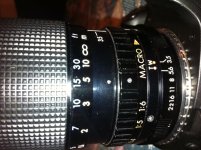
I have a Kiron lens, 35-135mm. It's a push/pull zoom, has a big focus ring, an aperture ring and a third, macro ring. I find when focusing, both the macro ring and the focus ring need to be adjusted to properly focus the subject more often than not, which is very tedious and difficult if you're not using a tripod. Can anyone enlighten me on the theory behind how this Macro ring actually works and is tied to the focus ring? At this point I'm just screwing around with the ring until I get the subject in focus and it's more time consuming than it probably should be. I have a picture of it below, it's the ring in the middle. (sidenote: anyone know what the TW means exactly in regards to the aperture ring?)

kiron lens.jpg
 
The "TW" could mean Telephoto - Wide, and it could have something to do with the macro focusing of the lens.

Don't be too frustrated; I have used macro lenses that took me for ever to figure out.
 
> I converted this 24mm to EOS mount myself using eos camera cap and replacing mounts.Its not hard to do.cost less than adapter.

Pictures or it never happened!

schowek4.png

Its on 3rd pic but its upside down,im too lazy to take another pic.
 
Back
Top