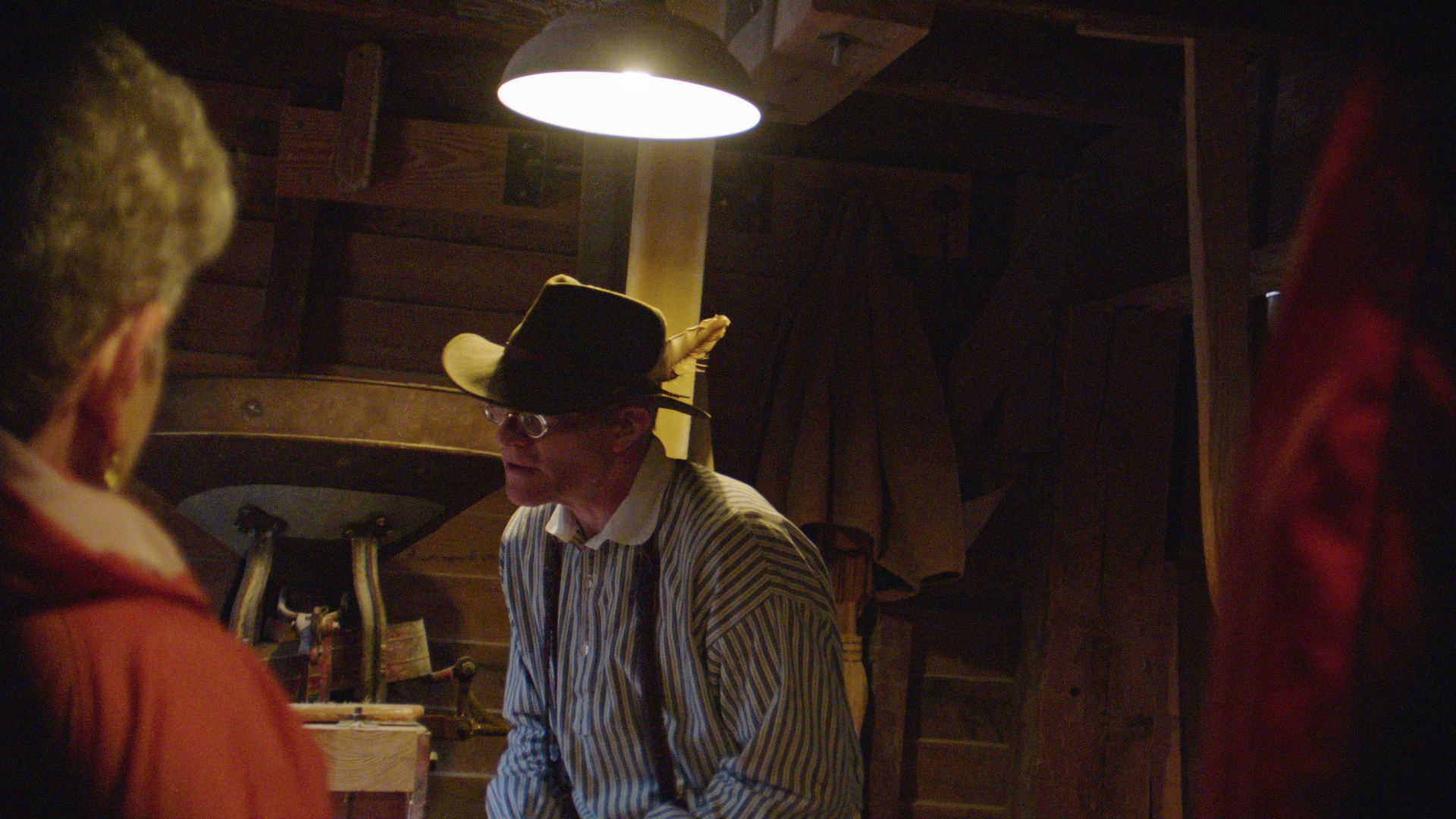
The Rise and Fall of Digital Bolex

Razz16mm

Veteran
An interesting interview with Joe Rubinstein.
http://blog.sharegrid.com/blog/inside-the-rise-and-fall-of-the-digital-bolex

After three years with mine I still haven't seen anything new come to market that I would replace it with. It is just such a joy to shoot with. Oddly enough with the emergence of HDR TV's and the REC2020 color space, display technology is just now catching up to the color gamut and DR this camera can produce.
 
Very interesting article. Thanks for posting, too bad it took its downfall to see how great of a camera it is.
 
I own a lot of cameras: going back to my Betacams to multiple VariCam's, C300, F55 and three different models of 5D's. And I firmly believe that CCD's are a big reason that our "ENG" cameras, like the pre-s35 VariCams, look so damn good, even to this day and even "only" being 720P(obviously the Vari's, not the old Betacam's. Lol).
 
I told Joe back in 2013 that a $3,000 1080p camera wasn't going to work. GH4 wasn't even announced yet (the official unveiling was in February, 2014) but it was already bandied about and I knew that the bulk of the market was going with the $1,700 4K option. Now he says he underestimated how aggressive the market was going to be but that wasn't the case either because Sony hadn't brought out A7RII until June, 2015.

Then he argued against 4K, which also went against him.

In retrospect, the markets were with BMD and Red cameras and would have been with AJA, had they been able to deliver Cion with the expected quality. But even that would have probably been a short window, as the Japanese began to ramp up their production of the low/er end 4K cameras.*

*There would have likely been a lot more models out already, had it not been for the 7.0 Kumamoto earthquake, which shut down Sony's sensor plant for several months.
 
Joe was right about his low profile targeted marketing approach for the D16. Spending the bucks to try to appeal to the broader commercial market was a failure. It was always going to be a niche camera that appealed to a particular type of creative indie filmmaker and it was also marketed directly to film schools as a digital alternative for their 16mm film camera inventory where it could use the same lenses they had in inventory. 12 film schools bought the camera. The planned product life was 6 years and it was to be replaced with a newer model, perhaps 4k, but no suitable replacement sensor came to market.
When the end of production was announced, all of the remaining cameras sold out in 24 hours. It had and still has appeal to filmmakers who would otherwise prefer 16mm film, not video. It belonged in marketing booths at indie film festivals, not NAB. Within the context of its originally intended market it was a rousing success, and still would be.
For less than $4k purchase price you got a camera that could shoot right out of the box requiring nothing but a lens, no rigs, no batteries, no media needed. It was especially appealing and affordable to filmmakers in countries and locations where access to production gear and accessories was remote. You could use cheap C-mount camera lenses, vintage cine lenses, m43 lenses or the most modern expensive PL glass. It is an extremely robust well made camera like its namesake. Something that can't be said of the BMPCC.
It is still the only camera in that price class that shoots a smooth seamless film like image free of virtually all the digital artifacts common to other low end cameras. No rolling shutter jello, no aliasing and chroma moire, no compression mud. As a fully manual camera, it requires at least a knowledge of basic photographic skills and is a superb tool for teaching those skills.
It is also the closest thing to a pure uncompromised photographic instrument you will find anywhere near its price.
When you bring up a frame from a D16 in a good raw processor like Raw Therapee, you can zoom in to 8x magnification and see discrete values for every individual pixel on the sensor surface. Something you will never see from a compressed format camera, even a RED. It exposes and shoots like 16mm film. It has a deeper color gamut and finer color discrimination than any compressed video camera, exceeding 100% of DCI-P3 color space thanks to its patented Kodak bayer filters. it has one stop better sensitivity, and significantly more usable DR than any of the older generation 16mm film stocks I used to shoot. It is a blank palette for visual artists who care about their image quality in depth beyond superficial considerations of pixel resolution.
The BM cameras are OK, but they still exhibit most of the digital artifacts of other low end cameras, even shooting raw. They have issues with fixed pattern noise when not exposed properly.
They have issues with aliasing and chroma moire unless you add an aftermarket OLPF. The BMPCC that is often compared with the D16 is mechanically flimsy and especially prone to failure of its mini HDMI port. It has an awkward form factor for motion shooting, like any DSLR form factor camera.
4k is just a buzzword. It says nothing about the underlying quality of an image. 4:2:0 8-bit heavily compressed video is not a very high quality acquisition medium 4k or not. 4:2:2 10 bit is miles better, but in its compressed formats still doesn't come close to the image depth and refinement of 12 bit linear raw. All of these in camera log or cine gamma settings greatly complicate the shooting and post process. They are just another form of image value compression.
Having full access to uncompressed full linear dynamic range raw data in the same way that still photographers do with their cameras is a real joy if one wants to exercise refined control over the look of the final image. It makes possible a range of looks and textures that video cameras just can't produce. The market for artisan filmmakers is not being served by the mass market alternatives in the D16's price range.
Some of you have seen a few of these images before, but I am attaching some examples to illustrate.
29933465162_352319bcdd_o.jpg


29420170073_8728ca151e_o.jpg


25798758471_444251d518_o.jpg


25893715995_e6a202d132_o.jpg


24732578739_2ccd681784_o.jpg
 
A few more:

24303048843_d0d8654d9a_o.jpg


24202108549_84e0b43217_o.jpg


Three images from an interview with Max Ginsburg.

Uncorrected raw frame
18132391776_1cb0e9a410_o.jpg


Wavelet processed experimental image:
17213969967_c14aacd27c_o.jpg


Final graded image:
18155346012_5718e3dfa0_o.jpg
 
All of the above images were shot with this rig: D16 with Angenieux 12-120 T2.1 HEC lens. Everything attaches to the camera as it came out of the box. No cheese plates, no base plate, no rails, no extraneous external accessories. Weight all up with the monopod rig for handheld shooting is 8 lbs. One hand for the camera one hand for the lens.

31860273794_d7af584213_b.jpg


29618714633_13242c7e3e_b.jpg
 
I mostly use a combination of sharpening tools tempered with a slight gaussian blur to smooth edges and fine tune the texture. The FX tools in Lightworks work better for this than the ones in Resolve. About the only filters I use are a UV filter and occasionally ND filters or a polarizer.
 
Great images, Razz.
Is that the 60's-70's 12-120? If so, you got a good one. Mine (CA 1 mount on my ACL II) was never that sharp or contrasty, even when tweaked by Century Optics.
Love what you were able to do with the Max Ginsberg portrait.
I recall meeting Joe a an industry open house 2-3 years ago. I was impressed by the actual build quality of the camera and the fact that one could "attach stuff to it" out of the box, as you have.

Still a wonderful tool that could actually increase in value.
Ken
 
Great images, Razz.
Is that the 60's-70's 12-120? If so, you got a good one. Mine (CA 1 mount on my ACL II) was never that sharp or contrasty, even when tweaked by Century Optics.
Love what you were able to do with the Max Ginsberg portrait.
I recall meeting Joe a an industry open house 2-3 years ago. I was impressed by the actual build quality of the camera and the fact that one could "attach stuff to it" out of the box, as you have.

Still a wonderful tool that could actually increase in value.
Ken

Mine is a very late model HEC version with the modern glass and coatings of their S16 series lenses. F/1.9-T2.1 constant aperture. Much better color contrast than the earlier version. Soft wide open but sharpens up nicely by f/2.8-f/4.
 
Joe was right about his low profile targeted marketing approach for the D16. Spending the bucks to try to appeal to the broader commercial market was a failure...
DB didn't have the production capacity to be the broad market competitor to something like GH4 (allegedly 5,000 units monthly) but a lower end camera that shipped in low volume wasn't going to keep the company in the black either. BMD has had the right strategy but have been suffering intermittently from the quality control/execution/customer relation problems. AJA had the right strategy but suffered from the execution problems. Joe and Ellen just happened to have missed on the strategy too.
 
The D16 does have a lovely image- one of my all time favoritest digital images of cameras that I've shot or owned. It comes in right after the Alexa and the F35 for me. In the right scenario I would gladly use it again if the project called for it. It truly is everything Razz says it is in the final result.

But it's a quirky camera to work with. It has a lot of workflow and usability oddities that you need to kind of accept as the price of admission. Some folks think that price is worth paying. Others, maybe not so much. It's perfect for solo grab & go holiday kind of stuff due to its form factor. Take it on a hike, or a vacation and its darn near perfect. I used mine in El Salvador as a small footprint documentary kit and it worked great, but there were zero mission critical moments that entire time I was there- just grabbing mood and tone bits for a sizzle reel kind of deliverable. Or if you're doing a non-scripted, non-planned narrative or experimental film- it's great for that, too. I can totally see it as an instructional camera or a camera where you're filming leaves blowing inter-cut with subway trains and undressed co-eds swimming in bathtubs full of motor oil (or whatever else the kids are doing in film school these days)- or even recording dance stuff like Joe's final DB produced piece. It's perfect for that kind of art-as-art kind of stuff. But if you're doing a full scripted and planned production with paid cast & crew and a hectic schedule- in that scenario those quirks became more evident (and stress inducing).

I'm not here to bag on the camera, again I absolutely love the image off of it. It's just kinda neither fish nor fowl. Add in the fact that it's EOL'd and the future prospects for the company are beyond dim and I figured it was a fun love affair while it lasted, but it was time to move along. Others have their own very valid reasons for hanging on with it and for them it's still perfect. It's all good.
 
Joe and team did a great job! I did not buy one, because it was almost there but not quite, as I think was the case for many, many people. I'm still looking for more a handicam body style, and more like $2,000 to $2,500 with viewfinder and everything.

x70.jpg

That being said, Joe did a lot more than most of us have done to materialize a dream camera. There are so many pitfalls and setbacks, even if the sensor is already made for you. Thanks for the article!
 
DB didn't have the production capacity to be the broad market competitor to something like GH4 (allegedly 5,000 units monthly) but a lower end camera that shipped in low volume wasn't going to keep the company in the black either. BMD has had the right strategy but have been suffering intermittently from the quality control/execution/customer relation problems. AJA had the right strategy but suffered from the execution problems. Joe and Ellen just happened to have missed on the strategy too.

Numbers are not always the way to success. Joe envisioned a small company selling more like three or four thousand units a year. Roughly $10 million in annual sales to make a successful company. Lots of small businesses thrive at that kind of income level. I read a news article about one Sony camcorder model that was built in England for the European market. It was built and tested in small batches of 200 at a time by one person.
Marketing could have been more focused, but it is not a camera that would be sold by advertising in the way a company like Panasonic does it. It actually takes some hands on with it to appreciate just how sophisticated the engineering is. An example is how they tuned the operating temperature of the sensor to produce a pleasant film grain like random noise level. The D16 needs to be warmed up for a few minutes after turn on to reach design temperature.
It was aimed squarely at creative filmmakers who are active in the festival circuits making movies for large screen projection. Joe and Elle both are very tightly tied into that crowd. It is a single purpose digital cinema camera intended as a direct replacement for 16mm film cameras. It is not and never was intended to be a normal video camera. It traded off popular market features for the best possible raw IQ at its target price range.
 
I own a lot of cameras: going back to my Betacams to multiple VariCam's, C300, F55 and three different models of 5D's. And I firmly believe that CCD's are a big reason that our "ENG" cameras, like the pre-s35 VariCams, look so damn good, even to this day and even "only" being 720P(obviously the Vari's, not the old Betacam's. Lol).

AMEN! I prefer CCD chipsets over CMOS any ****ing day. :)
 
I've been playing with color managed workflows in Resolve. Most recently using Slimraw 10 bit Cineon log compression. Still love the way the Bolex looks on its own. I don't need to make it look "like film". One writer recently commented that film looks have become a subset of what digital cameras are capable of.
My D16 handily surpasses any 16mm film stock I ever shot with in most meaningful respects. Cineon to Rec709 2.4 gamma samples:
41105512842_abe862152b_o.png


41105513522_0725e3d02d_o.jpg
 
Wonder if any new camera manufacturer will give a try at CCD again? Or maybe everyone is obsessed with their high ISO performance instead.
 
Back
Top