C200: The new Canon C200 with 4K

Just had a look at MP4 files from the C200 and when graded it did break quickly.

Upon closer inspection, yeah, Canon Log 3 is a bit too much for 8 bits. The graded footage suffers where there is noise and smooth gradients. The bit rate and the precision are just a bit too low.

Canon has helped by denying us Canon Log 2, BT.2020 gamut, and Cinema Gamut on the 8-bit codec of the C200. Canon Log 1 holds up better in 8 bits.

Though C200 denies us wide gamuts, if the C200 is anything like the previous Cinema EOS cameras, out-of-gamut colors are still encoded in Canon Log & Canon Log 3.
 
Last edited:
Just as with the C100 it's probably better to shoot at WideDR and keep within the boundaries of the codec used.

It's a bit odd not to include MPEG422 or similar 50mb/s 8:bit 4:2:2 as an alternative to the lower quality and higher quality ends.
 
How are you guys "breaking" the MP4 footage of the C200? I downloaded the 25p UHD clip from above and went crazy with Colorista, Lumetri, and Filmonvert (wild stuff with saturation, exposure, color wheels, etc...)

I'm seeing some badly graded footage, but no "breaking" per se--not seeing macroblocking, banding, etc. How is it breaking for you?
 
All I did was apply a curve to give the right contrast on an SDR monitor. Where there is banding, it dances with shot noise compounded by compression noise. I see it particularly in the metal dropbox. At 1080p I don't particularly see it, but I do at UHD 100%. It's not terrible. I'm pixel peeping. It's just a bit worse than I'd hoped.
 
A lot of politics are involved. Video delivery specs for broadcast are theoretically intended to provide a level of technical standards broadcasters know will hold up to the generations of degradation, and multiple levels of compression and recompression that your signal goes through from the time is leaves your camera's media to the time the end consumer views it. In reality, delivery standards have also served as a gatekeeper that prevents producers and content providers from using economical, lower end equipment, it used to be a way of weeding out the "serious professionals" from the "artists who are technically challenged or budget challenged". As low cost cameras have become better with more advanced specifications and as broadcasters, in the era of YouTube and web video regularly broadcast really bad quality video as a means of necessity because we are living in a video obsessed era, tech specs have somewhat become not as important as they used to be. The real differentiator these days is commissioned programming versus projects that are produced, completed and then bought by broadcasters and OTTs. If you are commissioned by PBS, a network, an OTT like Netflix, to produce content for them, you MUST adhere to their tech specs. These can include codec, raster size, picture bit depth, audio sampling rate and bit depth, etc. OTOH, if you produce a series shot strictly on Go Pros, which meet not a single one of these specs, broadcasters and OTTs will gladly purchase your program, IF they like it and want to air it. As we all know, content is king, that is why half of the video clips you see aired on the news are really horrific quality cell phone video or dashcam video. None of that content comes even close to meeting broadcast delivery specs as far as origination, but bad video is better than no video at all.

As far as the specifics of your question, delivery specs are fluid and change rapidly just as the cameras and media we buy change rapidly. In the 1080 era that we are just leaving as we head into the 4K era, the generally regarded spec for 1080 deliverables are something along the lines of, "1080p 59.94 10-bit 4:2:2 with a minimum data rate of 50Mbps", but of course, there are variations of this spec. So in theory, this leaves out 8-bit 4:2:0 or cameras that record the signal smaller than 50Mbps. But these specs depend on the broadcaster or OTT. Netflix requires UHD for all commissioned content, but I shot 1080 for their world premiere promotional package for "The Gilmore Girls: A Year in the Life" with Lauren Graham for them last year with a waiver. The content I shot for them was for web only usage, not "broadcast" on Netflix as content, it was used on their social media pages and YouTube. So basically what I am saying is that there are "the rules" aka video delivery specs, then there is reality. Reality is, delivery specs are a fluid and political concept, not nearly as cut and dried as many producers and production companies would lead you to believe. Also, few people shooting with medium to lower end cameras are commissioned by networks and OTTs, most of the content that they commission is going to be shot on higher end cameras where these specs are not as much of a concern, they are the norm. As indie filmmakers, you can really use whatever camera you want or can afford, IF your content is compelling, someone will buy it and run it. Of course, if you shoot it all on a 5D MKII, you are still going to have a deliverable master that conforms to their tech specs even though your origination content did not meet their acquisition specs.

Pure Drifting thanks for that epic response, answered all my questions! Helps a lot in narrowing the choice for my needs.
 
Just as with the C100 it's probably better to shoot at WideDR and keep within the boundaries of the codec used.

It's a bit odd not to include MPEG422 or similar 50mb/s 8:bit 4:2:2 as an alternative to the lower quality and higher quality ends.

Lets get this done with. Its a raw camera. Period. Transcode to whatever you want. Sorry to those that find that troubling. Freedom yayyyyeeee.
 
Lets get this done with. Its a raw camera. Period. Transcode to whatever you want. Sorry to those that find that troubling. Freedom yayyyyeeee.

As soon as CFast prices come down to more reasonable levels with 1GB cards, I am all for this. It's what I switched to with stills a decade ago, why not video?
 
Prices usually respond to the manufacturing costs and the competition. New SDXC V60/90 cards may cause the CFast 2.0 prices to drop a little faster. Delkin's V90 cards are priced at around $2/GB with some bad reviews. ADATA hasn't hit the store shelves yet.
 
Question. I know that at this point only a few people have shot with the C200 and others have only held it, but does anyone have any recommendations on a shoulder mount that may work for it? I have a C100 and I'm on the fence about the EVA 1 and C200. Is there a shoulder rig I could buy now that would be a safe bet for all three of these cameras? I'd like to be able to use it until I upgraded, but not have to buy a new one. That or at least not many parts to modify my shoulder rig to work with either one. Sorry if this isn't the right place for this question, but I thought it related directly to the C200 and mounting options. Thanks!
 
Come on...you cannot say it slows down post when Canon and the NLE companies are still working on everything.

You can import REDCODE RAW without blinking and start editing it immediately.

Maybe it will be the same. We'll know when the updates start coming out and how each NLE system handles it.
 
To use the raw feature might work for some but it slows down post and some might just want an easy and swift post workflow dropping files into the NLE and start editing.

All of the popular editing software are getting plug-ins and extensions that will allow drag and drop editing of Cinema RAW Light, that's kind of the whole point of the codec, it's 1/5th the size of Canon RAW and was developed with streamlined workflow in mind. I don't think people yet understand what Canon is doing here, they want to compete with the RED RAW style workflow and make it accessible and simple because it becomes a product differentiator just like DPAF. Remember when DPAF was introduced and many people scoffed that professionals would NEVER use autofocus, yet it's 2017 and here we are, many are holding back on other camera purchases because their autofocus implementation is sub par or non existant. Sure DPAF isn't as good as an AC but for those who would never be able to use an AC because of minimal crew, space, budget, DPAF has become a valuable tool, it's not easy to nail 4K focus. I predict Cinema RAW Light will eventually become quite popular and hopefully it will help to drive down CFast 2.0 card prices at an accelerated pace. You can bag on Canon all you want but they are not dumb and they know how create unique value propositions.
 
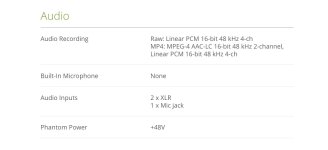
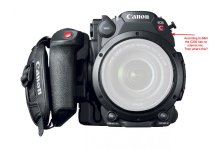
I am confused, does the C200 contain an internal microphone? I have watched two videos that specifically say that it doesn't have an internal microphone, the B&H site says it doesn't, yet other have said it does and if you look at the picture, the C200 appears to have an internal mic. Anyone know for sure? I guess it's possible that Canon put those holes in the body panel for another reason but it sure looks like a Canon internal mic, doesn't it?

C200 audio.jpg

Canon C200.jpg
 
Forget about B&H. Misinformation always spreads because people just copy and paste or hear someone else say it and say the same.

Always do your own research! (Saying that to no one specifically.)

This following document is a C200 full specifications list.

In the 'Others' section under 'Recording Media', it mentions the 'monaural microphone', which is the same item listed in the C300 Mark II specifications.

https://downloads.canon.com/nw/came...mmc=nw-_-eos-c200-_-specifications-_-download

I think it's safe to say it has an internal microphone.
 
While I was in there, I took a glimpse at the white papers. A snippet of further support about the post workflow:

"However, for those with systems powerful enough to handle live debayer and edit, Canon will be releasing plug-ins for Avid® Media Composer®, as well as other popular NLE and grading softwares, to accept Canon RAW Media files natively. This will allow the .CRM files to be ingested into the NLE’s as if it was any other standard codec, with a few main differences.

Imagine a world where we can shoot 12-bit high data rate media, ingest it into our NLE, and be able to change key factors on the fly such as white balance or color space. This is where Cinema RAW Light becomes more than a codec, and instead a malleable format within your NLE that allows for seamless creation of different compliant passes easier than ever before. With the abundance of metadata available as well, it’s a dream for heavy VFX workflow."
 
All of the editing machines I've worked struggles to a certain degree with 4K files so I guess IT Will be the same with 4K Canon raw? Not to mention most clients still dont want 4K files. So to then transcode wont be a fast post process. That' the reality I'm facing.
 
Lets get this done with. Its a raw camera. Period. Transcode to whatever you want. Sorry to those that find that troubling. Freedom yayyyyeeee.

But if it's all about the raw with this camera why only one cfast slot and 2 sd? I'm sure some will use it that way but 2 slots would have shown Canon's intent a little clearer...and made working with it a whole lot easier and safer
 
All of the editing machines I've worked struggles to a certain degree with 4K files so I guess IT Will be the same with 4K Canon raw? Not to mention most clients still dont want 4K files. So to then transcode wont be a fast post process. That' the reality I'm facing.

No offence: Maybe those editing machines just didn't have the specs for smooth 4K editing?
Still, it's RAW: Editing 4K straight from a Sony FS7 on my old iMac is slow, editing RED Raw is smooth - much less decoding power needed.

I still don't get, why people complain: If you need the highest possible quality you can shoot RAW(lite) internally, albeit with the added costs of CFast.
If you're product doesn't need that, you can shoot .mp4 with a bitrate that in relation to the C100's HD bitrate, should suffice for a lot of mid-range jobs.
AND you'll get AVC-HD in 2018 for free, probably adding 50Mbs for HD, but probably undercutting the C300mII 4K bitrate.
 
I will be buying a new iMac, not sure if I will spend as much as the Pro model, but a top of the line with a good Thunderbolt RAID should be able to handle Cinema RAW Light hopefully
 
Back
Top