FS5: Sony releases Venice REC709 3D LUT

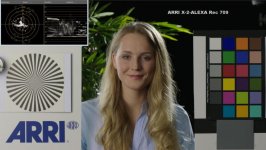
Curious about this "Venice" LUT so thought I would compare it with a number of the ARRI LUTs to see where Sony's Venice LUT inspiration was coming from. Three pics here. #1 if from the export screen of the ARRI Color Tool showing the selected "look" for export. In this case it's the X-2-ALEXA Rec 709. This was chosen as the comparison LUT to go up against the Sony Venice Rec 709 LUT. Pic #2 is the Sony Lut and pic #3 is the ALEXA LUT.

The reason for choosing the X-2-ALEXA Rec 709 LUT was because I noticed when used with ARRI's reference "Isabella" test shot (from Log C) the luminance levels between the two LUTs is amazingly close when you compare the two wave forms. Where I see the BIG difference is in the color charts and on the Vector scope. ARRI's magic has always been associated with the drop in chroma levels as luminance values go up. As I said just look how close the two waveforms are in luma levels but look how much more saturated the red, orange, pink, brown and skin tone patches are on the Venice color chart vs the ALEXA color chart. Conversely look for the opposite on the cyan, and the two darker blue chips on the ALEXA chart, much more saturated. To me the lower chroma levels on those important red, orange, pink, brown and skin tone patches, all of which contribute to skin tones, gives the ARRI skin tones a, let's say a slightly "lighter" more natural look to my eye given their lower chroma levels around that all important 50-60 IRE range.

As someone else pointed out there is a definite slight bias to yellowy-green in the Venice LUT. Study the grey patch below the Macbeth chart and i think most of you will see it. To me both are quite usable and I don't think I have any clients who could or would see the difference. Me I could go with either but having tried both out on S-LOG3 the X-2-ALEXA Rec 709 makes my smile a little wider.
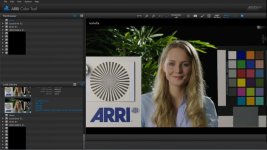
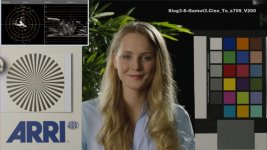
ARRI Color Tool.jpgSlog3-S-Gamut3.Cine_To_s709_V200.jpgARRI X-2-ALEXA Rec 709.jpg

I hope what I have described shows up on the uploaded files. On the originals and on the timeline all is as clear as day.

Long live our choices.

Chris Young
 
As someone else pointed out there is a definite slight bias to yellowy-green in the Venice LUT.
Chris Young


Interesting. Kind of reminds me of Kodak vs Fuji in the film days. I always thought that Kodak was warmer and Fuji had a slight green cyan bias. The Alexa look was very much modeled on Kodak Vision stock. (I am not saying that Sony emulated a long dead Fuji stock).

Maybe we are seeing a case of Western vs Eastern aesthetics or how each culture sees the world?

Regardless the Venice look is a big step forward for Sony.
 
That's because its not needed. You can grade S-LOG2 to look exactly like S-LOG3/Cine in Resolve without the convoluted (and I'll bet damaging workflow) of converting to S-LOG3 along the way. You're making things harder than they need to be.
 
I downloaded Alister Chapman's tweaked Venice 709 LUT's. His article says that he tweaked them to work better with the F55 and other cameras that are ~14 stops, where-as the Venice is rated at ~15 stops. After a frustrating stretch trying to load the LUT into my F55 from the files DL'd to my Mac*, it finally worked. Alister didn't go into great detail which LUT's to use, but I'm presuming it was the one in the file labeled CINE EI Camera. I didn't do what would be considered scientific testing, just looking at the image on my calibrated OLED monitor. Just looking at it on my on-cam monitor and shooting some stuff in my house, I generally liked it. It has nice color, contrast and seems warm, which is all in-line with what I like in a general image. Compared to the F55's built-in 709, LC709 and LC709A LUT's it has noticeably more contrast and color saturation and so far, I like it better. Something that Alister also didn't mention in his write-up(at least I didn't see it mentioned), his tweaked LUT is for S-LOG 3/S-LOG 3 Cine. If you apply it over S-LOG 2, it is too dark/too contrasty.

*Mac's write invisible files to removable media which can interfere with other non-mac devices reading them properly. After many unsuccessful and frustrating attempts of trying to load the file into my camera and some googling, I ended up downloading an app that scans and removes the invisible "junk files" when you eject the media from your computer. As soon as I did that, my 55 saw the file with no problem.
 
Curious so I tried downloading AC's tweaked Venice LUT but his download link is currently disabled?? Numerous posts on his blog saying the same. You was a lucky man Mr. R&G :)

Chris Young
 
I tested the Alister LUT too. As Run&Gun stated ist more contrasty and more saturated. For my taste it's too much. The green shift is easier to fix than to bring back the shadows.

NewVenice-200-2.jpg
 
Thanks for that Clermond. I was using a different link of his on his Sony CImediacloud.com downloads. Will now have a suck and see of it!

Chris Young
 
Before and during WW2 it was Leica, Leica, Leica, a few Zeiss Contax and 4x5 Speed Graphic.
Maybe throw in the Rolleiflex 6x6 for good measure.

Just after WW2 is was Leica and Rollei.

Nikon shows up during the Korean War and it becomes Leica and Nikon.

Leica drops the ball during the Vietnam era by not making a good SLR.
The Nikon F-series dominates everything for a very long time.
Hasselblad dominates fashion and advertising.

Canon gets in the game during the 70's/80's and slowly builds a following. Canon sees the potential of the microprocessor and makes a big push for automating many features.

By the 90's and 2000's Nikon and Canon are neck to neck.

Nikon drops the ball around the time of the 5D by not taking video serious. They still don't.
Most news shooters go Canon because they need to shoot both stills and video.
Anyone who ever wanted to shoot a movie buys a 5D mk2 and later on a Canon EOS movie camera, lenses etc
Canon sells more cameras than Nikon. Nikon has the better sensors and still doesn't take video serious.
Leica pulls back from the brink and reinvents itself as a luxury brand. Sales of Tri-X stabilize.

Nowadays no one cares what you shoot.

Nice write up! Have you been around since then or are you a photography historian?
 
No you don't. You judge Sony's business from your own POV.
I am far from defending Sony's strategy but Sony is way more than F-series digital cameras.

Of course I can't speak for Sony and it's obvious they don't think like I do. Or they wouldn't have done it that way. But I'm not judging from my POV. From my POV I would say sell the Venice to us for $10K and be done with it.

But from a business point of view it's the most stupid thing you can do. Release a very expensive product. One which many already think is overpriced. Then release a way for something cheaper to emulate it. Stupid business sense if you are talking about fries, about cameras or about cars. Stupid! Who would pay $20 for McDonald's great tasting new fries made with special Tibetan potatoes which taste wonderful, if you can get a sauce for free at the stand to make McDonald's ordinary fries taste the same or close enough? Yes marketing would say the Tibetan potatoes are healthier, bio, more nutritious etc etc etc. Still devalues them to have a free sauce for the other.

You are correct that Sony is so much more than F-series cameras. This is why they can't understand the cine business. Why they will likely never be seen in the same level as Arri, Panavision or even Red in the industry. Some may say they don't need that or even care. But Sony's continuing trials say different. They even talked to ASC DPs for the Venice. It's obvious it hurts somewhere that they are not taken seriously. If you take all the cinema movies shot with the F55 or F65 and then take off the ones which were Sony Pictures, Columbia, Tri-star or had any of their companies involved, you are not left with much. Just a couple of name DPs who shot with Sonys and then went back to Alexa or film. If it wasn't for the netflix rule, the F55 would have never done much outside of sitcoms and cooking shows. The problem is that for that the FS7 and F5 are more than enough. There you have the problem.
 
Last edited:
Something that Alister also didn't mention in his write-up(at least I didn't see it mentioned), his tweaked LUT is for S-LOG 3/S-LOG 3 Cine. If you apply it over S-LOG 2, it is too dark/too contrasty.

I didn't download the luts. But in the article he says: "I have created a set with offsets for both the Zacuto and Small HD viewfinders and monitors and finally I have also created sets of LUT’s for use with S-Log2 so users of the original A7s or those that wish to shoot with S-Log2 on an 8 bit camera are not left out."

So there should be a version for s-log2 in the package.:)
 
Agree with Clermond's comments. Alistair's Venice LUT is too crunchy in the blacks for me. Along with the yellowish / green bias it's a no go for me. Overall Bert's Balanced Arrilook is one of my more popular favorites. Especially when it comes to harsh outdoor sunlit conditions where you do have as we used to say in B&W film days "Soot and Whitewash" contrast conditions. There again the LUT I'm using more and more which is receiving more positive comments than any other LUT I'm using for standard 709 delivery is the good old faithful ARRI X-2-ALEXA EE 709. Doesn't have that traditional very slight green bias of the original ALEXA LUT. Cine EI rated at 800 with that LUT and hardly a thing to do in post. Love it, less work!

Chris Young
 
Nice write up! Have you been around since then or are you a photography historian?

Crazy this brings back memories. I started my career in the mid sixties as a trainee photographer with the Daily Mirror in London. The Japanese camera that was making all the waves back then was the original Nikon F with its Zeiss Contax shaped body. The reason being Nikon was grabbing a lot of attention was that National Geographic had just switched from Leica to Nikon for their staff cameramen. From memory, I think that was in 1964. I can remember exactly where I was standing in the newsroom at the Mirror when this news arrived. Like when Kennedy was shot. One thing Leica had going for them since Nat Geo had accepted that 35mm film was good enough for their publication was the undying loyalty of Nat Geo buying Leica cameras for their staff photogs. I seem to recall it was 180 Nikon F kits they bought. This was earth shattering news in the photo world in those times. In those days Leica was looked upon like ARRI is today in the film world. Germany's best. To buy Japanese kit was unheard of.

What got Nat Geo's attention drawn to the Nikon cameras was the phenomenal pictures David Douglas Duncan was shooting for LIFE magazine with Nikkor lenses. Duncan who really made his name in Korea as a war photographer for LIFE was the instigator of the introduction of Japanese cameras to the western photo journalism world. In my youth D. D. Duncan was giant amongst war photographers. We all wanted to be like him. He was one of my heroes back then. A bit of background here:

Chris Young

https://www.youtube.com/watch?v=UUvHAa1M7D4

https://en.wikipedia.org/wiki/David_Douglas_Duncan
 
Last edited:
That's because its not needed. You can grade S-LOG2 to look exactly like S-LOG3/Cine in Resolve without the convoluted (and I'll bet damaging workflow) of converting to S-LOG3 along the way. You're making things harder than they need to be.

It's not convoluted. It's literally 8 clicks and takes less than 10 seconds to have my entire timeline matching between all three cameras. That's not convoluted at all. And I've been doing this since early 2016 and have not seen any damage from converting S-Log3 to S-Log2. Not everyone works in Resolve Doug. For some of us, Premiere makes much more sense and being able to match three cameras across your timeline in seconds makes a lot of business sense, so that's why I shoot in S-Gamut3.Cine on all three cameras, meaning I have to use S-Log3 for the FS7. It may not be for you, but it's for me, just like working entirely in Premiere is for many people on this forum.
 
Crazy this brings back memories. I started my career in the mid sixties as a trainee photographer with the Daily Mirror in London.

I made a concerted effort to switch into photojournalism after many years in visual effects, but by the time I had a portfolio together the news photo business collapsed and has never recovered. So, I stayed in the movies.


What got Nat Geo's attention drawn to the Nikon cameras was the phenomenal pictures David Douglas Duncan was shooting for LIFE magazine with Nikkor lenses. Duncan who really made his name in Korea as a war photographer for LIFE was the instigator of the introduction of Japanese cameras to the western photo journalism world. In my youth D. D. Duncan was giant amongst war photographers. We all wanted to be like him. He was one of my heroes back then. A bit of background here:

Chris Young

https://www.youtube.com/watch?v=UUvHAa1M7D4

https://en.wikipedia.org/wiki/David_Douglas_Duncan

DDD basically made Nikon. He was on his way to cover the Korean War for LIFE magazine, when he stopped in Japan and was introduced to Nikon. This was in the early 1950's. Back then Leica and to some extent Zeiss ruled the business (Zeiss was in some turmoil after being split between West and East Germany). The Zeiss Sonnar 1.5/50 was the gold standard for high speed lenses at that time. We can't forget that there were no high speed films back then. Kodak Tri-X didn't show up until 1954 and initially was only rated at 200asa (later 400asa), so you needed fast glass to shoot in the dark. There isn't much you can't shoot at f1.4 and 1/30th @ 400asa. Anyhow Nikon showed DDD their Nikkor 1.5/50 and it matched the performance of the Zeiss Sonnar at a fraction of the cost. Same for their 85mm and 135mm. It also turned out that the Nikon rangefinder bodies, which were somewhat based on the Zeiss Contax, where rock solid and vastly cheaper than their German counter parts. It probably also helped that Japan was the jumping off point for news people covering the rest of Asia, so you could get everything serviced right there by Nikon. And then of course in the 60's the Nikon F SLR cemented Nikons reputation and pretty much killed most of the German industry, who simply couldn't manage to build a better SLR at a competitive price. Up until the 80's your standard news shooter kit was a Leica for wide-angle lenses (35mm and below) and Nikon F series for 50-200mm
 
Last edited:
Back
Top