
JPNola
Veteran
JP I think you should talk about the loupe situation a few more times!
Sorry. Didn't mean to drive you loopy.


Follow along with the video below to see how to install our site as a web app on your home screen.
Note: This feature may not be available in some browsers.
JP I think you should talk about the loupe situation a few more times!
I wouldn't be at all surprised if I got the model names mixed up... I do that
That said, AFAIK the only difference between the Shogun Inferno and the Shogun 7 is the display, though the difference there is huge. Jeromy talks about that in the same interview also -- how Atomos was able to update its peak brightness with a firmware update. It's an interesting listen.
The new raw codecs are pretty impressive in their efficiency. As storage improves, especially in the camera media, space and record times will be less of a issue. Now all we need is graphene batteries to replace LiPo and Li Ion so that we can get a nice boost in power density and battery life...
I overheard Alister Chapman today as he was giving an interview saying that raw likely won’t be available until summer next year. By that time Atomos have probably released 84 new shogun models so I’m sure we’ll be fine.On the downside it it looks like to get 16 bit RAW it looks like the only option will be buying a Neon and paying an estimated $5K price to get a new MCU. Ouch and ouch!
Thanks for posting the video!
Unfortunately, it looks like Atomos isn't planning updates for the Shogun Inferno. I think this is really unfortunate since the Shogun Inferno is obviously capable of processing a 6Kish image on the EVA1. It seems reasonable that they might be able to do the same on the S1H.
I do feel a bit abandoned and I think Atomos is creating an opportunity for Blackmagic. Some Shogun Inferno owners might consider adding one of the new Video Assist units and giving B-RAW a try.
The Shogun 7 also has significantly more processing power which is why it's able to do the live switching that will become available next month.
Jeromy did mention that it might be possible to go up to 14 bits with Shogun 7 which would likely make most FX9 users happy.
On the downside it it looks like to get 16 bit RAW it looks like the only option will be buying a Neon and paying an estimated $5K price to get a new MCU. Ouch and ouch!
Sony could have just let FX9 work with the R5 and R7 recorders like the FS7, FS5, and FS700. The recorders and especially media are pricey but at least it would have been a rental option for FX9 owners. Sony clearly doesn't want FX9 users to record 16-bit RAW if the only option is a tethered $9K desktop solution.
Considering that there's (slow but steady) movement toward 8K, one would think that the next generation of the external recorders would be able to deal with a lot more data than the current ones. This seems rather inevitable. The key, insofar as FX9 goes, is how Sony and Atomos decide to proceed with their partnership. Atomos has struck some solid ones with Nikon and Panasonic. The external Atomos Raw recorder for FX9 might be pricey at first but, if the connectivity to Sony product is established, the same model should cover a lot of different cameras a la R5 & R7.... if there IS demand, we might see an updated Shogun that can record 16-bit raw. Who knows?

Besides, what, Arris, what else shoots XQD?
The Arri Alexa uses SxS cards and they don't seem to officially support the SxS adapter for XQD cards:Besides, what, Arris, what else shoots XQD?

So who is thinking about buying?
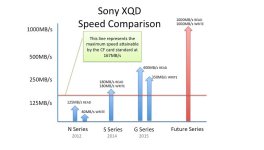
I suppose it's possible that the FX9 eventually gets a firmware update that enables CFexpress support, as in some cases this is doable through a firmware change. It's also possible that Sony wants to sell their own XQD media, since they are one of the few manufacturers of XQD cards, and Sony doesn't have any CFexpress cards on the market yet. Sony did announce the development of a CFexpress card earlier this year, but it doesn't actually seem to be available yet despite the claim that it would be ready by summer 2019

The Arri Alexa uses SxS cards and they don't seem to officially support the SxS adapter for XQD cards:
https://forum.arri.com/viewtopic.php?f=46&t=147
The Alexa Mini and Amira use CFast 2.0 cards.
In addition to Sony which used XQD cards in the FS7, FS7 mkII, and a couple of their early 4K camcorders, the PXW-Z100 and FDR-AX1, Nikon bet pretty big on XQD. The Nikon D5, D500, D850, Z6, and Z7 all have XQD card slots. Panasonic also included an XQD card slot in the S1 and S1R, although they kind of split the difference with one SD card slot and one XQD and then went with dual SD slots in the S1H.
I'm not sure why they didn't include CFexpress support in the FX9 though. CFexpress type B cards are the same connector type and dimensions as XQD, so it is possible for a camera to accept both types of cards for compatibility. And CFexpress definitely seems to be the future as it allows for significantly faster cards. The recently announced SanDisk CFexpress cards are faster without being any more expensive than existing XQD cards. Plus, they have a 512GB card which is a larger capacity than the biggest XQD card (256 GB) currently available and is actually less expensive per GB than the smaller cards:
https://www.cinema5d.com/sandisk-cfexpress-ultra-fast-cards-now-available-for-pre-order
I suppose it's possible that the FX9 eventually gets a firmware update that enables CFexpress support, as in some cases this is doable through a firmware change. It's also possible that Sony wants to sell their own XQD media, since they are one of the few manufacturers of XQD cards, and Sony doesn't have any CFexpress cards on the market yet. Sony did announce the development of a CFexpress card earlier this year, but it doesn't actually seem to be available yet despite the claim that it would be ready by summer 2019: https://pro.sony/ue_US/press/cfexpress

deltajohn you just about nailed in #1.
I think you are very close to Sony's reasoning as to the placement of the FX9 in the market. It's very rare since the introduction of the Betacam that Sony have launched a product that missed the mark to any reasonable degree. They know their market pretty well. The closest I can recall was the short lived Sony Betacam SX series with their low 17.5MB data rate recorded to those bright canary yellow cassettes. Worked well for news gathering when linking back to base with low bandwidth, on the from memory the 25Mbps SS3 microwave links. I think they will sell bucket loads of FX9s. As you say the FX9 is not aimed at the higher end cine market.
Chris Young
Elcaset wants to have a word with you.... Sony may indeed eventually support CFExpress technology but to do that means Sony would be relinquishing its control over ... media ...
I think overall the FX9 is a pretty solid evolutionary upgrade. Nothing revolutionary, like the FS7 kinda was, but enough that potential FS7/II buyers will probably pay the extra dollars instead. A lot of potential EVA1/C200/Ursa Mini Pro buyers might be tempted to go for this instead too, if for no other reason that it will also likely be an industry-standard money-maker like the FS7 was.
The comparisons to the C500mkII are understandable given their close announcements, but in reality they are totally different cameras for different markets. C500II has a higher price point and plays more in the low-end cinema camera market. It'll be used on a lot of commercials, high-end "content" (is that the accepted term these days for that blended doc/commercial style that generally lives on social media?) and indie features. It'll compete more with Red, offering a more complete system (ND's/XLR) that will tempt a lot of people who are fed up trying to shoot Red on certain projects that really aren't suited to it. Most of these jobs still require a crew, so the back unit is a requirement for extra outputs, D-taps, etc, which will further stretch the price difference from the FX9.
And speaking of the FX9:
It knows it's market, and it nails it pretty well. 4K in broadcast-standard formats, combined with an easy, flexible and familiar form factor. They've improved/closed the gap on the biggest areas their competitors were outdoing them - colour, and AF (though most will never use it). They've also added that prestigious FF sensor and will have a better 4K output thanks to the oversampling. Now, people can ***** and moan all they want about needing a recorder for raw, but the reality is that most of the target market does not need it or want it. Furthermore, pretty much any decent camera op will be able to pick this camera up out of the box, put a lens on, and start shooting footage that meets the standards of almost every client who's not demanding Arri/Red (and that includes doc, ENG, EFP, reality, live broadcast, events, commercials, corporate, short films, etc, etc). I think the only other cam that can do that is the FS7. What the FX9 does not do, however, is deliver MORE than their target market needs. They haven't quite blown the competition away like the FS7 did, and the FX9 upon release is perhaps not as future-proof as the FS7 was in 2014.
Having said that, I'd say Sony probably have a few tricks up their sleeve with this camera. If it's going to be their 5-year flagship in the same way the FS7 or - in a different tier - the F5/55 have been, they'll likely have a steady stream of firmware features, and possible factory-upgrades, both paid and unpaid, that will unlock potential into the future. I'd wager that in a few years time this camera will probably have internal 6K and 4K120p recording. There'll also probably be better raw options too in the future with 3rd party manufacturers (compare the AXS-R5 unit for the FS700 to the rush of after-market options that became available). And similar to the FS5, they'll release a mk II version in a few years time that comes pre-installed with all the paid upgrades they've released along the way.
So, while on paper the FX9 may seem underwhelming upon release (it doesn't offer anything the FS7 doesn't... blah blah blah), I think it'll become a bigger hit in the real world than the specs might suggest.

Compatibility with lenses one already owns is less a thing since EF lenses are easily adapted to e-mount.
Have you ever seen anyone in the field with a Canon R / RP camera? .
