So many filters - which to choose?

digifruitella

Active member
Hi, I'm a newbie to filters, and you may say to technicals of photography in general and I'm deciding to get a filter, or a few various ones for my T2i.

I just did a search for a Polarizer filter on B&H and there's a ton of them...

http://www.bhphotovideo.com/c/search?Ntt=polarizer+filters&N=0&InitialSearch=yes

which arises my question; how do I know which one to pick?

I see there are glass and round mount ones - if my assumption is correct the more quality ones are the glass ones that attach to a filter holder. I see them constantly being used by pros.

What would one need to look at before purchasing a filter, ANY filter at that...such as in my case. I've got the kit lens of the T2i package, and I just bought a Canon 50mm 1.8 II. Do filters (polarizer, ND, GD, etc) need to match your lens somehow or only if you're gonna get the round mounted ones that go straight on your lens (duh, I think I just answered THAT question myself) You see because I'm not well educated in this department and was wondering if a square glass filter is something I should INVEST in the long run instead of a round mount?

The same goes for an ND and GD filters. I'm looking to buy THREE filters for all purposes; obviously the Polarizer an the aforementioned two.

1. What do I need to know before I buy them (anything specific, and technical)

2. Should I buy a square filter or a round mount (is it quality or preference based?)
cokin-filter.jpg


vs

41IzUMPfqZL._SL500_AA300_.jpg


3. what Brand to go with?

4. Lastly, if with square filter, what filter holder do I need (different brands have their own holders to fit the filters or not?)

Thanks
 
The 2 filters that people use the most are ND filters and polarizers (Circular).

ND are an absolutely must if you're shooting outdoors to get proper exposure. A lot of people use Fader NDs which allow you to quickly change exposure.

If you have serious dough, the Singh-rays are the best Fader NDs. the Lightcraft workshop ones are much cheaper but you look sharpness on long lenses. Or you can just screw a linear Polarizer in front of a circular and you have a DIY Fader ND. If you use good glass, then it should be as good as the Singh-Ray.

Just use the circular filters that screw into the lens of your camera. The square ones you have in the pic are more for if you have a matte box (ie. more money). When you're starting out you don't really need it.

Oh yes, it might be a good idea to use a UV filter in front of your lens. It will keep the lens from getting scratched. I use the Hoya UV super multi-coat. Kind of expensive, but really clear.
 
Check out lee filters with mattebox
I will be investing in one those when the time comes .
I got the B+W ND, haze and circular polarizer screw-ons for now.
My ND is stuck in one of my step-up rings and I cant get it out . Frustrating !
 
I just did a search for a Polarizer filter on B&H and there's a ton of them...

What would one need to look at before purchasing a filter, ANY filter at that...such as in my case. I've got the kit lens of the T2i package, and I just bought a Canon 50mm 1.8 II.

The same goes for an ND and GD filters. I'm looking to buy THREE filters for all purposes; obviously the Polarizer an the aforementioned two.

1. What do I need to know before I buy them (anything specific, and technical)

2. Should I buy a square filter or a round mount (is it quality or preference based?)

3. what Brand to go with?

4. Lastly, if with square filter, what filter holder do I need (different brands have their own holders to fit the filters or not?)

Thanks
Start with a Polarizer filter. It will give you the most options for adjusting your image in one filter and acts as an ND at the same time. They work great for blue sky shots, water reflections, and anything glass you want to see through more clearly by dialing out reflections.

Get a quality Japanese filters in your budget. Most are good, if you have brands you are looking at maybe post a thread here for feedback before buying.

Your 50mm f1.8 is a 52mm thread which is a bit of an oddball size. The 18-55mm kit lens is a 58mm and many other lenses you will add on later may be different as well, such as the Tamron 17-50mm f 2.8 which is a 62mm thread.
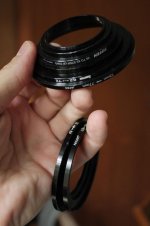
What I'm getting at is filters can add up in cost and bulk in your camera bag so you may consider collecting a larger size filter and adapter rings each time you get a new lens. I have a big variety of 72mm filters I started collecting a while back and use them on every new lens I buy. I'd rather have every adapter ring in the book then every filter ever made.
As you add on lenses to higher grade glass the filter sizes will be larger. Many are 77mm which is a little overkill for a 52 thread but a 72mm filter may be a good investment. Also remember lens hoods are necessary and large ones work well with adapter rings.
Look around the web for lenses you may want to add on soon or in the future. Check the filter thread sizes and you may find investing in a 72mm filter collection will be more efficient.
Ebay is loaded with used filters cheap as long as the coating is like new with no scratches or fungus.
The square filters may be more trouble to deal with in the plastic holder variety. They are usually cheap construction and not as secure as thread filters.
Quality square filters in the 6x6 variety are the best, but require a large expensive matte box and the filters cost an arm and a leg, but well worth it for right production.

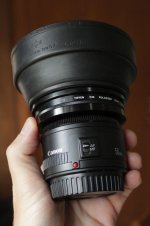
Here is my new 50mm f1.8 with a 72mm Pl and a 77mm lens hood. The lens cost me $99 and I had everything else already. The filter and hood also make the cheap little plastic lens look more on the outside, the quality the lens produces from the inside. It's a sharp little lens.
When I sell the 50mm f1.8 to upgrade to a 50mm 1.4 or 1.2 I already have the filters and hood.
 

Attachments

  • CANON-50MM-+-72-PL-+-77MM-HOOD.jpg
    CANON-50MM-+-72-PL-+-77MM-HOOD.jpg
    36.3 KB · Views: 0
  • FILTER-ADAPTERS.jpg
    FILTER-ADAPTERS.jpg
    30.4 KB · Views: 0
Last edited:
If you're going to buy screw-on UV, ND, or polarizer filters, anything other than B+W or Heliopan will degrade your image.
 
Isn't there an issue with fader nd on the kit lens cause of the focus ring rotating the filter too or something? So when you focus something the filter would go darker, and you'd have to readjust.
I am also interested in filters, a ND only makes the scenes darker so you can use slow shutter speeds for blurs and low apertures for DoF right? How do those step up rings and hood work, do you just connect step up rings to the front barrel of your lens i.e. 52-58,58-62,62-68, then put the filter on the 68 step up ring and then the hood over the filter? Would that be too much weight or anything for the focus ring on the kit lens?
 
Rockmore and everyone else, thanks for the information and your time to respond. I really appreciate it.

Back to what you were saying Rockmore... So I take it the smarter way would be for me to get a variety of filters (Polarizer, ND, GD, UV) in the 72mm range and just get adapters?

It seems like I'm going to hold off on the square filters and the mattebox because I'm still getting the basics down, but do want to have accessories while I learn them.

So now that this is out of the way, which one would you recommend more out of the two, Jordan S...the Heliopan or the B+W ?


I just dug this up - http://www.adorama.com/FLU5272.html

is this the correct adapter to get a 72mm filter to fit the 52mm lens I have? I see it says "step up" I know, sounds dumb, but I'd rather be sure and ask before I buy it.
 
Last edited:
All of my filters are B+W and I am totally satisfied with them and yes, when it comes to stills, I am a pixel peeper. I've read that Heliopan is nearly or just as good.

You don't need to spend a lot on step-up rings. I've been using metal ones bought on eBay for quite some time without a problem. Depending on the size, they should run two to four dollars.
 
SOmeone said to go for linear but here I read (from the link posted by Jordan S) that: "Be sure to get a "Circular" Polarizer Filter if you are shooting with an autofocus camera body such as the Canon EOS bodies. The "Linear" Polarizer Filter interferes with autofocus of these cameras. A Linear Polarizer Filter can be used only on certain manual focus camera bodies with no problems."
Comments ?
 
Back
Top