Room treatment

ggrantly

Veteran
Hello Listers,

I'm selling my house and am moving my edit suite to a small commercial office. There is enough room to do small interviews and green screen as well as space for a work station and storage. It has 12' ceilings. The main space is about 12' x 20'. The bad news it is a box with all hard surfaces and resembles an echo chamber. It is really awful. Good news though, no HVAC to deal with.

I will probably do some recording there and editing for sure.

So I'm looking for some economy sound treatment materials since I don't own the space. I don't play at a real high level, mostly web content and small corporate-commercial stuff. I plan on area rugs, possibly with a pad for the floor. I'd like to go up a step from moving blankets for vertical surfaces and apply some treatment to the walls and or ceiling. Does anyone have a specific product suggestion? I can take it a step at a time until I have enough to make me happy.

TIA
Grant
 
Auralex pyramid foam is a great place to start. If you're worried about having to adhere something to the walls, you can mount the sheets on slim, wooden frames and hang them.

The only challenge (avoiding adhesive mount) is corner bass traps, as low frequencies in a hard box like that space will be challenging. There are stand-mounted bass traps from Auralex, though they are a little pricier.
 
Auralex used to have a free recommendation service. Check out their website.
You'll still need to find a non-permanent hanging method as Alex stated.
I'm sure you're aware, dampening the room's acoustics will do little to block extraneous outside noise coming in. (or the other way around)
 
I will probably do some recording there and editing for sure.

Define that please. Video recording? Audio? What kind of editing? Just video, or audio too? I'm just saying that it makes a big difference what your primary use is.

For example, if it's video, you may want to build a light grid. If it's audio, you might want to build a couple of feet of bass traps across the entire ceiling, kinda sorta like you would in a recording studio (you can do this without doing much damage to the walls/ceiling). Those two things are quite different, and really change the way you access the ceiling.

Another example is wall treatments. For either video or audio, you don't want a completely dead room, nor a completely live room (which is what you've got now apparently). What you want is a controlled room. So, some places get absorption panels, some get diffusion panels. But if you're taping video, those panels have certain visual aesthics that they'll have to meet, and you have to get more serious about color, placement, etc. because they'll be on camera, even if somewhat out of focus.

I'm just sayin' that no one can solve a problem that has yet to be sufficiently defined. And whatever happens, I'd suggest paying for at least a few hours of a good acoustics consultant's time.
 
We did some very cheap treatment for a small Foley stage that needed to be up and running ASAP. It worked so well that we left it in.

The room had been built for this so it was double sheet rocked and the wall between the stage and control room was a double one.

But to cut down on bounce we first hung packing blankets floor to ceiling on two sides and some of the other two, they had a Big double windom in one and slidding double wall doors on the other so not much could be covered.

Then put egg crate foam on top of that.

So very cheap. The corner with treatment on both sides is VERY dead and moves out from there. In the middle is a sweet spot for many things.

The floor was usually covered with "stuff" (it's a Foley stage) and the ceiling is sloped. In a your case I would carpet the floor.
 
Thanks for all the suggestions.

To clarify the use, I would do video interviews, or commercials using green screen. My green background is a 10x12 chunk of green foam, so that is a start.

I had even considered mounting foam onto foam core panels and Velcro them to the walls. I could pull them and use them in other locations. A good sized panel would be pretty light.

Hey Scott, when you refer to egg crate, are you referring to the cheapo foam packing material? If so, how does it work compared to pro audio foam? I realize probably not as good, but will sheets like this help much, or is it a total wast of time?

Grant
 
Foam doesn't stop sound much, what it does is scatter it. BUT if you put a hard surface behind it a significant amount bounces back off that and it's not terribly effective. Having the packing blanket stops the bounce back. Packing blankets alone work pretty well but the foam helps defuse it more.

Out of the box I haven't found a significant difference between pricey "acoustic" foam and regular open cel foam. Down the road the pricey stuff holds up better. It's a bit stiffer so it probably scatters better. The big thing is regular foam will eventually disintegrate. How fast depends on a lot of things but it doesn't like sunlight for one thing. The foam was still in decent shape after ten years in our little Foley stage and part of the choice, other than cost, was that anything in a Foley stage is likely to get wet, damages, have weird stuff get squirted on it etc, so we wanted something that would be cheap to replace. As it turned out we were cleaner than we thought so...

I tried to "green screen" on green foam once and found it REALLY hard to light were you didn't get lights "sparkling" off the cells of the foam.

And no it wasn't packing material, it's sold for bed tops. THey use it bump side up because it minimises bed sores and such for folks who for whatever reason need to spend a lot of time in bed.
 
Scott,

I use a foam green screen often, I'll have to check on the brand, but it works really well. There are no sparkles whatsoever, the finish is very uniform. Even small wrinkles don't show up. I use this for both video and still photography. The key to success is light evenly and get good exposure. A light meter and or a wave form monitor is essential. Works for me.

Thanks for the foam advice, and David, thanks for the links.

Grant
 
PLEASE remember that most of those make-shift materials we use for sound treatment are NOT FIRE-RETARDANT.
It is one thing to use a bunch of flammable materials in a temporary setup for a few hours or days.
But it is completely different to install large areas of flammable materials in a semi-permanent way.
Please don't create a fire-trap room with walls and ceiling of flammable material and hot lights for ignition.
 
Another low cost solution that absorbs and scatters reverberant sound very well is rolls of paper backed fiberglass wall insulation you can get at any Home Depot stapled to luan door skin panels and covered with an open weave cheap polyester knit fabric. Can mount to walls with picture hangers, or fly from overhead. You can cover both sides too if you want to hang overhead panels or need more absorption in a small space.
 
The foam I played with was not made for greenscreen, it was just the right color. I was just playing around, obviously the real stuff akmes a difference.
I'll look into some real stuff, since I think I may do a project this winter when it's -40 out side.
 
PLEASE remember that most of those make-shift materials we use for sound treatment are NOT FIRE-RETARDANT.
It is one thing to use a bunch of flammable materials in a temporary setup for a few hours or days.
But it is completely different to install large areas of flammable materials in a semi-permanent way.
Please don't create a fire-trap room with walls and ceiling of flammable material and hot lights for ignition.

Good point. Mine was a Foley stage so no hot lights. I have notice the trend these days is to LED and other cool lights so probably less of a problem.

The foam betting, at least the stuff we bought, was flame retardant. But I doubt the packing blankets are. You can get solutions to soak them in that will make them flame retardant. And that would be an important step if you have heat sources getting anywhere close.
 
Owens-Corning 703 is really what you want in fiberglass. It's 2" thick but about 4 times the density of regular wall-cavity paper-backed stuff. It's solid so easy to cut and work with.

For corners, you can cut triangular wedges of it and stack them from desk height to ceiling. Wrapped in burlap they make a great background for hanging guitars, too.

Google Ethan Winer - he maintains a great forum for room treatment. If you want to do it right, it's fairly easy, but there are really specific places to put deadening to kill early reflections (kinda your #1 priority since it's fast and inexpensive and a huge bang for the buck) and dealing with corners, back walls (diffusion + deadening) and bass traps. Just sticking a bunch of foam rubber mattress pads on the walls won't help as much as understanding where sound waves pile up. Thickness of your wall units and offsetting them from the walls also matters a lot.

I got one case of OC 703, a couple pre-made panels, a few yards of burlap and a bunch of 1x4 lumber and got a really functional mixing space done over a weekend... and it looks legit, too.
 
Michael, could you post pictures of your mixing space for the visually satisfied ones here? :)
 
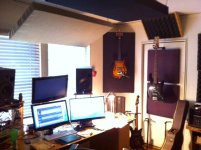
Here's a quick one, dealing with a bad drive enclosure today... this isn't an optimal space of course... you really want your desk away from a back wall, the Winer site has guidance on the optimal desk placement. But I can't afford to give up that much space.

Overhead, the angled and straight panels are 4" thick with OC 703, offset a few inches from the ceiling, just hung from light chain.

The corners are OC 703 stacked triangles in a frame with burlap.

To the right are panels from a manufacturer - they had a bunch of purple almost free, color mistake. Above that is a 703 box with Auralux on top.

Behind me about 9' away, back wall has a long panel of 4" 703, offset out from the wall about 6", with a very busy sort of cube-bookcase running the length of the room which makes a sort of ghetto diffuser. I'm not usually working loud enough for the back of the room to be a big issue though, but I do have the corners done as well.

It's very cool to walk in here with someone not into audio while you're chatting... their eyes always register this "WTF" since the room goes fairly dead yet sounds really clear. Funny how our minds will block this out til you point it out. Good sounding space though, recorded a lot of acoustic guitar and cello right by the desk, 1930's oak floors are nice!

walls.jpg
 
Music has a bit of a different requirement than Foley or VO. You are not dealing with the volume etc of most music spaces. And for Foley it's a real plus to have deader and liver sections of the same room since you are generally trying to match a space on screen. We would sometimes open the sliding doors so we could get more bounce.
But I agree completely that if you can actually tune a room, especially for music or any kind of mixing that is the way to go. To do it right though you need to sweep it and map out the problems.
When I was at Skywalker they were busy mapping the stages. It was very interesting to see these maps that showed some of the mix stages to have "all these big problems". Those were the stages that Indiana Jones was mixed on along with some of the early StarWars and other big sound films.
So your screwed up room, as long as it's not a bounce hell, can do good work, if you know how to compensate.
 
Michael,

Awesome room, dude. Thanks for putting yourself out there! For now, I can only aspire to this greatness.
 
Back
Top