RED unveils Monstro 8K VV full-frame sensor with 17+ stops of dynamic range

It's $80,000 just for the brain, so pretty exclusively a big boys' toy only...
One has to figure that ARRI's "real" 4K entrance into the TV production niche will be priced higher than the latest Alexa (SXT?) but lower than the semi-present (i.e., unavailable for TV production) Alexa65, which would probably place it in the $150,000 range ready-to-shoot. I am still surprised Sony hasn't come out with the 65mm/medium format high end camera but they seem to be content with the full frame capable Venice. Additionally, they had not passed the F65 sensor down the line, leaving their $15,000-$30,000 range begging for a replacement. This solidifies Red as the only company without a major void in their lineup.

For now.

I'm not sure I'd agree with that. I think that unless Arri boost their sensor size up to Vistavision (and even possibly if they do), the high-res replacement for the Alexa will probably be priced similarly to the current SXT. And from the sounds of it, SXTs will be able to have their sensors upgraded.

If Arri need to adapt to a 4k+ world, pricing themselves miles above the formula that's worked so well for them with Alexa would be problematic.
 
I actually had a decent possibility for their number and out of all of the other posts who actually bash the camera/company, you ask ME what's my issue, hahah.

Sorry, I thought it seemed obvious but perhaps it wouldn't be to everyone. I guess I am more familiar than most with RED cameras so I took it for granted but no RED never lists their DR specs in HDRx mode since it isn't really native DR and adds motion artifacts and cuts framerates in half. I only asked what your issue with the number was, meaning were you also questioning their previous generation's 16.5-stop non-HDRx spec?

It is quite hard to compare different manufacturers' DR specs, especially since noise character varies, for example Arri's dual-gain system means there is higher noise in the upper shadows but the lower shadows are quite clean. I do find the overall DR specs a bit easier to compare than the more subjective "useable" DR specs.
 
I am familiar with RED cameras, but to be honest, I didn't know they do not consider HDRx mode in their dynamic range tests. I honestly thought that's the only way they could possibly come up with those numbers over the years (after shooting with various models and concluding what's really usable for me on each end).

My personal opinion on the matter (and I say this in reference only to myself)...if I actually believed this camera had 17+ stops, I would have a lot to learn in this industry and a long ways to go.
 
I think the important point is that numbers can all be true but you have to have a point of reference to understand the context of how to compare them or what they mean. Even if it has 17stops that doesn't mean it'll be "better" than an Alexa in several respects. You can see 17steps on an Alexa DR chart if you push it a bit, so this isn't out of the realm of possibility, especially I'm a world where low end cameras are achieving 15-16stops.
 
On a XYLA chart, you may see 20 stops with some cameras. That's all good, but I'm a stickler with what's actually usable.

On the other hand, if I had a camera company, I would straight up stretch the truth because that's best for business.

I couldn't sell a new cinema camera in 2018 claiming 13-14 stops of dynamic range when everyone else is claiming 15+ (no matter if it's true or not).

A sad truth.
 
I just wanted to add that I am not saying anyone is stretching the truth.

Dynamic range tests are subjective.

MONSTRO may have 17 - 18 - 19 stops of dynamic range if someone finds they are all usable for them in practice.

My opinion is the numbers are a bit lower for me personally from every company (I don't have much experience with ARRIs).
 
I shoot on Red cameras quite a lot. Trust me, they have plenty of dynamic range. Way more than shooting log on my FS7. Who cares what the numbers are, just look at the pictures...
 
... If Arri need to adapt to a 4k+ world, pricing themselves miles above the formula that's worked so well for them with Alexa would be problematic.
So, I don't see how we are even in a minor disagreement here.

One, of course, has to toss in Panasonic Varicam/Pure/LT into the mix, as well as Canon who just might come out with a 5K'ish internal Raw camera in the sub $25,000 range. Monstro Trasho aims for the uppermost market niche but I assume many a pro production would be quite content with a $25,000 version of C700 too.
 
This is where living near a great dealer / camera rental place could really come in handy. For me, it's nearly impossible to look at videos on the web (or even a nice HD monitor) to get a real sense of what the true dynamic range of a camera is... since we're dealing with the results of log being squeezed into those 6 or 7 stops (I do not own nor have seen my first HDR monitor yet).
And I'm with Noah...the "useable" range of DR on just about any camera can be quite subjective...
 
Last edited:
When RED first came out with HDR mode, they said it gave 18 stops. So it doesn't make sense that their new sensor's HDR is just 17. I believe the 17 stops are native, which is how they've always rated their sensors.

On the other hand, if I had a camera company, I would straight up stretch the truth because that's best for business.

Are you serious?


I couldn't sell a new cinema camera in 2018 claiming 13-14 stops of dynamic range when everyone else is claiming 15+.

Like anything, there are diminishing returns. Watch a dozen videos on Youtube of "BMPCC." 13 stops looks like plenty to me.

Here's the problem with some testers going with "usable" dynamic range. Who here has measured the dynamic range of scenes you want to shoot? No one has measured 13 stops of dynamic range with a light meter or whatever and then went shopping, making sure to find a camera with 13 "usable" stops because that's what they measured.

No, this is how people consider dynamic range. "The DVX1000 had 9 stops, and that doesn't look good enough. The Canon DSLR had 11.5, and it looked okay. The BMPCC has 13, and it looked great. I need 13." This is why it would be better if all the camera makers simply followed the international scientific standard, which is ISO 21550. That way there would be consistency in the numbers across all camera makers.

People who have actually measured dynamic range have measured around 11 stops, even in extreme cases (e.g., http://clarkvision.com/articles/dynamicrange/).

But combatentropy, if all you need is 11 stops, how come cameras with 13 or more look better? Because people forget grade-school science projects. Does anyone here remember doing science projects in grade school? What was the procedure? You get to choose one variable. Everything else must be constants. You get to change one thing. People are often comparing cameras that are different in two, three, or five ways.

What is the feature that really makes a difference in how well a camera renders a contrasty scene? Answer: raw recording, or at least ProRes where you can push the tones around. Search Vimeo for Canon Raw Magic Lantern, and see how great the images look, even thought they're "just" 11.7 stops.
 
Last edited:
Are you serious?

I'm very serious.

---

Not sure what you're talking about as I literally don't understand what you're saying.

But I am not discussing what is enough dynamic range to look good or any post-production afterthought.

I use a Canon DSLR everyday that has like 9 stops and it looks great.

The conversation initially started with doubts about a certain #.

And I just mentioned (besides the HDRx comment) that it was my opinion that I find certain cameras have less usable stops than what they claim. Meaning maybe a company says their cameras has 5 stops of dynamic range but I only find 4 stops usable because the fifth is way too noisy for me.

---

These are just my thoughts, lol...I don't require a scientific breakdown questioning my opinion. Everyone is constantly arguing with each other.

---

And the BMPCC was 13, but the next generation camera was the URSA and it was a massive drop. 12 on paper but much less in practice according to many. It does make sense to only improve...but cameras are complicated. Sometimes you have trade-offs; dynamic range, sensitivity, native ISOs, colors, etc.
 
Just to be clear:

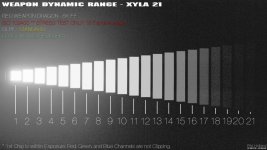
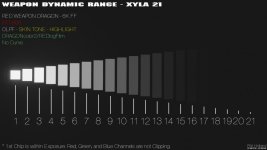
Phil Holland always tests these cameras and here's one where a chart is showing the Weapon with 21 stops. The camera sees them as he mentioned, but they aren't all usable.

"Remember this is a stress test, but yes, Weapon can indeed "see" all 21 stops amazingly. Are those "Usable Stops"? No, not exactly, but it does tell a bit of the story."

And my opinion is that this applies to EVERY company.

The C300 Mark II, FS7, EVA1, C200, REDs, URSA Minis, etc. all can claim a certain number, but I personally might find it to be a bit lower, and there is nothing wrong with that nor does it affect a camera's standing or performance.

That's all...nothing else.

http://www.reduser.net/forum/showthread.php?137883-RED-Weapon-Dynamic-Range-and-Latitude-Examined

RED.jpg
 
P.S. It would be unfair to not include the native ISO chart...so here it is.

If I had the Weapon and a different opinion, maybe I would think that my camera has 18 stops of usable dynamic range @800. Or maybe even 21 stops at higher ISOs with some noise reduction. (Or who cares about a little noise?)

Or maybe I find those last few stops a bit too noisy and can comfortably say that my camera has 15 stops of usable dynamic range FOR ME.

Not sure why this "concept" is so difficult to understand.

There will be no more comments of mine on the subject.

RED_2.jpg
 
Last edited:
I can't believe this is even a debate. It's common knowledge that there are discrepancies between claimed DR and real-life useable DR.

It's no different than battery life claims VS real-world testing or any other number of claims manufacturers make.

Clearly the RED cameras are extremely impressive, but let's be real: real world, useable DR is an inherently a subjective thing, and can even change depending on the scene's content and lighting.

Then again, any debate between actual VS perceived 15, 17, 18, 21 stops of dynamic range is a debate and budget point I am envious of!!! :D
 
Are you serious?

I'm very serious.

And don't call me Shirley.

I can't believe this is even a debate. It's common knowledge that there are discrepancies between claimed DR and real-life useable DR....

back in the day, when I first started working LA retail, I was selling car audio. The house brand claimed 10 watts of power while the major brands like Pioneer, Panasonic and Sony claimed 6w. The problem was distortion, which in general sense, is the same unwanted noise that people mention with regard to the dynamic range of a camera. Everyone was supposed abide by the international standards but the smaller brands paid a scant attention to it. One might say 10w at 20% distortion, the other 6w at 10% and so on. The off-brands played with the numbers because most consumers would not have purchased them otherwise. And the same went for the home audio, tape decks, record players and so on. I still can't forget - I had a good laugh about that at the time - when a very intelligent but completely insane salesperson tried explaining to an old lady interested in buying a gift head unit for her grandson what were the physics behind "wow and flutter" measurements on a $60 model!

PS. I think he showed her a Monstro Trasho HDR chart.

PPS. I know. I am old. Last night, I was listening to a live performance by a young Ukrainian lady. Her sense of a melody was quite lovely and she sang and performed well also but I thought her lyrics were a tad too simplistic. So I asked her, "Have you ever listened to the songs from the old Soviet era?". She looked at me and asked, "What's the Soviet era?". The girl is 19.
 
Anyone that would spend $80K on this camera "brain" doesn't need 17 stops of dynamic range.
Because they have got a lighting budget.
So this is really only for swinging d__ks and rental houses.

The price drop on the value of this camera is also going to be impressive.
Let's face it, Alexa's hold their value for a very long time, RED's do not.
Perhaps people should ask themselves why this is before purchasing anything from the bellicose blowhards...
 
The thing with DR claims is that, even when intependent tests can back the official claims (as is the case with the XYLA-21 graphs above), they can leave users terribly frustrated. 17 stops sounds like A LOT, but then you run tests like this this this and suddenly it's not so impressive. Or you see the RED vs a7RII-shootihg-RAW-stills DR comparison, and again, not impressive. Which, with a 17-stops claim, is hard to swallow.
 
INzqizS.jpg


Brought that test chart into Davinci to get a better sense of what we're seeing, the waveform shows 13 (and a bit) distinct stops. The rest of it is either clipped out or down in the noise floor. That would seem to hold true to my real life experience of shooting with Dragon - plenty of DR for just about any application, not as much as the Alexa, but still very good.

If Monstro adds 2/3s of a stop, that'll bring it to a genuine 14 stops, and that's terrific.
 
Back
Top