RAW vs. Everything Else

Zack Birlew

Veteran
Okay, after reading through thread after thread and comparison after comparison, at this point in 2023, if you were buying a previous generation Sony Cinealta or FS camera and the aim is to get the absolute best cinematic image quality out of it, how do all of them compare? For example, there have been threads that talk about the F35 versus the F65 and F3 but how about an FS7 with 16-bit RAW output? What about the F5 and F55? How do they compare to the others? RAW options vs. DPX 12-bit? What about newer AI upscaling efforts bringing some of these back to the table for special projects? I learned that the F65 has an 8K output option, anybody tried and tested it?

So we're talking - F23, F35, F3, F65, SRW 9000PL, FS700, FS5, and FS7, you can add in comparisons with the FX6, FX9, and Venice 1 & 2 if you want as well as the A7S series but only to compare with the cinematic aspects of the previous cameras at their maximum quality.
 
I have the F55 with R5 16 bit raw recorder. The file sizes are manageable. The compression is 3:1 wavelets. Wavelets are efficient and less processor intensive than DCT. The functionality inside Resolve is good; the raw panel has controls to manipulate the raw image. That said, overall it has been more difficult (for me) to get the exact starting point for grading than my Ursa 12K. I'm not exactly sure why. The out of the box image is just an easier starting point. I'm definitely not saying one is better than the other. The Ursa is just a little easier. Perhaps it's the harmony of BMD product families, camera + software. But the Sony 16 bit is as pure of a raw codec as there is. The BMD 12 bit raw on the other hand is DCT but leverages a partial debayer in-camera which lightens the computer processor load. You can select compression ratios for control of file size.

Although I like both cameras, the Ursa 12K can take Canon EF lenses which have optical stabilization, and for that reason alone gets used more for shooting from my shoulder. The Ursa 12K can also take my Sony Cine Alta PL lenses which are beautiful, but heavy and unstabilized. So I end up using them on the F55 and EF on the Ursa 12k, and don't share them. The Sony raw footage has to be offloaded from the AXSM cards via the CR1 reader. The Ursa12k I can edit on the same SSD that I shot the video on so it saves time there. Those points make the Ursa 12k overall more versatile to use. The Sony has the more rugged build and more comprehensive I/O.

You said I could compare cinematic aspects. They both make comparable images, beautiful in good light. The Ursa 12k is less noisy in low light, and unbeatable for frame rates. How does 12K75 sound? 8K160? What other cam does that? I like and use both cams but use them differently, the F55 on tripod, the Ursa 12K handheld. I have no plans for selling either one, although I do plan to add the Nikon Z8 to my backpack that I take offroad on motorcycles and ATV.
 
We are conflating bit depth, compression codecs and raw here.

DCT is what everyone uses now BTW. Even RED have left it behind. Since Komodo their beloved wavelets have been dropped. DCT generally has an advantage in higher resolution processing (faster). This has nothing to do with how good raw is, it is the compression used.

Bit depth is easier to understand as long as everyone understands linear or log encoding as well. More bits is better generally, but 16bit lin is generally considered the same as 12bit log. But I see a lot of people comparing 16b to 12b without saying (or understanding) that lin and log encoding part.

And raw.

Raw is a nice to have, but in reality 12b log encoded ProRes 444 is good enough for even the most high end projects.

Raw gives you three slight advantages.

The ability to change the white point.
The ability to change the iso.
The ability to re-encode it later (use different algorithms)

In reality, most of these advantages are not consequential.

edit. Sorry just realised this is posted in the Sony thread so sorry for the talk of ProRes 444.

I do not have enough recent experience other than Venice/Venice2 to discuss. My experience is limited to those and F55 / F35 / 65
 
Last edited:
Raw can't change the native camera iso or white point either, it's just adding or subtracting RGB gains like you can do with any codec in post.
 
"absolute best cinematic image quality" - this vague term is not measurable.

I know there is no definitive movie that showcases the F35, however from the shorts, tests, and footage that is out there you can get a pretty good sense of the camera.

If you are not immediately able to see why the F35 produces a different type of image that you can not get from any other system, it is not for you. Many F35 users came from film and were able to identiy the CCD produces grainier more alive footage that does not look like other cameras.

The F35 is same appeal as the Digital Bolex ( lookup prices if you don't believe me people think this image is special) Just like people who still shoot S16mm film, it's not because of ANY numbers and if you are considering F35 for any numbers, it will loose. That is not why you get into it because it is a pain at every step to get F35 system together and only done because some idenify they can get footage from F35 that can't be reproduced by CMOS.

All of the others FS700, F5, F55, FS5, FS7, F65 could be made to look very similar obviously F65 is gonna win ALL the numbers games.

F35 is HD cam you will never be able to make a penny on in 2023, meaning as rental its days are done because of those two letters HD. You will also have a hard time selling even if its project you are DP'ing people are terrified of those two letters in production, how many hundreds of times have you seen Netflix's Camera List mentioned.

F35 is a labor of love you do because you connect to the magic of the footage and to go after it for any other reason would be really foolish.
 
Raw can't change the native camera iso or white point either, it's just adding or subtracting RGB gains like you can do with any codec in post.

Just changing RGB will not do it in a mapped way. You can make it warmer or cooler but not type in a Kelvin value and tint.

You can make it brighter or darker but you will not be able to make it 1600 at 6500k plus 15.
 
So we're talking - F23, F35, F3, F65, SRW 9000PL, FS700, FS5, and FS7, you can add in comparisons with the FX6, FX9, and Venice 1 & 2 if you want as well as the A7S series but only to compare with the cinematic aspects of the previous cameras at their maximum quality.

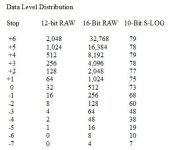
"Cinematic aspects"? Not sure what that expression means theses days. But If you are including the FS7's 12-Bit Linear RAW output into the calculations, I wouldn't even go there. I've only had to deal with it in post a couple of times, and I really don't like it at all. Which surprised me at the time, as I didn't know why I was having problems with it. Way too thin in the shadows. On further digging, I found out why. Its 12-bit RAW cannot be compared to Sony's 16-Biit RAW as output from the F5/55. Just look at the data level distribution. On the FS7 you are far better off working with the FS7's internal 10-Bit S-LOG.

My digging back then came across Alister Chapman's explanation of how it works. Link below.

Chris Young

https://www.xdcam-user.com/tag/fs7-12-bit/

RAW Data Level Distribution vs S-LOG.jpg.
 
The apparent stupidy of linear capture might be worth trading off against this.. Or might not.
Imagine we light a wall with one light bulb, its dark.
To makee it a stop lighter we use 2 bulbs
to make it a stop lighter again we use four bulbs
then 16,32,128, 256

Now once we are lighting with 256 bulbs we could blow a couple of them and light insead with 240 bulbs..

and the linear encoding chip has the sensitivity which it needs to show the difference in illuminance level on the wall!
 
Remember, when you look at the "Sony F35/F65" forums, you often see posts praising one or both cameras, usually the F35, for their "filmic" or "cinematic" look compared to modern 4K+ cameras. Reading the forum, there's often posts that say otherwise or praises other Sony cameras for having this "filmic" or "cinematic" aspect as well. My issue with much of the forum going nearly at the end with 40+ pages in, is that there are few discussions about comparing the 12-bit 4:4:4 output of the F35 that is so beloved to other cameras when using their RAW video modes for maximum visual output. Often the only examples are from compressed formats and not even the cameras' RAW modes which are much more affordable to get these days than they used to be.

This thread is not about the aspects of RAW versus compressed 10-bit formats, I'm talking about discussing the visual quality of the cameras in their RAW modes and comparing them to each other, including the 12-bit 4:4:4 of the F35, surely everyone that has bought these cameras aren't sticking to just compressed 10-bit 4:2:2 or Prores codecs, there has to be people using the RAW outputs for a film or commercial or some other reason like high-speed on the FS700 and those are the examples I'm asking about along with some other questions as posted in my original post. For example, if I wanted a RAW camera for a VFX heavy film and I wanted a legacy Sony camera, would I be better off spending extra for an F65 or would the RAW output of an FS700 or F55 be more than adequate or even equal to the F65? Does one look more "cinematic" or "filmic" than another? Might even a newer Sony camera like the FX6 or FX9 in RAW mode be better or would these older cameras actually be equal or even superior in some way to the newer models?

These are the kinds of questions I'm looking to answer with this thread, not a discussion of data rates or a technical paper on RAW, and also if you have video examples or side-by-side tests to share then please post them. Also, please, folks, let's keep the useless "look around at videos online" and "do your own research" comments to a minimum, this thread is meant for sharing experiences and examples so it can be a main point of research for someone looking at these still great cameras.
 
The FS700 is not in the same league as the F55 (or others). It was an excellent camera for its time, and can still produce amazing images, but the RAW output is limited to 12bit.

The F55 was used to shoot at least one or two seasons of Netflix's show The Crown, with a pretty hefty VFX component. Its RAW output is 16bit, and its sensor has the same color filter array as the F65 (which is not the same as the F5 and FS7).

My guess is an F55 would be more than adequate for most people's needs provided they are using it appropriately.

As best I can tell, "cinematic" is a buzzword without any clearly defined or quantifiable properties, mostly used to get YouTube clicks—it literally just means "of or relating to the cinema." Is the F55 more "cinematic" than the F35, or the FX6? It's like asking if the FX6 is more "huggable" than the FS7, or something.
 
The FX6 is way more huggable than the FS7.

I've honestly been considering this and while from a personality standpoint the FX6 is way more huggable (much more user-friendly) I feel like the bigger body of the FS7 is better for hugging. But it's a tough call...
 
The Z750 is more huggable than any of those because I can sling the Portabrace leather strap over my shoulder and walk around without being jabbed to death from a dozen pointy things that feel like I'm being tortured.
 
The Z750 is more huggable than any of those because I can sling the Portabrace leather strap over my shoulder and walk around without being jabbed to death from a dozen pointy things that feel like I'm being tortured.

ENG forever. Even when it's not ENG.
 
The lesson Zack, is that when you try and put limits on a discussion, they either lose interest and leave, or they go off on tangents.
 
The lesson Zack, is that when you try and put limits on a discussion, they either lose interest and leave, or they go off on tangents.

Not at all, Tom, just course correcting back to the topic. A few joke posts are to be expected. I know the DVXUser and REDUser boards aren’t as active as they used to be so hopefully we’ll hear more examples and user experiences in time.
 
For example, if I wanted a RAW camera for a VFX heavy film and I wanted a legacy Sony camera, would I be better off spending extra for an F65 or would the RAW output of an FS700 or F55 be more than adequate or even equal to the F65? Does one look more "cinematic" or "filmic" than another? Might even a newer Sony camera like the FX6 or FX9 in RAW mode be better or would these older cameras actually be equal or even superior in some way to the newer models?

These are the kinds of questions I'm looking to answer with this thread, not a discussion of data rates or a technical paper on RAW, and also if you have video examples or side-by-side tests to share then please post them. Also, please, folks, let's keep the useless "look around at videos online" and "do your own research" comments to a minimum, this thread is meant for sharing experiences and examples so it can be a main point of research for someone looking at these still great cameras.

I understand what you are saying. You are looking more at the image aesthetics of the cameras along with their workflows. Way back when Sony first started to peddle affordable S35 sensor cameras, I stated to get curious as to what they could offer me, doing mainly broadcast video production, over the long-standing well established 2/3" format. Initially 2/3" tube then 2/3" CCD then finally CMOS cameras. I'd been through the lot. What could they offer me? Especially these cheaper end S35 models.

During that process, I hunted around looking for comparisons and saved a few I found. The three following videos don't appear to have survived the years on YouTube. It was videos like these that made me make the move into the Sony S35 world with first the FS700 and then by the FS7s. Say no more. So for some camera comparisons against the el cheapo FS700 I've uploaded those clips here. They may be of some help in answering some of your questions. Please feel free to download.

Chris Young

Camera Comparison_ Arri Alexa - Red Mx - Canon 7D - Sony F65 - Sony FS700 - Canon C300-HD

https://drive.google.com/file/d/1bBN...ew?usp=sharing

Sony FS700_ Convergent Design Odyssey 7Q real world resolution_ detail tests-HD

https://drive.google.com/file/d/1jZn...ew?usp=sharing

Sony Professional Introducing the Sony NEX-FS700

https://drive.google.com/file/d/1_yQ...ew?usp=sharing
 
Thanks for sharing these clips, Chris.

There's an interesting phenomenon in the FS700 internal footage that I occasionally noticed with my Fs5 (which shares the same sensor): artifacts at very high contrast edges with the internal footage, as appears in the AVCHD footage of the light bulb. Clearly something with the HD debayer or downscaling, as the artifacts don't appear in the 4K footage from the RAW output.

Curiously, these types of artifacts also appeared in some early slow motion footage (that was HD, maybe?) I saw coming out of the FX9, as well.
 
Back
Top