Panasonic's new AG-CX350 camcorder

Thanks for posting. Some positive points in the review but IR pollution? Barry mentioned the EX-1 a few posts back - I thought we were past the days of IR pollution? Barry, I will look forward to the tests as I remember going through this on DVXUser back in the day. The HVX-200 vs the EX-1... The Sony had IR polluted blacks. But that was all the time, not limited to the ND filters.
 
Thanks for posting. Some positive points in the review but IR pollution? Barry mentioned the EX-1 a few posts back - I thought we were past the days of IR pollution? Barry, I will look forward to the tests as I remember going through this on DVXUser back in the day. The HVX-200 vs the EX-1... The Sony had IR polluted blacks. But that was all the time, not limited to the ND filters.

That will be part of my testing, but has not been yet.

IR pollution is not all bad, it depends on when it comes in. The Varicams and EVA can have a little bit of IR contamination too, but it's because if you put a hard cutoff on IR you lose something out of the skin tones, and skin tones are crucial to pleasing imagery. We had a long discussion on IR in the Varicam here a year or two ago; the relevant posts that Mitch and I made are these:

Mitch:
The following is general IR theory, and is not meant to be a specific statement on the VariCam LT's sensor and IR cut filter. This is still being examined.

IR cut is a misnomer. IR can be remediated, but it cannot be simply cut out like a cancer without effecting other wavelengths. The more one mitigates IR, the more one also reduces various red frequencies in the visible spectrum. One must be careful there as that gets immediately into skin tones. So while one can use a filter to knock down IR frequencies more and make fabrics appear more neutral, such filtration may also negatively alter skin tones. Don't just test by pointing at black objects; try some faces.

IR is heat. A quartz halogen cinema light is 3200 Kelvin and a higher efficiency of visible light to heat output compared to a household tungsten filament light bulb, which is typically closer to 2700 Kelvin and puts out more heat relative to its visible light output. A warmer color temp light will extend that balance of frequencies into the IR range. So effectively, given the same lumens, household bulbs will output more IR than cinema halogen fixtures. They spit out a lot of IR.

Me:
Posts 29 and 30 are examples of IR pollution, not bad white balancing. There are some fabrics that definitely reflect/reveal more IR than other fabrics, that curtain backdrop is a prime example.

Regarding IR sources -- tungsten lamps do put out a ton of IR. Under daylight, it may or may not be an issue, frequently depending on how much ND you're using. In terms of the ratio of visible light to daylight, if there's no ND involved, the amount of IR is generally low and not usually much of a concern. But the more ND you pile on, the more you change the ratio of IR to visible light; ND will block visible light but generally won't block IR, so the amount of perceived IR will rise when more ND is used.

And Mitch is spot-on with his explanation of IR overlapping into the visible red spectrum. IR has been and will always be an issue with certain high-end cameras, for that reason. In cinema, the answer would never be "put an IR cut filter on", the answer would be "change out that fabric for one that looks black to the camera." Of course, event shooters don't have that option, so an external IR-cut filter is probably the best solution. Leave it off whenever you can, and use it when you must...

That's for cinema though. For events, I think proper IR filtration is more important, because event/live shooters generally don't have the luxury of dictating what fabrics are used or what lighting instruments are used at an event, and the CX350 is more aimed at live production than cinema. I will compare it against the HPX250, a prior event camera that I have here, to see how the IR filter performance compares.
 
Thanks for the post Barry. look forward to your tests. I hope this is not an issue as it looks horrible on the screenshot from the linked review. Is this the "real" cost of a lower priced camera? Would rather not have lower end flaws but with a higher price tag.
 
Thanks for the post Barry. look forward to your tests. I hope this is not an issue as it looks horrible on the screenshot from the linked review. Is this the "real" cost of a lower priced camera? Would rather not have lower end flaws but with a higher price tag.

To be fair I think the shot of the backpack had the ND all the way on.
 
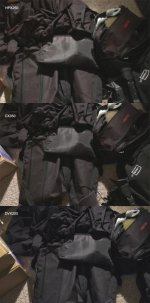
Okay, I've tried a sample test for IR on the CX350, as compared to a DVX200 and an HPX250. There seems to be a little, but the problem is -- how do you know when you have an IR-polluting fabric? I don't know. I mean, I gathered up a bunch of synthetic black fabric objects, as well as some cotton, but you never really know which objects are going to show IR pollution unless you've seen those particular objects be polluted on a camera before, and I haven't seen any of this stuff show IR pollution before, so -- is it? I don't know.

Testing was simple: gather a variety of black or black-ish fabric objects, both natural and synthetic fabrics. Light with solely tungsten lighting. Set each camera to the default scene file 1, with ND off, gain off, auto iris and auto exposure, and take a shot. Then stack the three together and see what we get.

IR Pollution Testing.jpg

To my eye, the CX350 looks better than the HPX250 as far as any tint of redness in the blacks, but it does look a little redder than the DVX200. It doesn't look problematic to me (not like seeing a black curtain turn purple, as we saw in that Varicam thread I referenced).

But again, I don't know if there are other fabrics that would show more IR pollution; if anyone knows of a readily-available and highly IR-reactive fabric that I could pick up, I'd be glad to do so.
 
I can’t remember the last time I didn’t bring something into post so IR isn’t a huge concern.

Also, looks like the DVX200 is a bit cooler overall. Definitely less red/orange in the carpet. Different color science. There’s probably a way to compensate for warm blacks in camera.
 
Thanks for the quick test Barry. I have a nylon/Kevlar LowePro camera backpack that screams IR pollution which seems very close to your examples. Since the reviewer raised the issue with ND filters, would it be possible to take some of these bags out In the sun with ND to see how they look? No worries if it is a hassle but it would be interesting to see. Thanks.
 
Slashcam.de just did a very comprehensive technical review. https://www.slashcam.de/artikel/Test/Panasonic-AG-CX350---4K-Camcorder-mit-allem-drin-und-dran-.html

for translation use Google Translate https://translate.google.com/transl...---4K-Camcorder-mit-allem-drin-und-dran-.html

they did not really test AF but commented on focusing problems, the low light was meh, but the resolution and detail blew away the Cannon XF705 at twice the price. Apparently they did tests in H265 4:2:0 and not the 4:2:2 10 bit mode, and still it blew away the Canon XF705.

Below are some relevant pieces of the the Google translation, which is only approximate.:


Manual Focus

what gave us the most headache was the manual focus. Both display and viewfinder showed no real 4K details (the associated recording but already). Instead, pixels become Is repeated at full magnification on the display. This may make the presentation even more visible, but not more detailed. Also the peaking explains peaking in the glossary can no longer work in the finest structures. Many Sony or Canon cameras encounter a similar behavior. The reason is usually in the DSPs, which can not handle multiple 4K signals (one for recording and one for preview).

The autofocus fortunately also controls a touch function, but this is pretty well hidden and accessible only via the multi-function icons (keyword AREA). The Canon AG CX350 does not match Canon's DPAF capabilities, neither in autofocus nor in manual focusing aids.


Sensor

At an esteemed crop factor Crop of 2.8 a sensor element should have a side length of approx. 2.5 μm. The XF705 has about 3.1μm and thus almost twice the surface per Sensel. Both values ​​are well below typical large-sensor cameras, which is why the CX350 also has a lower photosensitivity and dynamics. But the smaller Sensel can read faster in return and offer in Panasonic's case even a clean 5K to 4K downsampling.

And indeed, the resolution of the AG-CX350 is consistently high over all 4K frame rates of 24-60p:

High is even understated. The CX350 shows the finest details almost error-free and offers a much cleaner clean debayering than Canon. It is ironic that the AG-CX350 in 4: 2: 0 4 record much more details than the Canon XF705 in 4: 2: 2.

In FullHD the camera also shows its best side: Thanks to clean merging of the pixels the SlashCAM HD test chart up to 60p appears flawless:


At 1080p100 / 120, although it leaves out a few lines, but the quality of the FullHD recording is still at a very high level.


Low light

In low light, however, show the disadvantages of small sensors. Our test image is clearly muddier and noisier displayed than anything that current S35 or FullFrame cameras in 4K can deliver. Especially if you treat the latter even a bright fixed focal length.

Panasonic has installed a second mode on the CX350 that can read the sensor with high sensitivity. Obviously a kind of DUAL-ISO mode. In this mode, our 12 Lux theme looks like this:
We once amplified and compared the image with the normal sensitivity in the post: And in our opinion, the results donate nothing. Rather, the gain in the post even a little cleaner. Even in the mode with normal sensitivity, by the way, we see the AG-CX350 slightly ahead of the Canon, despite the smaller Sense. Possibly installed here Panasonic BSI sensor with back exposure, which could explain the competitive Lowlight behavior.


Rolling shutter

Also with the rolling shutter Shutter explained in the glossary Times delivers the Panasonic AG-CX350 more than down to earth values. In 4K24-60p we always measured about 14ms, in FullHD explained in the glossary FullHD this value improved even marginally to 13ms.

streaming

Another noteworthy point that we could not discuss in our review, however, is streaming Is Features of the Panasonic AG-CX350. This not only controls the streaming output via LAN or (with optional dongle) WLAN. In addition, it is also able to connect directly to IP-based multi-camera live production systems via NDI.


Conclusion

Compared to the much more expensive Canon XF705, the focus functions are not so successful( due to) nto the smaller display and slightly sluggish lens rings. Otherwise you get for 4.500 euros at Panasonic, however, in almost every respect, the rounder overall package. The picture quality is despite 4: 2: 0 recording at least at eye level, usually even a tad better. The Panasonic HEVC files are already running quite well with current editing systems and the proven AVC (HD) formats are unobtrusive in almost every current workflow. Thanks to long battery life and modern streaming / network options, the camera is equipped for many, including future applications, only for cinematic applications there are significantly better large-scale sensor specialists in this price region.
 
Last edited:
The CX350 is a hell of a camera at an excellent price. It basically has the full Film Rec and Video Rec from the VariCam, all the best features of all the Panasonic handhelds, and great performance. I have been spoiled by its light weight and small size; doing that test with the HPX250 and DVX200 was a quick reminder of how compact and hand-holdable the CX350 is. The HPX250 in particular felt like a bloated walrus compared to the CX350.

As far as manual focusing, I don't understand the comment... It sounds like they're saying that the LCD doesn't display full resolution and that it just doubles pixels or something? That's not how it works. The LCD is not a 4K LCD obviously, no small camera is, but it has a magnified display that you can zoom in to 4x magnification on, which means it's extracting the center 1/16th of the frame for a full frame view. It's not pixel-for-pixel, but it's very easy to focus. I might ask for a hair more precision in the focus ring, but it's totally workable, and it also inherits the MF ASSIST function from back in the days of the HPX170, where you can manually get the focus in the ballpark and then autofocus can touch it up for you when you let go of the ring.

Maybe the google translation is not doing justice to what they were saying, I don't know, but in my experience there's nothing missing in the manual focus department with this camera. If what they're saying is that the expanded focus doesn't deliver a true pixel-for-pixel image, then they're right, but it does deliver a very high resolution image, much higher than a native 1080p monitor can display. Even so, you'd be wise to put on some peaking to ensure you're getting the sharpest focus.
 
Regarding IR testing, that's delayed. We're at the start of a multiday rainstorm, and probably won't see the sun until next week.
 
Thanks Barry. I am in on this camera. I just hope I can find a way to get rear iris and zoom - (two separate controllers into the LANC port) and the IR pollution is a non-issue. I hated this aspect of the EX-1 when I owned it.
 
Panasonic AG-CX350 Started Shipping Today: Texas Media Systems

Panasonic AG-CX350 Started Shipping Today: Texas Media Systems

The AG-CX350 just started shipping today.

We have one left available to ship today.

Panasonic AG-CX350 $3695
 
Last edited:
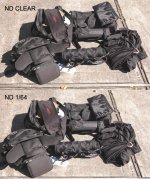
Okay, follow-up on the ND filter testing. I took the same collection of synthetic fabric objects, and even found a couple more, outdoors under broad daylight, and shot in the P56K preset with ND 1/64 (the maximum ND filtration), then I changed the shutter speed up very high and took the ND filtering out. Auto iris, auto focus. These are the results I got:

IR Pollution Testing ND.jpg


If anything, it looks to me like the shot with ND filtration in is very slightly less red than the ND clear option was.

Again, this is not a definitive IR test. I don't know if any of these objects are prone to IR contamination; I have no way to test them if they are because I don't have a camera that shows significant IR pollution. I will say that when I take the IR filter off the camera (putting it in IR REC mode), two of these objects show up as a lighter gray than a natural cotton black shirt does, which implies to me that they are reflecting more IR. Even that isn't conclusive though, because the two objects that seem to be reflecting the most IR are the bag in the upper left, and the one right next to it at the top. And the bag in the upper left seems the reddest, but the bag right next to it seems straight-up black.

In any case, while I can't say definitively that the camera has no problem with IR, I can say that I have not found any scenario in which there appears to be any sort of issue with IR contamination. It remains possible that there may be some fabric out there that would show up with notable IR contamination, but if so, I haven't found it and I have tested the widest variety of synthetic fabrics I have on hand.
 
Back
Top