GH4 Panasonic GH5 coming in 2017

I'm not sure I would complain if they did, but I also don't think they really need to. The GH4 currently offers 200 Mb/s for 1080p, so SDXC should be fine for that bitrate...
I don't think it's a constant 200.

I expect the GH5 will have similar low-light performance to its predecessors. It's the limitations of a m43-sized chip.
If they can get a Back Side Illuminated (BSI) sensor, they might get 1-2 stops more, making it ~ 13-14 in photo Raw and close to it in V-Log. The problem is that Panasonic isn't making BSI sensors. Sony does but it hasn't sold it to Panny. Samsung does too but it seems it wants to dance with Nikon only. There are other manufacturers, obviously, and the GH engineers would have to find the right partner if their corporate superiors want to take a step forward. Unfortuinately, with the APS-C cameras going for as little as $600, the superiors may think MFT is no longer a pro format.

PS. As to processors, the major fabs have switched to the 14 nanoMeter technology in late 2014/early-mid 2015 from the 28 nM of the previous generation, making the internal HEVC processing on the sub-$2,500 cameras possible without the heat related problems.
 
I don't think that matters. 200 Mb/s translates into 25 MB/s, well within the 45 MB/s speed rating for good cards.
All the cards and the SSD stated speeds depend on the buffer. In other words, for the first 20 seconds - a number taken out of a hat - a cheaper card/SSD functions just as well as the most expensive card/SSD. Then, the buffer fills up and the speed falls off a cliff. And that's why even the top of the line in this sector, Sony A7RII/SII models, top out at 100. That's basically as far as the SD format can take it and that includes the $5,600 FS5.

So, at the GH5 price point, it's likely to be either HEVC or CFast 2.0. The former will require a more powerful processor; the latter a bit more of a marketing calculation.

Here's why - when Sandisc announced its first 2.0 cards two years ago, they were going for over $7/GB ($1,800 for a 256 GB card). Now, they're less than $3/GB and for Trascent (low price leader), $2.34/GB. By the time GH5 is out, they should be under $2/GB; two years from now $1/GB. If a model has, at worst, a two year cycle, this is something that GH5 customers should tolerate.

And, of course, should GH5 have both HEVC and CFast 2.0, it could offer quite a variety of recording options.
 
Last edited:
All the cards and the SSD stated speeds depend on the buffer. In other words, for the first 20 seconds - a number taken out of a hat - a cheaper card/SSD functions just as well as the most expensive card/SSD. Then, the buffer fills up and the speed falls off a cliff. And that's why even the top of the line in this sector, Sony A7RII/SII models, top out at 100. That's basically as far as the SD format can take it and that includes the $5,600 FS5.

So, at the GH5 price point, it's likely to be either HEVC or CFast 2.0. The former will require a more powerful processor; the latter a bit more of a marketing calculation.

Here's why - when Sandisc announced its first 2.0 cards two years ago, they were going for over $7/GB ($1,800 for a 256 GB card). Now, they're less than $3/GB and for Trascent (low price leader), $2.34/GB. By the time GH5 is out, they should be under $2/GB; two years from now $1/GB. If a model has, at worst, a two year cycle, this is something that GH5 customers should tolerate.

And, of course, should GH5 have both HEVC and CFast 2.0, it could offer quite a variety of recording options.

Are you sure that this only occasionally hits 200mbit as well? Otherwise it seems there are cards that can do this fast enough. Of course, you probably would have to be very picky of which card to get. I see greatly varying performance on these cards..
EDIT: It does appear to be variable, though I saw tests where the avg ended up at over 195mbit, so I would guess Panasonic must be comfortable with the card format, otherwise they would probably get a lot of angry customers.
 
Last edited:
The fastest Sandisk Extreme Pro 280/250 MBs (MegaBytes per second) has a minimum sustained write speed of 30 MBs (aprox 240 MegaBits per second). Faster cards are probably in development.
That should be fast enough for the GH5.

A striped RAID of two would be almost twice as fast.
Of course that would require USB 3.x or a special card reader for download to a computer.
 
10-bit 422 internal
Clean image up to 6400 iso
4K-60p
1080-120p
Anamorphic desqueeze in live view/recording

Would be nice to have and not even asking for much, I could even do with just the top 3 or 4.
 
That's basically as far as the SD format can take it

I disagree. I've got the GH2 recording at 150 Mb/s constant without issues. (Moon T7 hack.)

Modern cards are plenty fast enough for 200 Mb/s. That's why it's an option for the GH4.
 
I disagree. I've got the GH2 recording at 150 Mb/s constant without issues. (Moon T7 hack.) ...
Well, like I said, LS300 does record - at least, on paper - at 150. Can every SD card do that or are some better than others?

It's like with the Convergent Design SSD tests. Once they went through the third party vendors, they found that only the Samsung 950 Evo Pro worked as claimed (or that's how I remember what Mitch wrote back then).

In any case, we've beaten the issue to the dead horse level (though, the dead horse seems to be alive and kicking). IMO, chances of them going HEVC are higher than CFast 2.0 but it's 50/50 they do neither and instead rework the internal processing for a better IQ.
 
As a side note - another idea is for them to install a small form factor SSD. The 1.8" size is tiny enough for a GH4 size camera and its retail prices are currently hovering around $1/GB. The internal SSD of - let's say - 120 GB would/should be sufficient for most daily uses, as a 220 Mbps bit rate recording is just under 80 GB/hr. And the SD cards can be used for a lower speed duplicate or even an offload.
 

How do you say eight t's in a row? Don't you mean Buuuuuuuut?

this card seems to run close to $4/GB retail

$1.50/GB and likely to fall fast.

If so, why not just go with CFast2.0?

Why not just go with XQD? I say camera-makers should either go budget-practical with SDXC and a plenty-good-enough codec like ProRes or DNXHD, or go long with 4K RAW and XQD. Or wait until XQD 3.0 comes out, which should be based on PCIExpress 4.0, which would allow something like 4K raw at 180 fps. CFast is based on the dead-end protocol SATA. But anyway, I'd be fine with SDXC and ProRes. That, with global shutter, in the body of an FS5 or smaller, and I would be satisfied for a long, long, long time.
 
I just bought a 256 GB Lexar 1000x (150MBs) card for $142. That is 55 cents per GB
They are cheaper in two packs
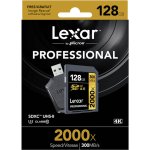
Their latest/greatest 128 GB 2000x (300MBs) SDXC card is $297 at $2.32 per GB but it will fall fast
and someone will soon come out with a faster card with faster minimum sustained read speed too.

I have no problem shooting 4k now with older slower cards in my GH4.
I am sure these will keep up with 4k P60 and 1080P120 at a good bitrate.
 
Last edited:
How do you say eight t's in a row? Don't you mean Buuuuuuuut?
It's an East European in me. Multiple consonants in a row present no threat.

Why not just go with XQD? I say camera-makers should either go budget-practical with SDXC and a plenty-good-enough codec like ProRes or DNXHD, or go long with 4K RAW and XQD. Or wait until XQD 3.0 comes out, which should be based on PCIExpress 4.0, which would allow something like 4K raw at 180 fps. CFast is based on the dead-end protocol SATA. But anyway, I'd be fine with SDXC and ProRes. That, with global shutter, in the body of an FS5 or smaller, and I would be satisfied for a long, long, long time.
The high end will go with whatever the format delivers the maximum performance, price be darned. The low/middle end has to remain value conscious and each card format has its advantages and disadvantages (some of which were enumerated above).

The rough summary is like that -

SD (XC) -

Advantages : low price; good enough for H264 based codecs already; will be more than good enough for the HEVC based codecs for the entry-to-mid tier camera market. (10-bit log at 120-150 Mbps HEVC, with enough head room for the VBR), Ability to be used across many platforms and models.

Disadvantages - Too slow for anything but a heavily compressed Raw and the lower compression codecs like ProRes. Some of the disadvantages may be negated by HEVC but HEVC has disadvantages of its own.

CFast 2.0

Advantages - A higher bit rate recording vs SD; rapidly falling prices; the "good enough" factor with ProRes and the compressed Raw right now and a likely lack of obsolescence even heading into the 8K (with HEVC).

Disadvantages - Currently pricey and not as ubiquitous as the SD.

QXD -

Advantages : top performing card (aside of SxS), scalability going forward

Disadvantages - high price; association with Sony.

SSD's :

Advantages - bang for the GB, high recording bit rates.

Disadvantages - the 2.5" external drives are too large for the handhelds without some sort of a modular adaptation; the 1.8" internals may not have enough capacity for the longer shoots.

Verdict - be flexible. IMO, the best value right now for the GH5 level camera is a combination of an internal 1.8" SSD and a removable SD card. The ~ $3,000-$8,000 cameras ought to go with CFast 2.0. Anything above that, with both larger internal SSD's and QXD.
 
Guys, it's a consumer camera, for 99.99999% it's gonna be SD based.
Yes, probably.

But (one "t", OK?) - the cut-off lines between "casual consumer", "enthusiast" and "pro" are moving downward. Let's say, last year, anything under $1,000 was deemed "consumer", $1,000-$3,000 "enthusiast/prosumer" and "$3,000+" pro. The following cycle is compacting everything to the lower price points - sub-$500 for "consumer", $500-$1,500 for "enthusiast/prosumer" and $1,500+ "pro". So, if GH5 stays at $1,700, it'll be a low end "pro". If it drops toward $1,000, it'll be "enthusiast". And the camera feature set would be adjusted likewise.

PS. For "consumer", Panasonic has G7 and GX8 and there's another compact 4K camera on the way. GH5 should be marketed considerably above that level.
 
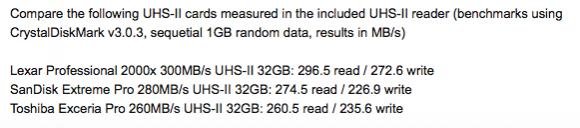
I use three 2000x Lexar SDXC UHS-II cards with my NX1 that is the only APS-C 4K camera with UHS-II support. It is the fastest SDXC card.
23523553094_de5edfd42c_z.jpg
Screen Shot 2016-01-03 at 12.33.30 PM.jpg

BTW the Panasonic G7 has UHS-II support also.
 
Last edited:
I am sure the 2000x is super fast at transferring files.
I did not pay their exorbitant price because the minimum sustained read speed is the same as the 1000x card.

With 4k Video becoming more common and 8k planed before the 2020 Tokyo Games we will need at least 60MBs for the minimum sustained rate and eventually a lot more.
 
Last edited:
... 8k planed before the 2020 Tokyo Games we will need at least 60MBs for the minimum sustained rate and eventually a lot more.
Canon will be showing their 8K camera at the CES while LG will be introducing their 98" 8K TV set. Price-wise, it might be slightly higher than GH5 though. Or so I hear.
 
I am sure the 2000x is super fast at transferring files.
I did not pay their exorbitant price because the minimum sustained read speed is the same as the 1000x card.

With 4k Video becoming more common and 8k planed before the 2020 Tokyo Games we will need at least 60MBs for the minimum sustained rate and eventually a lot more.

The U3 rating on SD cards does not mean they all have the same minimum read speed in the real world , that is a rating defined by the SD Association . Do a benchmark test on the 1000x and 2000x using the UHS-II reader in a USB 3.0 slot and you will see the 2000x has a much faster data rate from minimum to maximum. The 2000x card minimum is at least 60MB/s today but there is no U6 standard yet and the 2000x card is ready for 4K @60fps today.
 
Back
Top