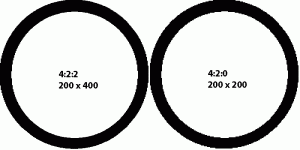
But I keep coming back to the point that the subsampling numbers are meaningless in themselves. For example, 4K 4:2:0 is MORE of a memory commitment than HD 4:4:4 - yes? Figures like "4:2:2" are meaningless in isolation.4:4:4 is just a huge memory commitment. As prices come down with time this will come more into play but 4:2:0 is the consumer format because of memory size. Consumers do not want large file sizes. Convenience trumps everything else in the "real world" - not the video geek world we live in.
That aside, it's useful to give some numbers here. All else equal, the ratios of sample numbers for 4:4:4, 4:2:2, and 4:2:0 are 6:4:3 - so AT MOST the difference between 4:4:4 and 4:2:0 is 2:1. (In practice, after compression, it's likely to be slightly less - you should be able to compress full raster chroma matrices more than subsampled ones.)
I'll also take you up on the comment about RAW. If we assume a 3840x2160 sensor, then 14 bit RAW will mean 116,121,600 bits per frame. An 8 bit, 3840x2160 coded raster, with 4:2:0 subsampling will mean 3840x2160x8 bits for luminance, and half as many for chrominance - 99,532,800 bits per frame.
So not far short! And use 4:4:4, 4:2:2 and the coded signal will have many more bits to start with than RAW.
The real issue with RAW is less the memory taken for storage, far more the processing it requires.