Panasonic 4K GH4 possibly coming next Spring...

4:4:4 is just a huge memory commitment. As prices come down with time this will come more into play but 4:2:0 is the consumer format because of memory size. Consumers do not want large file sizes. Convenience trumps everything else in the "real world" - not the video geek world we live in. :)
But I keep coming back to the point that the subsampling numbers are meaningless in themselves. For example, 4K 4:2:0 is MORE of a memory commitment than HD 4:4:4 - yes? Figures like "4:2:2" are meaningless in isolation.

That aside, it's useful to give some numbers here. All else equal, the ratios of sample numbers for 4:4:4, 4:2:2, and 4:2:0 are 6:4:3 - so AT MOST the difference between 4:4:4 and 4:2:0 is 2:1. (In practice, after compression, it's likely to be slightly less - you should be able to compress full raster chroma matrices more than subsampled ones.)

I'll also take you up on the comment about RAW. If we assume a 3840x2160 sensor, then 14 bit RAW will mean 116,121,600 bits per frame. An 8 bit, 3840x2160 coded raster, with 4:2:0 subsampling will mean 3840x2160x8 bits for luminance, and half as many for chrominance - 99,532,800 bits per frame.

So not far short! And use 4:4:4, 4:2:2 and the coded signal will have many more bits to start with than RAW.

The real issue with RAW is less the memory taken for storage, far more the processing it requires.
 
Barry Green said "I can make one case for 4:2:0 being better than 4:2:2, and only one case"... It got me thinking. I've heard something like that somewhere before... When Panasonic hired Art Aldrich for some of the performance in person shows with the AG-AF100 there was a thin case that Art made of AVCHD (4:2:0) looking better than P2 (4:2:2). What do I know. I thought A VERSE BEFORE DYING looked better than TRUE GRIT.
 
Barry Green said "I can make one case for 4:2:0 being better than 4:2:2, and only one case"... It got me thinking. I've heard something like that somewhere before... When Panasonic hired Art Aldrich for some of the performance in person shows with the AG-AF100 there was a thin case that Art made of AVCHD (4:2:0) looking better than P2 (4:2:2).
Barry's comments in this respect (when referring to a fixed bitrate) are absolutely correct - in such circumstances, lower compression of less data can indeed be better overall.

As far as "AVCHD (4:2:0) looking better than P2 (4:2:2)" then unless that's a simplification of the actual quote, it's silly in many ways - and an example of what I said about don't let "I want 4:2:2!!" just become a mantra. There are many differences between codecs - chroma subsampling is just one.

Firstly, it's comparing apples and oranges. AVCHD is a codec, P2 is a memory system.

Secondly, whilst it's true most codecs that get recorded to P2 cards ARE 4:2:2, that's not universally true - AVC-Intra50 is 4:2:0.

Thirdly - it's just not true. No codec used in association with P2 is worse than AVCHD. But that's due to various factors, not just chroma subsampling.

It's conceivable that the meaning was to actually compare the "look" of images from an AF100 with a given P2 camera, and he may have been referring to such as dof issues - I don't know. If that was the case, his thoughts may be valid in principle, but to then put the difference down to codec differences is just plain wrong.

Any visible differences are far more likely down to the front end of the cameras - not the codec, and not colour subsampling.
 
But move to HD and progressive and the benefit is much less. Go to 4K and progressive and the difference is less still. I said in the last post that "it's so wrong to just talk of "4:2:2" etc as an isolated concept" and I reiterate that now.
I have seen your point -- I just disagree. I think double is better than half, and it really doesn't matter the screen size. 4:2:2 will look better in 4K, than 4:2:0 would. 4:2:2 will key better in 4K, than 4:2:0 would. 4:2:2 will deliver higher color fidelity than 4:2:0 would. Of course, 4:4:4 would be better still.


And similar principle here. Assuming progressive, then if half chroma resolution is found unsatisfactory for whatever reason, then why double it vertically and not horizontally? Why only do half the job? If half resolution is unsatisfactory vertically, why is it fine horizontally? That's the significance of symmetry.
I've already answered that, but I'll try again -- your argument seems to place the goal of symmetry over the goal of having twice the color resolution. You seem to be arguing that having 25% color resolution is preferable to having 50% color resolution, and with that I profoundly disagree. Your symmetry argument seems to claim that it's better to have 2x2 than it is to have 2x1. With that, I profoundly disagree.

Please - would you or anybody else like to answer just that one question: "if half chroma resolution is found unsatisfactory for whatever reason, then why double it vertically and not horizontally?"
Because you cannot only increase it marginally -- it's all or nothing. The only middle ground between 2x2 and 1x1 is -- clearly -- 2x1. It's the only way to get there. Unless you want 1x2, which frankly I'm just fine with, I don't care if it's 2x1 or 1x2, either is twice as good as 2x2.

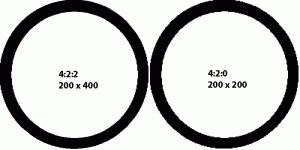
So -- simple test -- tell me which one looks better to you: the one rendered at 200x400 (4:2:2 simulation) or the one rendered at 200x200 (4:2:0 simulation)? I know which one I think looks better. And if you're telling me that the reasonable choice is to go with symmetry over resolution, I will disagree.
422-vs-420-circles.gif


Take the symmetry away and it's a completely different story. And that's exactly what happens with an interlace system. And that's exactly why 4:2:2 was the first digital component subsampling scheme. It was developed when all television was interlace, and that is the main reason why it's so preferred still today - as most broadcast HD is still interlace. The asymmetry of 4:2:2 compensates for the asymmetry of interlace.
I'm not going to disagree with any of that, for historical reasons. All I will say is -- what does it matter why it was developed, when the question is -- is 2x1 better than 2x2? If so, is it a difference worth pursuing? In my opinion, the answers are yes and yes.

You say that 4:2:2 is double the {chroma} resolution of 4:2:0. Which it may indeed be - but all on one axis only.
My forehead is bloody from banging it on the table, so let me strip it away to the absolute most simplest way I can possibly represent it: in a progressive 1080p HD frame of 4:2:0, there are 518,400 color samples. In a progressive 1080p HD frame of 4:2:2, there are 1,036,800 color samples. That is twice the resolution.

I suppose something is always better than nothing
At least we agree on that! Although I consider "double" much more significant than "something"

- but it's not the same, nowhere near as satisfactory, as a doubling of overall resolution whilst keeping symmetry. (Do I have to qualify with "in a progressive system" here?)
We all agree that 4:4:4 would be better than 4:2:2. Nobody disputes that. Simultaneously, it's not an option -- find a video system that produces 4:4:4, you basically can't, it's pretty much nonexistent. So we're left with the choice of 4:2:2, or 4:2:0. Again, I know which my choice would be, regardless of historical factors or interlace or anything, I assert that better is better.

Come on, the human eye has everything to do with the situation!! Even in the most complicated and expensive process, the object is to end up with an image on a screen that represents the subject as accurately as possible - to the human eye. We're not making films or programmes for aliens or cats and dogs! Scientifically, it won't really be anything like the original scene in many ways - it won't have anything like the accurate full spectral response, it won't have the fluidity of continuous motion, and yes, the chrominance resolution will be less than luminance - but the point is that TO A HUMAN it will closely seem as the eye would see the real scene. (Try to watch "Planet Earth" with a pet dog and don't be surprised if it doesn't get excited by the animals on screen - it's more likely to just perceive a flickering light.)
Okay, at last we're getting to the heart of the matter -- we're apparently having totally unrelated arguments! I'm not talking about pets or aliens, of course. If you want to understand where I'm coming from, please discard your preconceived notions and open your mind to this -- I am talking about fidelity in digital data acquisition because we are manipulating digital data here. We are sampling color into a digital matrix so that we can composite it, we can grade it, and we can compress it. Go and read the BBC's reasoning for why they disallowed Super16 as an origination format for HD, for example. It had nothing whatsoever to how it looked to the human eye, it had everything to do with how it ruined the processing and compression stages of production. Maintaining fidelity and high standards at the acquisition stage makes every step of the chain of production superior, and results in a final transmitted product that does, indeed, look better to the human eye. But to leap from "the eye samples light this way, so my digital system should do the same" is nothing short of fallacious thinking.

There is talk of 4K transmission in time (albeit at least a decade away) which will certainly be progressive with a framerate to be determined. Will 4:2:2 still be such a necessity then......?
Again, transmission is a totally different argument, I'm talking about fidelity in acquisition. Would 4K benefit noticeably from having twice the color sampling? Of course it would! But it's possible that by that time we'll have moved past the whole notion of color subsampling at all and will be dealing with full-bandwidth signals and the entire discussion becomes moot... at least, I can hope...
 
Last edited:
When Panasonic hired Art Aldrich for some of the performance in person shows with the AG-AF100 there was a thin case that Art made of AVCHD (4:2:0) looking better than P2 (4:2:2).
I am unaware of this quote or the circumstances around it, but I could imagine that he was referring to HVX200 vs AF100, in which case yes, the AF100 AVCHD looks better (sharper, cleaner, more DR, basically better in every way) than HVX footage would have, despite the HVX having recorded at 4:2:2.

But, as harddrive mentions, we're talking about different codecs and different cameras and different front ends and different processors, there are far too many variables to compare. If you wanted a true comparison of the two, you'd use an HPG20 to record AVC-Intra from the AF100, and compare the onboard recording to the external recording. That way you would eliminate all variables and focus solely on what the recording format does. And in that case, you'd likely find that the AVCI100 4:2:2 footage does look better than the AVCHD 4:2:0, but if you were comparing AVCI50 or DVCPROHD to AVCHD, I think they would be closer than you would expect.
 
My forehead is bloody from banging it on the table

Dear Barry,
It is a law of physics that no two objects can occupy the same space at the same time.
I would strongly advise allowing the table to remain where it is, and resting your head on an intermediary object known as a pillow.
Sometimes it's just not worth it.

Cheers,
C
 
Barry, you may know your stuff, but you're not making allowances for others.

This started when I gave the historical background to why 4:2:2 first came about and said "... all that historical logic has got largely lost and "4:2:2 good, 4:2:0 bad" has just become a mantra"

You read far, far more into that than was ever intended, and to be honest I'm now fed up trying to get the real sense across. This will be the last attempt. (You may be delighted to know.) Would you be happier if I rephrased it as "......has got largely lost and all too often "4:2:2 good, 4:2:0 bad" has just become a mantra"

What I was arguing against when I used the word "mantra" was the simplistic view of "4:2:2 good - 4:2:0 bad" *REGARDLESS OF ALL OTHER FACTORS*. And that can include factors such as luminance subsampling, even system resolution! Look at it this way. Let's think of a 720p 4:2:2 system compared to 1080 4:2:0. In the former we have 460,800 chroma samples, in the latter 528,200, yes? In other words, we have a 4:2:0 system with MORE chroma samples/frame than a 4:2:2 one!

Yes, it's obvious to YOU that in many ways that's effectively a cheat, you may even call it ridiculous, flippant, whatever - but I've had students to whom it's far from obvious, believe me. Which is why I feel so strongly about it. They just look at the subsampling number and base all opinion on that alone. THAT is why I used the words "become a mantra".

if you think the example is just too much of a cheat, (mixing 720 and 1080) then what about if we were to consider two hypothetical 1080 systems. A is 4:2:0, B is 4:2:2 - how do they compare? Yes, yes, ..... you'll tell me it's easy, 518,400 colour samples versus 1,036,800 - but before you hit the keyboard, what if I told you B was also luminance subsampled to 1440?

Then we have A still with 518,400, but B now with 777,600.

Yes, still more chroma samples- but now A still has 2,073,600 LUMINANCE samples, whereas B only has 1,555,200.

I'd argue that OVERALL it's now A that will look better - in spite of being "only" 4:2:0 - the higher luminance count more than making up for the lower chroma count. It's an example of "other factors".

Yes, all that I'm sure is blindingly obvious to you. Maybe so obvious that you think I'm simply being flippant. Maybe so obvious that you can't see why it's not obvious to everyone. Believe me, that's not the case. I've even had it thought that a 4:2:2 SD codec may be better than a 4:2:0 HD one.

Barry Green said:
We all agree that 4:4:4 would be better than 4:2:2. Nobody disputes that. Simultaneously, it's not an option -- find a video system that produces 4:4:4, you basically can't, it's pretty much nonexistent. So we're left with the choice of 4:2:2, or 4:2:0.
One last point. No argument from me about the above - we may have an effective choice of 4:2:2 or 4:2:0 AT THE MOMENT, but this whole thread is about a future rumoured camera, 4k, costing little but with an advanced codec. The post I originally responded to talked of "At the pace of technology, 10-bit 4:2:2 should have come to consumers years ago ....."

I think that was over optimistic, but this whole thread is looking ahead, and it's right to assume that the pace of technology here, especially as regards memory capacity and speed shows no sign of slowing. I gave the figures earlier about relative memory needs - 4:4:4 needs 50% more overall than 4:2:2. (Luminance and chrominance together.) That's all. So shouldn't Moore's Law give us that in less than a year, all else equal? Should 4:4:4 really be such a distant pipedream?

That's why I look forward to a future when we'll predominantly have 4:2:0 (for such as transmission) and 4:4:4 (for acquisition). Wouldn't you like that? The question is when. Of course, all this entirely ignores RAW, likely to increasingly play a larger and larger part in acquisition as well, at least at the high end.

Agree with the above or not, entirely up to you.
 
harddrive, that's a post that I can agree with, pretty much across the board. And no, I didn't see it in that context at all, but someone suggesting SD 4:2:2 vs. HD 4:2:0 does bring up an obvious need for further educating.

My default stance is always "all other things being equal", because when all other things aren't equal, it's pretty much impossible to make a proper comparison.

As far as looking forward to 4:2:0 for transmission, I don't look forward to that, (more like I rather dread it), but accept it as likely inevitable given that the observable difference to the human eye isn't THAT different, and it does make a notable reduction in bandwidth. 4:4:4 for acquisition would be ideal, if possible. Until that day, I believe that the ideal goal is full-raster 4:2:2 from three sensors for ultimate color res and image fidelity. I find Bayer a less-satisfying compromise necessary for a single-chip system, and among the single-chip systems available, it's probably the most reasonable, although I can make a pretty good argument for RGB Stripe.

In any case, yes, it's probably about time to get back on topic -- the topic of which, I believe, is an outlandishly optimistic and fundamentally baseless rumor about a fictional camera that makes no sense and will not exist, right?
 
If Panasonic would release such a camera it's going to be without a list of endles flaws. BM is great on sheet but in reality it has so many flawes that other camera manufacturers aren't taking it seriously yet. BMCC is an anomaly (IMHO offcourse). If one off the "serious" camera manufacturers makes a BMCC like camera in the same price range, now that's going to be some serious price dumping.

I don't think BMD will make a "perfect" camera in the near future and if they do, it's going to cost as much as other cameras do from different manufacturers. Maybe a tad less, just to stay true to theirs marketing/company outlook that they've build so far with the release of BMCC and Resolve lite.
 
You are certainly right with what you are writing about the BM camers - except the timing of their evolution. I think most of the flaws can be addressed by firmware and with the next generation of hardware they could be pretty close to the big ones. One might argue that 10bit 4:2:2 is not really attractive for consumers. But as storage evolves the advantage of a better codec will become mainstream. So, as I think while you are generally right, I believe that things are moving faster and that therefore a camera like the GH4 might not be mere science fiction but could become a real product in the nearer future.
 
Last edited:
we shoot today some corporate with GH3 and BMCC side by side.. I would tell.. If GH3 would just have 2 stops more of latitude ( Raw or Slog2 ).. it would be a perfect fit.. It is so practical..but it misses latitude..
 
Right now, i love the pocket. Probably best buy for quality ratio. Im actually using it more than the bmcc simply because its so much comfortable to use
 
If one off the "serious" camera manufacturers makes a BMCC like camera in the same price range, now that's going to be some serious price dumping.

Its really not a question of if but when, Im guessing 2014 we'll have the perfect camera for a reasonable price, in the meantime plenty of great options to shoot with!
 
Back
Top