Overhead Butterfly Frames - Outdoors

DDirector

Veteran
I was just curious.
I have never shot with any overhead butterfly frames before outside.

I have seen it in some b.t.s. pictures and videos.
Basically putting up an 8x8' or 12x12' diffused frame over the actor(s).

I notice that the actor(s) are soft and sometimes the background is more exposed/overexposed than the actor(s).

I just wanted to know the reasoning for this, and maybe some advice/info on doing this.
Why use this method. What about bouncing light back as fill to decrease contrast? Or another method?
When should it be used, when shouldnt it?
Material thicknesses?
 
I notice that the actor(s) are soft and sometimes the background is more exposed/overexposed than the actor(s).

Exactly what you should "notice". eg subject is softly lit and the harsh light has been controlled.

From there ...the D.P can add and mix any degree of additional lighting to the subject that the DP chooses. eg back light, cross light, up light, fill light, eye light, shadows or alter exposures to control the background levels / exposures ( up/down).


The is no rule or reason for using an overhead apart from ...the D.P wants the control of the light source. If its coming from up high.....you deal with it from above. Sometimes its just necessary to deal with the "problem" before you start the job of lighting the subject.

As a general rule... once I do this...I light from back to front. ie. I deal with the issues...set back and side lights..then work on the front light . Note that front light is not always the Key Light.
 
You can make a really good overhead for cheap by using the galvanized electrical conduit from Home Depot, they sale the 45% angle joint, should only cost between 30.00-50.00 +silk or muslin from Joanne fabric, or I recomend buying one from a reputable dealer with I loops already in the fabric. You just cut the conduit to the size you need, use the corner joints to make a square or rectangle, use a couple grip heads on a set of c-stands, there you go, saved about 600.00 bucks :)
 
I just wanted to know the reasoning for this, and maybe some advice/info on doing this.
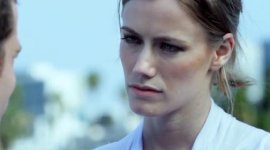
I'm a big fan of shooting under a butterfly outdoors. I do it whenever possible. The reason I prefer this is hard sunlight causes things to look way too contrasty, which results in really ugly shadows on peoples' faces (unless that's the effect you want, of course). I own an 8x butterfly frame I bought from Modern Studio Equipment in L.A. (http://www.modernstudio.com/). I also bought a 1/4 grid cloth to go with it, which cuts light by about a stop. So, when shooting your foreground (under the cloth) is about 1 stop under the background, which isn't bad. The diffusion is nice, but you sometimes still get shadows on faces. In my film, Rachel, we shot a rooftop scene between the two characters under a 1/4 grid and I still had to lighten some stuff in post. However, I much prefer that over hard sunlight.

Direct sunlight under 1/4 grid cloth:

Screen Shot 2013-02-21 at 12.24.21 PM.jpg

Notice how there aren't any hard shadows on her face. There definitely would have been if we didn't use the grid cloth.

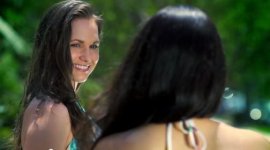
The alternative is to try to fill the foreground using bounce or a really powerful light. Here, we were shooting in direct sunlight but couldn't use the butterfly frame. So, we filled with bounce:

Screen Shot 2013-02-21 at 12.27.04 PM.jpg

We were going for an edgier look with this video, so it wasn't as big of a deal if the lighting didn't make "sense." The idea was to try to cut down on the ugly shadows as much as possible.

You might also use the butterfly and fill. It just depends on the look you want.

One other thing to keep in mind. Whatever you've got in that frame can be flapping around and noisy while the wind is blowing. They make "slient" grid cloth, for example, that makes less noise when windy. If you're shooting sound, you may want to think about that.
 
Okay. Cool.

When under the frame, do you still generally light the subjects with additional diffused lights, or leave it as it?
I believe I saw someone light someone under the frame, if that's the case, whats the point then? - Unless if its very subtle lighting to show off a little bit of contrast instead of it being 1:1.
 
I just wanted to know the reasoning for this, and maybe some advice/info on doing this. Why use this method?

To convert a hard source (the sun) into a softer source. This in turn softens the shadows, especially noticable around eyes, noses, and chins.

There are lots of ways to accomplish more or less the same thing. Flying diffusion is just one of those ways.
 
When under the frame, do you still generally light the subjects with additional diffused lights, or leave it as it?
I believe I saw someone light someone under the frame, if that's the case, whats the point then? - Unless if its very subtle lighting to show off a little bit of contrast instead of it being 1:1.
It depends on how much diffusion you're using. There are different grades of grid cloth, for example. Some may cut down the light by two or more stops. In that case, you may want to add light back to the subject(s) otherwise the background may be too hot. In my case, I probably could have used some additional light because although the 1/4 grid diffused the scene beautifully, there was still a hint of hard light as their eyes were a bit too dark. Lightening in post helped, but it may have worked better (and saved time later) if we'd used some light under the diffusion.
 
I used an overhead silk here just to get the journalists eyes open in the afternoon sun. No additional bounce or lights.

OverheadSilk_zps51bd8e78.jpg
 
Okay. Cool.

When under the frame, do you still generally light the subjects with additional diffused lights, or leave it as it?
I believe I saw someone light someone under the frame, if that's the case, whats the point then? - Unless if its very subtle lighting to show off a little bit of contrast instead of it being 1:1.

Michael, Michael, Michael.....

You have to start thinking about "light" and not "hardware ". Develop your eye to the subject / image.. There is no rule of hardware that covers all the situations.

Really look at how "light" works and "falls" on a subject.

A fundamental knowledge is .......everything you see is a reflection of the light source from the subject. ( Light is invisible until it is reflected).

Next fundamental...angle of incidence. This is an essential "tool" of the D.P

Those two fundamentals will take you far if you study, test and practice them.

Analyse what you see and recreate it from the fundamentals.

You are looking at : light angle and light "quality". They both offer all the clues.

Shadows show the angle of the light source.

The quality and nature of the light reflecting from the subject...show you what the source is likely to be. Soft / hard, wrapped, contoured, back , front side.......single light spource, multiple light source etc....

You can mix all this stuff up any way you wish.

FWIW: Yes...generally once I controlled the situation ( eg harsh sun) ...I would light the subject. No different to starting a shoot with no light ( dark studio or night exterior on location )

"paint it with light"
 
There's no hard and fast 'rule' as to specifically when you should (or shouldn't) use an overhead silk, and/or extra lights or any specific equipment (as Shooter says). Depending on the film you're shooting you may (or may not) want to use all sorts of different equipment to get a certain look. Some films/scenes/shots you'll want to diffuse heaps, others you'll want really harsh shadows. It depends on a number of things, including the position of the sun.

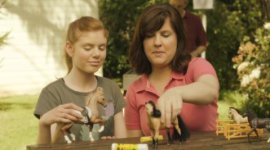
FWIW: Here's a grab from something I recently shot. Shot on a bright sunny day. Used a silk to soften the light falling on the girls in the foreground. Used flags and floppies to shape the light around the Dad in the background.

LSscreen.jpg
 
I use overheads all the time from 20X20 to 6X6 depending on the scene size. I skin them with silks, grid cloth, nets, lame' and ultra bounce. However, you have to be mindful of the wind and secure accordingly. It has to be nearly dead calm to deal with a 20X20 or a 10X20.
 
The Digital Juice 8x8' butterfly frame, anyone know anything about the diffusion used?
What type of diffusion and thickness it is? - how many stops lost?
 
The Digital Juice 8x8' butterfly frame, anyone know anything about the diffusion used?
What type of diffusion and thickness it is? - how many stops lost?

I have two of them. They don't list any specs for the silk but I think it's a standard 1 stop artificial silk.
 
You can make a really good overhead for cheap by using the galvanized electrical conduit from Home Depot, they sale the 45% angle joint, should only cost between 30.00-50.00 +silk or muslin from Joanne fabric, or I recomend buying one from a reputable dealer with I loops already in the fabric. You just cut the conduit to the size you need, use the corner joints to make a square or rectangle, use a couple grip heads on a set of c-stands, there you go, saved about 600.00 bucks :)

And lots of sandbags and lines! FWIW your putting up a large sail. I've seen them bend stands with a sudden gust of wind
 
I have the Digital Juice 8' Butterfly silk. It's a synthetic material with a seam down the middle, (which I didn't know until after I ordered it.) I haven't seriously tested it outdoors. I want to make a video review of it soon.
 
Cool, Jon, I'm looking forward to your review... at around $400, it's tempting... does the seam show up if you lit it from the other side? Also, could you test how much light is lost?
 
John and Tony, could you share your thoughts on the build-quality and ease-of-use of the Digital Juice 8x8 frame? It's tempting as an all-in-one kit, but a lot of the Digital Juice gear I've seen looks pretty cheaply made. So I'm wondering whether (for a little more) an Avenger 8x8 frame would be a smarter investment?

Cheers
 
Back
Top