F3: Noise in Slog?

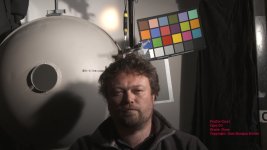
These images the Slog (top) holds the highlight blob really really well (a dedo pointed straight at the wall) , The highlight is gone in Cine one, Cine one is cleaner. You gotta asky yours self - how badly do I want that highlight.
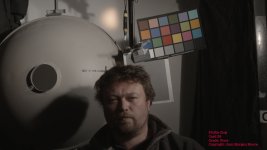
w001.jpg
w009.jpg
 
Last edited:
This goes beyond whether I want that highlight or not. S-log changes the way skin is recorded and how the highlights roll off. I need those attributes, not what Cine modes offer. If all I can use is Cine mode, the F3 is no better than many other options in my book and I will definitely sell it asap if I cant work this out.
 
I agree that 'that highlight' can be critical - it might be a whole sky taking 1/3 of the image.

---

I would suggest setting up some form of controlled test as I tried to do, testing a few cameras at many settings/iso/grades and draw your own conclusions.

I think unless you shoot 16bit linear raw you will be making compromises of some form.

--

One consideration is that Slog turns off most in camera processing, mainly we are pleased to have that processing off, but in camera noise reduction is very high tech (esp on thin codecs) and you might be needing to consider some shadow NR as standard in your post flow, just like you should consider sharpening a standard action. Adjustment of the onboard matixes may help with 'skintones and rolloff' but investigating them is a royal PITA

S
 
You need to distinguish between "camera noise" and XDCAM EX noise. To repeat an earlier post, the SN number of the F3 is as low or lower than any large sensor camera - find a camera with better specs and let me know. The 444 10 bit output is clean. The camera has many shortcomings, but noise isn't one of them. If you are seeing noise in the shadows you are either underexposing or introducing it with recording codec. I recently shot a series of national spots, all at night, with only a 2K backlight and light reflected from rain machines for fill. No noise. Recorded on Gemini, slog, shot with Cooke S4s. Client a national network. They wanted a "clean" look, and that's one reason we used the F3 instead of an Alexa. No complaints.
 
You need to distinguish between "camera noise" and XDCAM EX noise. To repeat an earlier post, the SN number of the F3 is as low or lower than any large sensor camera - find a camera with better specs and let me know. The 444 10 bit output is clean. The camera has many shortcomings, but noise isn't one of them. If you are seeing noise in the shadows you are either underexposing or introducing it with recording codec. I recently shot a series of national spots, all at night, with only a 2K backlight and light reflected from rain machines for fill. No noise. Recorded on Gemini, slog, shot with Cooke S4s. Client a national network. They wanted a "clean" look, and that's one reason we used the F3 instead of an Alexa. No complaints.

Did you see my post about the black shirt? Explain how someone is suppose to change that. I also don't understand how it's possible to "underexpose" shadows. If my shot has a shadow in it, I'm suppose to light that just to get rid of noise? For some reason a lot of people skip this part of what I'm talking about. Anyone hearing me? :Drogar-Evil(DBG):

SN numbers can be whatever Sony says but in the real world, it means nothing. I'd love to see the spot you are talking about in full rez so I can watch the blacks.
 
Not a Hollywood DP here, but I gotta think thoughtful framing, a little powder and even minimal lighting would pretty much cure 90% of the examples eveyone's so worked up about over the last 12 pages.
 
I'm still at a bit of a loss as to people's concerns with this 'problem'.

Every sensor is subject to its S/N ratio and the exposure level at which you reach its noise floor. Log gamma curves make the noise floor more obvious for the simple reason that they give you the full contrast range of the sensor. Which means that you don't get deep, crushed-down blacks at minimal exposure levels (say 0-20 IRE), you can see all of the detail that the sensor is resolving right down to (and below) the noise floor.

But the noise in those deep shadows will go when they're crushed down in the grade, look at this example below, the girl's eyelashes and the deeper shadow in the underside of her hair are clearly quite light and grey in the log image, graded down they return to sort of black you'd expect them to be (and any objectionable noise that was visible in the full-range image, can no longer be seen):

Slog21.jpg


So if you have detail that you want/need your audience to see, and you're exposing it at 0-20 IRE... well you're fluffing your exposure, and that's on you. Detail in those deep shadows is going to be crushed down to black in almost any basic grade. If you want to see specific things in your frame, you have to expose them properly (i.e. at a level that you'll retain detail once your shadows are crushed down in the grade).

And if you want completely noise free images, well then you have to expose your image to specifically prevent any part of your exposure hitting that noise floor (i.e. keep everything above about 20 IRE) and then add all of your contrast back in the grade. Which CAN be done, but you HAVE to light and expose for it.

Either way, the choice is yours, I can't really see how the camera (and any camera for that matter) is to blame.

I honestly can't recommend exposing using the zone system and false colour metering enough. It makes the entire process SO easy - it tells you instantly where your highlights, midtones and shadows are falling; it shows where you'll have shadow detail and where your shadows are too deep to expect detail to be retained. Voila! Problem solved, need detail in a dark part of your frame? Don't let it fall too far into the blue - that's all there is to it.

Personally I like shadows, I like darkness, I like a lot of contrast in my images - so I have a lot of low exposure values in many of my frames, but unless I'm severely compromised in my crew or lighting package, I never have issues with excessive noise with the F3. Because if you use the zone system, if you determine where you want white, black and grey to fall in your image, and you use your false colour or waveforms to put them there... well, there really isn't much to it.
 
I understand and have read the replies but lets just step back for a second. That black shirt... lets stick with that here. Lets say that is a doc interview that you had to do and it was in that same spot, just like you saw in Timur's test. Yes it could have been shot a little more open but lets say the building in the background had a big splash of hard sun on it and he is talking about the building so you dont want it blown out. A couple of you guys are actually suggesting carrying a light to make his shirt brighter, if I am to understand you completely. Another opinion is that it should just be crushed down into a solid, DSLR looking black nothingness.

I don't agree that either is a good idea and shouldn't be a requirement.

Just to wrap this up. The F3 is more like an 8 stop camera when in log mode and if you are shooting at night, its safer to use cine gamma. Ok, got it. :Drogar-Thinking(DBG
 
That black shirt... lets stick with that here. Lets say that is a doc interview that you had to do and it was in that same spot, just like you saw in Timur's test. Yes it could have been shot a little more open but lets say the building in the background had a big splash of hard sun on it and he is talking about the building so you dont want it blown out. A couple of you guys are actually suggesting carrying a light to make his shirt brighter, if I am to understand you completely.

If the dynamic range of your scene is wider than the 13.5 stops of the camera can adequately capture, then yes, adding a light or reflector to balance your exposure is precisely what you need to do.

There really isn't any way around it (other than using a camera with a dynamic range wide enough to capture the full contrast range of the scene - but very few cameras offer a wider DR than the F3 in SLOG, and even then, they top out at just one stop more).
 
You make perfect sense as do we.

Slog opens the sensor to your interpretation in the grade and your exposure choice on set.

Let us say that 'unacceptable' (to you) noise is up to 20IRE, well then you must expose your black shirt at 20 or higher

If your final intent is for the shirt to be at 5IRE then that will happen in the grade - the grade has a down pulled curve taking values from 20 to 5

So how many stops of headroom do you have above that 20 floor? That is the 'true DR' of the camera in your book.

It is no different from a DSLR that has a 12000 ISO setting - it is there; many will find it 'unacceptable', some may find is 'acceptable in emergencies' and some may think it is just fine any time.

You have to get into a dark box, set up a controlled test, bracket some grey cards, examine the noise a IRE and IRE after a pull grade, view them on scopes and find your levels of acceptability and use the camera within that zone of acceptability, I would certainly agree with you that 13stops is BS.

S
 
When people talk of the sensitivity and S/N ratio of the F3 that does not make it the right camera for you.

I tested the Scarlet in depth. Simply it has a better image than the F3 - but it needs a lot of light - more light than I could provide.

My basic test was 'could I use a window to light a face at F3.5?' (which is my 35-70 wide open)

With the Scarlet at that (low) light level the noise was certainly worse than the F3 - so the F3 was a better lowlight camera and most suited to my shooting needs. If I shot with a lot of light all the time I would probably have got a Scarlet.

S
 
cut off my replay - also your post process can easily add noise, either through the software, hardware and/or operator error. Slog HAS to be graded, and there is a lot of variations between grading systems and platforms. Also you are mixing apples and oranges with sensitivity and sensor noise. Any sensor can have lousy S/N numbers. Many other variables - is your detail cranked up in either the camera or in your grade? Are you using contrasty low resolution lenses?
Finally, the zone system reference is right on the money - go back and learn what Ansel Adams figured out. Log was created to provide the same result with video - capturing everything between pure black and pure white, although you go about it differently - the idea is that the entire gamma range is captured in the correct exposure and can be available in the post phase. If you're getting noise in a dark shirt in a simple interview with an F3 you're doing something wrong.
Don't blame the camera - It's not that simple. Buying a "low-light" camera would be the F5, and it's SN numbers are worse than the F3's because of the smaller pixels. But is has an ISO of 2000. Maybe you won't even need lights. If you bend a nail and blame the hammer you'll never learn how to drive a nail.

Read: http://photography.tutsplus.com/tutorials/understanding-using-ansel-adams-zone-system--photo-5607 for the concept of maximizing the black to white range and then look at the Abelcine blog about the F3 and slog by Andy Shipsides, a three part series. He demonstrates how slog works and shows you on scopes how the camera can achieve its dynamic range through slog.
 
Not sure who you are talking to barons. I have several years experience shooting with all kinds of cameras from reds to 16mm and 35mm and dont need a zone lesson from 12 years ago. I saw the Able F3 stuff a while back but thanks.

Yes, slog is still new to me but I am seeing issues with it that the marketing and hype was hiding. I dont think you are fully getting what my posts are stating. Again if that black shirt was a doc interview and I grabbed that shot I'd be pissed that noise was all over it when I was sold a camera that had the best SN of all and s-log was promised to have 13+ stops.

You are saying someone is doing something wrong if you got that noise and I dont agree at all. How is grabbing a shot without perfectly lighting it "wrong"? You and someone else are acting as if you are suppose to only use slog when you can perfectly control every part of a frame, which makes it mostly useless in my book. Doc. work doesnt allow controlling anything. Whatever the case may be, all of this is about the fact that its not 13 stops at all, or even close, and the sn is BS in practical application.

I'd love to see some comments on that last example I posted of the mini doc that was shot on the beach. He recorded the s-log LUT and I cant find much fault in those images.
 
Last edited:
What did you find the scarlet to be rated at morgan? I keep wanting to jump into that pool but I know its more work and workarounds than I want to deal with. But then again those images are really hard to argue with. But I need xlr's and batteries that last a while. And i cant hand off files that are ready to edit. Damnit.
 
Also someone mentioned the noise and XDCAM codec - but in fact Sam and others are shooting to external decks which would bypass any such artificats or degradation caused by the XDCAM codec.

I typically light my shadows to create a more narrow scene dynamic range but for all practicality this can not always be done, nor is it feasible.
 
What did you find the scarlet to be rated at morgan? I keep wanting to jump into that pool but I know its more work and workarounds than I want to deal with. But then again those images are really hard to argue with. But I need xlr's and batteries that last a while. And i cant hand off files that are ready to edit. Damnit.

The base is 320 - I use that gen of cams/chips at base+1 to give a little headroom so about 500/640 ISO

I think the 'neg' gets thin if you rate at 800+

Overall the Scarly was not for me, too heavy, no ND, no XLR, no deliverable codec, 3X the cost of a used F3, forced to buy proprietary touch screen yada yada. Im sure the new gen of Red chips are awesome.

I tested the F5 too and dont think that will get you your 'true' DR unless you buy the raw recorder, which put it beyond me.

I had to just sit down and realise that while there are better cams the F3 hit my price point, my clients can handle less than cinema quality and it certainly has put me in a place of reasonable confidence wheras my FS100 used to bite my bottom on occasion.

I own a sinarback/hassy MF stills combo (not to mention 5d2,D600,D3) so have to work a lot on personal expectation management with video capture - I cannot afford a 'D3 motion camera' yet - that is the F5 or the upcoming Arri.

-----

Dennis - the is external deck 10/422 and then there is uncompressed 10bit (1gb every 10s), the 10/422 is still 'noisy', and of course 444uncompressed which must be 1gb every 5seconds or less! I think it is all about crushing the blacks and then considering if the remaining DR offers a cost/quality/dataload balance than works for the OP


S
 
Last edited:
Regarding the F3 having one of the highest SN ratios, etc.. well camera makers can use numbers and conduct their own tests to produce any myriad of numbers that work in their favour. Then there is the real world, and use out in the field.

I always saw "dithering" in my F3 images but accepted it as some potential noise or dithering because I was using 8-bit 420 to SXS. Near the end of owning my F3 I did do a side by side test of XDCAM internal codec to 10-bit 422 ProRes and 10-bit uncompressed. My findings (and I still have the footage) is that the noise between the XDCAM and ProRes footage is honestly not that far off from each other. The uncompressed footage was clean. So in conclusion does the noise come from use of a codec? I find that hard to believe.

Sam you are finding the same thing yes?
 
Back
Top