F3: Noise in Slog?

For the cleanest possible images, set the camera at 0db (which is 800 ISO) and rate it at 800 ISO. So long as you don't have blown highlights to worry about, that'll give you the cleanest, least noisy images possible.

Indeed Im all over low ISO where possible. Your gain 0:0:0 comment piqued my interest in considering if the EI modes in Slog are different to the gain on the switches, and also if they are additive. And also if they perform differently in their noise characteristics.

Ie does "gain=1600ISO SlogEIoff" make the same file as "gain=0 SlogEI=1600"

An emperical guess is that if they perform differently then the OP should use gain not EI to get a cleaner file where there is not enough light to expose at base ISO.


S
 
Last edited:
Im using whatever it came with. The problem is that its from 2008 I guess. I haven't ever had problems with software on this computer but Resolve likes the newer hardware it seems. The "keeping up" game is too costly to make the camera life worthwhile sometimes.

To get a clean file you will need to get to a point were a richly exposed (a thick negative) image - not under by one stop as per your OP - looks nice.

I am fighting the same battle as I clearly see noise (and amazing highlight headroom which is the upside of a 'thin' exposure which gives space to the under-resourced DP to shoot without too many lights.. at the cost of noise)

SLog and luts seem to in the main be geared towards 'thin negatives' something neither of us want but are fashionable in an under lit world.

Your post choices I cannot really comment on beyond that what Nate is laying out here should lead to a workflow that enables you to expose a 'thick negative' and will lead to a noise free file.

To get the most from the camera you will have to engage with the post workflow. Just like film, a tank full of expired dirty chemicals did not yield the best restults - you have to engage with the lab to make sure that was not happening. Of course one huge cultural difference is that you are trying to be a lab - of course you could just employ a colourist or deliver raw files to the client. I can quite understand if being a shooter and a lab for a shooter fee annoys you - it annoys me!
 
Let me add that, on the positive side, I am very happy with the range I'm seeing and better color in Slog. We all know that few good examples of F3 Slog footage is posted online but these tests prove to me that many users who have bothered to do so simply don't understand how this camera works. I also assume that many I have seen were done in standard video modes too. I am seeing better dr than the last red camera that I used on a short film. The red also shut down on us at least once which I doubt will happen with the F3. I know that the epic can deliver but the costs and lack of the money-making features, like XLR's and practical battery options, keep me into making the F3 work.

I should expand on the test shot. It was a car parked against a fairly dark background at sunset. I was wide enough that I could see a lot of background and at the top of the frame was blue sky. I exposed the white car mostly in shadow at about 35 and was trying to hold the sky at around 70. To do that, much of the frame appeared fairly underexposed. In post I saw the noise on the darker parts of the car... bumper, tires and so on.
 
Being positive. Ive tested Red, F5 and F3 in depth. I bought the F3. It is great.

==

This is a classic situation where you will get noise.

You have two options.

Treat it like film.
If you lit the car and crushed the curve in post you would take the noise away - this is what a film shooter would do - add light, but for a big scene you could need a huge light budget. Depending on the composition you could have used an ND grad, another film teqhnique.

Be a digital nerd.
In the digital world to show the scene without adding light or grad ND you need to get close to a 'linear' performance from the sensor and expose so the highlights are very close to 100, thus lifting the shadows out of the noise floor of the sensor - the shadows will look milky and need to be crushed down in post.

Making the F3 do 'linear' is somewhat 'the wild west' even with the latest post tools.

S
 
Oh yes you could do those things but this kind of testing is what I would run into if doing doc. work, if it comes along, so I want to really understand how to make the best decision when these shots come up. Im going to do several shots next with the sky right at the 100 zebras and see how those pull down.
 
Yep that is exactly what you want to be doing (or at least up to 90 as per Nate's quote above) .. and finding a way pull it down nicely.

With all of these cameras I have taken a 'pure' approach; believing nothing, not the iso, not my light-meter, and certainly not any web chat.

Testing the F5 I shot a bunch of tests of high DR scenes from 2.8through22 and then fiddled with them all in post to see which made the most pretty picture!

Any new camera ownership that doesn't start with a bunch of "wildly bracket exposure + add many curves in post" tests will leave you in a compromised position.

S
 
Having a rough guide to keep in mind is where Im trying to get to. I feel like I need a formal class to reset my brain. Exposing film is easier than this![/QUOTE]


+1, with you there.....
There's an increasing greater number of camera people and DP's coming into the game now that have never exposed a foot film, and probably never will. It's somewhat impossible to get that small factoid by them. Yes, I agree with you though Shoots65. Much easier with film. No messing with camera settings other than fps and exposure. Load the right stock, concentrate on framing and roll.....then some great days in transfer with a good colourist.....Viola!
Yes I know, I've opened a Pandora's box......again.
 
I think it is important , and I hope I have some experience, having shot film ('86-99) and many iterations of digicam and software (2000-now) to dwell on two of my comments..

"the wild west" - digital is not yet standardised in LUTs, Operator Experience, Director Experience, passing inatruction (metadata) to the post team.

Also the fact that the relationship with the 'post team' (or is that us now) is complex financially and culturally.

I never got into this game to sit at a computer and remember just dumping my film with another party and going to the pub. Wonderful.

It is really important that professionals (across the industry and in unison) are charging if they have now become a 'lab'.
 
Having a rough guide to keep in mind is where Im trying to get to. I feel like I need a formal class to reset my brain. Exposing film is easier than this!
+1, with you there.....
There's an increasing greater number of camera people and DP's coming into the game now that have never exposed a foot film, and probably never will. It's somewhat impossible to get that small factoid by them. Yes, I agree with you though Shoots65. Much easier with film. No messing with camera settings other than fps and exposure. Load the right stock, concentrate on framing and roll.....then some great days in transfer with a good colourist.....Viola!
Yes I know, I've opened a Pandora's box......again.

Is it really all that different (with cameras that shoot log or raw)? Even with film we had to make choices as to whether we'd just shoot straight, or overexpose and then pull the footage for greater shadow detail. The basics haven't really changed all that much.

Granted, I'm just a young buck, so I've only shot and cut two shorts on 16mm film (years ago) and that's the full extent of my experience with motion picture film (though a great many rolls of 135 and 120 have passed through my hands for stills work). But my primary consideration with any camera (film or digital) has always been to set it up to function as simply as possible - I want control of my colour temperature, shutter angle, frame rate and ISO... and that's pretty much it. Those are the only camera related aspects you should ever have to deal with. There shouldn't be any dicking around with matrix and knee settings, no fiddling around with obscure menu items and customisations. I just want the fattest digital negative possible, so that it can be developed as effectively as possible, and yield the best looking images possible.

There really isn't all that much to it - exposure sensitivity, shutter angle, colour balance and frame rate. That's it. And those things were no different in the film days.

With digital I just want to know how much overexposure headroom I have and how much underexposure headroom I have; and then I can plan my contrast ratios accordingly. But again, I think all of this is greatly simplified when you just stick to the basic principles of the zone system - know what you want to be black, know what you want to be white, and know what you want to be the various shades in between - digital makes this so easy to do by distributing the values between pure black and pure white across a simple 0-100 IRE scale (Okay, 1-109 if you want to be picky and deal with super-whites). All you need to do is know where you want the various elements of contrast in your shot to fall, and then place them there using false color or a waveform - which is the easiest thing in the world! You don't need to meter anything! It's all just there on your monitor.

Apply that simple system and the only thing you need to learn is where your camera likes those values for white and middle grey to fall.

Exposure has never been easier! (especially since digital cameras have pulled level with film in the DR stakes)
 
There's an increasing greater number of camera people and DP's coming into the game now that have never exposed a foot film, and probably never will. It's somewhat impossible to get that small factoid by them. Yes, I agree with you though Shoots65. Much easier with film. No messing with camera settings other than fps and exposure. Load the right stock, concentrate on framing and roll.....then some great days in transfer with a good colourist.....Viola!
Yes I know, I've opened a Pandora's box......again.

I started shooting 7240 news-film stock with maybe 2 stops of latitude, I used a light meter to get me in the ballpark and let tele-cine do the rest. I still have a light-meter but I have found my WFM in my viewfinder gives me so much more information to make a better exposure while shooting S-Log. I try keeping the flesh tones around 50% don't clip or crush. Even shooting docs I most often can find an angle on an interview outside where I can avoid clipping the scene.
 
The advice is nice but not all of us can use Resolve and the discussions always seem to revolve around it. I use Color because my 8-core MacPro will not run Resolve because, apparently, it is not a 64bit system. I tried everything but it wont work on it so I'm stuck with the so called outdated stuff.

I don't view that as much of a limitation for this discussion, since Color can apply LUTs.

But it should be said, the general trend is that if you want to get the most out of any new camera, you probably need to build the finances for a new computer into the equation if at all possible as well.
 
To me the F3 is an ISO800 camera that works best at ISO800. For most jobs I tend to stay at IS800. I sometimes run into noise which easily can be removed with the right software but even when I let the noise stay it looks nice.

I follow the 38% 68% rule and as long as you do not expose faces to low it comes out great with little noise. In daylight scenes I sometimes even go to ISO1600 without any penalty in noise but for darker scenes ISO800 is the thing. Compared to the FS100 I see how AVCHD masks much of the noise and you could argue that the FS100 is better in low light but that camera has much less resolved detail than the F3.
 
I think it is working well at 800 - like a typical 800 look - whatever that is. My challenge is to find a way of shooting at 200 and getting a cleaner picture?
 
ISO200? Really? That's not an ideal ISO to shoot at since you'll loose more highlight DR than at ISO800 or ISO1600. You shouldn't have any problems shooting with very little noise at ISO200 but as always you gotta feed the sensor some exposure or it will never look good.
 
it would be great if you posted an original frame from footage, as well as your graded frame.

perhaps your image is far too under-exposed, or you pushed the shadows too much in the grade.

would love to see some actual frames.

cheers,
 
ISO200? Really? That's not an ideal ISO to shoot at since you'll loose more highlight DR than at ISO800 or ISO1600. You shouldn't have any problems shooting with very little noise at ISO200 but as always you gotta feed the sensor some exposure or it will never look good.

Well if you are in a controlled situation then you can control the DR of the scene. And also, Im not averse to the odd, or even significant, blown highlight (as long as the roll is smooth)

S
 
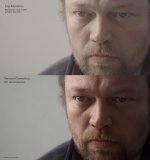
Dennis, a picture of me on the wrong side of the lens. :(
I think it looks good, but the 'negative' feels a little thin.
I would say my lit cheekbone is at the limit before curve compression kicks in and 'plastics' my skin- I might be wrong.
Online jpg has significantly degraded the image but my cheekbone is accurately represented.

done_not_1.4.4.jpg
 
im new to the f3 club and performing my first tests. I would agree with the op that slog seems noisy-a trade for retained highlights that seems entirely logical, but not always desirable.

My understanding is that you don't have many options on how to expose.

i am very used to working with raw stills and exposing right for the cleanest possible file.

The nature of the log capture which flattens the highlights means that one must afaik keep skins for example out of the higher values in the exposure zone.

My initial testing backs this up and I am getting a best result with a grey card put at 38 which is afaik what the "manual" suggests?

It seems therefore that you don't really have any choice in "how you expose" (unlike in raw where you can ettr if you can accept the highlight trade offs that implies)

I am wondering if one can make the camera cleaner by using a more linear profile in lighting situations where you don't need the amount of dr offered by slog. To me that theoretically makes sense.

Maybe those with more time with the cam would share further thoughts ..

Morgan,

I only now just realized you must have picked up a F3 off the market! Congrats, and I hope you enjoy it.

Are you testing with any external 10-bit recorder?

Regarding exposure and 38%, I don't recall much being in the manual itself, but you might enjoy the Sony white paper on slog which reviews slog characteristics and is also where you can see how 38% and 68% are mapped accordingly to regular full scale IRE. http://www.starcentral.ca/forums/SLOG.pdf

You can also calculate your own mapping with this equation if you like math and so wish to do so:

full scale IRE value =((0.432699 *LOG10(( slog IRE input value )+0.037584) + 0.616596) + 0.03)*100

I agree with your statement that with slog you don't really have a lot of choice in how you expose. I mean of course you can place middle grey over, under or on middle grey depending on the scene and what aspects you want to prioritize, but in general since dabbling with Sony's slog and even slog2 I find you really need to be quite "precise" with it for the best results compared to say shooting with RAW where there is a different kind of "freedom".
 
Last edited:
Yep I picked one up after deciding the 5 was a step too far and various reasons I may choose to expand upon elsewhere.

As for precise exposure - I am precise - well I am at the moment because Im testing in my studio, with raw you make trade offs eg less headroom and less noise, Im trying to learn if the same trade offs are possilbe with Slog, not from first glance, for example my face shot which was precisely exposed I could not really have opened up because my cheek is at the edge of going all Sony. I appear therfore not to be able to make that noise/headroom trade off and like the OP observing shadow noise.

Im gonna look for a cleaner profile Cine One seems a lot darker and I suspect therefore cleaner (once fed more light or opened up Tstop), but what the costs of that will be (lost highlights) I will discover in time.

And yep I got a Shuttle.

S
 
Back
Top