
Navigation
Install the app
How to install the app on iOS
Follow along with the video below to see how to install our site as a web app on your home screen.
Note: This feature may not be available in some browsers.
More options
You are using an out of date browser. It may not display this or other websites correctly.
You should upgrade or use an alternative browser.
You should upgrade or use an alternative browser.
Nikon Z9 with internal 8K 60p RAW !
- Thread starter joe1946
- Start date


Up to 8k/60p in 10 bit prores and raw, Impressive. My first DSLR was the Nikon D90 with 720p then Canon released the 7D followed by the 5d which made me move to Canon. I wanted to stay with Nikon but they were taking forever to enhance video features and AF. I am vested in Canon now butI might consider Nikon if it trickles the 10bit and raw down to the Z7 line. What would make me take a very serious look at Nikon at this stage is if they introduce a cinema body with ND and xlr. I believe this is the only way for Nikon to compete with Sony and Canon among filmmakers and pro Youtubers.

ahalpert
Major Contributor
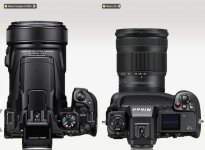
I just did a size comparison with my Nikon P1000 with 4.3-539mm F2.8-F8 (24-3000mm FF eqiv.) and the Z9 with 24-120mm F4 and the Z9 is smaller than I thought.
Did you mock this up or is this an online tool somewhere?

NorBro
Major Contributor
I don't know if a top view is the best for a comparison...here's another look (and there are other comparison sites, too):
https://camerasize.com/compare/#884,789
https://camerasize.com/compare/#884,789

joe1946
Veteran


I am rooting for them. When I started in photography (film days only) you were a serious photographer if you shot nikon. Their pro dslr bodies have always been rock solid for me, their engineers & what they are able to accomplish compared to way larger companies is incredibly impressive. I still love & use their lenses for many situations.
Nikon mightily missed the boat with people transitioning to mirrorless & hybrid shooters especially. They priced this especially nicely & having internal prores was really smart. I have yet to have owned a new flagship anything, but this is more attractive than an A1 for someone like me. I don't really see Panasonic getting AF like this together in the next few years. Their 24-120 f4 is priced nicely & probably going to the best of those workhorses
Nikon mightily missed the boat with people transitioning to mirrorless & hybrid shooters especially. They priced this especially nicely & having internal prores was really smart. I have yet to have owned a new flagship anything, but this is more attractive than an A1 for someone like me. I don't really see Panasonic getting AF like this together in the next few years. Their 24-120 f4 is priced nicely & probably going to the best of those workhorses
I have tens of thousands of dollars invested in the Canon systems and am not intending to transition to either Nikon or Sony.
Which means that, for folks like yourself, Nikon provides competition to your chosen brand/ecosystem and, hopefully, pushes everyone a step forward faster than they would have moved otherwise.
But they have a tough sledding ahead. I mentioned in a different thread that they went from ~ 31% of the DSLR market in 2015 to only 8% of the mirrorless. They still move some DSLR bodies but that ship has long sailed.
On the other hand, if one can pick up some bargain Nikkor glass on the cheap, it may be a worthwhile investment.
Up to 8k/60p in 10 bit prores and raw, Impressive. My first DSLR was the Nikon D90 with 720p then Canon released the 7D followed by the 5d which made me move to Canon. I wanted to stay with Nikon but they were taking forever to enhance video features and AF. I am vested in Canon now butI might consider Nikon if it trickles the 10bit and raw down to the Z7 line. What would make me take a very serious look at Nikon at this stage is if they introduce a cinema body with ND and xlr. I believe this is the only way for Nikon to compete with Sony and Canon among filmmakers and pro Youtubers.
From a cursory observation, Nikon is a brand non grata among those who moved into the business within the last decade or so.
I am rooting for them. When I started in photography (film days only) you were a serious photographer if you shot nikon. Their pro dslr bodies have always been rock solid for me, their engineers & what they are able to accomplish compared to way larger companies is incredibly impressive ...
Nikon is 100% owned by Mitsubishi and it doesn't get much bigger than that in Japan.
That said, they seem to have an independent management from Mitsubishi's other branches.
Last edited:


ahalpert
Major Contributor
Right- the only reason to use type A cfexpress (which no one used before the a7siii) was that they could craft dual-purpose card slots (SD/cfexpress A) because of the similar form factor of those 2 cards. Which means I can use exclusively sd cards on my a7siii and fx3
it's a bit of a bummer that there's no sd option on the z9 as that will raise the cost of purchase for most people. but type b cards are surely a better investment than type a, and there are far more purchase options. I wonder if type B cards will be standard for a while to come or if faster speeds will be required in a few years
it's a bit of a bummer that there's no sd option on the z9 as that will raise the cost of purchase for most people. but type b cards are surely a better investment than type a, and there are far more purchase options. I wonder if type B cards will be standard for a while to come or if faster speeds will be required in a few years
NorBro
Major Contributor
I wonder how Nikon is able to provide internal compressed RAW recording (whether ProRes RAW or N-RAW) without running afoul of the RED camera patents.
I'll believe it when I see it (ProRes RAW)...they wouldn't be the first to promise a spec and never release it via future FW.
Or maybe the FW will arrive in 2028. :2vrolijk_08:
As far as N-RAW, likely through a technicality like CRL and BRAW.
Three likely possibilites -
- Nikon has licensed the Raw codec from Red
- Nikon's Raw isn't legally Raw but more like Canon Raw Light or Sony's X-OCN
- Nikon traded something of value to Red or, conceivably, flexed some rhetorical/technical/marketing muscle against Red.
Apple ProRes Raw is obviously Apple property, so the licensing fees go to Apple and it's Apple's job to fend off any patent right holders. At the moment, it pays Red licensing fees or has negotiated an agreement where Red's codecs work with Apple's editing software, including the Final Cut Pro. If so, Nikon would have to pay Apple, which then would have to pay Red.
NorBro
Major Contributor
If Nikon pulls this off, it would be one of the most important steps for the history of the next generation of cameras since everyone would follow. (Similar to BM with CinemaDNG but that was shutdown.)
The body, the price, internal ProRes RAW...and the irony is too great that it would be Nikon doing it.
Maybe RED is open to more opportunities in the final years of their patents' reign, and compressed and limited video output which existed for the last 40 years or so in most hardware will slowly come to an end as the next generation has mostly cameras that offer some of the purest output possible which should have always been the reality (but wasn't).
joe1946
Veteran
EOSHD:
Nikon is keeping the details of internal RAW recording close to its chest so far, I think partly because the firmware isn’t yet final and most of the RAW recording capabilities will be added later in a 2022 firmware update.
However what we do know is that Nikon is licensing a RAW codec technology for the Z9 from “intoPIX”.
Quite how they are manoeuvring around RED’s compressed RAW patent is another question mark, but we’ll see if we can figure out some answers below…
The Nikon Z9 undoubtedly caught many by surprise!
The headline grabbing video features are world-beating, but it’s the more practical side of the camera I’m most interested in.
Aside from topping out at 8K 60p, can the Z9 give us practical internal 4K N-RAW recording in 12bit at similar file sizes to 10bit H.265? And will it be widely compatible and easy to edit?
Nikon Japan’s official website offers some clues. It says that the Z9 uses a RAW codec for stills from intoPIX. When we go to intoPIX’s website we discover their codec isn’t just for stills. Indeed, it’s a hybrid stills/video codec, which is interesting.
In my opinion it is very likely Nikon could be using intoPIX technology for internal N-RAW recording.
The interesting thing about the numbers above from intoPIX is that the TICO RAW bitrate for 4K/60p is just 500Mbit at 1 bit per pixel (1BPP). This means at the cinema frame rate of 24p we can expect just 200Mbit for 4K RAW. That compares to Long GOP H.265 10bit recording!
This would be extraordinary if Nikon’s RAW video edits well and the image holds up at this file size.
The Z9 of course licenses ProRes from Apple (422 and ProRes RAW). This makes a lot of sense as it’s a widely supported codec, but there’s no BRAW recording from Blackmagic here, or any talk of whether that will be possible via HDMI.
However both ProRes 422 HQ and ProRes RAW file sizes are pretty enormous.
As you can see TICO RAW offers two compression settings at 12bit. The higher quality 2 bits per pixel setting is 6:1 compressed compared to uncompressed RAW.
Meanwhile the 1 bit per pixel setting is 12:1 compressed.
This makes possible 8K 60P RAW at 2000Mbit/s which is a smaller file size than uncompressed Cinema DNG RAW at just 4K.
This is all the more impressive when we compare it to ProRes RAW.
At most settings it has a larger file size than ProRes 422 HQ and tips the scales at over 1680Mbit for 4K/60p – and that is only in the lowest quality setting at 10bit!
So when we compare the 500Mbit or even 1000Mbit for TICO RAW at 4K/60p that is a huge saving on card space and efficiency.
For me it absolutely makes sense for N-RAW on the Z9 to be this way.
However Nikon need to make it a bit clearer for us at launch. There’s not a lot of good info out there…
As far as I can tell 8K/60p RAW is coming in the later firmware update and that will be N-RAW format only, and that ProRes RAW will be in there at launch in December, but top out at 4K/60p (ProRes 422 as well)?
But what other flavours of ProRes are there in the Nikon Z9? Will (as I hope) ProRes 422 LT and Proxy be supported for smaller file sizes with minimal loss in image quality?
If Nikon licensed TICO RAW from intoPIX for video as well as for stills, which bitrates and settings for 12bit N-RAW did they implement in-camera?
I still tend to choose codec settings of under 400Mbit, with 200Mbit usually my go-to file size on my cameras so that it can be archived away without a major investment in permanent storage, without deleting the master recordings or further compressing everything with a loss of image quality.
So I have a feeling N-RAW will be a go-to setting for me in 4K on the Z9 if the bitrates are under 500Mbit!
https://www.eoshd.com/raw-video/what-are-the-details-of-nikons-new-cinema-8k-4k-raw-codec-on-the-z9/
joe1946
Veteran
TICO-RAW is the new RAW
TICO-RAW delivers the most beautiful pixels and most perfect colors, with the most brillant brights and the deepest darks ... with the world's best efficiency.
Designed by intoPIX, it unleashes image sensor and traditional RAW data-flows thanks to an innovative processing and coding. The full power of the image sensor is preserved while reducing the bandwidth, the storage needs and the transfer time. It offers high image quality and the capability to manage high resolution, high frame rate and high dynamic range workflows.
TICO-RAW is the world’s first RAW codec, handling both RAW pictures and RAW videos, that can offer compression efficiency with such low complexity on RAW Bayer and other Color Filter Arrays (CFA) patterns. The technology and associated products are covered by one or more claims of patent, awarding intoPIX's hard work and innovation.
https://www.intopix.com/tico-raw