
Navigation
Install the app
How to install the app on iOS
Follow along with the video below to see how to install our site as a web app on your home screen.
Note: This feature may not be available in some browsers.
More options
You are using an out of date browser. It may not display this or other websites correctly.
You should upgrade or use an alternative browser.
You should upgrade or use an alternative browser.
FS7: New Sony PXW-FX9 with venice features and 6k full frame
- Thread starter J.Brown
- Start date
My understanding is the zoom issues on the 28-135 and the 18-110 are pretty similar, the main question in my mind would be IQ. I
I've never read anything about that comparison.
I just looked it up. Apparently the 28-135 is not a true mechanical zoom like the 18-110. So when crash zooming you’re at the mercy of a relatively slow internal mechanism which lags. Also at its fastest, it takes 8 seconds to get from 28-135. The 18-110 has a true manual zoom mode which can be toggled like an ENG lens.
Thanks, that's quite a difference - yikes 8 seconds! They should come up with a new version.
On the other hand, the new multi cable that replaces the lanc is supposed to be better for the new handle. It’s said that it makes for much smoother zooms from the rocker on the handle, but I’ve only seen this said by Sony reps so grain of salt and all that.
I had purchased the 28-135 with my original FS7 and the 18-110 with my FS7 II. I was not particularly happy with the 28-135 since manual zooming definitely felt servo lag. Obviously Sony is trying to sell remaining 28-135 inventory, which gets a kit to market much faster than if they were to develop a new lens in that price range. And of course putting the full frame 28-135 on an Super35 sensor meant inability to shoot wide. That should be a decent enough range for a FF camera and the optics were decent enough. I wouldn't be terribly unhappy with that camera-lens combo for the money. Just recognize the servo lag in manual functions.
Ned
Ned

cyvideo
Veteran
Me curious. Wouldn't it be possible, media limitations of FX9 excluded, to create an updated version of XAVC for the 6K cameras?
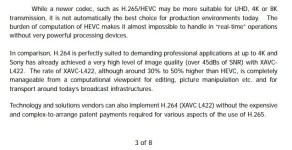
No not really as XAVC is H.264 based. As is Canon's XF-AVC and Panasonic's AVC-Intra.
Standards like MPEG-4 Part 10, Advanced Video Coding (AVC) / ITU-T Recommendation H.264 (H.264) exist to allow different hardware and software manufacturers to exchange video files with the guarantee they’ll actually work on someone else’s system.
Because of this standards have to impose limits on things like frame size, frame rate for a given frame size, and data rate in bits per second. For AVC/H264, the different sets of limits are called Levels. At its highest level, Level 5.2, AVC/H.264 has a maximum frame size of 4,096 x 2,304 pixels @ 56 frames per second, or 4,096 x 2160 @ 60 frames per second, so that standard H.264 decoders don’t have to accommodate any frame size or frame rate larger than that.
The thing is that all of the above H.264 iterations from Sony, Canon and Panasonic all comply with recognized SMPTE film and broadcast H.264 standards. If these manufacturers want to sell into the film and television market where standards apply to guarantee national and international program interchange they will stick with the standards. For anyone to offer larger frame sizes in I - Frame for example they would have to go to one of the traditional codecs like ProRes or in Long-GOP go with HEVC H.265 which supports 422 and 10 - bit. The ProRes solution is there but the data loads require very fast throughput and very fast and high capacity media to cope with those large data streams. Just look at the data rates below for ProRes and do your own math for anything above the quoted 5K bit rates. These are monster bit-rates. This is why nearly all camera manufactures have gone with H.264 based systems as it offers the best all round balance between quality, ease of processing and storage.
4K 4096 x 2160 Mbps @ 50p
ProRes 422 Proxy 323
ProRes 422 LT 730
ProRes 422 1049
ProRes 422 HQ 1573
ProRes 4444 (without Alpha) 2359
ProRes 4444 XQ (without Alpha) 3539
5K 5120 x 2880 Mbps @ 50p
ProRes 422 Proxy 405
ProRes 422 LT 912
ProRes 422 1966
ProRes 422 HQ 1573
ProRes 4444 (without Alpha) 2949
ProRes 4444 XQ (without Alpha) 4424
On the other hand you could go to HEVC H.265 in 422 10-bit but your processing demands will sky rocket. For example the processing demand of true 4K UHDTV HEVC H.265 requires 80x more processing power than HD AVC H.264. 6 and 8K processing demands especially in HEVC are astronomical. As great as some of the new camera's ASICs and FPGAs are they just don't have the processing power to handle this kind of data processing imposition. Primarily that's why nearly every camera out there that offers HEVC is supplying the bare bones version of HEVC. That being 10-bit 4:2:0 which is the consumer streaming version of HEVC. Many will attest to just how hard that version of HEVC is to edit on an average PC system. In reality to get the best performance even in 4K let alone anything larger it's easier to handle HEVC once it's transcoded to a decent intermediate codec, a la ProRes, Avid, Cineform or GV HQX or any one of the other intermediate codecs out there.
So in answer to your question "Wouldn't it be possible, media limitations of FX9 excluded, to create an updated version of XAVC for the 6K cameras?" The answer would have to be no in H.264 as that does not support the 6064 x 4040 frame size of the FX9. Any codec to handle the larger frame size would have to be developed and it would not be part of the H.264 family and therefore not XAVC as we know it. Also knowing what Sony's current published position on HEVC H.265 is I don't thing they will be offering anything anytime soon in HEVC.
Chris Young
https://pro.sony/s3/2019/04/3016172...point-for-advanced-media-architectures-EN.pdf
cyvideo
Veteran
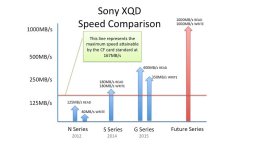
Yes they could I guess but I don't see why they would do that as Sony's future roadmap for their own XQD cards has a decent future speed increase outlined. Mind you if the FX9 for one isn't going to go past 4K XAVC internally there is no further need for more speed in that environment. In an interview re the FX9 one of the Sony engineers said they had no present plans for CFexpress adoption but he didn't rule it out and indicated it would be down to market demand to some degree. Sony have always liked to stick with their own proprietary media right back from the "Memory Stick" days. Still used in the XDCams for scene and all file storage. First it was their "Memory Stick" then SxS, originally co-developed with San Disk, and then XQD and of course later Sony's AXS Memory Cards for X-OCN recording with their R7 RAW backs. They state as do Panasonic with their P2 technology that they can maintain a much more stringent set of standards with their own proprietary media plus it enables them to implement firmware upgrades to both cameras and media in concert if required without having to relay on third party vendors to issue upgrades. Like as happened recently with the introduction of the new Sony Sony 120GB and 240GB G Series XQD Memory Cards. To use those cards cameras like the FS7s etc required new firmware.
Chris Young
Chris Young
At its highest level, Level 5.2, AVC/H.264 has a maximum frame size of 4,096 x 2,304 pixels @ 56 frames per second, or 4,096 x 2160 @ 60 frames per second, so that standard H.264 decoders don’t have to accommodate any frame size or frame rate larger than that.
The Wikipedia entry on h.264 lists LEVEL 6.2 as having a maximum frame size of 8,192×4,320 120fps, and I've seen other sources listing h.264 as having a maximum color depth of 16-bit 4:4:4 through extensions to the h.264 standard. ( likely these limits have never been implemented, but the h.264 standard keeps growing to accommodate the future needs of the camera / software companies )
cyvideo
Veteran
( likely these limits have never been implemented, but the h.264 standard keeps growing to accommodate the future needs of the camera / software companies )
Yes Dingo technically you are correct as regards the published specs. It all comes down to what levels have been implemented.
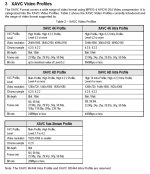
The H.264 level 5.2 supports up to 9437184 luminance samples per frame, which is the number of luma samples needed for a frame with dimensions of 4096x2304. There may indeed be encoders that can be forced to encode higher resolutions. Currently though there is no no valid level which can be set for streams above level 5.2. Up to level 5.2 is currently used by Sony's XAVC 4K 422 Intra Profile. Level 5.2 can support support bit rates of up to and including 960Mbps. On that basis I can't see H.264 going any larger in frame size because of the 5.2 level limitation. I believe Adobe Encoder now will support encoding in levels 6.0, 6.1 and 6.2 although that is a very different story to a camera manufacturer investing a bucket load of money into a codec development for which there is no ratified universally accepted AVC profile level. Below is a list of Sony's current XAVC video profiles as published.
Chris Young
thirdyearff
Active member
How about the Manual focus?
I got the 28-135 originally for the FS700 because i wasn't particularly fond of the 18-200 it shipped with. In the rare instance that i use auto focus with the 28mm lens, i found it hunted far less w the Fs7 then the FS700...fwiw.
And yes, as others have stated, zooming via the rocker w the 28mm has a lot to be desired. I use the lens manually 95% of the time. Its got a decent throw...to each his own i suppose, but between the 28-135 and 18-110 they are both about the same size and weight, they look and feel identical so there is a comfort level and i'm just accustom to using both. If i'm running and gunning outdoors (which happens a lot) I generally have both with me, however, I do find myself using the 18-110 more...but that may change once i get the fx9.
cyvideo
Veteran
Also at its fastest, it takes 8 seconds to get from 28-135.
8 seconds? I would suggest something is amiss with that particular lens. Normally when tested I have found the 28-135 go from 28-135 in 4-4.5 seconds or just under. The 18-110 does the full range in about 2 to 2.5 seconds at its quickest. Using a BeBob Engineering Zoe Lanc controller I can't get any quicker speeds with either lens but can with the Zoe speed control wound right back get a very consistent 30 seconds slow creep zoom on the 18-110. With another Zoe but without the internal speed limiter pin I can creep zoom for just on 90 seconds if required. Never had need to zoom that slow yet but..? Haven't timed the slowest on the 28-135. If anyone wants a direct lens comparison as regards speeds and field of view on an FS7 check out the following video.
https://www.youtube.com/watch?v=93o2Tle_evw
A rough and ready test I did out the back of the house two and a half years ago on the 18-110 can be seen below. All of that test was done using the built in lens servo.
https://www.youtube.com/watch?v=iQRs-8CbohQ
Chris Young

SJX
Veteran
Yes Dingo technically you are correct as regards the published specs. It all comes down to what levels have been implemented.
The H.264 level 5.2 supports up to 9437184 luminance samples per frame, which is the number of luma samples needed for a frame with dimensions of 4096x2304. There may indeed be encoders that can be forced to encode higher resolutions. Currently though there is no no valid level which can be set for streams above level 5.2. Up to level 5.2 is currently used by Sony's XAVC 4K 422 Intra Profile. Level 5.2 can support support bit rates of up to and including 960Mbps. On that basis I can't see H.264 going any larger in frame size because of the 5.2 level limitation. I believe Adobe Encoder now will support encoding in levels 6.0, 6.1 and 6.2 although that is a very different story to a camera manufacturer investing a bucket load of money into a codec development for which there is no ratified universally accepted AVC profile level. Below is a list of Sony's current XAVC video profiles as published.
Chris Young
View attachment 137108
So FX9 drops SRmaster? Many people with F55 likes this for HD with less compression.

Grug
Veteran
So this camera will finally replace F5 and F55? I think venice replaced F65? Or is F65 still for sale?
I don't think it replaces either the F5 or F55, as it doesn't record any high bitrate codecs, or raw.
I think it will do really well in the FS7's space. And the dual ISO and built-in timecode will make it very appealing for doco and actuality work. But it exists for a different part of the market than the PMW cameras.