FS7: New Sony PXW-FX9 with venice features and 6k full frame

It's such a shame Sony designed the FX9 well and then still persist on adding that ugly bulky piece of extension back. Yikes.

Isn't this for legal reason regarding RED patents on RAW recording?

But I agree. it's a PIA and adds a lot to the cost of the camera
 
Isn't this for legal reason regarding RED patents on RAW recording?

But I agree. it's a PIA and adds a lot to the cost of the camera

But if it was a patent issue, then why does the FS5 get the ability to record raw out directly to a recorder without the need for an extension unit and the FS7/FS7II/FX9 do not?
 
In my personal opinion, I think it's less with RED patents and more with camera cartel. Sony is big enough to think outside the box and play with Canon and Blackmagic, but aren't for whatever reason.

I think Canon drew the internal RAW longer end of the stick and gets to offer it for a few years before Sony does.

There is absolutely ZERO reasoning for the FX9 to not have internal RAW recording. The FS7, OKAY. Older technology, different world. But not the FX9.

Only other argument would be to get paid a ton of money by Atomos and Apple to sell recorders and use ProRes RAW in FCP X, but don't see that being the case as the latter could have internal ProRes RAW.
 
Seems to me Sony is resting on its laurels and exploiting its customers. I expect many may jump ship to Canon.
 
But if it was a patent issue, then why does the FS5 get the ability to record raw out directly to a recorder without the need for an extension unit and the FS7/FS7II/FX9 do not?

To the best of my knowledge for what it's worth.

The FS5 data output is technically a derivation of the original FS700 data output. Original FS700's had to go back for a hardware upgrade to output Sony's 4K and proprietary compressed data out. That upgrade cost $400. Later FS700R models came with the necessary 4K and data output hardware already installed. Because the data has to be output before it is converted to RAW it doesn't transgress on RED's patent which covers INTERNAL RAW recording. In the case of the FS700 that was done via the Sony HXR-IFR5 interface that docked with Sony's AXS-R5 RAW recorder. Originally the FS700 when used with a Convergent Design Odyssey 7Q was not allowed by Convergent Design's licensing agreement with Sony to record the 4K output of the FS700.

The FS7 hardware internally technically is a derivation of the F5 hardware set which is why it also cannot record RAW internally. It needs an external recorder to handle Sony's proprietary data output. Sony's FS7 with its proprietary data stream needed an external interface data module to output that data stream so Sony developed the CA extension back hardware to output that proprietary data stream and then licensed Atomos and Convergent Design to convert that data stream to RAW but not Sony X-OCN RAW. Additionally in the case of the FS7's CA back the ability to round trip record ProRes HD to its internal XQD cards was also included. Atomos and Convergent Design were licensed by Sony to decode Sony's proprietary data stream because without that license there was no way for Atomos and Convergent to convert and record RAW from Sony's data stream. I believe this to be the case with the FX9 also but in its case it is now 16-bit linear RAW as opposed to the FS7's 12-bit linear RAW. Sony has never licensed it's X-OCN RAW to outside partners so the RAW recorded by Atomos and Convergent Design recorders follows their own implementations and only became available after Sony licensed out the ability to read and decode the information in the Sony camera data streams.

In the meantime Sony who have not released a "Light RAW" a la Canon are still bound by REDs no internal RAW recording patents. Canon got around this by developing CRM which is a way around those patent restrictions. Loren Simons, a Canon Hollywood Professional Technology and Support Center Senior Product and Sales Trainer stated at Canon’s Digital Learning Center that:

"Canon's Cinema RAW Light requires a different post-production process than the traditional RAW workflow you may be accustomed to with the EOS C300 Mark II or EOS C700. Cinema RAW Light does not record in the frame-by-frame file structure of a traditional RAW format. Instead, using a proprietary format developed by Canon, the RAW information is compiled into a single Canon RAW Movie file, or .CRM.”

This is the reason Canon's CRM doesn't impinge on RED's internal RAW stranglehold. This is the reason the F5, F55, FS5, FS7 and now the FX9 are all dependent on external RAW recording.

Whether Sony will ever see it necessary for marketing reasons to develop maybe an X-OCN Light single file RAW record capability to get around REDs internal RAW patent lock up who knows. I wouldn't be holding my breath. Sony are totally capable of doing it. They have obviously not felt it necessary on the FX9 as I think the market they are aiming that camera at is the day to day jobbing cameraman who shoots company messaging, interviews, green screen, sports and entertainment and other sorts of corporate market videos. Who most likely will never have the need of RAW. If you need RAW occasionally go hire a CA RAW output back I guess is their sentiment.

As an aside until SMPTE ratify an H.264 encoded format greater than 4K, the max frame size available where ratified decoders are available I don't think you will see Sony XAVC or Canon's XFAVC go above 4K. Even though on the issued specifications the specs outline frames sizes up to 8K.

Chris Young
 
Last edited:
All great info, but that still didn’t really address my question; “But if it was a patent issue, then why does the FS5 get the ability to record raw out directly to a recorder without the need for an extension unit and the FS7/FS7II/FX9 do not?”

At the end of the day, it’s absolutely ridiculous that the new FX9 still requires the extension unit in addition to a recorder for raw when the measly and much less expensive FS5 does not. That clearly has nothing to do with RED’s patent and has everything to do with Sony.
 
But if it was a patent issue, then why does the FS5 get the ability to record raw out directly to a recorder without the need for an extension unit and the FS7/FS7II/FX9 do not?


I'm not a lawyer, but from what I understand RED holds certain patents in regards to recording RAW internally i.e. in cameras. In order to get around this you either pay RED or record RAW externally.
What is interesting is that the patent seems to refer to 'compressed RAW', like REDcode. That would include Prores RAW, BM-RAW etc. Maybe X-CON and Canon RAW Lite?

I wonder if Arri gets around this because ArriRAW claims to be uncompressed? Maybe they just paid up.


Apple went after RED last year, but it looks like they failed. Regardless RED has the entire camera business over a barrel because of this patent.

https://www.newsshooter.com/2019/11...tent-challenge-dismissed-by-us-patent-office/

No matter what the reason is, it is incredibly annoying and Sony has done a very poor job of figuring out a way around this. The FS7 solution was ridiculous from an economic standpoint. $2500 for an I/O box, plus the cost of a recorder ($2500 Odyssey 7Q+ etc) or even more if you bought the Sony recorder. This drives the cost of the camera up to a ridiculous price point. And now we are faced with the same approach with the FX9. It's even more glaring considering that there is the relatively cheap FS5 II, which sports a direct RAW output without the need for the I/O box dongle.
 
Last edited:
From following RED's patent defense against Apple and others, I believe their patent is for compressed raw of 6:1 and above. To get around it the options are compressed raw of 5:1 and below or uncompressed raw. I believe this is why Canon's Raw Light is 5:1 and 3:1. From what I have read, it is also probably one of the reasons that Blackmagic developed BRAW, so that they could not only have their own codec and not have to deal with cDNG but also allow greater compression which is welcomed as we enter 6K and 8K resolutions.

I'm not necessarily sure what compression ratios Atomos are using with ProRes Raw, but they did enter a licensing agreement with RED last year.
 
All great info, but that still didn’t really address my question; “But if it was a patent issue, then why does the FS5 get the ability to record raw out directly to a recorder without the need for an extension unit and the FS7/FS7II/FX9 do not?”

At the end of the day, it’s absolutely ridiculous that the new FX9 still requires the extension unit in addition to a recorder for raw when the measly and much less expensive FS5 does not. That clearly has nothing to do with RED’s patent and has everything to do with Sony.

As I said the hardware for the FS5 already existed from the FS700. The Hardware for The F5 - F55 existed in the R5 recorder back but that was 16 bit. There was never any camera hardware capability in 16 bit built for the FS7. Sony cobbled the awful 12 bit data stream technology from the FS700 into that awful CA back. If you have ever worked with Sony's FS5 or FS7 12 bit linear RAW you know it is worse than Sony's 10 bit internal LOG recording as it has insufficient data bits to cover a 14 stop output. Why anyone would want Sony's 12 bit linear RAW is beyond me. Sony fought a legal battle with RED over internal RAW recording. In the end Sony decided to walk away rather than fight a battle they may never win due to REDs patent. They decided it was economically a better deal to build the RAW record capability into a seperate recorder and thats what they did for their decent 16 bit RAW for the F5 and F55. With the advent of the R7 recorder X-OCN arrived and this is what is available for the Venice. Sony have not built a camera since the advent of the FS700 that has internal RAW. Sony have demostrated that that is their philosophy and why people expect that to change given RED's internal RAW stranglhold I can't understand. Yes if Sony went for a light RAW like Canon they could circumnavigate RED's RAW hold. Why would they do that though and compete with themselves on their higher end cameras? At least with the FX9 the CA back outputs 16 bit but that 16 bit is not compatible with the R7 back. That staement alone states if you want real 16 bit RAW from Sony you buy up the model range not an FX9.

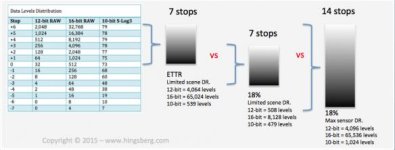
BTW Dennis Hingsberg did to a great deal of work to show just how sad Sony's 12 bit RAW was and his chart below shows why.

My experience with it has not really been satifactory. Banding being an issue. Copyright of the chart below belongs to Dennis.

Chris Young

Screen Shot 2015-11-12 at 10.50.43 PM_zpsw2k99tb0.jpg
 
Last edited:
I don't think Sony have any concern of Red patents. As I remember it, F5 and F55 RAW external recording solution with the AXS-R5 recorder predated the Red lawsuit. Red sued Sony for violating its patent but Sony counter sued Red for violating a bunch of its patents too; Red subsequently dropped its patent suit as did Sony.
 
There was a question of whether Red's case was really that tight or whether Apple just hired a bunch of idiots to handle the situation. Nonetheless, Apple has backed down while working with Red on other items. I wrote during the law suit that, if Apple really wanted to hurt Red, they would have given a third party like Samsung an order for the pro style camera and sold it for under $5,000. I mean, if Z Cam can do it, Apple should be able to do it at a minor profit or even a loss. Well, Canon is inching toward that target without any assists from Apple.

The second - problem with the extension is that it's so unwieldy. Hypothetically speaking, it could have been done as a side loading cartridge - an 8-track size, as it were, with connections or even a card slot - without effecting the handling of the camera itself. But it's probably not going to matter that much either way, especially if someone can do a high end compressed 444 or 12-bit LOG in HEVC.
 
Been using my FX9 for about a week and it's really an amazing piece of kit. I have to stop reading and listening to all the naysayers on the video comments and other pages. It's extremely versatile and lightweight when not fully rigged out for small projects. I hope those who have it here are also finding it just as good!
 
CineD publishes surprisingly weak numbers for the FX9 - 22.2ms RS and 11.5 stops DR at both ISO 800 and 4000

https://www.cined.com/lab-test-sony-fx9-rolling-shutter-dynamic-range-latitude/

Obviously it's still a great camera. But it seems that by some fundamental measures, it lags the C500mk2 and C300mk3


"the FX9 also has a huge dynamic range, I’ve measured well over 14 stops using a DSC Xyla test chart and am not going to argue with Sony’s 15+ stop claim. I counted 16 steps on the chart from the FX9, but how useable the bottom 2 are is open to some debate. "

http://www.xdcam-user.com/2019/09/my-take-on-the-pxw-fx9/

granted, Alister is a longtime Sony user and loyalist. So make of that what you will.

_____________

"In real-world shooting, most of us are satisfied with cameras that can record 12 stops of DR and up. Sony rates the FX9 at 15 stops, the same as the Canon C200 when shooting Cinema RAW Light in Clog 2. I believe that the Canon and this Sony are likely seeing about 13.5 usable stops, rather than the claimed 15 stops, but regardless of that, I did see a nice distribution of DR and latitude when I pushed the FX9 as hard as I possibly could shooting a couple of sunset scenes. Overall, I think you’ll find the DR of the FX9 to be very good, especially keeping in mind this an $11k camera, not a $50k or $80K digital cinema camera."


https://www.hdvideopro.com/gear/cameras/hands-on-review-sony-pxw-fx9-digital-cinema-camera/

"by some fundamental measures, it lags the C500mk2 and C300mk3"


The Sony FX9 costs less than either the C500mk2 or C300mk3. Only slightly less in the case of the C300mk3, but still less. And there are likely some fundamental measures where the Canons are weak compared to the FX9. ( dependability might well be one ).

confession: I've been using Sony professional video cameras for 38 years. Over 8000 days on Sony cameras. Likely only around 100 days on Canons.
 
FWIW, I'm a Canon guy pretty much and I REALLY dug the FX9, it IS a great camera that I enjoyed shooting with. Clients loved the footage we shot too.
 
confession: I've been using Sony professional video cameras for 38 years. Over 8000 days on Sony cameras. Likely only around 100 days on Canons.

I have an FS7 and a pre-order on an A7SIII. I try not to be a brand loyalist.

One of the guys who runs CineD bought an FX9 in January and used to have an FS7.

They were surprised by their own findings and tried to get clarification from Sony. Their DR number doesn't quite make sense to me.

But the RS is pretty indisputable and it's the reason it will never record 60p from the full 6K area.

But aside from these numbers, everything I've seen makes me like the camera
 
That test is off. It was mentioned in the FB groups that these guys are not doing the tests correctly and it’s always going to gimp the usable DR. Based on their findings, the FS7 has more DR than the FX9 and I don’t need a chart to tell you that’s totally false. I’ve shot both extensively and the FX9 has more DR than the 7 no doubt. Rolling shutter is a bummer, and although it has never reared it’s ugly head in my shoots, I can see vehicle shots suffering from this.
 
CineD publishes surprisingly weak numbers for the FX9 - 22.2ms RS and 11.5 stops DR at both ISO 800 and 4000

https://www.cined.com/lab-test-sony-fx9-rolling-shutter-dynamic-range-latitude/

Obviously it's still a great camera. But it seems that by some fundamental measures, it lags the C500mk2 and C300mk3

I haven't used a Xyla 21-step chart before (I shoot over/under tests when I want to test a camera's dynamic range), but I'm not sure they've exposed the chart exactly the way it's designed to be used. As I understand it, the idea is to clip out the 1st chip (to set a reference point on your waveform for white clipping) then bring the 2nd chip up to the exact same level (so that you know it's exactly at the clipping point). Then you count the steps between each line of exposure on the waveform.

CineD do clearly explain their methodology here: https://www.cined.com/the-cinema5d-camera-lab-is-back-dynamic-range-tests/ and that they are pulling that 2nd chip down just below the clipping point - so their method is at least consistent across every single camera they test. So if you want to give the FX9 another 1/3 of a stop in the shadows than their waveform is currently showing, then you can add that same value to ALL of CineD's tests (for the sake of comparison).

The waveform is absolutely the way to measure these things though (not those constantly-posted screengrabs of the Xyla chart itself - from which people get these "15/16/17 stop" DR figures), because the waveform leaves you with no uncertainty as to where the noise floor is, and where your shadow details disappear into it.
 
Last edited:
They used the same methodology to test the C500MK2 and all the cameras they test. They feed the waveform from the xyla test into Imatest and it spits out the number of stops above a 2:1 signal to noise ratio.

They also did an undeexposure latitude test and found that the camera lagged the Canons by a stop or 2 in that test as well.

But I agree that their findings dont make sense to me based on what I know of the camera and the footage I've seen, or the history of Sony sensor performance relative to Canon.
 
But I agree that their findings dont make sense to me based on what I know of the camera and the footage I've seen, or the history of Sony sensor performance relative to Canon.

Surely that's the beauty (and primary function) of objective testing? Taking subjective assessments out of the equation.
 
Back
Top