
Navigation
Install the app
How to install the app on iOS
Follow along with the video below to see how to install our site as a web app on your home screen.
Note: This feature may not be available in some browsers.
More options
You are using an out of date browser. It may not display this or other websites correctly.
You should upgrade or use an alternative browser.
You should upgrade or use an alternative browser.
NEW more detailed info on the DVX200 (4/24/2015)
- Thread starter atroa
- Start date
sodotoguwangus
Well-known member
I can't believe that no one has brought up the fact that this camera can reportedly shoot DSLR-like shallow depth of field--on a fixed lense camcorder design. I think this feature will be huge if it can in fact accomplish this. I can't think of a single fixed-lense camera that can accomplish this. Am I alone on noticing this claim about this camera?
I think this feature will be huge--shallow interchangeable lense like DOF and bokeh -- on a fixed lense design. If panasonics claim is true I wonder why no one else has mentioned this feature?
I think this feature will be huge--shallow interchangeable lense like DOF and bokeh -- on a fixed lense design. If panasonics claim is true I wonder why no one else has mentioned this feature?

I can't believe that no one has brought up the fact that this camera can reportedly shoot DSLR-like shallow depth of field--on a fixed lense camcorder design. I think this feature will be huge if it can in fact accomplish this. I can't think of a single fixed-lense camera that can accomplish this. Am I alone on noticing this claim about this camera?
I think this feature will be huge--shallow interchangeable lense like DOF and bokeh -- on a fixed lense design. If panasonics claim is true I wonder why no one else has mentioned this feature?
Well, yeah, it's been pointed out many times, in this thread:
http://www.dvxuser.com/V6/showthread.php?335737-AG-DVX200-4K-Large-Sensor-Handheld-Camcorder
So, no, you're not alone.
That's what makes this camera unique. There are plenty of large sensor 4K cams with interchangeable lenses and many small sensor 4K cams with fixed lenses, but this is the first 4K camera with a large sensor and a fixed lens (unless you count the AX100 and X70 as large sensor cams).
I'm sure Panasonic's claims are true. I, for one, find this camera very interesting.
alaskacameradude
Veteran
I can't believe that no one has brought up the fact that this camera can reportedly shoot DSLR-like shallow depth of field--on a fixed lense camcorder design. I think this feature will be huge if it can in fact accomplish this. I can't think of a single fixed-lense camera that can accomplish this. Am I alone on noticing this claim about this camera?
I think this feature will be huge--shallow interchangeable lense like DOF and bokeh -- on a fixed lense design. If panasonics claim is true I wonder why no one else has mentioned this feature?
Well I mean it's not 'that' unique. Take a FS700 (or a VG30,
FS7 or even AF 100) and put a ramped aperture but long
range lens (like the 18-200 kit lens on the FS700)on it and
you've basically got the same thing. Versatile
lens that can go wide to tight and still get shallow depth of
field. There is nothing new or revolutionary about the
Panasonic cam really. Nothing wrong with it either.
Just another option.
sodotoguwangus
Well-known member
Well I mean it's not 'that' unique. Take a FS700 (or a VG30,
FS7 or even AF 100) and put a ramped aperture but long
range lens (like the 18-200 kit lens on the FS700)on it and
you've basically got the same thing. Versatile
lens that can go wide to tight and still get shallow depth of
field. There is nothing new or revolutionary about the
Panasonic cam really. Nothing wrong with it either.
Just another option.
true, but I think this is a relative first for a fixed lense design. The cameras you mentioned above all were interchangeable lense systems unless I'm missing something
philiplipetz
Veteran
But to get a powered 13x zoom costs many times more than the DVX200
alaskacameradude
Veteran
true, but I think this is a relative first for a fixed lense design. The cameras you mentioned above all were interchangeable lense systems unless I'm missing something
You are right, but I'm not sure why that is such a big deal. If you want to,
you could just leave the 18-200 on one of the other cameras and never
remove it.....then it would basically be the same as a fixed lens camera?
Is there something special about fixed lens designs that makes their lenses
better? Maybe I'm missing something here.
I'm not trying to dump on this camera....I'm sure it will be similar in
performance to say a AF100 with the 14-140 lens (depth of field wise
anyways.) Maybe you'd say it's similar to the GH4 with the 14-140 lens
since it will shoot 4K. Or rather a GH4 with built in ND's and a powered
zoom version of the 14-140. So yeah, nice camera. And probably a good
price too. It's just I see nothing especially 'revolutionary' about it. You
could always get a wide range zoom on a big sensor. Either you pay
a lot and get a big heavy lens......or you pay less and get a 'variable
aperture/ramping iris' lens (just like the one on the DVX200.) The fact
that you 'could' interchange lenses if you wanted to doesn't seem to me
to be any kind of downfall.......if anything it made those cameras MORE
desirable and versatile. You COULD get the long range if you didn't mind
the ramping iris, yet could change to a fast prime for another 'look' when
you wanted. So it's not like some grand new design which gives us 'new
abilities with a camera' is being unveiled here. It's the same compromise
anyone that wants a wide ranging lens on a big sensor, has to deal with.
It's just, they 'bolted' the lens on front so that you can't remove it.
Last edited:

Spartacus
Veteran
You COULD get the long range if you
didn't mind the ramping iris, yet could change to a fast prime for another 'look' when you wanted. So it's not like some
grand new design which gives us 'new abilities with a camera' is being unveiled here. It's the same compromise anyone
that wants a wide ranging lens on a big sensor, has to deal with. It's just, they 'bolted' the lens on front so that
you can't remove it.
Everything is a compromise. Many 24-105s basically are "soldered" to the C300s they came bundled with (or the other way around).
Changing lenses opens up possibilities. Lenses not being parfocal or motorized limit possibilities.
This is a camera many of us would have bought in a heartbeat 3 years ago.
I think many given the chance now, will reconsider.
One thing I just can't understand is the constant crippling of internal codecs, while at the same time giving the option to record HQ via HDMI or SDI.
Kind of strange that the Atomos Star still seems the only option available for a small recorder, given the hundred of thousands of GoPros sold who would benefit from a tiny HDMI ProRes recorder...

joe 1008
Veteran
Just for the sake of argument, let's consider the 4k 100mbit codec an option for excellent results in 2k 4:2:2 10bit. I have a question for GH4 owners with experience in the use of the codec:
How much extra time and additional computer power is required to work the codec that way? Is that a realistic solution to get the best out of this camera internally? Given this new thread about the recording modes of the DVX200 - on the answer pends my future interest in this camera.
How much extra time and additional computer power is required to work the codec that way? Is that a realistic solution to get the best out of this camera internally? Given this new thread about the recording modes of the DVX200 - on the answer pends my future interest in this camera.

I think people are asking for everything in one camera. It isn't going to happen. Users who want shallow depth of field look likely will shoot for a film style output so may not want long continuous record times or 60P in 4K !! This may not be the camera for them as an interchangable lens camera would suite that style a lot better. However people like me who shoot theatre from the back of the hall do not want shallow depth of field at all. I want 4K in low light with 60P and long record times with easy focusing. The DVX200 fits this requirement assuming the low light performance lives up to what we think.

Thomas Smet
Veteran
You are right, but I'm not sure why that is such a big deal. If you want to, you could just leave the 18-200 on one
of the other cameras and never remove it.....then it would basically be the same as a fixed lens camera? Is there
something special about fixed lens designs that makes their lenses better? Maybe I'm missing something here.
I'm not trying to dump on this camera....I'm sure it will be similar in performance to say a AF100 with the
14-140 lens (depth of field wise anyways.) Maybe you'd say it's similar to the GH4 with the 14-140 lens since it will shoot 4K.
Or rather a GH4 with built in ND's and a powered zoom version of the 14-140. So yeah, nice camera. And probably a good price too.
It's just I see nothing especially 'revolutionary' about it. You could always get a wide range zoom on a big sensor. Either you pay
a lot and get a big heavy lens......or you pay less and get a 'variable aperture/ramping iris' lens (just like the one on
the DVX200.) The fact that you 'could' interchange lenses if you wanted to doesn't seem to me to be any kind of
downfall.......if anything it made those cameras MORE desirable and versatile. You COULD get the long range if you
didn't mind the ramping iris, yet could change to a fast prime for another 'look' when you wanted. So it's not like some
grand new design which gives us 'new abilities with a camera' is being unveiled here. It's the same compromise anyone
that wants a wide ranging lens on a big sensor, has to deal with. It's just, they 'bolted' the lens on front so that
you can't remove it.
Does that 18-200 lens start at f2.8? This is a faster lens and yes a fixed lens does offer a lot of benefit. One of the biggest issues many traditional video camera shooters have with the switch to DSLR cameras is not having a power zoom and a decent lens speed. Having a fixed lens means a perfectly integrated lens into the camera for maximum optical quality and features.
If you have never used a true fixed lens then of course you don't really appreciate the benefit they can have for certain types of shooting. Just because you have never done that type of work doesn't mean others would not find great value in it. Not every type of video is a indie film with zero budget and sometimes zooming while shooting is a must. The DVX200 is worth every penny because it is the first m43 type camera with a true traditional video type lens for that kind of shooting. Slapping a 18-200 on another camera may give you the range but thats about it and can still be a pain to use in situations where you do want to zoom smoothly while shooting.
Plus this camera is 4k. Which other cameras in this price range give you 4k recording with a larger sensor. You have to compare apples to apples and it isn't really a good comparison to compare a cheaper camera that can only shoot HD.
You really have to think of the DVX200 more like a video camera that finally has a grown up sensor and not as a wanna-be cinema camera trying to force the DSLR to grow up. Completely different perspectives on cameras. I view this more like a traditional yank the camera out of the bag and start shooting in five seconds video camera.
I can tell you without a doubt that if Panasonic made a 13x lens that was f2.8-f4.5 with a smooth power zoom it would cost $2,000.00 or pretty darn close to that. That puts the price of the camera closer to about $3,000.00 for a 4k camera with a m43 sensor. Thats a pretty darn good deal if you ask me and kind of unique in the industry right now. Almost every other 4k video camera currently out there has a 1/2.3" sensor.
This is not a film camera but a video camera. A video camera that shares many of the same quality advantages of a film camera but at the end of the day still a video camera.
Thomas Smet
Veteran
Just for the sake of argument, let's consider the 4k 100mbit codec an option for excellent results in 2k 4:2:2 10bit. I have a question for GH4 owners with experience in the use of the codec:
How much extra time and additional computer power is required to work the codec that way? Is that a realistic solution to get the best out of this camera internally? Given this new thread about the recording modes of the DVX200 - on the answer pends my future interest in this camera.
I have a friend who exclusively shoots 4k with the GH4 and edits in FCPX on a i7 2013 iMac with no issues at all. While the iMac is a great computer it is not the bleeding edge in terms of CPU and GPU performance so that should tell you how well a decent i7 computer should handle the 100mbps 4k.
To help you all visualize the sensor sizes we're talking about, here's a nifty little chart that compares the size differences of various sensors.

The 4/3 sensor is considerably larger than the 1/2.3" normally found on fixed lens 4K cameras, like the HC-X1000, Z100 and the new JVCs. The AX100 and X70 aren't too bad with their 1" sensors.
Here's a chart with more video sensor sizes, like the 1/3"
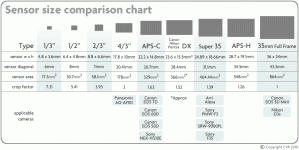
The 4/3 sensor is considerably larger than the 1/2.3" normally found on fixed lens 4K cameras, like the HC-X1000, Z100 and the new JVCs. The AX100 and X70 aren't too bad with their 1" sensors.
Here's a chart with more video sensor sizes, like the 1/3"
Last edited:

NorBro
Major Contributor
I sound like your friend because I only shoot 4K from BM cameras (with higher data rates depending on the codec used) and edit the UHD files on a MacBook Air in FCPX after I transcode the files to Proxy...super efficient with fast drives and 16GB of RAM. Yes, it can be slow depending on what you're doing to the footage, but absolutely doable.
Bassman2003
Veteran
No doubt it will be interesting to see the output from this camera. I am looking forward to seeing if the DVX200 will be a fit for me.
Gosh the 1/3" sensor is tiny compared to a full frame sensor!
Gosh the 1/3" sensor is tiny compared to a full frame sensor!