Need help with lighting setup - Illustration inside

Hey there!

So, soon I will shoot a small "modern" interview style series with the following setup:
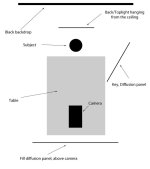
3point.jpg

I'm shooting with a HDSLR (GH2) and would like to use the following settings:
24p, 1/50, ISO 160, f2.8 (fastest)
Diffusion panels (heavy frost) are 5ft away from the subject (key) and 10ft (fill). The panels are hit with 1k halogen lamps.

With this setup, the image is quite underexposed by a few stops.

So to minimize loss in quality, is it preferable to raise the ISO, lower the shutter speed or....?
I don't have access to other equipment, so I would have to use what is described above.

Because of the framing I want to achieve, I cannot really move the panels closer to the subject, nor can I go wider with the lens as it's on its widest focal length.

Any suggestions welcome :)
 
If you have only a black backdrop, what about the framing wouldn't allow you to move the camera/adjust the zoom to accommodate moving the lights closer?
 
If you have only a black backdrop, what about the framing wouldn't allow you to move the camera/adjust the zoom to accommodate moving the lights closer?

I'm not sure I understand so forgive me for sounding thick. The lens I have is a prime lens, so no lens zooming. As for moving the camera around, I cannot move it further back or else the diffusion panels come into view.
Want to achieve some kind of medium long shot framing, so the subject is in frame from head to waist, more or less.
 
if it isn't bright enough I would bump ISO. But, that is quite a bit of light to not have enough. Not that I don't believe you, I am just confused.
 
if it isn't bright enough I would bump ISO. But, that is quite a bit of light to not have enough. Not that I don't believe you, I am just confused.

Well I'm guessing it's the diffusion material being too dense. But I've got no other material to compare it to. It is a very soft light, so there's a lot of diffusion.
Are there any sites where I could compare materials or say translucence?
 
Hey there!

So, soon I will shoot a small "modern" interview style series with the following setup:

View attachment 45025

I'm shooting with a HDSLR (GH2) and would like to use the following settings:
24p, 1/50, ISO 160, f2.8 (fastest)
Diffusion panels (heavy frost) are 5ft away from the subject (key) and 10ft (fill). The panels are hit with 1k halogen lamps.

With this setup, the image is quite underexposed by a few stops.

So to minimize loss in quality, is it preferable to raise the ISO, lower the shutter speed or....?
I don't have access to other equipment, so I would have to use what is described above.

Because of the framing I want to achieve, I cannot really move the panels closer to the subject, nor can I go wider with the lens as it's on its widest focal length.

Any suggestions welcome :)

Stating the 'wattage' of a lamp does not actually state the important information. The important information is the amount of light actually falling on the
subject at the distance from the lamp. Hence knowing the output of the lamp at various distances, in terms of Footcandles or Lux is the important
parameter for exposure.

I looked up a 1000 W lamp form Lowel, a popular lighting solution, and lamp designated the DP lamp, has for the 1000 W option, 77 FC at 10 feet in 'flood mode'.

However you say you pass the two 1000 W lamps through defusion, so, I don't know exactly where the lamps are relative to the subject. You indicate where
the diffusion panels are... but not the lights...

For the purpose of discussion I'll estimate the 'key' is say 8 feet from the subject, and the 'fill' is about 13 feet from the subject, without the diffusion panels.

Then from the Lowel light data, you should have about 60 FC for fill, and 130 for the key. If the diffusion is about a stop's worth, then you'd have 30 for fill
and 65 for key...

In any case, my handy 'table' of exposure vs ISO vs F/stop... gives... again estimated, for a 2.8 with ISO of 160... about 75 FC is required for a MIDDLE GRAY
value... for caucasian skin, you need to 'open up' one stop, or in this case get about 140 FC to the subject... or change the ISO to 400 (near enough to double
160...) to get the proper exposure for such a complexion.

Alternatively, given that you have the setup, a light meter would have indicated underexposure, and since light and f/stop are fixed, the only other variable left
is ISO...

These estimates are highly variable depending on the type of light, housing, where the diffusion is relative to the subject etc... For example the Lowel DP light can
be 'focused' and so more of the 'cone' of light can be directed to the subject, and thus upping the FootCandles falling on the subject...
 
Well I'm guessing it's the diffusion material being too dense. But I've got no other material to compare it to. It is a very soft light, so there's a lot of diffusion.
Are there any sites where I could compare materials or say translucence?

Go to a fabric store, and look for 'shear' material, perhaps even test some of it... construct a frame from Home Depot PVC tubing. Any one asks, just say your following ideas found on the Roger Deakins site...

If they don't recognize Deakins start listing a few movies, such as "No Country For Old Men"(2007), "Oh, Brother Where Art Thou"(2000), etc. if these draw a blank... then just finish off with
'a famous cinematographer'...
 
Stating the 'wattage' of a lamp does not actually state the important information. The important information is the amount of light actually falling on the
subject at the distance from the lamp. Hence knowing the output of the lamp at various distances, in terms of Footcandles or Lux is the important
parameter for exposure.

I looked up a 1000 W lamp form Lowel, a popular lighting solution, and lamp designated the DP lamp, has for the 1000 W option, 77 FC at 10 feet in 'flood mode'.

However you say you pass the two 1000 W lamps through defusion, so, I don't know exactly where the lamps are relative to the subject. You indicate where
the diffusion panels are... but not the lights...

For the purpose of discussion I'll estimate the 'key' is say 8 feet from the subject, and the 'fill' is about 13 feet from the subject, without the diffusion panels.

Yes, I totally forgot about the lights. But your estimation of the distances is fairly accurate.


Then from the Lowel light data, you should have about 60 FC for fill, and 130 for the key. If the diffusion is about a stop's worth, then you'd have 30 for fill
and 65 for key...

In any case, my handy 'table' of exposure vs ISO vs F/stop... gives... again estimated, for a 2.8 with ISO of 160... about 75 FC is required for a MIDDLE GRAY
value... for caucasian skin, you need to 'open up' one stop, or in this case get about 140 FC to the subject... or change the ISO to 400 (near enough to double
160...) to get the proper exposure for such a complexion.

Alternatively, given that you have the setup, a light meter would have indicated underexposure, and since light and f/stop are fixed, the only other variable left
is ISO...

These estimates are highly variable depending on the type of light, housing, where the diffusion is relative to the subject etc... For example the Lowel DP light can
be 'focused' and so more of the 'cone' of light can be directed to the subject, and thus upping the FootCandles falling on the subject...


Thanks for detailed explanation. I figured the solution would be more complex than just using different material, or say how to improve the scenario I have to work in.
But this is giving me quite some pointers, I shall get me a light meter first :D
 
Go to a fabric store, and look for 'shear' material, perhaps even test some of it... construct a frame from Home Depot PVC tubing. Any one asks, just say your following ideas found on the Roger Deakins site...

I'm not sure what's meant by 'shear' material? I'm from Germany btw. Are we talking a nylon fabric? Btw I hear the 'heavy frost' diffusion material I have is pretty close (if not the same) to some semi-translucent white shower curtain. They're 5x5ft and I just got some blocks of wood from the depot to create an appropriate framing.

If they don't recognize Deakins start listing a few movies, such as "No Country For Old Men"(2007), "Oh, Brother Where Art Thou"(2000), etc. if these draw a blank... then just finish off with
'a famous cinematographer'...

Will do, haha! :D
 
I'm not sure what's meant by 'shear' material? I'm from Germany btw. Are we talking a nylon fabric? Btw I hear the 'heavy frost' diffusion material I have is pretty close (if not the same) to some semi-translucent white shower curtain. They're 5x5ft and I just got some blocks of wood from the depot to create an appropriate framing.


Will do, haha! :D

Shear == Translucent wie weisses/gebleichtes (Kunst)Seidenstoff, oder so was.
 
Just want to throw out there that in addition to what everyone else said, if you're determined to shoot at 2.8 on a 50mm lens your depth of field is going to get pretty shallow... not sure exactly what you're looking to shoot or your distance, might be okay for short interviews but we're probably talking about a foot where everything's in focus, so they can't be moving too much... thus i agree with what everyone else is saying, bump up the ISO and stop down a little.

other options of course are to move the lights closer, move the diffusion closer to the lights, or get lighter diffusion
 
Shear == Translucent wie weisses/gebleichtes (Kunst)Seidenstoff, oder so was.

Ummm... five posts and we're still spelling "sheer" wrong. A "shear" is what you would use to cut "sheer" fabric.

Regardless of spelling... your diffusion may be too thick. But don't mess around with the fabric store where white fabric can be all kinds of tints; get some 1/4 or 1/2 stop diffusion material.

I shoot DSLR footage around 400 ISO and it always looks fine.
 
Perhaps you could take a photo of your setup and an post example of your shot.

I have to agree with the other posters, 2k of light at that distance should be plenty, even going through some diffusion.
What kinds of lights are you using? Sounds like you're generating more heat than light.
 
Back
Top