NAB and affordable external recorders with 444 for FS100

Grading doesn't benefit AT ALL from 4:4:4. It only helps in greenscreening. Oh and theatres are 4:2:2.
.

Ummm i have to disagree on both points...

1) DCP spec is 12 bit per pixel, and DCP is what gets screened in theatres, and the standard i work to... hence the Dolby mon, the only screen that shows 12 bit per pixel

2) There is advantages to working with YUV sourced material in RGB, mainly due to creating colors in gradeing that are not discribed by YUV, and monitoring while working in P3 (gammut is far wider than 709) shows colors that just do not exist in YUV.

I do agree that keying / qualifying masks / secondaries is far easier in RGB as well... but the real advantage of working with YUV footage in DCi-P3 is WYSIWYG, something YUV/709 can and will never, ever be

Some light reading;
DCP specs;
http://en.wikipedia.org/wiki/Digital_Cinema_Package

XYZ color space;
http://en.wikipedia.org/wiki/CIE_1931_color_space
 
Just to clarify, it's 4:4:4 from a 4:2:2 image. So think of it as 4:2:2 in a 4:4:4 wrapper.

No gains there really, if you are editing with Premiere Pro it will put it in a 4:4:4 color space
and apply corrections there. Obviously it's not an up-sampled image in Premiere Pro it's just
making adjustments in such a color space on the fly.

Correction, it is ture 444 out the HDMI port not a wrapper of 422. as stated by Isacc at AbleCine, and several Sony reps, including the one I talked with at NAB last year as well as what was stated by a Sony rep during the report by CineGear - FS100 does 444, but is it all that? link below read for your self.

http://setlafilms.com/2011/06/04/report-from-cinegear-fs100-does-444/

A paragraph taken from the report.
I just received a call back from the Sony Rep from CineGear and he confirmed that the Sony FS100 now does true 4:4:4 Color Space out of RGB output. Now why is this important? well let’s look at how the camera works. The FS1oo records the image in digital format. it then sends that signal through the an analog channel (RGB) only to be converted to digital again through HD-SDI to be recorded to Apple ProRes 4:4:4. Think that there might be some loss of quality here? I think so… so the obvious choice here is to record AppleProRes 422 from the HDMI port at HQ quality if you have the space. I think that this was an oversight on the part of Sony personally, but when I get the cameras I will do a test with them and get back to you.

So lets quit debating over this, and stick to the topic. It would be nice if someone came out with an affordable 444 8bit recorder at NAB this year that was in the price range of the ninja!

Please, if anyone else is going to post about this at least do some research before you do or better yet read the links I have put up. Thanks in advance.
 
I have to disagree here. FS100 doesn't even have enough megapixels to create 4:4:4 1080p signal from a beyer cmos.

The truth is out. If the FS100 spit out 4:4:4 at 16 bits per pixel - it would not really change anything. The nature of the bayer mask is that red and blue get sampled at half the resolution of the green. The de-bayer algorithm (hidden from public view in this case) mathematically interpolates for the missing information as best it can.

Just so everyone knows, there are two critical terms that seem to be crashing here. Bit depth and color sampling - they are not interchangeable and they describe different things.

Bit depth is what determines how many shades of gray can be described numerically - from black to white. The more bits you have the smoother the transitions from one shade to the next. In the case of the FS100 being 8 bits you get 256 shades of gray. In 10 bits you get 1024, 12 bits 4096 etc. I am not an expert, but I believe the DCI norms are 4:2:2 for projection at 12 bits.

Color sampling (super abbreviated) is a ratio of how many pixels of red, blue, and green are sampled relative to the maximum possible. If "4" in 4:2:2 means 1920 horizontal pixels then the "2" means 960 pixels are sampled. In almost ALL cases, no one can tell the difference between 4:4:4 or 4:2:2 regardless of display used. Not for technical reasons, but physiological reasons - your eyes and brain gets is detail from the green and fills in the blanks left by partially sampled red and blue. i have totally been down the block on this one starting in 2003 with prototype F950's on a certain 6 part sci-fi movie.

With all that said, I really don't care why anyone would want 4:4:4 or more bits or whatever. I have worked on tons of jobs that needed more/better technology and tons more that were overwhelmed with too much technology. To speak to the original question for this thread, there is no reason there could not be a 4:4:4 8bit HDMI recorder at NAB. The problem is that there is no camera capable capturing an RGB image in 8bits with an HDMI output - so there would not appear to be any business justification for it.

I hope this does not push anyone from the discussion. I hate to see people frustrated to the point where they no longer contribute.

very informative thank you rx8pilot
 
The truth is out. If the FS100 spit out 4:4:4 at 16 bits per pixel - it would not really change anything. The nature of the bayer mask is that red and blue get sampled at half the resolution of the green. The de-bayer algorithm (hidden from public view in this case) mathematically interpolates for the missing information as best it can.

Just so everyone knows, there are two critical terms that seem to be crashing here. Bit depth and color sampling - they are not interchangeable and they describe different things.

Bit depth is what determines how many shades of gray can be described numerically - from black to white. The more bits you have the smoother the transitions from one shade to the next. In the case of the FS100 being 8 bits you get 256 shades of gray. In 10 bits you get 1024, 12 bits 4096 etc. I am not an expert, but I believe the DCI norms are 4:2:2 for projection at 12 bits.

Color sampling (super abbreviated) is a ratio of how many pixels of red, blue, and green are sampled relative to the maximum possible. If "4" in 4:2:2 means 1920 horizontal pixels then the "2" means 960 pixels are sampled. In almost ALL cases, no one can tell the difference between 4:4:4 or 4:2:2 regardless of display used. Not for technical reasons, but physiological reasons - your eyes and brain gets is detail from the green and fills in the blanks left by partially sampled red and blue. i have totally been down the block on this one starting in 2003 with prototype F950's on a certain 6 part sci-fi movie.

With all that said, I really don't care why anyone would want 4:4:4 or more bits or whatever. I have worked on tons of jobs that needed more/better technology and tons more that were overwhelmed with too much technology. To speak to the original question for this thread, there is no reason there could not be a 4:4:4 8bit HDMI recorder at NAB. The problem is that there is no camera capable capturing an RGB image in 8bits with an HDMI output - so there would not appear to be any business justification for it.

I hope this does not push anyone from the discussion. I hate to see people frustrated to the point where they no longer contribute.

Thanks for the post rx8pilot, if this is true it could be a big deal on this issue. Do you have a link to any information from a credible source that would confirm what you are saying?
Don't worry about pushing anyone from the discussion, this is something I would like to know more
about as I have never heard anything like this before.
Thanks in advance.
 
yea i remember those early camera's.. i had two and you guys had three, but i think it was 2001 for the prototype 900's? i had an early production sn # in Shanghai by June 2001... and the hand made camera's went back home around then

So here's the DCP thing... If i go to the XYZ & P3 displays that i use (Dolby 4200 / Christie 4K) and select YUV, they will lock out XYZ & P3, you have to be in RGB/444 for the option to use P3 & XYZ even spark up, so how is 422/YUV going to get to a screen or projector?

But really it's about the question.. why work in RGB? well because you have to to get to P3 or XYZ, even if your source is 422/YUV.. and why do you want to work in P3 or XYZ? Because that's what is projected..and it has a much wider gammut than 709 can hold, you will never know what you are loseing by limiting yourself 422 when working. The next question was can one see the diffrence? Even my half blind grannie can see the diffrence as soon as she would enter the suite... it's big, not subtle as long as the colors are outside the range of 709... and you never knew those colors were there...

Simple really it's all about WYSIWYG....
 
Really, if someone wants 4:4:4 out of their camera, I don't think it is necessary to berate the person over their interest. And honestly, until someone actually takes the 4:4:4 out of the FS100 and compares it to the 4:2:2 out of the FS100, we really don't know what the difference is. I'm not saying it is good or bad, but, you never know what magic is happening in the camera, so it would be interesting to see what if any difference is coming out. It's not like the generation of a 4:4:4 or 4:2:2 image is a specific exact process. Sometimes there are advantages to a signal path that really have nothing to do with 4:4:4 and instead some other difference in how that signal comes out. I say this because bayer resolution alone is the reason I am happy with 4:2:2 if I need it HOWEVER I've seen enough cameras with 4:2:2 and 4:2:0 to know that they are not equivalent in their implementations.
 
The comment about the debayering of the sensor is a valid and good point but do we know anything about the sensor itself? What is it's native resolution? Is it straight 1080p or is there downsampling happening. I have a vague memory of the way the pixels were aligned being different. So this may lead to there being more resolution there after all.

The HDMI out is full RGB we know that. If someone has access to one of the black magic ultra cards then that does 4:4:4 so it would be interesting to see if there was a real world difference first and then start lobbying for 4:4:4 portable recorders.

Frankly if there was going to be a improvement i'd rather 10bit out...

cheers
Paul

The product manager said they are oversampling big time - so, as an educated guess I would say, they made the actual pixel count just enough to compensate for the debayering, that would be something in the neighborhood of 2.5k. Would be also an explanation, why it held up so good in Bloom´s tests against the C300, that - at least on paper and how the C300 sensor works - should blow the FS100 (resolution wise) out of the water, but it did not.

Had anyone ever tried the RGB (components) out? Would be interesting to see the differences (if any) to the HDMI signal.

Frank
 
because fs100 and f3 are 14mp sensors with pixel binning to downscale image to 2.5K same as af100 or gh2 ...
look at the bbc tech evaluation ... they probably use 16:9 part of sensor from sony 5n or nikon d7000 but there is
difference ... 5n and d7000 use line skipping ...
c300 probaly use APS-C crop of canon 5dmark iii ...
when u upscale c300 to full frame u got 22 MP...
all companies do that ...
desing one sensor technology and the upscale or downscale size and deactivate some options for cheaper cameras ...
c300 has huge profit margin
 
Last edited:
because fs100 and f3 are 14mp sensors with pixel binning to downscale image to 2.5K same as af100 or gh2 ...
look at the bbc tech evaluation ... they probably use 16:9 part of sensor from sony 5n or nikon d7000 but there is
difference ... 5n and d7000 use line skipping ...
c300 probaly use APS-C crop of canon 5dmark iii ...
when u upscale c300 to full frame u got 22 MP...
all companies do that ...
desing one sensor technology and the upscale or downscale size and deactivate some options for cheaper cameras ...
c300 has huge profit margin

I don't think this is the case at all. The C300, F3 and FS100 do not have stills sensors that are being down sampled. The VG10, VG20 for example do and the difference is quite apparent. I also recall a pixel side of 12um for the F3 from some old sony marketing stuff. There was another talk on the F3 that mentioned a 3.4 mpix sensor, they didn't give pixel dimensions and said it had an interesting arrangement of pixels.

cheers
paul
 
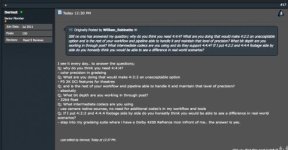
The (attached) seems reasonable is there an independent source of confirmation of the assessment that the advantage of 444 is critical in HD broadcast work. I have a line in to my POC's at Discovery to see what their requirements are as they often demand RAW footage for in-house post. I could care less about film stock in theaters but obviously that sentiment will not be shared by everyone.
why444.jpg
 
The (attached) seems reasonable is there an independent source of confirmation of the assessment that the advantage of 444 is critical in HD broadcast work. I have a line in to my POC's at Discovery to see what their requirements are as they often demand RAW footage for in-house post. I could care less about film stock in theaters but obviously that sentiment will not be shared by everyone.
View attachment 50564

I've never delivered 444 for broadcast. Never been asked to. It's never even been brought up. 4:2:2 is pretty much the accepted standard for every network. And, while it may be a small thing, let's get our terminology right - Discovery will ask for original footage, not RAW. No offence, just trying to dispel and FUD before it starts.
 
I have never been asked for anything but 422 for HD broadcast as well, often on a HDSR tape these days

Whereas deliverables for film are always 444 - DPX 10bit for film plotters & 16bitt TIFF for DCP

The deliverables list for films call for the OCN / COr in native format to be stored by the producer for 7 years, and any intermediate work like VFX be stored in matching format to the deliverable or better (example is EXR flies from VFX).

I have not seen a contract yet that asked for the COr to be deliverd to the broadcast partner, and often that would be impossiable as several deliverable partners all require access to the CON for 7 years, makeing it impossiable to send the CON to one of them without breaking the contract with the rest.

d
 
Last edited:
Back
Top