
Navigation
Install the app
How to install the app on iOS
Follow along with the video below to see how to install our site as a web app on your home screen.
Note: This feature may not be available in some browsers.
More options
You are using an out of date browser. It may not display this or other websites correctly.
You should upgrade or use an alternative browser.
You should upgrade or use an alternative browser.
NAB and affordable external recorders with 444 for FS100
- Thread starter Gary W
- Start date

Tim Nitsch
Well-known member
Can you record in 8 bit 444? I was under the impression that it had to be 10 bit to be 444? I could (and probably am) wrong.

wannabeapilot
Well-known member
on page 15 it says that the hdmi out is only 4:2:2
http://sonypro-latin.com/corporate/...duleInternal2/0/file/sony_fs100_handbook2.pdf
http://sonypro-latin.com/corporate/...duleInternal2/0/file/sony_fs100_handbook2.pdf
wannabeapilot
Well-known member
do you have a link to verify this?FS100 is 8 bit 444 out, currently no recorders that do this except Gemini 10 bit 444
which would be over kill for this camera.

William_Robinette
Shallow Member
Why do you think you need 4:4:4?
Why do you think you don't? I do allot of color grading and the more I can get out of the camera the better!
http://setlafilms.com/2011/06/04/report-from-cinegear-fs100-does-
444/http://crookedpathfilms.com/blog/2011/07/05/idiots-guide-to-the-sony-fs100/
http://setlafilms.com/2011/06/04/report-from-cinegear-fs100-does-
444/http://crookedpathfilms.com/blog/2011/07/05/idiots-guide-to-the-sony-fs100/
Last edited:
Can you record in 8 bit 444? I was under the impression that it had to be 10 bit to be 444? I could (and probably am) wrong.
Bit depth and color sampling are two independent things. There is no reason that 8bit 4:4:4 cannot exist. In general, those interested in RGB sampling also have 10 bit or better bit depth as well. Will it make a real difference? Maybe, depending on the shape of the clouds in the sky on that day (many variables). To get more data in the blue and red will not get rid of the banding you see in 8 bits.
paulcurtis
Veteran
I'd read in various places that the HDMI was 4:4:4 (full RGB signal). The only devices i'm aware of that record 4:4:4 are some of the higher end blackmagic products (the ultra studio) which aren't portable. I'd imagine, based on pixel peeping footage, that you would see an increase in resolution in the files. I see something about a Sony announcement of interest to FS users, i do wonder whether sony are getting into the external recorder game.
cheers
Paul
cheers
Paul
Why do you think you need 4:4:4?
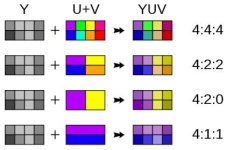
here's a simplified idea of the diffrences, found on a google search, not my artwork;

cheezweezl
Veteran
http://pro.sony.com/bbsc/ssr/cat-broadcastcameras/cat-nxcam/product-NEXFS100UK/
Says 4:2:2 right on the front page in the features. Last one bottom right.
Says 4:2:2 right on the front page in the features. Last one bottom right.
William_Robinette
Shallow Member
Haha, OK....
I'm all for squeezing all the quality you can get out of a system, but I think just like any other industry the camera people love to give customers bigger numbers. At this level (aka, shooting with a FS100) there are about a million other things that should come into play before one starts worrying about 4:4:4. 4:2:2? Sure.
I'm well aware of technically the advantage 4:4:4 gives you. Still no one has answered my question; why do you think you need 4:4:4? What are you doing that would make 4:2:2 an unacceptable option and is the rest of your workflow and pipeline able to handle it and maintain that level of precision? What bit depth are you working in through post? What intermediate codecs are you using and do they support 4:4:4? If I put 4:2:2 and 4:4:4 footage side by side do you honestly think you would be able to see a difference in real world scenarios?
I'm not trying to sh*t on the party here, but so many on this forum nowadays get fixed on numbers and can't see the forest for the trees. Before dropping a load of cash on an external recorder that does 4:4:4 and records to a codec that handles 4:4:4 ask yourself; is that the final piece of the image puzzle holding me back? I'm going to bet... no.
I'm all for squeezing all the quality you can get out of a system, but I think just like any other industry the camera people love to give customers bigger numbers. At this level (aka, shooting with a FS100) there are about a million other things that should come into play before one starts worrying about 4:4:4. 4:2:2? Sure.
here's a simplified idea of the diffrences, found on a google search, not my artwork;
View attachment 50452
I'm well aware of technically the advantage 4:4:4 gives you. Still no one has answered my question; why do you think you need 4:4:4? What are you doing that would make 4:2:2 an unacceptable option and is the rest of your workflow and pipeline able to handle it and maintain that level of precision? What bit depth are you working in through post? What intermediate codecs are you using and do they support 4:4:4? If I put 4:2:2 and 4:4:4 footage side by side do you honestly think you would be able to see a difference in real world scenarios?
I'm not trying to sh*t on the party here, but so many on this forum nowadays get fixed on numbers and can't see the forest for the trees. Before dropping a load of cash on an external recorder that does 4:4:4 and records to a codec that handles 4:4:4 ask yourself; is that the final piece of the image puzzle holding me back? I'm going to bet... no.
I'm not trying to sh*t on the party here, but.
that ship has saled hahah let me just say If Im asking about 4:4:4 I know what I will need 4:4:4 .....for


Matt Gottshalk
Resident Preditor
that ship has saled hahah let me just say If Im asking about 4:4:4 I know what I will need 4:4:4 .....for
Using what camera?
http://pro.sony.com/bbsc/ssr/cat-broadcastcameras/cat-nxcam/product-NEXFS100UK/
Says 4:2:2 right on the front page in the features. Last one bottom right.
I put up two links, if you would have taken the time to read them you would have
answered your own question. Below was taken from one of the links I put up.
@Bart: Thanks for the kind words. The FS100 can output 4:2:2 OR 4:4:4 after auto detecting which signal the capture device is using. (see page ten)
I see it every day.. to answer the questions;Still no one has answered my question; why do you think you need 4:4:4? What are you doing that would make 4:2:2 an unacceptable option and is the rest of your workflow and pipeline able to handle it and maintain that level of precision? What bit depth are you working in through post? What intermediate codecs are you using and do they support 4:4:4? If I put 4:2:2 and 4:4:4 footage side by side do you honestly think you would be able to see a difference in real world scenarios?
Q; why do you think you need 4:4:4?
- color precision in gradeing
Q; What are you doing that would make 4:2:2 an unacceptable option
- P3 2K DCi features for theatres
Q; and is the rest of your workflow and pipeline able to handle it and maintain that level of precision?
- absolutly
Q; What bit depth are you working in through post?
- 32bit float
Q; What intermediate codecs are you using
- use camera native sources, no need for additional codec's in my workflow and tools
Q; If I put 4:2:2 and 4:4:4 footage side by side do you honestly think you would be able to see a difference in real world scenarios?
- step into my gradeing suite where i have a Dolby 4200 Refrence mon infront of me.. the answer is yes.
Last edited:
Haha, OK....
I'm all for squeezing all the quality you can get out of a system, but I think just like any other industry the camera people love to give customers bigger numbers. At this level (aka, shooting with a FS100) there are about a million other things that should come into play before one starts worrying about 4:4:4. 4:2:2? Sure.
I'm well aware of technically the advantage 4:4:4 gives you. Still no one has answered my question; why do you think you need 4:4:4? What are you doing that would make 4:2:2 an unacceptable option and is the rest of your workflow and pipeline able to handle it and maintain that level of precision? What bit depth are you working in through post? What intermediate codecs are you using and do they support 4:4:4? If I put 4:2:2 and 4:4:4 footage side by side do you honestly think you would be able to see a difference in real world scenarios?
I'm not trying to sh*t on the party here, but so many on this forum nowadays get fixed on numbers and can't see the forest for the trees. Before dropping a load of cash on an external recorder that does 4:4:4 and records to a codec that handles 4:4:4 ask yourself; is that the final piece of the image puzzle holding me back? I'm going to bet... no.
Its amazing to me how such a simple question can be turned into such a pain in the but by some people,
and yes I did already answered your question the first time. Your quote (If I put 4:2:2 and 4:4:4 footage side by side do you honestly think you would be able to see a difference in real world scenarios?) I know this already, I am interest in it for grading, and for your information I mainly grade in Davinci a 32 bit float system. I mainly work on features, shorts, commercials and sometimes a few comedy shows ect... I am a Cinematographer, Editor, Color Grader, Sound Tech, Lighting Tech, Writer, Director, ect... I have allot of my own equipment, and I am a digital film major at the Art Institute of California. And you are trying to sh*t on the party here.
Your quote (There are about a million other things that should come into play before one starts worrying about 4:4:4. 4:2:2?) Correction there are about a million other things you should find out first before you voice an opinion like this.
It was a simple question, if you can't interject something positive then don't post. This was not the kind of
response I was looking for, and I don't have time for this.
I am working with an 8 bit camera that already grades pretty good, if I can get it to grade even better it would be a big plus for my kind of work!
Last edited:
stancemedia
Carbonite Member
@Bart: Thanks for the kind words. The FS100 can output 4:2:2 OR 4:4:4 after auto detecting which signal the capture device is using. (see page ten)
Just to clarify, it's 4:4:4 from a 4:2:2 image. So think of it as 4:2:2 in a 4:4:4 wrapper.
No gains there really, if you are editing with Premiere Pro it will put it in a 4:4:4 color space
and apply corrections there. Obviously it's not an up-sampled image in Premiere Pro it's just
making adjustments in such a color space on the fly.
I see it every day.. to answer the questions;
Q; why do you think you need 4:4:4?
- color precision in gradeing
Q; What are you doing that would make 4:2:2 an unacceptable option
- P3 2K DCi features for theatres
Grading doesn't benefit AT ALL from 4:4:4. It only helps in greenscreening. Oh and theatres are 4:2:2.
There might be a very slight benefit in doing chroma masks...but that's about it.
- step into my gradeing suite where i have a Dolby 4200 Refrence mon infront of me.. the answer is yes.
I have to disagree here. FS100 doesn't even have enough megapixels to create 4:4:4 1080p signal from a beyer cmos.