MKH50 indoors - placement on mic stand

seanadl

Active member
Hi there,

I'm on a steep learning curve when it comes to audio, so please bare with me. I'm a one man band, trying to set up a mini studio at my home. I'm converting a portion of a living room into a studio space to record a show.

I'm using the MKH50 on a mic stand to record the audio from the talent (one person doing pieces to camera). What is the best way to reduce echo/ambient noise in the room? I'm looking at sound blankets - but wondering how many I should be getting, where I should be placing them, and what equipment I would need to get in order to hang them up?

The talent has a wall around 1.5 meters either side of them, a hardwood floor beneath. In front of them (around 2.5 meters) the camera and behind the camera (another 2 meters or so) a set of windows/wall.

Sorry if this is a complete newbie question. Like I said, i'm on a steep learning curve here.
 
If look is important, you might look a bit silly with blankets? However - get an ordinary boom stand, make it tall, and have half the boom one way and the other going the other - like a giant T. Drape the blanket over it. With 6 boom stands you cansurround the talent. For extra absorbance - use a duvet. The trouble is signal to noise. In this case, wanted vs unwanted sound. Distant mics makes for problems, hence why clipping on a lav works better in a live room - it's closer in!
 
If i was to use blankets, I'd place them out of shot. The camera is in quite close to the talent, so I can get the mic quite close. I could go with a lav, but isnt the sound on a MKH50 nicer if I can reduce the unwanted room sound?
 
You can buy furnis on Amazon in four packs. Depending on how wide the frame is and as space allows, I usually put them on the floor, to the left and right of the speaker and one behind the camera. I use c-stands with grips, arms and clamps. C-stands work best for this because they're beefy and can handle the weight being dangled on an arm. But bring sandbags. For stationary mic placement, and I use an mkh50 as well, I use a c-stand with a cradle to hold my boom pole with the mic pointed down towards the speaker. If the ceiling is low, I'll use an MKH40 cardioid mic instead which doesn't pick up as much from the rear. I wouldn't use a mic stand because it don't give you enough flexibility for mic placement. Once you start setting everything up including lights, you'll need this flexibility.
 
You can buy furnis on Amazon in four packs. Depending on how wide the frame is and as space allows, I usually put them on the floor, to the left and right of the speaker and one behind the camera. I use c-stands with grips, arms and clamps. C-stands work best for this because they're beefy and can handle the weight being dangled on an arm. But bring sandbags. For stationary mic placement, and I use an mkh50 as well, I use a c-stand with a cradle to hold my boom pole with the mic pointed down towards the speaker. If the ceiling is low, I'll use an MKH40 cardioid mic instead which doesn't pick up as much from the rear. I wouldn't use a mic stand because it don't give you enough flexibility for mic placement. Once you start setting everything up including lights, you'll need this flexibility.
Ah ok, good call on the c-stand recommendation. I currently have the Tascam Boom Microphone Stand, and the stand itself has to get fairly close to the frame in order to get the boom arm near the speaker.

what is furnis? I'll check out all those recommendations. Appreciate it!
 
A properly placed overhead Sennheiser MKH50 on a boom should sound miles better than pretty much any lav mic, and there's no issues with clothes rustling against the mic.

As for placing sound blankets, I would set up the video shot the way you like it and then put blankets everywhere else that's not in the shot (including the floor).
 
I'm using the MKH50 on a mic stand to record the audio from the talent (one person doing pieces to camera). What is the best way to reduce echo/ambient noise in the room? I'm looking at sound blankets...

Proper mic placement is the first step toward reducing reverb and ambient noise. Boom the mic just out of frame, out in front of the talent, pointed at talent's mouth at about a 45 degree down angle. That should put the mic in the range of 45-60 cm from talent's mouth.

As to sound blankets, there are equally effective ways that look far better (both on camera, and in your real life living room). I'm talking about book cases (full of books and stuff of course), upholstered chairs / couches, plants on plant stands, art in big frames that stick out from the wall, etc. The object is to break up reflections. The thing that makes a recording sound like a small room is those first rapid reflections, so break them up, reflect them in different directions, play with their timing, etc. This is what all that furniture does for you. All that and they do double duty as set decoration. Don't forget to light that stuff in the background well.

If you really want something to do with sound blankets, you can lay them on the floor in front of talent (and out of frame) or use them on the walls behind the camera position (those walls also reflect sound, as well as light).

Good luck, and have some fun with it.
 
The snag here is that a super-cardioid really need being on close, and in a terrible sounding room, how close is that? If you don't want t he treatment in shot, then the reflections from what you can see will colour the sound. The BBC have gone back to desk mounted mics rather than wavs for health reasons, and sound great actually. My opinion on booming the Sennheiser is that you won't get close enough for the room sound to not intrude.
 
Lav. You are fighting bad room acoustics. Feel free to fight them but if you just
want to get on with it and actually record, lav. MKH-50 is a great mic but a lot of that
doesn't matter if you cannot decrease distance to subject to increase S/N ratio.
 
If I'm shooting a talking head, then first choice is always a lav. Lots of horror stories but put on properly, they work pretty well. From lapel to mouth is at least half the distance to the closest boom position. Inverse square law works for you, as in more you and less room. In a bad room, don't forget super-cardioids and hyper cardioids have a habit of picking up bounce from the surface behind the subject.
 
As Puredrifting stated, "the MKH-50 is a great mic" but that doesn't matter if you cannot get it close to the source, especially in a 'live' room.
 
It all depends on the framing of the video, though. If it's a wide angle or medium shot, then the lav mic will be closer to the talent. But if it's a close up, a property placed boom mic should sound better, and because most of the environment is out of view of the camera, you can place blankets everywhere.

Your first decision is to determine what you want the shot to look like, and then figure out how to mic it properly.
 
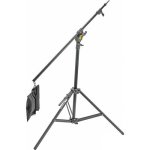
Furnis are just padded moving blankets. They're pretty cheap and really can help take the edge off reflection. I always lav and boom which gives me the option to mix tracks and provides a backup. But my boom track almost always sounds better than my lavs unless it's a really wide shot and the boom mic can't be placed at a reasonable distance. That Tascam stand is too short to be useful. If you're looking for something simple and easy to set up for a boom, try an Avenger or Manfrotto combi stand. I think the Manfrotto one is called the 420. I have the Baby Combi Avenger version and it's convenient to use. The boom arm is built in and collapses inside. You'll also need a shock mount and a spigot adapter. The only negatives is that combi stands have a pretty wide stance so can be tricky in small spaces. Also, the arm is only around 7 feet long and may not be long enough for some shots.

Avenger stand.jpg
 
Last edited:
How would you go about hanging up sound blankets if there isn't any walls nearby to attach it to? I've seen videos where people have used C-stands with a rod going across the top to then hang the blanket over. Seems like i'd need a lot of c-stands if I do that. Two main areas of concern will be behind the camera (where there are a row of windows) and directly behind the talent (there's a small wall and a bigger space behind and to the right that I want to 'seal' off as much as possible with blankets).
 
FWIW I purchased moving blankets along with a tarp Grommet kit from Harborfreight.
That way you can hang then using Trick Line or similar as long as there is something to tie them to.
Of course I also have a couple dozen C-Stands in my Sprinter van.
 
Yeah, use a c-stand with an arm and background clamps, which you can get cheaply at Home Depot. For interviews, I'll seldom use more than three or four c-stands with furni's on the floor. Probably nothing behind the interviewee if that's in frame. You can get used c-stands pretty cheaply with arms and grip heads. I use Matthews and Avenger grip gear but also have a few beat to hell Norms and American c-stands that I inherited from a friend when starting out. Kupo and Impact are cheaper, though I've not had much luck with Kupo stuff. Impact actually make their own combi boom stand but that thing is really flimsy.


How would you go about hanging up sound blankets if there isn't any walls nearby to attach it to? I've seen videos where people have used C-stands with a rod going across the top to then hang the blanket over. Seems like i'd need a lot of c-stands if I do that. Two main areas of concern will be behind the camera (where there are a row of windows) and directly behind the talent (there's a small wall and a bigger space behind and to the right that I want to 'seal' off as much as possible with blankets).
 
I love to read and write and when my mind is filled I speak about my views with my students and people at large. Oral communication is the best way to communicate your knowledge and when you are addressing the large gathering, you need a good quality mic. Even doing essay writing from last five years, I cannot consider written communication effective.
 
A properly placed overhead Sennheiser MKH50 on a boom should sound miles better than pretty much any lav mic, and there's no issues with clothes rustling against the mic.

As for placing sound blankets, I would set up the video shot the way you like it and then put blankets everywhere else that's not in the shot (including the floor).

100% agree with this. Ignore the suggestions about using a cardioid instead. A well placed MKH50 is a solid choice here.

And just put up the "sound blankets" (moving blankets) in places that are out of view and don't obstruct the lighting

How would you go about hanging up sound blankets if there isn't any walls nearby to attach it to? I've seen videos where people have used C-stands with a rod going across the top to then hang the blanket over. Seems like i'd need a lot of c-stands if I do that. Two main areas of concern will be behind the camera (where there are a row of windows) and directly behind the talent (there's a small wall and a bigger space behind and to the right that I want to 'seal' off as much as possible with blankets).


I generally use an MKH50 for indoors. But in cases where you're dealing with low ceilings with high reflectivity, a cardioid on a boom is a better choice if you have access to one. Far less rearward pickup. Also, on a fixed boom, cardioids have a wider pattern so has a better chance of keeping speakers on axis if the speaker moves around a lot in his or her chair. Even better if you've got the mic in closer because of how small the room is. Or if you need to capture two people and only have a single mic, a cardioid would work better.


100% agree with this. Ignore the suggestions about using a cardioid instead. A well placed MKH50 is a solid choice here.

And just put up the "sound blankets" (moving blankets) in places that are out of view and don't obstruct the lighting


Last edited:
Back
Top