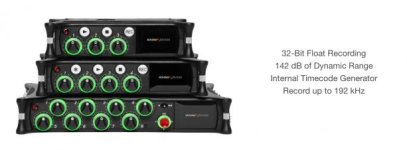
MixPre II recorders- 32bit float, internal TC generator, lotso dynamic range

BTW SD has a paper that does a good job of explaining the differences between 16 bit, 24 bit, and 32 bit float.
https://www.sounddevices.com/32-bit-float-files-explained/

I thought I knew the difference but turns out I was wrong!

The big takeaway is
16 bit fixed has -96 dB of space below zero. 96dB dynamic range
24 bit fixed has -144 dB of space below zero. 144dB dynamic range
32 bit float has -758 dB of space below zero AND +770 dB space above zero. 1,528dB dynamic range

Which is why level selling is not really an issue.
It's great to have float32 but remember that the dynamic range is not limited by the calculation and encoding format it is limited by the quality of the AD converters.
 
SD asked me why I was pushing float recording when talking to them about MixPre6 issues, apparently the response was effective* ;)


* j/k- they were probably already working on it and wanted market confirmation. All this stuff is pretty obvious: unclippable float is a winning design (a kind of RAW audio). Hopefully they've fixed all the other issues I found too :)
 
Anybody know what's new with the new ones? I can't find any articles describing the updates.

I was hoping they would have found a way to fit an XLR and BNC output into the 3 and 6, but that's still reserved for the 10 which is a bit large and with way more inputs than I'd ever need. While I'm not thrilled with my Mix Pre 3, I do really like how I can throw it in a small compartment in my camera bag and hardly notice it's there in terms of size and weight it takes up, especially considering I don't use it often.
 
It's great to have float32 but remember that the dynamic range is not limited by the calculation and encoding format it is limited by the quality of the AD converters.

True but the dynamic range of life is a bit over 200dB so the point basically was that you need only a small fraction of what is available with 32bit float so wherever you record the encoding will not clip out on you. SD already has really good A/D converters and mic preamps, what this changes is that instead of trying to optimize your levels to get the most out of the encoding bandwidth you don't need to because the bandwidth available is over three times what you can ever use. In practice 32 bit float shouldn't give you much more bandwidth than an optimized 24bit fixed setup but the the 32bit setup gives you an extra 770 dB or so of headroom. As long as you don't clip the microphone or the preamp you are not going to clip no mater what. Also if you record really low you can bring the level back up after the fact with out the low bit garbage that you would get with 24 fixed because your bit rate doesn't shrink when you record below where you should.

It's not a magic bullet and crappy recordings will still be crappy recordings but for production work and SFX and really any live recording this could be a BIG help when you get "suprise" levels.

My guess is that it will be a boon for C to B+ recordings, once you get below a C there will be plenty of other issues and your A recordings are still going to be A's. But that A recording where the star decided it might be fun to scream for some reason will stay A recordings instead of becoming an A recording with an F moment.
 
But will it record the plutonium rock band Disaster Area without clipping? Also, wouldn't the SPL of microphones be the limiting factor?

1. Yes, in Cartoon Space, Universe C-137 (physics for 2019, HGG's model has been updated)
2. Yes, the mic becomes the limiting factor. As long as the mic is in spec, the preamp can handle anything
 
What’s New in the MixPre-6 II ?

- Bit depth up to 32-bit float for increased dynamic range.
- Same intuitive interface, more powerful hardware.
- Internal LTC Timecode Generation and Output.
- Adjustable Limiters.
- Auto-copy to USB Drive.
- Pre-roll buffer increased to 10 seconds.

SD MixPre-6 II Web Page

What's great is this is also for the MixPre-3 II as well.
 
"The dynamic range that can be represented by a 32-bit (floating point) file is 1528 dB. Since the greatest difference in sound pressure on Earth can be about 210 dB, from anechoic chamber to massive shockwave, 1528 dB is far beyond what will ever be required to represent acoustical sound amplitude in a computer file." --- https://www.sounddevices.com/32-bit-float-files-explained

The amount of headroom is absurd.

Decibels are logarithmic. Every 6 decibels is twice the amplitude.
1,528 dB is not 7 times the loudest possible sound.
It is 2[SUP]220[/SUP] times the loudest, if my math is right ((1528 - 210) / 6)
I am not aware of a word for that number, like million, billion, quadrillion. But I have read that the estimate for the number of atoms in the universe is 2[SUP]256[/SUP].

Anyway, my question is, if you made a recorder that only recorded in 32-point floating point (and ditched these silly 16-bit and 24-bit settings) then would you even need knobs?

---

Actually, do you really need knobs for 24 bit, whose dynamic range is 144 decibels? Don't most microphones max out around this point?
 
Last edited:
"The dynamic range that can be represented by a 32-bit (floating point) file is 1528 dB. Since the greatest difference in sound pressure on Earth can be about 210 dB, from anechoic chamber to massive shockwave, 1528 dB is far beyond what will ever be required to represent acoustical sound amplitude in a computer file." --- https://www.sounddevices.com/32-bit-float-files-explained

The amount of headroom is absurd.

Decibels are logarithmic. Every 6 decibels is twice the amplitude.
1,528 dB is not 7 times the loudest possible sound.
It is 2[SUP]220[/SUP] times the loudest, if my math is right ((1528 - 210) / 6)
I am not aware of a word for that number, like million, billion, quadrillion. But I have read that the estimate for the number of atoms in the universe is 2[SUP]256[/SUP].

Anyway, my question is, if you made a recorder that only recorded in 32-point floating point (and ditched these silly 16-bit and 24-bit settings) then would you even need knobs?

What else are we going to turn to make it look like we know what we are doing?
 
"The dynamic range that can be represented by a 32-bit (floating point) file is 1528 dB. Since the greatest difference in sound pressure on Earth can be about 210 dB, from anechoic chamber to massive shockwave, 1528 dB is far beyond what will ever be required to represent acoustical sound amplitude in a computer file." --- https://www.sounddevices.com/32-bit-float-files-explained

The amount of headroom is absurd.

Decibels are logarithmic. Every 6 decibels is twice the amplitude.
1,528 dB is not 7 times the loudest possible sound.
It is 2[SUP]220[/SUP] times the loudest, if my math is right ((1528 - 210) / 6)
I am not aware of a word for that number, like million, billion, quadrillion. But I have read that the estimate for the number of atoms in the universe is 2[SUP]256[/SUP].

Anyway, my question is, if you made a recorder that only recorded in 32-point floating point (and ditched these silly 16-bit and 24-bit settings) then would you even need knobs?

When using floats for audio, all knobs do is adjust the scale- past +/-1.0 that's the exponent. So you can set the headphone volume and mic gain for comfortable monitoring and no matter what you're going to get a perfect recording, to the limits of the microphone.

One of the features I suggested to SD was a limiter for the headphone output to protect your ears. There were a ton of bugs with the Ambisonic code, and you could get ear blasted when the bugs manifested- especially painful/dangerous as the MixPre has a very powerful headphone amplifier. I would say protecting your customers' hearing is more important than any other feature: hopefully they fixed all the bugs and also added a limiter for the headphone out, so that no matter what happens, hearing is protected.

It's interesting that the Zoom F6 keeps getting pushed back for release: now it's October. It's possible that SD might beat Zoom to market with the first float recorders.
 
This is a very interesting development. I was thinking of replacing my Zoom F8 with the F6, but this Sound Devices MixPre 10 II seems more promising. I only wish it had dual SD card slots.
 
Here's the conversation starting on June 26, 2019 when testing the MixPre-6 with the Schoeps CMC641, CMIT5U, and Sennheiser Ambeo:

=====================================================================================

John:
The MixPre 6 was purchased primarily to replace a Zoom F4 which feeds a Canon 1DX II for our green screen productions. The F4 is fine (quiet preamps), however it sounds a bit thin compared to the USBPre2 (expect the MixPre 6 to be better (with newer AKM AK5578EN converters?)). The other reason is the F4 only has a look-ahead 10dB (headroom) limiter. Recently an actress yelled into the limiter range (didn't clip fully) and I didn't like how that sounded: prefer the SD analog limiters. Zoom has the new F6 with 32-bit float support- effectively unclippable, however that won't work feeding a camera.

On that note, is it possible to implement 32-bit float support via a firmware update for the MixPre 6? The SD analog limiters are nice (and needed for feeding a camera), however the sound does change when the limiter activates (has a kind of AGC sound); 32-bit float can move clipping to the microphone.

SD:
In regards to 32-Bit, could you tell us more on why you would like 32-Bit recordings?
The MixPre series has discrete Class-A preamps with a 32-Bit converter. What this allows users is a very low-noise floor for all preamps and high dynamic range. This means you can record a signal fairly low, around -40dBFS and gain it up in posts without additional noise and drawbacks. This has been with the unit since it's launch in 2016 and is a feature that is often overlooked.

John:
Why 32-bit support? 24-bit integer is plenty with your current ADCs: https://www.akm.com/akm/en/product/datasheet1/?partno=AK5578EN (found via Google and Gearslutz. Would be pretty cool if you included more tech info in the manual/publicly, including key components in the DAC too. Look at high-end sports cars- no detail left hidden on important (marketing) specs!).

Not requesting more integer bits, requesting basically unlimited range! If we go from 24-bit int to 32-bit float (8-bit exponent), those extra bits will give us basically unlimited range for audio applications. Your current analog limiter will change the waveform (a form of compression), whereas if we had 32-bit float samples, we can capture the original unmodified uncompressed signal up to the point of microphone clipping! This is what the new Zoom F6 does (which doesn't have analog limiters). This would only work for internal recordings (vs. feeding a camera where analog limiters are the best option), and the extra byte per sample isn't a big deal re: file size (1/3 more data). Currently your hardware pulls gain in the analog stage to prevent clipping, not clear if a firmware update can pull gain for monitoring (and output to camera) while recording internal in 32-bit float where the exponent goes up and the signal never clips when the signal passes +/- 1.0. Then in post you'll have the complete dynamic range provided by the microphone and can adjust levels, apply compression, etc. as desired. This is kind of like raw audio compared to raw video: much more flexibility in post (all modern DAWs support and can do all DSP in 32-bit float)!

SD:
Thanks for the feedback! I'll pass this information on to our team, especially with the Ambisonics information.

=====================================================================================

Pretty impressive if they added 32-bit float support in less than 3 months (if they weren't already working on it), especially if it required hardware changes. From the pics I see they added a plastic ring to the headphone volume (someone was making those as an aftermarket part IIRC), curious what changed in the hardware on the computing side. I re-sent the list of issues I found with the MixPre-6 checking to see if they've all been addressed. If so I'll check out the MixPre6-II when it's released.

Compared to camera companies taking away features with new cameras, it's pretty cool that SD added 32-bit float support- that'll be super useful! Hopefully they added an adjustable limiter for both the headphone and line out (to camera) so that 32-bit float can be captured for recording the full range, and the camera can also get a non-clipped recording too at the same time.
 
Back
Top