
Jim Feeley
Veteran
Just got the email announcement. Apparently shipping now. Looks like lower prices, too.
More info:
https://www.sounddevices.com/mixpre/
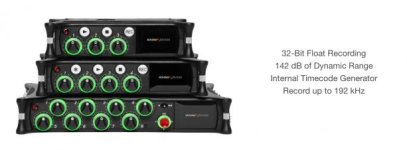
More info:
https://www.sounddevices.com/mixpre/

Follow along with the video below to see how to install our site as a web app on your home screen.
Note: This feature may not be available in some browsers.


It's great to have float32 but remember that the dynamic range is not limited by the calculation and encoding format it is limited by the quality of the AD converters.BTW SD has a paper that does a good job of explaining the differences between 16 bit, 24 bit, and 32 bit float.
https://www.sounddevices.com/32-bit-float-files-explained/
I thought I knew the difference but turns out I was wrong!
The big takeaway is
16 bit fixed has -96 dB of space below zero. 96dB dynamic range
24 bit fixed has -144 dB of space below zero. 144dB dynamic range
32 bit float has -758 dB of space below zero AND +770 dB space above zero. 1,528dB dynamic range
Which is why level selling is not really an issue.


Anybody know what's new with the new ones?
It's great to have float32 but remember that the dynamic range is not limited by the calculation and encoding format it is limited by the quality of the AD converters.
But will it record the plutonium rock band Disaster Area without clipping? Also, wouldn't the SPL of microphones be the limiting factor?
But will it record the plutonium rock band Disaster Area without clipping? Also, wouldn't the SPL of microphones be the limiting factor?
But can the MixPre II limiters handle Vogon poetry?
I see your Vogon poetry and raise you the next generation of Yoko Ono inspired singers...
What’s New in the MixPre-6 II ?
- Bit depth up to 32-bit float for increased dynamic range.
- Same intuitive interface, more powerful hardware.
- Internal LTC Timecode Generation and Output.
- Adjustable Limiters.
- Auto-copy to USB Drive.
- Pre-roll buffer increased to 10 seconds.
SD MixPre-6 II Web Page
"The dynamic range that can be represented by a 32-bit (floating point) file is 1528 dB. Since the greatest difference in sound pressure on Earth can be about 210 dB, from anechoic chamber to massive shockwave, 1528 dB is far beyond what will ever be required to represent acoustical sound amplitude in a computer file." --- https://www.sounddevices.com/32-bit-float-files-explained
The amount of headroom is absurd.
Decibels are logarithmic. Every 6 decibels is twice the amplitude.
1,528 dB is not 7 times the loudest possible sound.
It is 2[SUP]220[/SUP] times the loudest, if my math is right ((1528 - 210) / 6)
I am not aware of a word for that number, like million, billion, quadrillion. But I have read that the estimate for the number of atoms in the universe is 2[SUP]256[/SUP].
Anyway, my question is, if you made a recorder that only recorded in 32-point floating point (and ditched these silly 16-bit and 24-bit settings) then would you even need knobs?
