

Samuel H
Major Contributor
No sound yet in any camera, AFAIK.
On the 6D, it works, but resolution is very low because the SD controler is very slow. Or you can use a higher resolution, but then there's a very short duration limit (around 120 frames; for this, dual-iso doesn't make a difference).
If all the SD card controller can do is 40 MB/s, then max resolution at 24p with full sensor would be 1792x556, which has a very wide 3.2:1 aspect ratio.
For 2.40:1 ratio (1792x746), you'd need 54MB/s.
For 16:9 (1792x1008), it would be 73 MB/s.
outdated chart:
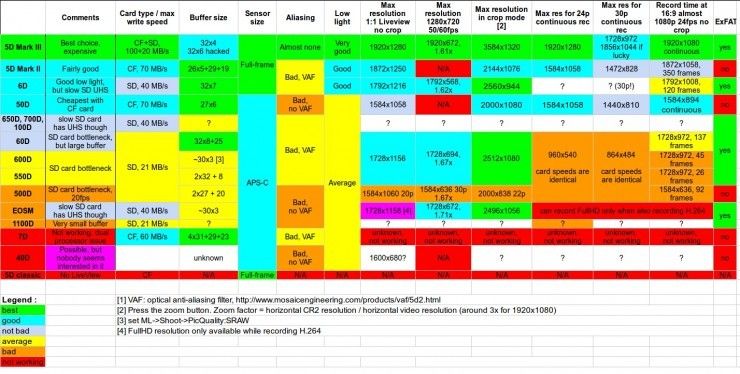
updated chart:
https://docs.google.com/spreadsheet/ccc?key=0AgQ2MOkAZTFHdFFIcFp1d0R5TzVPTVJXOEVyUndteGc#gid=5
thread where ML devs posted this chart:
http://www.magiclantern.fm/forum/index.php?topic=6215.0
On the 6D, it works, but resolution is very low because the SD controler is very slow. Or you can use a higher resolution, but then there's a very short duration limit (around 120 frames; for this, dual-iso doesn't make a difference).
If all the SD card controller can do is 40 MB/s, then max resolution at 24p with full sensor would be 1792x556, which has a very wide 3.2:1 aspect ratio.
For 2.40:1 ratio (1792x746), you'd need 54MB/s.
For 16:9 (1792x1008), it would be 73 MB/s.
outdated chart:
updated chart:
https://docs.google.com/spreadsheet/ccc?key=0AgQ2MOkAZTFHdFFIcFp1d0R5TzVPTVJXOEVyUndteGc#gid=5
thread where ML devs posted this chart:
http://www.magiclantern.fm/forum/index.php?topic=6215.0